#5B Keyser suspect memory fail aided Kavanaugh & hurt Ford
[wpseo_breadcrumb]
By George H Butcher III
Table of Contents for Blog Post #5B
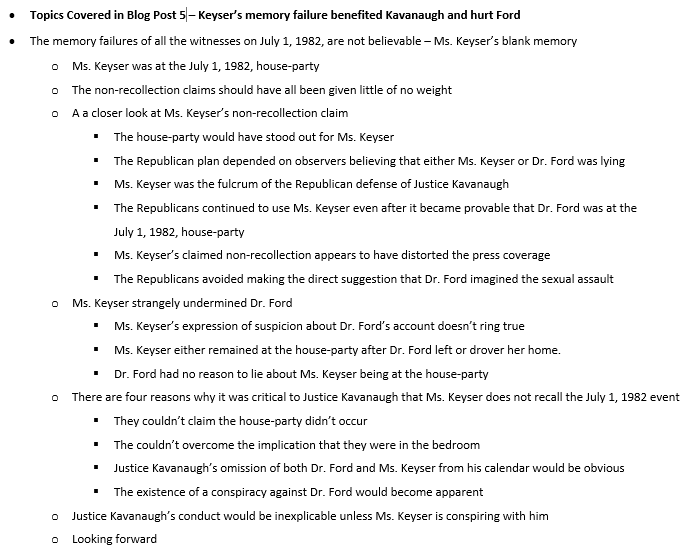
The collective memory failures of all the witnesses on July 1, 1982, are not believable – Ms. Keyser’s suspect blank memory
The supposedly blank memories of all of the witnesses who were present on July 1, 1982, are not credible. They reflect the existence of a conspiracy led by Justice Kavanaugh, as explained in Blog #5A. The purpose of the conspiracy is to obscure the fact that Dr. Ford attended the July 1, 1982 house-party, where she was sexually assaulted.
The Kavanaugh defense theory was that Dr. Ford just imagined being at the event she described and just imagined being sexually assaulted by Justice Kavanaugh. But it is certain that Dr. Ford was there on July 1, as explained in Blog #2.
Their most crucial defense evidence that the event described by Dr. Ford didn’t occur was the fact that Ms. Keyser claimed not to have any recollection of the house-party. But Ms. Keyser didn’t claim that the event described by Dr. Ford didn’t happen. She also did not assert that she and Dr. Ford were not at the July 1, 1982 house-party.
Ms. Keyser only claimed that she didn’t have any relevant memory, one way or the other. She also claimed not to recall ever having met Justice Kavanaugh.
But the alternative perspective, described in Blog #5A, was used to interpret Ms. Keyser’s non-recollection claim as evidence that the event did not occur. As described in Blog #5A, there was no justification for the use of the alternative perspective to question Dr. Ford’s credibility once the existence of the July 1, 1982 house-party was revealed.
How did we get to this point?
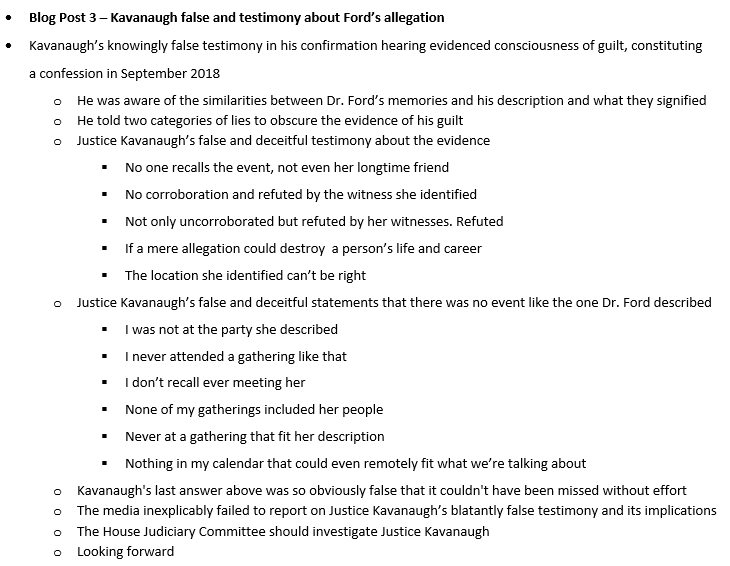
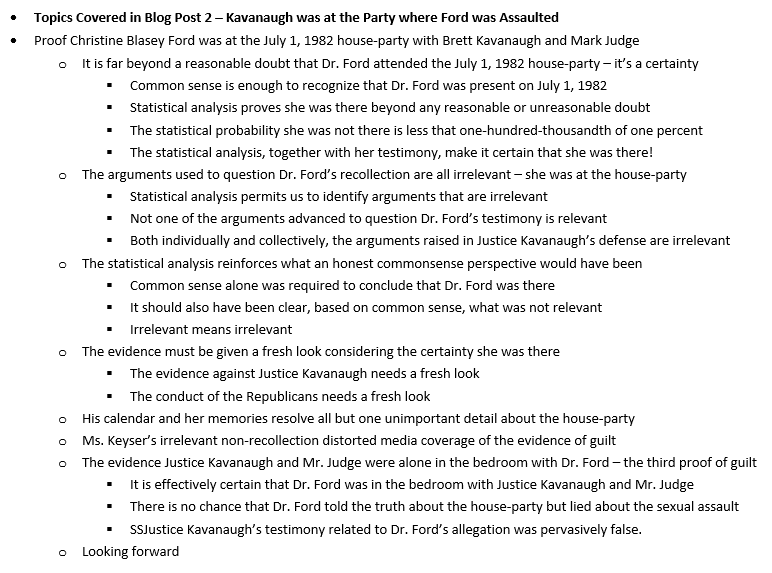
This is Blog #5B in my series of blog posts. Blog #1 through Blog #4 explained the three independent proofs of Justice Kavanaugh’s guilt of sexually assaulting Dr. Ford. Blog #3 and Blog #4 described his admissions of guilt in 2018 and 1982, respectively.
Blog #5A described how the seven or eight other witnesses who were present at the July 1, 1982, house-party, based on Justice Kavanaugh’s calendar and Dr. Ford’s memory, all made non-recollection claims. That is, they all claimed to have no relevant memory at all of whether the event happened or didn’t happen.
This Blog #5B specifically looks at Ms. Keyser’s non-recollection claim. Did she attend the July 1 house-party? Was her non-recollection claim treated as having special significance? Was her non-recollection claim truthful or dishonest? If it was untruthful, what does that signify?
Ms. Keyser was at the July 1, 1982, house-party
Dr. Ford testified that she was aware that Ms. Keyser and Mr. Judge would attend, even before going to the house-party. She also testified that they were both there. His presence is confirmed by Justice Kavanaugh’s July 1 calendar entry.
Dr. Ford’s credibility is established, and she had no reason to lie about Ms. Keyser
All the other details of Dr. Ford’s recollections about the July 1, 1982 event have proved to be accurate, including that she was present. So, it is not credible that she misremembered that her friend Leland Keyser was also there.
There is no evident reason for Dr. Ford to have lied about the lone detail regarding Ms. Keyser’s presence. Dr. Ford’s claim that her friend was there would only provide support for her allegation against Justice Kavanaugh if the claim is truthful.
Making a false claim about Ms. Keyser’s presence would only have undermined Dr. Ford’s sexual-assault allegation. So, the only reason for Dr. Ford to have claimed that Ms. Keyser was present is that Ms. Keyser was there.
Justice Kavanaugh had a reason to hide the fact that Ms. Keyser was at the July 1 event
Ms. Keyser’s not being listed in Justice Kavanaugh’s July 1 calendar entry is not evidence that she wasn’t there. His calendar entry has already proved to be inaccurate since it failed to list Dr. Ford as having attended the house-party.
Justice Kavanaugh’s goal in omitting Dr. Ford from his July 1, 1982 calendar entry was to hide the fact that she was at the house-party. That goal would have been frustrated if he had listed Ms. Keyser as having been present. So, he would have also needed to omit Ms. Keyser from his calendar if she were there.
The evidence supports the conclusion that Ms. Keyser was at the July 1 house-party
In the absence of credible and material contrary evidence, Dr. Ford’s demonstrably accurate and truthful testimony is enough to establish that Ms. Keyser attended the July 1, 1982 house-party. Dr. Ford provably told the truth about all the other details she recalled of the July 1 event, including that she was present.
There is no credible and material evidence that Ms. Keyser wasn’t there. Justice Kavanaugh’s July 1 calendar entry is material, but not credible since it omitted Dr. Ford. So, the omission of Ms. Keyser from the calendar entry does not evidence that she wasn’t there.
The claims of the seven male witnesses, and Ms. Keyser, that they have no recollection whether or not the house-party even occurred are immaterial. Those claims do not contradict or support Dr. Ford’s assertion that Ms. Keyser was there.
Plus, the male witnesses’ non-recollection claims are all provably unreliable or dishonest. They each claim to have no memory of the July 1, 1982 house-party, at which they were all present.
Ms. Keyser’s non-recollection claim is evidence of nothing. And her claim not to recall whether or not she was at the July 1, 1982 event is dubious, as explained below.
Accordingly, it should be viewed as a virtual certainty that Ms. Keyser was present on July 1, 1982. Dr. Ford knows whether Ms. Keyser was there, or not, and had no reason to lie. And there is no other credible and material evidence.
Several questions about Ms. Keyser’s honesty arise from the fact that she was at the house-party
Since Ms. Keyser was at the house-party, the crucial question is whether her non-recollection claim is honest. Is it realistic that she could have forgotten having been at the July 1, 1982 house-party with her girlfriend Christine and seven older boys? Is it realistic that she could not know whether or not she was there?
Alternatively, has she been conspiring with Justice Kavanaugh and her friend Mr. Judge to hide the fact that she and Dr. Ford were at the July 1, 1982 house-party? What is her motivation, and what does it signify if she is part of the conspiracy against Dr. Ford?
I will address the questions about the honesty of Ms. Keyser’s non-recollection claim further below. But first, I will examine the impact that her non-recollection claim had, particularly on the media.
The news media gave weight to Ms. Keyser’s claimed lack of memory after it was clearly irrelevant
Before the September 27, 2018 hearing, it might have been reasonable to treat Ms. Keyser’s non-recollection claim as having some evidentiary significance. But after the evidence concerning the July 1, 1982 calendar entry was revealed, the rationale no longer existed.
Ms. Keyser’s lack of any memory became irrelevant after the September 27 hearing
First, the existence of the July 1, 1982 house-party by itself eliminated the rationale, since it was apparent that the house-party could have been the event Dr. Ford described. There is no other event in his calendar that could be the one she described. Thus, her event is the July 1 event, unless she completely fabricated or imagined her story.
There was no rational basis to believe that Dr. Ford imagined or fabricated her story. Moreover, the existence of the July 1 event, with its similarities to her description, is compelling evidence that she didn’t invent or imagine the event she described, at which she was sexually assaulted.
So, the presumption should have been that the July 1 house-party was the one she described and that she was present at the event. That conclusion applies without doing the additional analysis required to prove that she was there.
Second, Ms. Keyser’s non-recollection claim could no longer be bolstered by the similar claims of the seven boys. The boys’ claims not to recall the July 1, 1982 event were demonstrably unreliable or dishonest at that point since they were all at the house-party they claimed not to remember. And Ms. Keyser’s non-recollection claim would only have been relevant if she was at the July 1 event, in which case her recollection would also have been unreliable or dishonest.
Dr. Ford was provably at the July 1 house-party
Third, a common-sense analysis of Dr. Ford’s testimony, together with Justice Kavanaugh’s calendar and related statements, should have produced the conclusion that Dr. Ford was present on July 1, 1982. So, the house-party on that date is the event that Dr. Ford described.
Ms. Keyser’s non-recollection claim was only ever relevant to raising doubts concerning whether the event Dr. Ford described occurred. Once it became impossible to undermine Dr. Ford’s claim, because of the proof that she was at the the July 1 house-party, Ms. Keyser’s non-recollection claim was no longer relevant.
The media reporting failed to evolve as it should have with the factual developments
Unfortunately, it appears that the news media’s response to Ms. Keyser’s non-recollection claim did not evolve with the facts. The news media continued to give weight to Ms. Keyser’s non-recollection claim, as though it was actual evidence, even after there was real evidence that eliminated any conceivable relevance of her lack of memory.
The weight given by the media to Ms. Keyser’s non-recollection claim indicated a belief that Ms. Keyser would have recalled the event if she were there. That belief is one that I share. But there was never an adequate basis to disbelieve Dr. Ford.
However, the news media only questioned Dr. Ford’s credibility and not Ms. Keyser’s. They only questioned the victim’s credibility. And they continued to question it after long after Dr. Ford’s credibility was beyond question.
Both a common-sense analysis and a statistical analysis show that the event recalled by Dr. Ford is the July 1 house-party. And Justice Kavanaugh’s calendar entry corroborates virtually all of Dr. Ford’s recollections about the event.
So, the accuracy and truthfulness of Dr. Ford’s recollections were all confirmed after September 27, 2018, except as to whether Ms. Keyser was at the July 1 event. It is the truthfulness of Ms. Keyser’s claim to have no recollection of the house-party that should have been doubted.
Is it fair for me to attribute the flawed viewpoint to the media broadly?
It could be argued that the media outlets or reporters who explicitly reflected the alternative perspective in their reporting were right-leaning. So, it would arguably be more precise to attribute the reporting flaw only to that segment of the media. The reporting flaw was using the alternative perspective to assume that Dr. Ford was lying because Ms. Keyser claimed not to recall the event.
However, I’m going to take the more aggressive position that the absence of any response to that poor reporting from other segments of the press reflected a lack of clarity about how flawed that reporting was. My assessment would be even worse regarding the broader media if there were an understanding (as there should have been) that Dr. Ford was definitely at the July 1, 1982 house-party, so that Ms. Keyser’s non-recollection claim was irrelevant.
The weight given to Ms. Keyser’s claimed non-recollection appears to be one cause of an inexcusable news media reporting failure
The press failed to report the objective corroboration of Dr. Ford’s testimony about the event where she was assaulted. In July 2020, it continues to be a constant refrain of Republicans that there is no corroboration of Dr. Ford’s story.
It appears to me that the failure of the media to report the corroboration of Dr. Ford’s testimony was impacted by Ms. Keyser’s irrelevant non-recollection claim. That is grossly inadequate as a justification or explanation for such a significant reporting failure.
My belief is speculation. It reflects a search for an explanation for the inexplicable. The connection between the purported cause (Ms. Keyser’s non-recollection claim) and the effect (the failure to report on the evidence which supported Dr. Ford’s allegation) is irrational.
But I don’t see any other explanation for the industry-wide reporting failure regarding Dr. Ford’s allegation that isn’t much worse. I’ll save my detailed analysis of the media failures related to the reporting on Dr. Ford’s accusation for Blog # 12.
A closer look at the honesty and impacts of Ms. Keyser’s non-recollection claim
It is implausible that Dr. Ford misremembered Ms. Keyser being present. There is no basis to believe that she wasn’t telling the truth about what she recalled. So, there is no basis to believe that Ms. Keyser was not at the July 1, 1982 house-party.
Thus, there is a conundrum whether it is plausible that Ms. Keyser has no recollection of the July 1, 1982 house-party. It is not, in my view.
That opinion was initially based on the demographics of the event – seven boys and two girls, with no parents and underage drinking. However, there are multiple other reasons to believe that Ms. Keyser must remember the July 1 house-party.
Based on her reported comments, the house-party would have stood out for Ms. Keyser
According to Washington Post columnist Kathleen Parker, citing “Justice on Trial: The Kavanaugh Confirmation and the Future of the Supreme Court” by Mollie Hemingway and Carrie Severino, “Keyser remembers the summer of 1982 very well… Keyser worked full-time in the pro shop at a Washington-area country club and had very little time for socializing.”
That context makes it apparent that Ms. Keyser would have been very conscious during the summer of 1982 of having attended the July 1, 1982 house-party with her friend Christine and seven older boys. Given Ms. Keyser’s limited social activities during that summer, the July 1 house-party should have been a singular and memorable event, which she wouldn’t have forgotten.
The Republican plan depended on convincing observers that either Ms. Keyser or Dr. Ford was lying
Ms. Keyser’s non-recollection claim could have been substantively damaging to the viability of Dr. Ford’s sexual-assault allegation. An observer or analyst might reasonably have doubted that Ms. Keyser could have forgotten the July 1 house-party, even though she didn’t know about the sexual assault. The observer or analyst might have also reasonably thought that Dr. Ford couldn’t have mistakenly remembered Ms. Keyser as being there.
So, even if it went unsaid, the observer or analyst might have concluded that one of them was lying. That is the so-called “alternative perspective” referred to in Blog #5A. That perspective was used to convert Ms. Keyser’s otherwise immaterial non-recollection claim into an argument that the event described by Dr. Ford didn’t happen.
That thought process reflected the Republican plan for defending Justice Kavanaugh from Dr. Ford’s sexual-assault allegation. Their plan relied on the notion that Ms. Keyser should have remembered the event. It then used her claim that she has no memory of the house-party to undermine the credibility of the affirmative truthful recollections to which Dr. Ford testified.
They used the alternative perspective to create the impression that Dr. Ford is delusional
Dr. Ford’s testimony on September 27, 2018, was highly credible. And there was no apparent reason that Dr. Ford would have lied about Ms. Keyser having been at the house-party where she was sexually assaulted. But the Republicans exaggerated the closeness of their friendship to create the impression that Ms. Keyser would have had no reason to lie and would have been motivated to support Dr. Ford.
The Republicans and Justice Kavanaugh then used the implication that either Dr. Ford or Ms. Keyser must be lying to suggest that Dr. Ford is either lying or delusional about whether the event where she claimed to have been sexually assaulted even occurred. They granted that Dr. Ford isn’t lying, but implied that she is delusional.
Ms. Keyser was the fulcrum of the Republican defense of Justice Kavanaugh
For the plan to work, Ms. Keyser had to continue to claim to have no recollection of the house-party. In the absence of a conspiracy between Ms. Keyser and Justice Kavanaugh, he should have viewed that as a very tenuous plan.
Indeed, Ms. Keyser’s non-recollection claim was the fulcrum of the entire Republican plan! That plan included ignoring and hiding evidence that supported Dr. Ford’s sexual-assault allegation, using falsified evidence and false statements to undermine her credibility, ignoring Justice Kavanaugh’s false testimony about her accusation, and portraying Dr. Ford as delusional.
How could Justice Kavanaugh have relied on Ms. Keyser not to blow up the plan?
And the success of the entire Republican plan rested up Ms. Keyser’s questionable claim to have no memory of an event that definitely occurred, that it is virtually certain she attended, and that should have been memorable to her. Without certainty regarding Ms. Keyser’s cooperation, that plan would have been untenable in my view.
But how could Justice Kavanaugh have known that he could continue to rely on Ms. Keyser not to recall the house-party? In my opinion, he couldn’t have relied on her to play such a pivotal role unless he believed that she was part of the conspiracy.
With the benefit of Ms. Keyser’s claim to having no memory of the event, the Republican plan came close to working substantively. It would have substantively undermined Dr. Ford’s sexual-assault allegation, if not for the definitive proof (based on Dr. Ford’s recollections and Justice Kavanaugh’s calendar entry), that Dr. Ford was at the July 1, 1982 house-party.
The Republicans successfully used Ms. Keyser’s non-recollection, even after it was provably irrelevant
Taking account of that proof, Ms. Keyser’s claimed non-recollection is irrelevant to the credibility and viability of Dr. Ford’s sexual-assault allegation. Dr. Ford is telling the truth about the house-party where she was assaulted and should be presumed to be telling the truth about Ms. Keyser having been there.
Nevertheless, Justice Kavanaugh (in his testimony) and Senator Collins (in her speech) still engaged in the pretense that Ms. Keyser’s non-recollection claim was evidence that the event described by Dr. Ford didn’t happen. They made that argument even though they knew the event occurred on July 1, 1982.
Even though their argument was a substantive failure, it was a pragmatic success. It was the foundation of their successful plan to confirm Justice Kavanaugh. Bizarrely, their argument was even successful in distorting the media coverage of Dr. Ford’s sexual-assault allegation, after Ms. Keyser’s non-recollection claim was demonstrably irrelevant.
Ms. Keyser’s actions strangely undermined Dr. Ford
According to media reports in September 2019, Ms. Keyser had initially stated that she didn’t recall the event but believed Dr. Ford; however, she subsequently questioned Dr. Ford’s story. She reportedly said in conversations with Robin Pogrebin and Kate Kelly, the authors of “The Education of Brett Kavanaugh: An Investigation,” that she doesn’t recall the get together referenced by Dr. Ford, or others like it.
However, the event recalled by Dr. Ford provably occurred on July 1, 1982, and Dr. Ford made no claim that there were others like it. Ms. Keyser’s irrelevant reference to not recalling “others like it” feels like she consciously intended to undermine Dr. Ford. Ironically, Ms. Keyser’s claim that she doesn’t remember other similar gatherings makes it even more apparent that she must remember the July 1, 1982 event.
Her actions that undermined Ford were characterized in the press as heroic
Ms. Parker also reports, based on Pogrebin’s and Kelly’s book, that “friends and acquaintances tried to persuade [Ms. Keyser] to say she didn’t remember the party, not that it didn’t happen” but that she “has become increasingly convinced that Ford’s story isn’t true and doesn’t make sense.” In her column, Ms. Parker celebrated Ms. Keyser as heroic for “her integrity and valor” in refusing to give in to pressure from her friends and acquaintances.
Ms. Parker treated it as an open question whether the house-party described by Dr. Ford even occurred. In other words, she ignored or overlooked the dispositive evidence that it was the July 1, 1982 house-party. Ms. Parker’s failure to draw the obvious conclusion was apparently influenced by Ms. Keyser’s irrelevant non-recollection claim.
Ms. Keyser’s expression of suspicion about Dr. Ford’s account doesn’t ring true
Ms. Keyser’s blank memory wouldn’t have appeared to be a reasonable basis for a friend to question Dr. Ford’s story, even if Dr. Ford’s recollections of the house-party were not provably accurate. But since Dr. Ford was provably at the July 1 house-party, Ms. Keyser’s questioning of her friend’s story seems to be either inexplicable (which I don’t believe in) or duplicitous (which I think was the case).
Ms. Keyser is, no doubt, an intelligent person. Thus, she should have made the common-sense observation that Dr. Ford must have been present at the July 1, 1982 house-party, even if Ms. Keyser doesn’t recall being there herself. So, what could have motivated her to question Dr. Ford’s account?
Dr. Ford’s other recollections about the house-party details are all corroborated. Thus, Ms. Keyser’s memory failure would only be substantively significant at this point if there were reasons to believe her non-recollection claim might be dishonest. There are reasons for that belief, as further described below and in Blog #6.
There are two scenarios for Dr. Ford’s departure from the July 1 house-party
When Dr. Ford left, Ms. Keyser either remained at the house-party, or she drove Dr. Ford home. Dr. Ford doesn’t have a memory as to which occurred. But she has apparently concluded that Ms. Keyser likely drove her home.
Ms. Keyser would have remembered if she remained at the house-party
Pogrebin and Kelly further quote Ms. Keyser as saying: “It would be impossible for me to be the only girl at a get-together with three guys, have her leave, and then not figure out how she’s getting home. I just really didn’t have confidence in the story.”
It is implicit that Ms. Keyser would have recalled the scenario where she remained at the house-party after Dr. Ford left and, therefore, would remember having been at the house-party. It is unclear what reason Ms. Keyser had for questioning Dr. Ford’s account.
Both girls should remember if they were the only girl at the house-party
If Ms. Keyser was at the July 1 house-party and remained after Dr. Ford left, then she was the only girl at a get-together with seven older guys. Based on her statements, that is not a circumstance that she could have forgotten.
On the other hand, if Ms. Keyser didn’t attend the house-party, then Dr. Ford would have been the only girl at a get together with seven older boys. Dr. Ford could no more have forgotten that circumstance than Ms. Keyser could have forgotten being in the same situation.
Dr. Ford knows for sure if Ms. Keyser was there and had no reason to lie
Dr. Ford would know whether or not she was in that situation. So, she knows for sure whether Ms. Keyser was at the July 1, 1982 house-party.
If Dr. Ford had been the only girl at the house-party, she would have had no reason to make a false claim that her friend Ms. Keyser was also there. Dr. Ford should have expected that making such a false claim would have hurt the credibility of her accusation against Justice Kavanaugh.
And Dr. Ford demonstrably told the truth about all the other details she recalled. So, why then would Dr. Ford have made a false claim that Ms. Keyser was present? She would not, in my view.
That Dr. Ford had no reason to lie is just another reason to believe Ms. Keyser was there. But there is an absence of any credible and material evidence that Ms. Keyser wasn’t there.
Ms. Keyser may have given Dr. Ford a ride home
The other possibility concerning Ms. Keyser’s presence at the party is that she was the person who drove Dr. Ford home. In that case, the two of them would have unexpectedly left the party, resulting in a 100% reduction of the number of girls at the house-party shortly after Justice Kavanaugh, Mr. Judge, and Dr. Ford returned downstairs from the second floor. That should have made the house-party memorable to everyone present, even if it wasn’t already based on the demographics.
Dr. Ford doesn’t recall the drive home from the house-party. And she made no mention to Ms. Keyser of the sexual assault. So, Ms. Keyser may not specifically remember the drive home either.
Under either scenario, Ms. Keyser should remember having been at the house-party and should know if she wasn’t there
However, even assuming Ms. Keyser doesn’t recall the drive home with Dr. Ford, it is not credible that she has no recollection of the July 1, 1982 house-party, in my opinion. It would have stood out simply because of the demographics – two girls and seven older boys.
The party would have stood out for her, based on her description of her limited activities that summer. It also should have stood out because of the way it ended. In addition, the July 1 house-party would have been unique since Ms. Keyser didn’t attend others like it. So, Ms. Keyser should also know if she wasn’t at the July 1 house-party.
However, there are other reasons related to Justice Kavanaugh’s conduct in both 1982 and 2018 to believe that Ms. Keyser remembers the house-party. Those additional reasons will be discussed below and in Blog #6.
There are four reasons why it was critical to Justice Kavanaugh that Ms. Keyser does not recall the July 1, 1982 event
It is a virtual certainty that Ms. Keyser was there. And it seems implausible that she doesn’t recall the house-party. However, there are four reasons why it was critical to the defense of Justice Kavanaugh that Ms. Keyser did not acknowledge being at the July 1, 1982 house-party.
Remember, it wasn’t anticipated that there would be an objective source of proof that Dr. Ford attended the house-party. So think about the importance of Ms. Keyser’s memory failure in a context in which eyewitness testimony would have been the only way to confirm that Dr. Ford was at the July 1 house-party.
It is virtually certain that Ms. Keyser was at the house-party and likely that she remembers it, for the reasons explained above. The following are the motivations for her non-recollection claim, in my opinion – i.e., the problems that would have been caused for Justice Kavanaugh’s defense if Ms. Keyser had recalled being at the party.
They couldn’t have claimed the house-party didn’t occur
First, if Ms. Keyser had acknowledged she recalls the event, that would have proved that Dr. Ford was at the July 1, 1982 house-party. Such proof would have destroyed the Republican strategy of claiming the event at which Dr. Ford described being sexually assaulted didn’t occur and that she is delusional.
They couldn’t overcome the implication that Kavanaugh and Judge were in the bedroom with Ford
Second, once Dr. Ford was acknowledged to have attended the July 1, 1982 house-party, it would have then been impossible for Justice Kavanaugh to overcome the inference that Dr. Ford told the truth about having been in the bedroom with him and Mr. Judge. Ms. Keyser might also have confirmed that the three of them were on the second floor together.
Justice Kavanaugh and Mr. Judge couldn’t possibly have forgotten an interaction in the bedroom with Dr. Ford. So, they would have each made provably false statements to the Senate Judiciary Committee or the FBI about (i) the interaction in the bedroom with Dr. Ford, (ii) not recalling the July 1, 1982 house party, and (iii) not remembering that Dr. Ford was there.
That could have subjected Justice Kavanaugh to criminal prosecution and judicial sanction
This second point highlights how vulnerable Justice Kavanaugh would have been if any of the witnesses to the house-party had acknowledged remembering the event and testified that Dr. Ford was indeed present. That would have been catastrophic.
The question to think about is what could have given Justice Kavanaugh confidence that none of them would provide testimony that supported Dr. Ford’s version of events. Her testimony accurately reflected the details of the house-party. So, Justice Kavanaugh would have needed to have a very high level of certainty (that the others wouldn’t truthfully recount what occurred) to mitigate his exposure to criminal prosecution and judicial sanction if he proceeded with the confirmation process.
Kavanaugh’s omission of both Ford and Keyser from his calendar would have been an obvious admission of guilt
Third (and more devious), if Dr. Ford and Ms. Keyser were at the July 1 house-party, then Justice Kavanaugh consciously failed to reflect their presence at the house-party in his July 1, 1982 calendar entry. He vehemently testified about how carefully he maintained his calendar and how precise he was in reflecting who was present at the events recorded in his calendar.
So, the omission of both girls would have constituted a contemporaneous admission of guilt by Justice Kavanaugh in July of 1982. However, we know that Dr. Ford was at the house-party, and it is virtually certain that Ms. Keyser was also at the house-party. So, we don’t need her testimony to recognize that he made an admission of guilt in July 1982.
Justice Kavanaugh did omit both of them from his July 1, 1982 calendar entry, even though they were both there. That omission was a contemporaneous admission of his guilt of sexually assaulting Dr. Ford.
The existence of a conspiracy against Dr. Ford would have become apparent
Fourth, (and still more devious), if it were acknowledged that Dr. Ford and Ms. Keyser were at the house-party, the existence and potential scope of the conspiracy against Dr. Ford would have become visible. And the birth date of the conspiracy would have been established as in July 1982.
Justice Kavanaugh’s omission of the two girls from his calendar would have been at best useless, and at worst damning (as evidence of guilt) unless he had reason to know that none of the people at the house-party would confirm that Dr. Ford or Ms. Keyser was there. That realization is a mind-bender!
Justice Kavanaugh’s conduct would be inexplicable unless Ms. Keyser is conspiring with him
To be clear, the omission of Dr. Ford and Ms. Keyser would have been useless or damning, unless Justice Kavanaugh already knew in July 1982 that Ms. Keyser would not confirm that she and Dr. Ford were at the July 1 house-party. Without that assurance, there would have been no reason for him to have left Dr. Ford and Ms. Keyser out of his July 1, 1982 calendar entry, in my opinion.
Dr. Ford was provably at the July 1, 1982 house-party. So, we already knew of the existence of Justice Kavanaugh’s 1982 confession by the omission of Dr. Ford from his July 1 calendar entry. However, by taking account of Ms. Keyser’s presence at the house-party and omission from his calendar, the implications of his 1982 confession become even more significant.
The implications I draw include that the conspiracy to hide Dr. Ford’s presence at the July 1 event must have included Ms. Keyser from day one. Otherwise, nothing would have been accomplished by leaving her and Dr. Ford out of his calendar entry.
If Ms. Keyser is a co-conspirator, then she has been lying about not recalling the July 1, 1982 house-party. Also, that would evidence the existence of a conspiracy against Dr. Ford among a broader group, and possibly all, of the July 1, 1982 party attendees.
Looking forward
Blog #6 will examine the collective non-recollection claims of the seven boys who were present based on Justice Kavanaugh’s calendar entry. We will first look at the credibility of the non-recollection claims of the five male fact-witnesses. We will then look at the non-recollection claims of Justice Kavanaugh and Mr. Judge.

 OPIFACTION