Featured

#9 Mitchell’s report clearing Kavanaugh is worse than a joke

[wpseo_breadcrumb]

By George H Butcher III

Table of Contents for Blog #9

Prosecutor Mitchell’s report cleared Kavanaugh of Blasey Ford’s accusation by using a flawed analysis and ignoring the most crucial evidence

Rachel Mitchell’s report clearing Justice Kavanaugh of Dr. Ford’s sexual-assault allegation is part of the answer to a crucial question. The question isn’t how the Republicans convinced everyone there’s no corroboration of Dr. Ford’s accusation. It’s how they convinced anyone? A predicate for appreciating the flaws in Ms. Mitchell’s report is understanding the certainty that Dr. Ford was at the July 1, 1982 house-party, as explained in Blog #8C.

In an earlier blog, I complimented Ms. Mitchell’s competent questioning of Justice Kavanaugh during his September 27, 2018 confirmation hearing. Unfortunately, that complementary view of her work does not extend to the report she wrote.

Ms. Mitchell’s report is entitled, “An Analysis of Dr. Christine Blasey Ford’s Allegations.” I don’t qualify as an expert in such matters. But, her report was catastrophically flawed for reasons which don’t require an expert to discern.

Ms. Mitchell’s analysis of the facts she considered was flawed, as described below. Moreover, she purposefully ignored the most relevant evidence.

A succinct characterization of Mitchell’s report on Dr. Ford’s sexual-assault allegation is, “it’s a sick joke” on the American people. The American public was the ultimate target of her report. However, it was provided to Republican senators for use in justifying their votes to confirm Justice Kavanaugh.

How did we get to this point in the discussion?

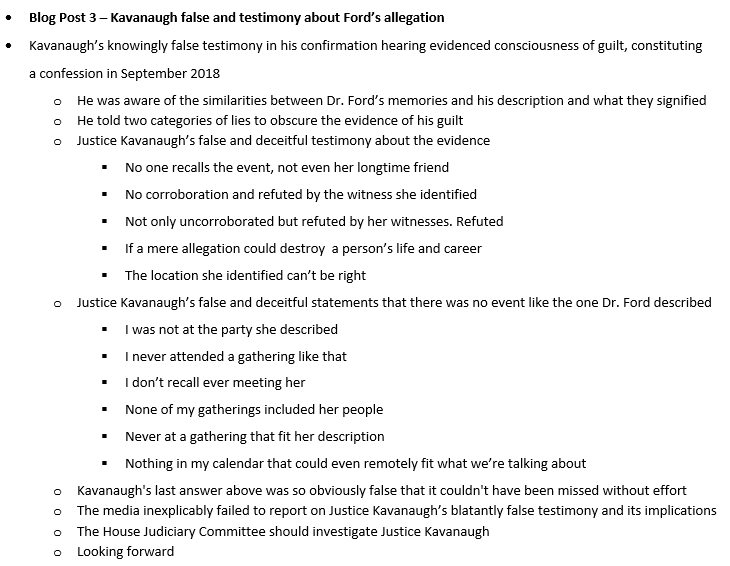
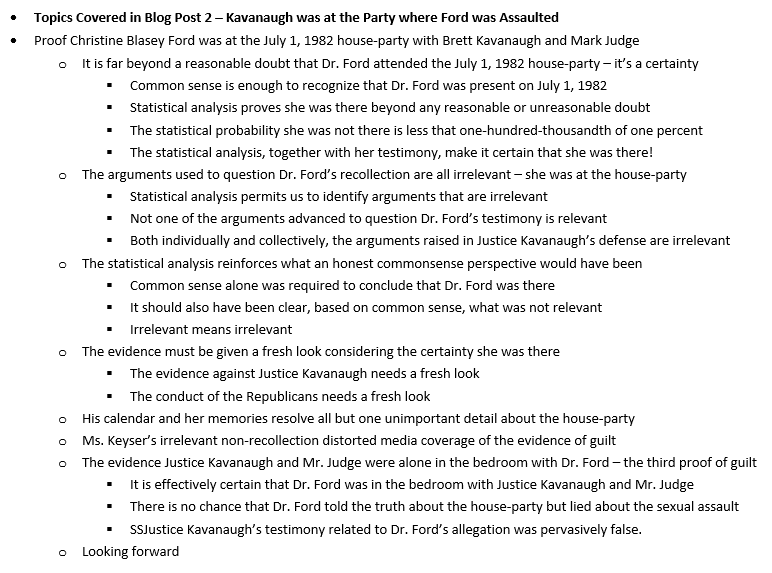
Blogs #1 to #4 describe proof that Justice Kavanaugh is guilty of sexually assaulting Dr. Ford. Blog #2 details the definitive evidence that she attended the July 1, 1982 house-party. Blog #3 and Blog #4 explain his admissions of guilt in 2018 and 1982, respectively.

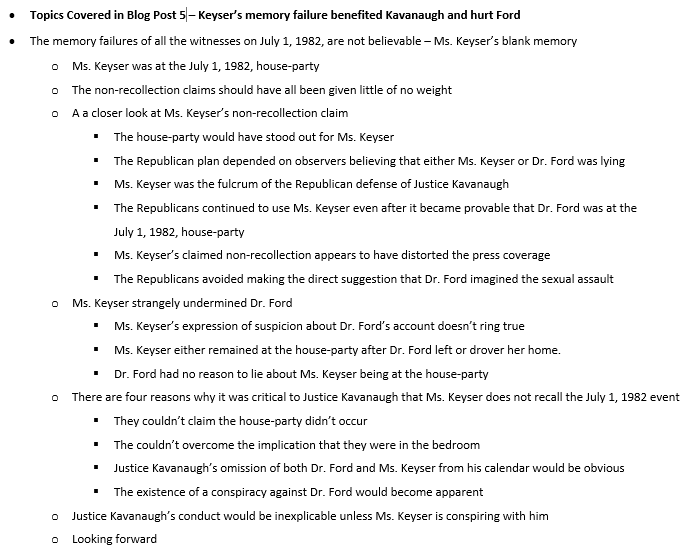
Blogs #5A, #5B, and #6 describe evidence that Kavanaugh is the leader of a conspiracy among most or all of the other July 1 party attendees. Blog #10 will provide additional insight into that conspiracy.

Blogs #7A and #7B discuss the Republican coverup of the evidence of Kavanaugh’s guilt, particularly Senator Collins’ role. They also discuss various impacts of the coverup.

Blogs #8A and #8B explain the Republicans’ comprehensive systematic approach for undermining and rejecting victims’ allegations. Their systematic approach has eleven pillars or components. This blog post focuses on component number 7.

Blog #8C exposed the claim that the FBI confirmed “there is no corroboration” of Ford’s allegation as falsified or false. Blog #8C restates the proof that Dr. Ford was at the July 1, 1982 house-party. Blog #8D demonstrates that the proof Ford was at the July 1 party decimates Kavanaugh’s defense arguments.

Blogs #7C, #7D, #8A, and #8D describe the critical roles in the Republicans’ systematic approach played by the news media. Blog #8D describes the active roles played by several journalists.

Blog # 9

This is Blog #9 in my series of blog posts. It focuses on a critical component of the Republicans’ systematic approach for rejecting victims’ allegations – pillar 7. That component involves using purportedly independent experts, who really aren’t, to undermine a victim’s accusation. This blog post analyzes Rachel Mitchell’s report on Dr. Ford’s sexual-assault allegation.

Ms. Mitchell’s reached two conclusions, each indefensible!

Ms. Mitchell’s two critical conclusions are:

”… I do not think that a reasonable prosecutor would bring this case based on the evidence before the Committee. Nor do I believe that this evidence is sufficient to satisfy the preponderance-of-the-evidence standard.”

“Preponderance-of-the-evidence” and “more-likely-than-not” have the same meaning. I’ll continue to use the latter term.

Neither or Ms. Mitchell’s conclusions could be justified based on an honest and competent analysis of the evidence. I fully explain and justify my viewpoint below.

Ms. Mitchell is undoubtedly competent since her credentials are impeccable. Thus, the outrageous flaws in her report described below are 100% attributable to a lack of honesty on her part.

Her report focused on an irrelevant evidence standard to make Kavanaugh’s defense look stronger

Ms. Mitchell’s report expressly indicates that her reasoning relates to whether a prosecutor would criminally charge Justice Kavanaugh. She does not explain or justify her assertion regarding the “more-likely-than-not” evidence standard.

Ms. Mitchell was fully aware that of the two evidence standards, only one is relevant to the Senate’s deliberations. The more-likely-than-not evidence standard is applicable, and the beyond-a-reasonable-doubt evidence standard is not applicable.

Yet, the more-likely-than-not is evidence standard is the one for which Ms. Mitchell provided no analysis. That disconnect requires an explanation, and I provide one below.

Mitchell’s report was deceptive from the outset regarding the evidence standard she used

According to paragraph #2 of her report, Ms. Mitchell wasn’t given any guidance concerning the evidence standard to use in her analysis. So, she used the legal standard that she would typically use as a prosecutor – beyond-a-reasonable-doubt.

But that’s absurd! The idea that she would have accepted the assignment without receiving such guidance isn’t credible. It likewise isn’t credible that she would have been hired by the Republicans without being given such direction.

Perhaps her statement is literally true in that there was no explicit “direction.” Maybe it was only tacitly agreed that she would use the beyond-a-reasonable-doubt standard.

But that would still make her statement substantively false deceptive in my view. It would also indicate that the Republicans didn’t want to take responsibility for her use of the irrelevant beyond-a-reasonable-doubt standard.

Thus, we can draw two conclusions about the evidence standard. First, Ms. Mitchell’s use of the criminal evidence standard reflects a conscious election by the Republicans. Second, that election wasn’t one that they could easily justify.

Her report was intended to support the Republican con job on the public

So evidently, Ms. Mitchell’s report wasn’t intended to be relevant to an honest determination concerning Kavanaugh’s suitability. The discussion below provides corroboration for that conclusion.

In my opinion, Ms. Mitchell intended her report to be a hit job on Dr. Ford’s accusation and the Democrats. Moreover, the report was intended from its conception by the Republicans to support their con job on the American people. That reflects the implementation of pillar 7 of their systematic approach.

She supported the con job’s two components and then went the extra mile

The con job has two components. The first is that Justice Kavanaugh’s testimony is credible. The second is that there is no corroborative evidence for Dr. Ford’s testimony regarding her allegation.

Ms. Mitchell supported the first component of the con job by completely ignoring the subject of Kavanaugh’s credibility. She unjustifiably ignored the apparent evidence of his lack of credibility. Ignoring the topic of Kavanaugh’s credibility was worse than unjustifiable. It was wholly dishonest in my view.

Ms. Mitchell supported the second component of the Republican con in two principle ways. She ignored the obvious and compelling evidence that corroborates almost all of Dr. Ford’s recollections. She also attempted to undermine Dr. Ford’s prior consistent statements and turn them into a liability.

However, Ms. Mitchell went the extra mile in obscuring the evidence against Justice Kavanaugh. She undermined Dr. Ford’s credibility as though she were a defense counsel with very low standards regarding her own credibility.  

That is an accurate description of Ms. Mitchell’s actions in constructing her report, in my view. But she absurdly presented her role as that of an “independent” prosecutor.

Rachel Mitchell’s report ignored the most relevant evidence

This blog post will evaluate Ms. Mitchell’s report from two perspectives. The first focuses on the evidence which she considered in her report and evaluates her analysis from that perspective. The second takes account of all of the relevant evidence and evaluates her report from that perspective.

The evidence Ms. Mitchell consciously ignored

To analyze Ms. Mitchell’s report based on the evidence that she considered, I have to ignore the corroborating evidence for virtually all of Dr. Ford’s recollections. So, I will ignore the evidence that she was present at the July 1 house-party attended by Kavanaugh and Judge.

I will also ignore the evidence of Kavanaugh’s knowingly false and purposefully deceitful testimony, and the implications thereof. And I will ignore his omission of Dr. Ford from his July 1, 1982 calendar entry, and the implications thereof. Those last two sets of evidence represent admissions of guilt by Justice Kavanaugh, thirty-six years apart.

Let’s review the limited subset of the evidence that Ms. Mitchell considered. It ignores all of the evidence that corroborates any details of Dr. Ford’s story. And it ignores everything that constitutes evidence of Justice Kavanaugh’s guilt, except Ford’s testimony.

Bizarrely, Ms. Mitchell’s report never mentions the date July 1, 1982, the house-party on that date, or the details thereof. So in her analysis of Dr. Ford’s allegation, she never mentioned the single most critical piece of evidence.

She even failed to follow the evidence during her questioning of Kavanaugh

Ms. Mitchell’s failure to follow the evidence is highlighted in an article by Phillip Bump of the Washington Post dated September 27, 2018. The article is entitled, “Kavanaugh is pressed on the key July 1 entry in his calendar. But only to a point.” Mr. Bump describes Ms. Mitchell’s questioning as follows:

“This is a central point to Ford’s allegation. Kavanaugh denies knowing her, denies being at a party with her. Here is an event in July where he was with several long-standing friends, two of whom were named by Ford and one of whom she’d been going out with.

But Mitchell’s next question completely fumbles the point.

MITCHELL: Have you reviewed every entry that is in these calendars of May, June, July and August of 1982. 

KAVANAUGH: I have.

MITCHELL: Is there anything that could even remotely fit what we’re talking about in terms of Dr. Ford’s allegations?

KAVANAUGH: No.

That was it. Mitchell changed the subject.”

Mitchell failed to ask obvious followup questions about the July 1, 1982, house-party

Mr. Bump makes the following observations about her failure to ask the critical questions about the July 1 house-party. (Emphasis added.)

“There were all sorts of ways that Mitchell could have pressed the issue. How, for example, might Ford have been able to identify by name two of Kavanaugh’s close friends if she didn’t know him or had barely met him? Why isn’t it possible that this July 1 get-together was precisely the sort of event at which Ford alleges she was assaulted? That more than remotely fits the allegation? But she didn’t ask.”

Ms. Mitchell’s failure to pursue this critical line of questions was compounded in her report. She failed even to mention the crucial July 1, 1982 house-party in her report.

Mr. Bump notes that Justice Kavanaugh’s answer to Ms. Mitchell’s question was an obvious lie. That unavoidably false answer was a focus in Blog #3. But she ignored the lie both in her questioning of Kavanaugh and in her report.

The evidence that Ms. Mitchell considered

Ms. Mitchell’s report ignored the highly relevant evidence that is detailed further below, and its implications. So, what evidence did she consider in reaching the conclusions in her report?

The evidence considered by Ms. Mitchell was limited to:

  1. Dr. Ford’s allegations, prior statements, and testimony;
  2. Justice Kavanaugh’s and Mr. Judge’s denials and claims to have no recollection of the event described by Dr. Ford;
  3. Mr. Smyth’s statement that he had no recollection of the event described by Dr. Ford; and
  4. Ms. Keyser’s statement that she had no recollection of the event described by Dr. Ford and no recollection of having met Justice Kavanaugh.

Ms. Mitchell’s report was dishonest from the outset concerning the evidence

Her report dishonestly characterized the subset of evidence that she considered. She described it as “the evidence before the committee.” But that was a blatant lie. The evidence before the committee included all the evidence she ignored.

The evidence Ms. Mitchell ignored in her analysis was not hidden or difficult to discern. It was plainly visible in the record of the confirmation hearings. For example, it was obvious that the July 1 house-party was highly relevant. Kavanaugh’s false testimony was also evident.

Ms. Mitchell’s report, which didn’t mention the July 1 event, was dated September 30, 2018. But Mr. McCormack’s September 29 article attempted to address Kavanaugh’s July 1, 1982 calendar entry. Also, Mr. Benson’s and Mr. French’s October 1, 2018 articles spent considerable effort trying to debunk its importance. Finally, Mr. French did the same in his October 5, 2018 article.

Mr. French even tried to cover up Ms. Mitchell’s failure to consider the relevant evidence. He absurdly characterized her report as “summarizing Ford’s evidence against Kavanaugh.” Ms. Mitchell’s report did the opposite.

There is no honest rationale for Ms. Mitchell to have ignored either the July 1 house-party, Kavanaugh’s false testimony, or the implications thereof. So, I conclude that her report was not honestly constructed.

A group of former prosecutors referenced below charitably characterized her report as “partisan.” But those prosecutors weren’t fully taking account of the critical evidence that she consciously ignored. Thus, “dishonest” is a far more appropriate description of her report in my view.

She fixed the outcome of the beyond-a-reasonable-doubt analysis

Ms. Mitchell limited the evidence of guilt she considered to Ford’s testimony about a 36-year-old sexual assault. She also converted Ford’s prior consistent statements into a detriment by exaggerating the importance of insignificant differences in wording.

Accordingly, she put her thumb on the scale to assist Kavanaugh’s Republican supporters in the Senate, who hired her. The limited subset of the evidence she considered could not possibly have met the beyond-a-reasonable-doubt evidence standard.

By ignoring Kavanaugh’s dishonest testimony and general credibility, Ms. Mitchell put his credibility on par with Dr. Fords. So, her approach assured she would reach the irrelevant conclusion that a reasonable prosecutor would not prosecute him.

No complicated analysis was required to reach that conclusion. Thus, the process Ms. Mitchell went through, of supposedly justifying her conclusion by undermining Dr. Ford’s credibility, was a sham. It was unnecessary, given her assumptions.

She also attempted to fix the outcome of her more-likely-than-not analysis

Viewing the evidence Ms. Mitchell considered fairly, it could have met the more-likely-than-not evidence standard. Dr. Ford’s testimony was measured and highly credible. Justice Kavanaugh’s testimony was neither, even ignoring his false statements about her allegation and other matters.

Even ignoring Kavanaugh’s many lies, a trier-of-fact could have simply found Ford’s testimony to be more credible than his. Thus, it should have been impossible for Ms. Mitchell to conclude the evidence is insufficient to satisfy the more-likely-than-not standard.

So, Ms. Mitchell again put her thumb on the scale to assist Justice Kavanaugh’s supporters. She made a series of weak arguments about the limited evidence that she considered.

Her arguments were framed as if they related to the decision a criminal prosecutor might make. But it was never in doubt that the beyond-a-reasonable-doubt evidence standard wouldn’t be met, given the evidence she considered.

Her arguments were actually intended to create the appearance that the evidence she considered doesn’t meet the more-likely-than-not evidence standard. They were designed to accomplish that objective by creating the illusion that she had undermined Dr. Ford’s credibility.

But Ms. Mitchell’s arguments could have been dismissed in a proceeding using that lower evidence standard. The credibility of Dr. Ford’s testimony could easily have been the dominant consideration, even ignoring Kavanaugh’s lies and accounting for Mitchell’s efforts to undermine Ford’s credibility.  

Using the criminal evidence standard helped make Mitchell’s efforts to attack Dr. Ford’s credibility appear to be less unreasonable

Her framing of the arguments, as if they related to a decision whether to prosecute, allowed her to present them as significant. The beyond-a-reasonable-doubt evidence standard permits weak arguments to be made by defense counsel as a potential basis for acquittal.

Ms. Mitchell’s weak arguments are much less effective when measured against the relevant standard – more-likely-than-not evidence. Thus, it shouldn’t have been possible for her to opine that Ford’s testimony alone doesn’t meet the more-likely-than-not evidence standard.

So, in her analysis, Ms. Mitchel ignored the lower evidence standard, i.e., the one that’s relevant to her report. She didn’t measure her arguments against the more-likely-than-not evidence standard and only mentioned it in a single sentence. She completely ignored it in analyzing the limited subset of the evidence that she considered.

Yet, Ms. Mitchell asserted, without analysis, that the evidence against Justice Kavanaugh doesn’t meet that lower evidence standard. There is no justification for her assertion, without even considering the critical evidence she ignored.

Various prosecutors published severely critical analyses of Ms. Mitchell’s report

Multiple prosecutors published severely critical analyses of Mr. Mitchell’s report on Dr. Ford’s sexual-assault allegation. Their criticisms of her poor judgment in accepting the assignment and constructing her report are brutal.

Excerpts from several articles containing such critiques are included in a separate Appendix to this blog post. The articles were published in The Intercept, the Washington Post, AZCentral, and New York Magazine.

These critiques by prosecutors related to whether Kavanaugh could have been criminally prosecuted using the beyond-a-reasonable-doubt evidence standard. Based on their collective analyses of her report, her assertion that no reasonable prosecutor would have charged Kavanaugh is BS.

Ms. Mitchell’s report is far worse than is captured by the prosecutors’ critiques.

The analyses by the various prosecutors of Ms. Mitchell’s report are excellent, and their criticisms are severe. But none of their articles considers that she consciously ignored the July 1, 1982 house-party. Nor do they account for the fact that the relevant evidence standard is more-likely-than-not.

Thus, Ms. Mitchell got off very easily in the prosecutors’ seemingly brutal critiques. Considering the matters their articles ignored, her report is beyond being a joke – its an abomination. An important context for my assessment is that she presented her report as reflecting an analysis by an “independent” prosecutor.

Key takeaways from the prosecutors’ critiques of Rachel Mitchell’s Report

Highlights from the articles critiquing the report are below.

  1. The investigation of Dr. Ford’s allegation was insufficient to support Ms. Mitchell’s memo.
  2. She failed to take account of the issues relating to Justice Kavanaugh’s credibility.
  3. The report sent the message the Republicans wanted, but with the undeserved legitimacy of a “prosecutor’s” report.
  4. Ms. Mitchell’s position was akin to a defense attorney, which disqualified her from delivering a prosecutor’s report.
  5. If this were a trial, she would take the stand to explain her position. Her expert opinion would be subject to cross-examination for its basis and validity. And Dr. Ford would also be represented by an expert.
  6. Ms. Mitchell should have known better than to accept the assignment and known better than to write her report.
  7. The report was slanted, inconsistent with professional standards, and obscured rather than advanced the issue of Justice Kavanaugh’s fitness.
  8. One of Ms. Mitchell’s former longtime deputies characterized her report as “absolutely disingenuous.”
  9. The report was purely partisan and political.

The consistency of the criticisms of her report is damning. Moreover, those criticisms focused on whether the evidence is sufficient to meet the beyond-a-reasonable-doubt standard.

So, her assertion that the evidence doesn’t meet the more-likely-than-not evidence standard is truly outrageous.  Her statement doesn’t deserve to be called a conclusion because she offered no analysis to support it. In my opinion, she couldn’t have even gone through a process of justifying the assertion to herself.

Analysis of Rachel Mitchell’s report – based on the evidence she considered in her report

So, what were the arguments that Ms. Mitchell relied on to conclude that the limited subset of evidence which she considered didn’t meet the beyond-a-reasonable-doubt evidence standard? At this point, we’re ignoring the proof the event Ford described was the July 1 house-party and the implications thereof. We’re also ignoring Kavanaugh’s false testimony and the implications thereof.

So, for the analysis in this section, there’s no corroboration of Dr. Ford’s account except her prior consistent statements. Her previous statements confirm that Dr. Ford made her allegation long before Kavanaugh was nominated to the Supreme Court. But they don’t corroborate any details of her account.

Ms. Mitchell made three categories of arguments

Ms. Mitchell’s arguments about the evidence she considered primarily fall into three categories.

  • First, there are details that Dr. Ford doesn’t recall, and her memory is not perfect.
  • Second, Dr. Ford didn’t provide certain details initially, like her assailant’s name and the year the assault happened. She didn’t specify the year of the incident before making her allegation against Justice Kavanaugh in 2018.
  • Third, Dr. Ford may have used slightly different words to describe her experience at various times. But, it’s not clear whether the variations in wording were due to Dr. Ford or the people she told about the incident. 

Framing Ms. Mitchell’s arguments in this way highlights the fact that they are make-weights. Each category of argument tries to attack or criticize phenomena that are irrelevant or normal. As such, they could easily be rejected as irrelevant concerning the more-likely-than-not evidence standard. Given Dr. Ford’s superior credibility, they could also be dismissed by a trier-of-fact applying the criminal evidence standard.

Ms. Mitchell’s third category of argument is diabolical. By focusing on irrelevant differences in wording at different times, she turned Dr. Ford’s prior consistent statements into a negative consideration in assessing the evidence in her report. However, considered honestly, those prior consistent statements should be viewed as providing support for Dr. Ford’s account.

Another prosecutor’s analysis confirms the weakness of her second category of arguments

The Intercept article references a comment by a prosecutor about one of the arguments Ms. Mitchell made.

“One thing that particularly disturbed him was Mitchell’s focus on Ford’s inability to narrow down a date for when the alleged assault occurred. That, he said, ‘is absurd. It is offensive. It is laughable, because she knows better.’”

The other prosecutor’s critique was in the context of the beyond-a-reasonable-doubt evidence standard. So, Ms. Mitchell’s comment about narrowing down the date would be even more absurd, offensive, and laughable in the context of the more-likely-than-not evidence standard.

This example illustrates that Ms. Mitchell’s arguments are disingenuous. They don’t justify either her relevant or irrelevant conclusion.

Ms. Mitchell’s assertion that Dr. Ford’s accusation is weaker than a he-said, she-said case

Ms. Mitchell offered the following insidious argument to dishonesty undermine Dr. Ford’s allegations.

“A ‘he said, she said’ case is incredibly difficult to prove. But this case is weaker than that. Dr. Ford identified other witnesses to the event, and those witnesses either ‘refuted her allegations, or failed to corroborate them.”

For the reasons described below, Ms. Mitchell’s statement was both flatly wrong and intentionally deceptive. Moreover, that assessment applies even before taking account of the critical evidence that she ignored.

Ms. Mitchell’s assertion was irrelevant but served as a tool to support the Republican con job

Ms. Mitchell’s statement was explicitly made relative to the “beyond-a-reasonable-doubt” evidence standard with which she works as a prosecutor. So, it was irrelevant to the consideration of Justice Kavanaugh’s nomination.

Then why did she say it? She made no effort to justify her assertion using the more-likely-than-not evidence standard.

She should have anticipated that her irrelevant statement would be misused to undermine Dr. Ford’s accusation against Justice Kavanaugh. That predictably happened in with Anneke E.Green, who may have been misled by Ms. Mitchell’s statement. Ms. Green’s reliance on Ms. Mitchell’s report is covered in Blog #8A.

Since it should have been expected, that outcome should be viewed as deliberate on Ms. Mitchell’s part. To speak plainly, she dishonestly structured her report to facilitate the Republicans’ efforts to undermine Ford’s allegation, in my opinion.

Ms. Mitchell’s assertion was dishonest, even before considering the corroboration of Dr. Ford’s account.

There are problems with Ms. Mitchell’s reasoning, even using the beyond-a-reasonable-doubt evidence standard and only using the evidence that she considered in her report.  

  • The only other witness to the alleged sexual assault was Mr. Judge. He would be characterized as a co-defendant and not a fact witness. His denial, like Kavanaugh’s, was not a refutation of Ford’s allegation. It was a denial by an alleged assailant. So, Ms. Mitchell’s reference to a refutation of Dr. Ford’s allegation was dishonest, in my view.
  • No fact witness was in a position to corroborate Dr. Ford’s sexual-assault allegation. The fact-witnesses only observed the house-party, not the assault. So, their non-recollections of the house-party were not failures to corroborate her sexual-assault allegation. That characterization by Ms. Mitchell was also dishonest, in my opinion.

Analysis of Rachel Mitchell’s report – based on the relevant evidence

In my opinion, Ms. Mitchell’s report is flawed, even only considering the evidence she used in her analysis. However, those flaws pale compared to the grotesque flaws she created by ignoring the most relevant and probative evidence.

Ms. Mitchell should have accounted for the following considerations

The facts, evidence, and inferences that Ms. Mitchell ignored in her report, but should have considered, include:

  1. Justice Kavanaugh’s blatantly false testimony about Dr. Ford’s allegation. Ms. Mitchell should have viewed it both as a measure of his credibility and an admission of guilt.
  2. The correspondence between the event Ford described and Kavanaugh’s July 1, 1982 calendar entry. Also, his testimony about his practices in keeping his calendars.
  3. That the evidence referenced in paragraph 2 proves that Ford’s event is the same as the July 1 house-party. So, it proves she was present at the house-party. In my opinion, no competent prosecutor, including Ms. Mitchell, could have missed common-sense proof #1, that the two events are the same. Common-sense proof #2, that Dr. Ford was at the July 1, 1982 house-party, should also have been readily evident.
  4. Given paragraphs 2 and 3, no competent prosecutor, including Ms. Mitchell, could have missed Kavanaugh’s omission of Ford from his calendar entry. Such omission constitutes another admission of guilt, which was contemporaneous with the sexual assault.
  5. Since the two events are provably the same, Kavanaugh’s July 1, 1982 calendar entry corroborates virtually all of the details of Ford’s memories of the house-party where she was sexually assaulted.
  6. Accordingly, no witness testimony is necessary to corroborate her recollections about the house-party. Also, the recollections of all of the males who attended the house-party are provably unreliable or dishonest. They claim not to recall an event at which they were provably present.
  7. Since Dr. Ford’s event is provably the July 1 house-party, none of the arguments used to question her recollections and credibility are viable. Those arguments are analyzed below.
  8. Given that Dr. Ford was at the July 1 house-party, her testimony about being in the bedroom and being sexually assaulted is highly credible and almost certainly accurate.  
  9. Since Dr. Ford was at the house-party and in the bedroom with him, virtually all of Justice Kavanaugh’s testimony about her allegation was purposefully false. His knowingly false statements about her allegation are substantially greater than 30.

Ms. Mitchell’s failure to reflect any of the above in her report is inconsistent with an honest and competent analysis. I’m not suggesting she is incompetent. In my opinion, she consciously chose not to reflect an honest analysis in her report.  

Ms. Mitchell’s arguments in defense of Kavanaugh fall into several categories

The irrelevance of Ms. Mitchell’s arguments in defense of Kavanaugh is established by the proof Ford was at the house-party. Her arguments are even irrelevant in relation to the beyond-a-reasonable-doubt evidence standard.

The six categories of defense arguments are defined and analyzed in Blog #8D. Ms. Mitchell made the following nine arguments in defense of Kavanaugh. The category of each argument is indicated.

  1. “Dr. Ford has  not  offered  a  consistent  account  of  when the  alleged  assault  happened.” (Type I argument)
  2. “Dr. Ford has  struggled to  identify  Judge  Kavanaugh  as  the  assailant  by  name.” (Type II argument)
  3. “When speaking  with her  husband, Dr. Ford changed her  description of  the  incident  to become less  specific.” (Type I argument)
  4. “Dr. Ford has  no memory  of  key  details  of  the  night  in  question—details  that  could help corroborate  her  account.” (Type II argument)
  5. “Dr. Ford’s  account  of  the  alleged assault  has  not  been corroborated by  anyone  she  identified  as having  attended—including  her  lifelong  friend.” (Type III argument)
  6. “Dr. Ford has  not  offered  a  consistent  account  of  the  alleged  assault.” (Type I argument)
  7. “Dr. Ford has  struggled to  recall  important  recent  events  relating  to her  allegations, and her testimony  regarding  recent  events  raises  further  questions  about  her  memory.” (Type II argument)
  8. “Dr. Ford’s  description of  the  psychological  impact  of  the  event  raises  questions.” (Type I argument)
  9. “The activities  of  congressional  Democrats  and  Dr.  Ford’s  attorneys  likely  affected Dr.  Ford’s account.” (Uncategorized partisan nonsense)

All of Ms. Mitchell’s arguments are irrelevant given the proof Dr. Ford was present on July 1, 1982

All of Ms. Mitchell’s arguments, except the last one, fall into the Type I, II, and III categories. As demonstrated in Blog #8D, such arguments are irrelevant since the event Ford described is provably the July 1 house-party.

Ms. Mitchell’s argument IX is partisan nonsense. There was no basis to suggest that anyone influenced Dr. Ford’s memories of the event where she was assaulted. Her memories were not affected by others since Kavanaugh’s calendar entry corroborates them.

The apparent purpose of this argument was to enable Ms. Mitchell to include an appendix that criticized the Senate Democrats. Both her argument and the appendix had no conceivable role in a prosecutor’s report.

So, argument IX is a demonstration of Ms. Mitchell’s partisan objectives. By itself, it puts the lie to any claim that her report reflects an independent, nonpartisan assessment of the evidence.

Here is what Ms. Mitchell should have concluded about Kavanaugh’s guilt

Ms. Mitchell should have made no mention of the irrelevant beyond-a-reasonable doubt evidence standard. But, if she did, she should have stated at a minimum that:

  • She was unable to conclude that a reasonable prosecutor would not decide to prosecute Justice Kavanaugh; and
  • The evidence against Justice Kavanaugh substantially exceeds that required to meet the more-likely-than-not evidence standard.

A more forthcoming conclusion would have included that a reasonable prosecutor would decide to prosecute Justice Kavanaugh:

What were the Republicans looking for from Ms. Mitchell’s report, and what did she think her job was?

The simple answers are that she gave them what they were looking for, and that is the job she thought they hired her to perform. We can infer the motivations and intentions of both the Senate Republicans and Ms. Mitchell from what her report is, what it did, and what they did with it.

We can infer that what the Republicans were looking for was a report that exonerated Justice Kavanaugh by any means necessary. I can’t say precisely when Ms. Mitchell agreed to perform that task. But that is what her report ultimately did, in my view.

For Ms. Mitchell, her report was “Mission accomplished!”

Ms. Mitchell’s report played an essential role in the Republicans’ comprehensive systematic approach for rejecting victims’ accusations. The Republicans relied heavily on her irrelevant and dishonest report to justify dismissing Ford’s sexual-assault allegation and confirming Kavanaugh.

Despite the prosecutor’s articles demonstrating that her report is BS, the dominant media response was acceptance. Initial reporting on Ms. Mitchell’s report occurred without meaningful commentary. Examples include the Washington Post, Axios, Politico, NBC News, and the Washington Times.

Examples of their headlines are:

  • Axios: “Read prosecutor Rachel Mitchell’s memo about the Kavanaugh-Ford hearing.”
  • NBC News: “Evidence doesn’t support claims against Kavanaugh, Judiciary Committee questioner says.”
  • Washington Times: “Rachel Mitchell: ‘No reasonable prosecutor’ would take on Ford’s case based on evidence.”

Some journalists gave the Republicans exactly what they were looking for from Mitchell’s report

Marc A. Thiessen wrote a highly supportive column in the Washington Post dated October 2, 2018.  It was entitled, “Rachel Mitchell expertly eviscerates the case against Kavanaugh.” He approvingly echoed many of Ms. Mitchell’s arguments. So, the Washington Post had neutral, highly complementary, and extremely critical articles on her report.  

An extreme example of bizarrely favorable commentary on Ms. Mitchell’s report by a widely followed journalist came from Piers Morgan. In an October 1, 2018 tweet responding to her report, he said:

“A steely-eyed, fact-led, emotion-devoid lawyer cuts through wildly partisan political grandstanding to the cold, hard reality (so far… ) of the case vs Kavanaugh.”

It hardly seems possible that Mr. Morgan could have read Mitchell’s report unless he did so without thinking at all. I view his statement as straight propaganda that belongs with the articles by Rothman, McCormack, Benson, and French previously discussed.

First, the flaws in Mitchell’s report are so apparent that I don’t believe a competent observer could have honestly come to his viewpoint. There is a vast chasm between Mr. Morgan’s characterization and recognizing her report as the joke which it is.

Second, even if one accepted the arguments that Mitchell made without analysis, her report couldn’t possibly be viewed as stating the case against Kavanaugh. Mr. Morgan’s comment shares that dishonest characterization of Mitchell’s report in common with Mr. French’s October 1, 2018 article.

There were more insightful views of Ms. Mitchell’s report expressed on Twitter, but

Measured numerically, I estimate that there were many more highly critical articles and comments on her report than favorable ones. Such critical articles are included in the previously referenced Appendix to this blog post.

But, the weight of the media attention was on agnostic or explicitly favorable articles and commentary. Because agnostic reporting simply repeated statements Ms. Mitchell made, it functioned as favorable commentary on her report.

In contrast, the Americans for Progressive Action Alliance tweeted that “RMs a Trumpist Republican hack.” Another party commented, “Prosecutor’s ‘reprehensible’ memo proves GOP aimed to put accuser Christine Ford on trial — not Brett Kavanaugh.”

Also, in an October 3, 2018 tweet, Monte Hamilton stated (emphasis added):

“From a legal perspective, Rachel Mitchell’s memo was a tawdry sham that tried to paint the GOP’s show trial of Dr. Ford as anything else. It wasn’t due process, it wasn’t fair and balanced, it wasn’t complete, and it wasn’t sound. It was a fraud.”

However, Speaker McConnell cited Ms. Mitchell’s report in the Senate to assert that Dr. Ford is not credible. Similarly, the right-wing media pushed the conclusion of the memo about Dr. Ford’s sexual-assault allegation. So, on balance, the Republicans got exactly what they wanted from her report.

The Democrats response to Mitchell’s report was technically impeccable but didn’t get coverage

Senator Feinstein was the ranking Democrat on the Senate Judiciary Committee. She released a response to Ms. Mitchell’s report on behalf of the Democrats.

The response was everything that Mitchell’s memo was not – honest, thoughtful, thorough, and relevant. Her memo explicitly states that July 1, house-party “matches Dr. Ford’s description of the gathering where she was assaulted.” (Emphasis added)

Politico made the response available to the public. The Washington Examiner published a very brief article on the response. The headline was, “Dianne Feinstein offers ‘reality’ check on Rachel Mitchell’s memo on Christine Blasey Ford.”

The article noted two of the fifteen points made in the response. The first point noted was that a reasonable prosecutor would investigate before deciding whether to charge. The second point was that the relevant question wasn’t Kavanaugh’s guilt but his suitability to be a Supreme Court justice.

While the Democrats’ response was substantively effective, it got virtually no attention in the media. In effect, the reporting in the mainstream media about justice Kavanaugh was ultimately defined by Rachel Mitchell’s report. And there was little offsetting impact from either the critiques by prosecutors of her report or from the thoughtful Democratic response.

Ms. Mitchell’s report is so flawed that no Republican senator or media observer should have missed it

No competent observer could have honestly missed three observations

Every senator and media observer had to know that Dr. Ford was at the July 1, 1982 house-party based on common-sense proof #1 (the two events are the same). Common-sense proof #2 (the probability she was there on July 1, 1982, exceeds 99%) should have been readily apparent to any senator or observer who inexplicably overlooked proof #1.

Overlooking both proofs could only have occurred if a senator or observer gave no thought to the significance of the similarities between the two events. However, every senator and media observer necessarily was aware of the similarities. Thus, they were obligated to give significant thought to the matter.

Also, no senator or media observer should have missed that Justice Kavanaugh omitted Dr. Ford from his July 1, 1982 calendar entry, even though she was provably there. That such omission constitutes an admission of guilt in 1982 should have been apparent.

Finally, Kavanaugh’s blatantly false testimony about Ford’s allegation should have been obvious as an admission of guilt in 2018. The fact-reporting by major media outlets may have unjustifiably characterized his lies as exaggerations or ignored them. But that doesn’t relieve either senators or media observers of responsibility to acknowledge the obvious.

Specifically, no assertion that an observer, like Mr. Morgan, viewed Kavanaugh’s testimony as credible should be accepted as honest. Such assertions are laughable, and they should be treated with the derision they deserve. Moreover, they should be aggressively criticized by the media, not passively accepted.

No competent observer could have believed Mitchell’s report was anything but a joke

Thus, every Republican senator and media observer should have known Ms. Mitchell’s conclusions were wrong (both of them) without needing to examine the balance of her report. Even beyond that, the analysis in her report is obviously flawed on two critical points. So, no senator could reasonably have used it to support his or her decision.

Even an unsophisticated observer who read Ms. Mitchell’s report couldn’t have missed two fatal flaws. First, that her report completely ignores Justice Kavanaugh’s credibility issues should have been unmistakable as a severe flaw.

Second, no competent observer could have missed that her report inexcusably never mentions Kavanaugh’s July 1, 1982 calendars entry. It never addresses the most crucial evidence that corroborates Ford’s account. In contrast, the contemporaneous articles by McCormack, Benson, and French each focuses on trying to debunk the relevance of the July 1 calendar entry.

The Republicans in the Senate, the Trump Administration, and the media consciously revictimized an actual victim of sexual assault

Both the Republicans who hired her and Ms. Mitchell knew they were revictimizing Dr. Ford through their dishonest actions. That was the Senate Republicans’ intention in hiring Ms. Mitchell. They planned to use her cross-examination of Dr. Ford and her report to reject Ford’s sexual-assault allegation, without regard to the merits. That is definitively proved by what they did!

Initially, the Republicans expected the case to be primarily a he-said, she-said controversy. So, they expected to be able to semi-plausibly argue that they believed Kavanaugh is innocent, by pretending he was credible.

But when Kavanaugh’s calendar corroborated virtually all of Ford’s testimony, they continued with their plan with one critical adjustment. The adjustment was that they actively covered up the significance of the July 1, 1982 calendar entry.

The significance of the calendar entry in corroborating Ford’s testimony and establishing Kavanaugh’s guilt is readily evident. So, Republican journalists who claimed either that Kavanaugh is credible, that Ford isn’t credible, or that there is no corroborative evidence had to know those assertions were lies. Thus, they knew they were participating in revictimizing a real sexual-assault victim.

The collective lack of morality is stunning and damning!

Ironically, Ms. Mitchell’s report is compelling evidence of the collective dishonesty underlying the Republicans’ efforts to confirm Justice Kavanaugh. Her report evidences the existence and fraudulent purpose of the Republicans’ comprehensive systematic approach for rejecting sexual-assault allegations.

The Republicans’ collective willingness to reject truthful sexual-assault allegations and to revictimize the victims evidences a pervasive lack of morality. While their lack of morality isn’t unique to this context, the clarity of the targets of their conduct is unique – women, all women!

Joe Biden said in his acceptance speech at the Democratic convention, “My father taught us, silence is complicity.” The nonpartisan press has been and continues to be complicit in supporting the Republican con job through their inaction.

They failed to report honestly on Kavanaugh’s pervasive dishonesty during his testimony regarding Ford’s allegation. Moreover, they made editorial decisions after his confirmation to shut down their reporting about his dishonesty and the Republican coverup.

The complicit media reporting about Dr. Ford’s allegation will be the subject of Blog #12. The Republicans claim to be the victims of biased media reporting concerning Ford’s allegation against Justice Kavanaugh. The reality, however, is that they have been the beneficiaries of complicit reporting by the very media entities they criticize.

Perhaps Rachel Mitchell has unintentionally done some good

Ms. Mitchell’s report contains an arsenal of arguments that are used to undermine the accusations of sexual assault victims. But the vast majority of sexual-assault allegations are undoubtedly truthful.

So, even just using common sense, her arsenal of defenses should not be viewed as probative. A methodology that consistently produces false negatives is meaningless. It should be viewed with a great deal of suspicion by the judicial system since it could be used to discredit most truthful victims.

For example, almost all honest witnesses can be shown to have imperfect memories. So, an accuser’s incomplete memory isn’t material evidence of anything. It’s normal.

Perhaps in an actual court proceeding, instructions are given that would put the irrelevant arguments in Ms. Mitchell’s arsenal into an appropriate context. But no such contextualization is evident in Ms. Mitchell’s report. Perhaps in an actual proceeding, the prosecution’s expert witness might have put the value of Mitchell’s arguments into perspective.

However, Dr. Ford’s allegation and Ms. Mitchell’s defenses provide a concrete demonstration of the irrelevance of Mitchell’s arsenal of arguments. Since Dr. Ford was provably at the July 1, 1982 house-party, this fact-pattern offers a tangible demonstration that Ms. Mitchell’s defenses of Kavanaugh had no probative value. Even worse, they had negative value in getting to the truth.

Looking forward

Blog #10 takes a closer look at the alleged conduct of Justice Kavanaugh and Mr. Judge on July 1, 1982. It also examines the possibility that a broader conspiracy existed among house-party attendees, even before the sexual assault occurred.
Featured

#8D Proof Ford at 7/1/92 party decimates Kavanaugh defense

[wpseo_breadcrumb]

By George H Butcher III

Table of Contents for Blog #8D

The proof Ford was at the 7/1/92 party make the arguments used to undermine her allegation irrelevant, leaving Kavanaugh with no defense

The proofs that Dr. Ford attended the July 1, 1982 house-party are based solely on facts which are verified by Kavanaugh’s calendar and which she knew as of September 16, 2018. She could only have known those facts by having been present at the July 1 house-party.

The proofs described in Blog #8C provide certainty that Dr. Ford was at the July 1 event. Thus, the arguments for Kavanaugh listed below are individually and collectively irrelevant to the certainty that she was there. All that she mattes is what she provably knew based on the correspondence between the following “two events”:

  • The July 1, 1982 house-party described in his related calendar entry, and
  • The house-party were she was sexually assaulted, as described on September 16, 2018 and September 27, 2018.

How did we get to this point in the discussion?

Blog #8C demonstrated that the conclusion stated in the FBI Supplemental Investigation Executive Summary is false. That conclusion is that there is “no corroboration” of Dr. Ford’s allegation against Justice Kavanaugh.

That demonstration was accomplished by proving that Dr. Ford was present at the July 1, 1982 house-party. Thus, virtually all her memories of the event where she was sexually assaulted are corroborated by his calendar entry.

This Blog #8D starts with the predicate that Dr. Ford was provably at the July 1, 1982 house-party. It then shows that all the defenses used by Kavanaugh and his supporters to undermine Ford’s allegation are rendered ineffective.

The collection of arguments used by Kavanaugh and his supporters and their categories

Arguments about Dr. Ford’s prior recollections or non-recollections (“Type I” arguments”)

  • Arguments that Ford previously reported facts differently or that people recorded what she said differently.  Whether there were four people or two present is an example. Another example is Ford having used “sexual assault” and “physical abuse” at different times to describe the incident.
  • Arguments that she didn’t initially recall or report specific facts. The year of the assault and Kavanaugh’s name are examples.

Arguments that Dr. Ford should remember more (“Type II” arguments”)

  • The nonsensical argument that if only Dr. Ford recalled more details, it would have corroborated her story. Examples cited were who invited her, how she got there, and how she went home.
  • Arguments that are based on Ford’s inability to remember other details related to the house-party. Examples are her not recalling that Squi (whom she briefly dated) and two other boys were there.
  • Arguments that are based on Ford’s inability to remember recent events. Examples are whether she showed a full or partial set of her therapy notes to a reporter.

Arguments about what others recall, or don’t recall (“Type III” arguments”)

  • Arguments that other alleged or possible witnesses don’t recall various things. Examples of items not remembered include the house-party Ford described; the July 1 house-party; her being at the July 1 party; having met Ford; and having met Kavanaugh.

Arguments based on Dr. Ford and Ms. Keyser not being included in Kavanaugh’s July 1, 1982 calendar entry (“Type IV” arguments”)

  • Arguments that the absence of Ford and Keyser from Kavanaugh’s calendar entry proves the event Ford described is not the July 1 party;

Arguments about other alleged discrepancies between Ford’s and Kavanaugh’s descriptions of the two events (“Type V” arguments”)

  • The argument that Timmy’s house being 11 miles from Ford’s country club is inconsistent with her description of the location of the assault.
  • The argument that because Timmy’s house was a townhouse and not a free-standing single-family home, Ford’s use of “house” is inconsistent with his townhouse.

Arguments based on purported experts (“Type VI” arguments)

  • Relying on the FBI’s purported conclusion that there is “no corroboration” of Ford’s allegation
  • Incorporating statements from Ms. Mitchell’s report

Analysis of the six categories of defense arguments given the proof Ford was at the July 1 house-party

Type I, Type II, and Type III arguments are irrelevant

Type I arguments about her recollections and non-recollections before September 16, 2018, are all irrelevant. The facts she described as of that date, which are verified by his calendar entry, represent her provably correct memories of the event she described.

The Type II arguments that she should have remembered more details are irrelevant. Her verifiably correct recollections prove the event she described is the July 1, 1982 house-party. Specifically, the argument that she should have remembered Squi is irrelevant. It would have been a baseless argument even in a he-said, she-said controversy.

Type III arguments about what others don’t recall is irrelevant. The verifiably correct things Dr. Ford recalled in September 2018 prove she was present on July 1, 1982. There is no need for other witnesses’ corroboration.

Even if one of the other witnesses had an inconsistent memory about her having been present, it wouldn’t overcome the proof that she was there. Instead, it would indicate that such person’s recollections were unreliable or dishonest.

Type IV: Dr. Ford’s absence from Kavanaugh’s July 1, 1982 calendar entry is incriminating, not exculpatory

The Type IV argument is that Dr. Ford’s absence from Justice Kavanaugh’s July 1, 1982 calendar entry indicates that she wasn’t present. Justice Kavanaugh made that argument during his testimony. Various journalists also made that argument in their defenses of Kavanaugh.

But given the proof that Dr. Ford was present, her absence from his calendar entry takes on a completely different meaning. As discussed in Blogs #8C and #4, her omission indicates that Kavanaugh falsified his calendar entry. Thus, her omission is incriminating, rather than exculpatory. It constitutes an admission of guilt by Justice Kavanaugh in July 1982.

Type V arguments are the one category where a discrepancy might appear to be material

The Type V arguments about other alleged discrepancies couldn’t rationally overcome the certainty that the event Ford described is the July 1 party. However, Type V arguments are the one category where its possible that an apparently material discrepancy could exist.

Type V arguments could be created by things Ford recalls about the event where she was assaulted. They might also be created by a memory someone else has about the July 1 house-party.  For example, Dr. Ford might have misremembered a detail about the house-party that creates an arguably material inconsistency. The two alleged discrepancies listed above in category V will be analyzed below to see if they rise to the level of an arguably material inconsistency.

In a he-said, she-said controversy, an arguably material inconsistency could be an important factor at trial. However, given the certainty of the proof that Ford was at the July 1 party, that proof would overcome such an inconsistency, if one existed.

Type VI arguments get analyzed on the merits

Given the proof that Ford was at the July 1 house-party, arguments adopted from experts get analyzed based on the substance of the argument, as though the expert didn’t exist. For example, specific views adopted from Ms. Mitchell get analyzed based on their category.

The assertion that there is “no corroboration” for Dr. Ford’s allegation – gets addressed with the proof that it is wrong. The purported FBI conclusion is treated in the same manner as the assertion by anyone else that there’s no corroboration.

David French was among three journalists wrote articles defending Kavanaugh against Ford’s accusation

Three journalists who wrote articles defending Justice Kavanaugh, and their respective articles, are listed below.

Blogs #7C and #7D contain an analysis of the articles written by Mr. McCormack and Mr. Benson. That analysis identifies fatal flaws in the defenses of Justice Kavanaugh that were offered by those two journalists. Those flaws include that they ignored the similarities between the event described by Dr. Ford and the July 1 house-party.

Mr. French’s two articles also contain a defense of Justice Kavanaugh against Dr. Ford’s allegation. His two articles include the most comprehensive defense of Justice Kavanaugh, in my view. However, Mr. French also failed to consider the seven similarities between the two events.

This blog post will analyze Mr. French’s defense of Kavanaugh, taking account of the proof the two events are one. The analysis will evaluate his arguments in relation to various categories of arguments discussed above.

Mr. French began by deceptively referencing Ms. Mitchell’s report

Mr. French made the following statement about Ms. Mitchell’s report (emphasis added):

“Which brings us to Christine Blasey Ford. Yesterday, Arizona prosecutor Rachel Mitchell released a memorandum to all Republican senators summarizing Ford’s evidence against Kavanaugh. I’d urge you to read the entire thing. Democrats are describing it as a “partisan document,” but it refers to multiple, undisputed facts that should cause even Ford’s most zealous defenders to pause and reevaluate her claims.”

However, Ms. Mitchell’s report absolutely did not summarize Ford’s evidence against Kavanaugh. Instead, it ignored the evidence that is supportive of Ford’s allegation.

Mr. Kavanaugh was specifically aware of that fact because he addressed the critical July 1, 1982 house-party. And Ms. Mitchell’s report never mentions the July 1, 2018 calendar entry or house-party. Thus, Mr. Mitchell’s first sentence was a blatant lie.

The rest of his statement was also deceptive. He knew her report was a partisan document since he described her report as doing the opposite of what it did. And the characterization of the facts she cited as “undisputed” was just made up without any basis.

Mr. French’s October 1 article makes the following Category I, II, and III arguments, based on Ms. Mitchell’s report

Mr. French referenced multiple arguments that he attributed to Ms. Mitchell’s report (Category VI). The arguments are largely deceptive, in my view. But the list below takes his statements at face value and categorizes them.

  • Ford has no corroborating witnesses, and even the friend she says was at the party in question has denied being there or knowing Kavanaugh at all. (Type III)
  • She doesn’t know who invited her to the party, where it took place, how she got there, or how she got home after, by her account, Kavanaugh attacked her. (Type II)
  • She previously offered substantially different accounts about when the attack occurred (she’s previously said it happened in the “mid Eighties,” in her “late teens,” and in the “Eighties.” Now she’s saying it happened in 1982, when she was 15) and how it occurred (her therapist’s notes conflict with her story of the attack, and she has offered different accounts about who attended the party). (Type I)

As discussed above, Type I, II, and III arguments are all irrelevant given the corroboration of the details recalled by Dr. Ford as of September 16, 2018, and September 27, 2018.

Mr. French’s October 1 article also makes the following Category II and IV arguments

Mr. French offered the following arguments as his own. He couldn’t reference Ms. Mitchell’s report because she ignored the July 1, 1982 house-party.

  • The lineup of attendees on July 1, based on Kavanaugh’s calendar entry, does not mention a single female. (Type IV – because Dr. Ford and Ms. Keyser were omitted from Kavanaugh’s attendee list)
  • The lineup of attendees on July 1, based on Kavanaugh’s calendar, is substantially different from the one she has described (Type II –Dr. Ford indicated that four boys were present and seven were present based on Kavanaugh’s calendar. The implication is that she should have remembered more detail.)
  • Kavanaugh’s attendee list includes “Squi,” the nickname for Chris Garrett, a boy Ford was (according to her testimony) seeing at the time. It would be odd indeed to remember a party’s attendees and forget that one of them was your then-boyfriend. (Type II – The implication is that she should have remembered more detail.)

As discussed above, Type II arguments are irrelevant. The details Dr. Ford recalled as of September 16 and September 27, 2018, are corroborated by Kavanaugh’s July 1 calendar-entry.

The Type four argument is based on facts that are incriminating rather than exculpatory for Justice Kavanaugh. Moreover, Mr. French must have realized the event described by Ford is the July 1 party. So, he would have recognized that Ford was omitted because Kavanaugh falsified his calendar. He would also have recognized the calendar falsification as a contemporaneous admission of guilt in 1982.

Mr. French’s October 5 article makes the following arguments

Mr. French offered the following arguments. His arguments are mostly deceptive, in my view. But, the list below takes his statements at face value and categorizes them. A discussion follows each relevant grouping of arguments.

Type I and III arguments

  • Not one of the witnesses that she’s put forward have backed her version of events – not even her own friends. At best, they’ve said they have no recollection of the party. (Type III)
  • Her friend, Leyland Keyser, went further, declaring through her attorney that “Simply put, Ms. Keyser does not know Mr. Kavanaugh and she has no recollection of ever being at a party or gathering where he was present, with, or without, Dr. Ford.” (Type III)
  • Dr. Ford herself has provided conflicting accounts of her age at the time of the attack and the number of attendees at the party. Even the evidence of the details of the attack isn’t uniform. Her therapists’ notes allegedly indicate that four boys were present, not just Kavanaugh and Judge. (Type I)

As discussed above, Type I and III arguments are irrelevant. The details Dr. Ford recalled as of September 16 and September 27, 2018, are corroborated by Kavanaugh’s calendar.

Moreover, claims by witnesses that they recall nothing are evidence of nothing. And the so-called conflicting accounts are not real conflicts. In her earlier discussions, Ford provided an appropriate level of detail for those contexts. So, even in a he-said, she-said case, Mr. French’s arguments would not be as persuasive as he represents them to be.

Type I argument with a deceptive twist

  • She claims these notes are erroneous, but contemporaneous notes of a conversation are almost always far more reliable than a years-later recollection of that same conversation. (Type I with a deceptive twist)

The deceptive twist is that Ford’s relevant memory is of the events that she discussed with her therapist. It is not of the conversation with him. Her memory of the events is the relevant evidence, not his notes.

It is entirely plausible that he didn’t accurately reflect what she said. But in any case, the deceptive twist doesn’t make the Type I argument any less irrelevant.

Uncategorized argument

  • Dr. Ford’s conduct since coming forward has also been disturbing. When making a serious claim against another person, it is the obligation of the accuser to come forward with evidence. Instead, she has withheld evidence – including her complete therapists’ notes and the complete polygraph record. She has defied the Senate Judiciary Committee and refused to fully cooperate with its investigation. In a civil litigation context, the persistent refusal to hand over relevant evidence can lead to dismissal of a plaintiff’s claim. In this context, it should at the very least lead to a negative inference about the contents of the withheld evidence.

The argument is hyperbolic and irrelevant. Ford’s recollections of the event where she was assaulted are virtually all corroborated by Kavanaugh’s calendar. So, her therapist notes and polygraph are not needed to confirm her account.

Moreover, Mr. French’s argument is ironic, given his failure to acknowledge Kavanaugh’s 2018 and 1982 admissions of guilt. Those admissions – through Kavanaugh’s false testimony and his omission of Ford from his calendar entry – are truly disturbing.

Type IV  and II arguments

  • The attendee list in Kavanaugh’s July 1 calendar entry does not mention a single female. (Type IV – because Dr. Ford and Ms. Keyser were omitted from Kavanaugh’s attendee list)
  • The attendee list in Kavanaugh’s July 1 calendar entry is substantially different from the one she has described. (Type II –Dr. Ford indicated that four boys were present, and seven were present based on Kavanaugh’s calendar. The implication is that she should have remembered more.)
  • And finally, the lineup includes “Squi,” the nickname for Chris Garrett, a boy Ford was (according to her testimony) seeing at the time. It would be odd indeed to remember a party’s attendees and forget that one of them was your then-boyfriend. (Type II – The implication is that she should have remembered more.)

As discussed above, Type II arguments are all irrelevant. The details Ford recalled as of September 16 and September 27, 2018, are corroborated by Kavanaugh’s calendar. But even in a he-said, she-said case, the Type II arguments would be grossly exaggerated. Having an incomplete memory is normal and is evidence of nothing.

The Type four argument is based on facts that are incriminating rather than exculpatory. Moreover, Mr. French must have realized that the event described by Ford is the July 1 party. So, he almost certainly would have recognized that Ford was omitted because Kavanaugh falsified his calendar. He would also have recognized the calendar falsification as a contemporaneous admission of guilt in 1982.

Type VI argument

  • Moreover, the FBI interviewed most of the individuals listed on the calendar entry, including Garrett and Timothy Gaudette (“Timmy”), and still determined that there is “no corroboration” of Dr. Ford’s claims. (Type VI)

As a sophisticated observer, Mr. French must have realized that the event described by Ford is the July 1 party. Accordingly, even though the FBI is an authoritative source, he almost certainly knew that the stated conclusion is false, in my opinion.

Mr. French used the two alleged Type V discrepancies as a core argument in his defense of Kavanaugh

Both Mr. French and Mr. Benson used the two alleged discrepancies in the Type V category. They argued that the event described by Dr. Ford could not be the July 1, 1982 house-party. I will focus below on those two discrepancies to confirm they don’t rise to the level of arguably material.

Mr. McCormack’s and Mr. Benson’s articles have already been discussed in Blogs #7C and #7D. However, their arguments about the alleged Type V discrepancies reflect a pattern of conduct among the three journalists. The discussion below describes that pattern.

Mr. McCormack clearly described the alleged discrepancies

The following excerpts from Mr. McCormack’s article describe the purported discrepancies (emphasis added):

“Ford recalled that … the alleged attack occurred … ‘not far from the country club’.”

“But the house where [the July 1] gathering took place … does not appear to match the description offered by Ford in her recollection of events….”

“Tim Gaudette’s house was … 11 miles away from Columbia Country Club. And it wasn’t a single-family home. It was a townhouse.”

“[The] townhouse where Gaudette lived… is a 16-minute drive from the Columbia Country Club if one were to take the fastest route… without significant traffic.”

Mr. McCormack’s article contains a straightforward description of the facts and clearly identifies the purported discrepancies. However, none of the three journalists articulates a rationale of why the points he cites represent discrepancies.

There are three critical flaws in the journalists’ arguments based on the alleged discrepancies

There are three flaws in how the journalists attempt to use the purported discrepancies. The first flaw is that they describe as discrepancies things that are not discrepancies. The second flaw is that they treat those items as dispositive when they wouldn’t be even if they were actual discrepancies. They unjustifiably rely on those purported discrepancies to conclude that the event described by Dr. Ford didn’t occur.

A third critical flaw exacerbates the second flaw. The third flaw is that each of the three journalists ignored the seven similarities between the two events. As described in Blog #8C, the similarities they ignored are dispositive considerations in establishing the two events are the same. 

The alleged discrepancy concerning the characterization “not far” from the country club

Whether the distance between two points is viewed as “far” or “not far” is subjective. It might be influenced, for example, by the distances the person who is making the judgment regularly travels. Also, a person’s determination whether a distance is “not far” might be affected by how long the trip takes.

First, assume we have only that context and no other information about the person making the judgment. A distance of 11 miles couldn’t seriously be argued to be inconsistent with a characterization of “not far.” So, their argument – that Ford’s description of the distance she recalled as “not far” is inconsistent with Timmy’s house being the place where she was assaulted – is beyond being a weak argument.

It is an unserious argument which is much closer to laughable than to reasonable. Moreover, that’s before taking account of any specific knowledge about Dr. Ford.

Dr. Ford testified that her country club was a 20-minute drive from her home. And she made that journey frequently during that summer. So, a 16-minute drive from her country club to Tim Gaudette’s house would understandably be classified as “not far.” With that additional context, the argument is laughable, especially given that import Mr. Benson and Mr. French attached to it.

The three journalists didn’t offer any rationale why the distance reflects a discrepancy

As described above, Mr. McCormack simply observed that Tim Gaudette’s house was 11 miles from Ford’s country club. He offered no rationale for why that distance is inconsistent with Dr. Ford’s characterization of “not far.”

Mr. Benson simply quoted Mr. McCormack’s statement. He also provided no rationale why the distance represents a discrepancy with Dr. Ford’s characterization of “not far.”

In his October 1, 2018 article, Mr. French simply stated that Timmy’s house “was ten miles from the country club Ford has described as in proximity to the party.” He didn’t offer any rationale why the cited distance is a discrepancy relative to Dr. Ford’s characterization of “not far.”

In his October 5, 2018 article, Mr. French’s said:

“But the entry doesn’t support Ford’s claims. As I’ve explained before, “Timmy’s” house was ten miles from the country club Ford has described as in proximity to the party….”

So, his October 5 article repeated his same statement. But it also included the false implication that he had previously explained the rationale for his argument. He again did not explain why the distance reflects a discrepancy relative to Ford’s characterization of “not far.”

In my opinion, Mr. French’s failure even to offer a rationale for his pretend argument was deceptive. He wasn’t trying to create a persuasive argument in my view. He was creating propaganda.

The alleged discrepancy that a “townhouse” is not a “house.”

Mr. McCormack’s statement of the argument in his article is: “And it wasn’t a single-family home. It was a townhouse.” Mr. Benson’s article simply quotes Mr. McCormack’s article on this point.

In his October 1 article, Mr. French only stated that Timmy’s house “did not meet the description of the house that Ford offered in her testimony.” (Emphasis added.) He didn’t even identify the argument that he pretended to rely on to support his conclusion.

In his October 5 article, Mr. French said: “But the [July 1, 1982 calendar] entry doesn’t support Ford’s claims. As I’ve explained before, “Timmy’s” house … did not meet the description of the house that Ford offered in her testimony.” (Emphasis added.)

Again, Mr. French didn’t explain what his argument was (i.e., house versus townhouse) that he pretended to rely on. But the phrase “As I’ve explained before,” deceptively suggested that he had previously explained his argument.

The argument that “townhouse” is inconsistent with “house” is nonsensical on its face. Dr. Ford made no reference to the house where she was assaulted being a freestanding single-family unit. Her only statement was that it was a house.

The argument that a townhouse isn’t a “house” would be beyond weak even in a he-said, she-said matter. But there’s proof the two events are the same. So, the argument doesn’t register above zero on a scale of one to ten.

The three journalists didn’t offer any rationale why the distinction between a townhouse and a house manifests a discrepancy

Mr. McCormack offered no rationale why the distinction between a house and a townhouse represents a discrepancy. Mr. Benson also didn’t explain why the difference between a townhouse and a house represents a discrepancy.

In his October 1, 2018 article, Mr. French didn’t offer any rationale why the distinction that he didn’t even describe represents a discrepancy. Mr. French’s October 5 article contained the false implication that he had previously explained his argument. However, he once again didn’t offer any rationale why the unidentified supposed discrepancy supports his conclusion.

In my opinion, Mr. French’s failure even to offer a rationale for his pretend argument that he didn’t even identify was highly deceptive. He wasn’t trying to create a persuasive argument in my view. He was creating propaganda.

The arguments the three journalists relied upon don’t support the conclusions they reached 

Mr. McCormack, Mr. Benson, and Mr. French relied on arguments in each of the categories Type I to Type VI. However, none of those arguments has any impact relative to the proof that Ford attended the July 1 party.

All three journalists appeared to purposefully ignore the similarities between the two events described by Ford and Kavanaugh. That indicates that they were acting as advocates and not as journalists in writing their articles, in my view.

Mr. McCormack

Although his arguments were ineffective, for reasons discussed above, Mr. McCormack’s conclusion was more temperate than the other two. He said, “for now there is good reason to be skeptical of the theory being promoted … about that party.” The theory was that the event described by Dr. Ford is the July 1, 1982 house-party.

However, even Mr. McCormack’s conclusion was unsupportable given the proof the events described by Ford and Kavanaugh are the same. His article was also designed to undermine the conclusion that the July 1 party was the event Ford described.

Mr. Benson

Mr. Benson stated that Tim Gaudette’s house “does not in any way match her description of the home in which she was allegedly assaulted.” He said that “virtually none of the details match with Ford’s description, meaning that we can conclude with relatively strong certainty that Ford was not assaulted at Timmy’s party on July 1, 1982.”

Mr. Benson’s two statements statement would have been blatantly false, even if the “not far from” and “townhouse versus house” arguments were not baseless. Both views ignore Dr. Ford’s description of the general location in the list of seven similarities above.

However, the two discrepancies that he was relying on to support those statements were each frivolous. Moreover, any competent journalist would have known that the two events are the same. I assumed that Mr. Benson reached the obvious conclusion. Therefore I conclude that his two statements were knowingly dishonest. 

Mr. French

In his October 1, 2018 article, Mr. French concluded that “for the July 1 theory to be correct, Ford’s previous testimony would have to be substantially incorrect.” That conclusion was ridiculous, in my opinion. Nothing in his article supports it.

The discrepancies on which it was largely based are frivolous. And the absence of Dr. Ford and Ms. Keyser from his attendee list is incriminating, rather than exculpatory. Moreover, as a competent journalist, Mr. French had to be aware the two events are the same. Thus, his conclusion was both blatantly false and knowingly wrong, in my view.

In his October 5 article, Mr. French said: “Christine Blasey Ford’s claims aren’t credible.” He also stated that:

“the evidence simply doesn’t support [Dr. Ford’s sexual-assault] claim. In fact, her claim is worse than just “uncorroborated,” it’s contradicted – sometimes even by her own testimony and her own evidence. And her behavior since bringing the claim raises further doubts about its veracity.”

The discussion above analyzes the arguments made in Mr. French’s article. And none of his arguments provides substantive support for his conclusion. However, if his statement were to be taken seriously, without further analysis, it would create the false impression that Dr. Ford’s allegations are baseless. As previously noted, his article was intended to function as propaganda, in my view.  

Competent professionals would have known their arguments are irrelevant

Any competent professional like Ms. Mitchell, any FBI agent, and experienced journalists, should have recognized that the types of counterarguments discussed above are irrelevant given the proof that Dr. Ford was there on July 1, 1982.  Similar arguments would be potentially relevant if they involved real (as opposed to pretend) inconsistencies in a he-said, she-said controversy.

The three journalists’ focus on location, as if it were the only relevant attribute, was consciously dishonest in my view. The common characteristics of the two events, which they ignored, are far more probative viewed collectively. Consequently, their arguments are irrelevant due to the objective corroboration that Dr. Ford was at the July 1 house-party.

Moreover, the arguments advanced in defense of Kavanaugh by him, Senator Collins, Ms. Mitchell, Mr. Benson, Mr. McCormack, Mr. Rothman, and Mr. French didn’t identify real inconsistencies or substantive reasons to question Dr. Ford’s story. They relied upon make-believe inconsistencies and exaggerated arguments which would not have been compelling even in a he-said, she-said matter.

Looking forward

Blog #9 will focus on the Republicans’ use of a purportedly independent expert to undermine Dr. Ford’s allegation. That expert is Rachel Mitchell, a prosecutor they supposedly hired “to present her independent assessment” of Dr. Ford’s allegation.

Featured

#8C FBI Kavanaugh conclusion: falsified by Grassley or false

[wpseo_breadcrumb]

By George H Butcher III

Table of Contents for Blog #8C

Either Senator Grassley misrepresented that the FBI confirmed “there is no corroboration” of Ford’s allegation about Kavanaugh or the investigation reflected malfeasance by the FBI

One of the following statements is true:

  1. Senator Grassley’s Executive Summary falsely stated that the FBI investigation confirmed “there is no corroboration” of Dr. Ford’s allegation or
  2. The conduct of the FBI investigation reflected malfeasance since it reached a demonstrably incorrect conclusion.

The Supplemental FBI Investigation Executive Summary states that:

“The Supplemental Background Investigation confirms what the Senate Judiciary Committee concluded after its investigation: there is no corroboration of the allegations made by Dr. Ford ….”

The Executive Summary was released by the Senate Judiciary Committee and not the FBI. Thus, it is uncertain whether the Executive Summary accurately describes the results of the FBI’s supplemental investigation.

The committee was chaired by Senator Chuck Grassley, R-Iowa, throughout the Kavanaugh confirmation proceedings. So, he and the other Republican members would bear responsibility if the executive summary doesn’t accurately describe the FBI’s investigation.

There is corroboration of almost all of Dr. Ford’s story

There is definitive corroboration of virtually all of Dr. Ford’s testimony about the event where she was sexually assaulted. That corroboration is fully detailed in the discussion further below. And the existence of the corroboration is readily apparent. So, the FBI could not have honestly and competently conducted its investigation without discovering such corroboration.

Thus, if the Executive Summary reflects what the FBI communicated to the committee, the FBI has engaged in malfeasance. The FBI misconduct could be either in conducting its investigation or in communicating the results of the investigation. Those two things are functionally equivalent.

The Executive Summary also references the Senate Judiciary Committee’s conclusion after its investigation. For the same reasons, the committee couldn’t have honestly concluded that there’s no corroboration of Dr. Ford’s allegation.

The comments herein will focus on the FBI investigation. However, every observation or criticism of the FBI investigation applies equally to the Senate Judiciary Committee’s investigation.

One way or the other, the Executive Summary reflects FBI malfeasance

Any competent investigator would conclude the event described by Dr. Ford is the July 1 party detailed in Kavanaugh’s calendar. Thus, his calendar corroborates virtually all of her memories about the event where she was sexually assaulted. Her corroborated memories are listed further below.

His calendar entry also provides information she didn’t recall. Such information includes:

  • the exact date that she was assaulted (07/01/82),
  • the precise location (Tim Gaudette’s house), and
  • the party attendees whom Dr. Ford didn’t recall by name (Timmy, Tom, Bernie, and Squi).

There are multiple reasons no competent observer could have overlooked the significance of the July 1, 1982 event. That includes journalists, investigators, prosecutors, and FBI agents. Those reasons are explained further below.

Accordingly, if the FBI considered the July 1 event, a failure to reach the correct conclusion would reflect malfeasance. But the question of whether the two events are the same was apparent and had been raised by Senator Whitehouse. So, it would reflect malfeasance not to have addressed the issue, unless the FBI was prevented from doing so.

It would also reflect malfeasance if the FBI’s communication of its conclusions was inaccurate or facilitated an inaccurate description. For example, if the FBI was prevented from considering the significance of Kavanaugh’s July 1 calendar entry, that should have been clearly reflected in its report. Finally, it would reflect malfeasance in my view if the FBI permitted its investigation to be misrepresented to the public. 

Both the FBI and Senator Grassley’s committee were necessarily at fault

It’s possible the FBI expressed a limited conclusion about corroboration. An example would be that none of the people identified as witnesses corroborated any details of Dr. Ford’s story. That would have been an accurate statement. However, no corroboration by witnesses is entirely different from their being no corroboration at all, in this instance.

The importance of that distinction would have been readily apparent to both the FBI and Senator Grassley. So, any failure to accurately describe the FBI’s investigation could not have been faultless.

Moreover, as explained below, every observer should have known the event described by Dr. Ford is the July 1 party. So, the committee’s conclusion reflected malfeasance, even if the FBI’s investigation was accurately described in the Executive Summary.

Moreover, the FBI couldn’t possibly be faultless. It would have known after-the-fact if the committee’s description of its investigation was inaccurate. And the FBI should not have permitted the American people to be deceived in its name. Specifically, the FBI should not have accepted Senator Grassley’s characterization of its investigation if it was prevented from considering Kavanaugh’s July 1 calendar entry.

The FBI malfeasance would be foundational if it relates to the conduct of its investigation or its communication of the conclusion

FBI involvement in supporting a Republican con job on the American people would be a significant development. That would be true even if the misconduct was limited to not correcting a false description of its investigation.

However, FBI malfeasance in conducting or communicating the results of its investigation would be of even more concern. That would reflect on the FBI’s capacity to carry out its fundamental mission on behalf of the American people.

On reflection, I’m understating the significance if the FBI passively permitted its investigation to be mischaracterized. Even that would reflect on the FBI’s capacity to carry out its fundamental mission on behalf of the American people.

A topic for any congressional investigation should be to identify the nature and source of the FBI malfeasance. Testimony from the FBI is required only to explain specifically how and why it engaged in misconduct. That the FBI was at fault in some respect is already demonstrable since the conclusion attributed to it is false.

What would the motivation have been for a dishonest investigation or a dishonest communication of the FBI’s conclusion? What’s the impact?

The apparent motivation for either a dishonest investigation or a dishonest communication about the investigation’s conclusion would have been to achieve what actually occurred. What happened is that almost everyone accepted the false conclusion that there is “no corroboration” of Dr. Ford’s allegation. The plainly visible evidence disproves that conclusion.

As a consequence, the investigative efforts by the media and by Congress were impeded following Kavanaugh’s confirmation. More specifically, the consideration of July 1, 1982, was effectively shut down even though its relevance is obvious.

For example, “Justice on Trial: The Kavanaugh Confirmation and the Future of the Supreme Court,” by Mollie Hemingway and Carrie Severino, is a lengthy and well-researched book about the Kavanaugh proceedings. Yet it does not even once mention the crucial July 1, 1982 date or the events of that day.

I am not suggesting that the media’s failure to pursue the crucial storyline concerning the Kavanaugh proceedings is justifiable. It is not in my view, despite the Republicans’ propaganda efforts. Blog #12 will consider the failures of the nonpartisan media in covering the Kavanaugh confirmation proceedings.

Manipulation of the FBI to facilitate rejecting victims’ allegations is part of the Republicans’ systematic approach

In Blog #8A, I didn’t include manipulation of FBI investigations among the pillars of the Republican’s comprehensive systematic approach for undermining and rejecting sexual-assault allegations. That failure occurred because I was unaware of the purported Executive Summary of the FBI’s investigation.

However, manipulation of FBI investigations of victims’ allegations should be included as the eleventh component of the Republicans’ systematic approach. It is a highly impactful element of their system because of the FBI’s reputation and credibility, and its pivotal role.

Despite the reported FBI conclusion being obviously flawed, it has gone unchallenged. By contrast, Ms. Mitchell’s report on Dr. Ford’s allegation was promptly severely criticized in multiple articles by former prosecutors.

This moment represents a singular opportunity to address the misogyny underlying the false or falsified FBI conclusion

In any he-said, she-said controversy, there would be no remedy for such dishonesty by or relating the FBI. There would be no way to prove that a purported FBI conclusion is false. Moreover, there would absolutely be no way to prove that it is knowingly false.

So, Dr. Ford’s allegation against Justice Kavanaugh is a Unicorn. It is a once-in-a-lifetime opportunity in which the bad guys have provably been caught red-handed. Thus, the response by the Democrats and by the nonpartisan media should reflect the singular nature of the opportunity.

The opportunity is not just to expose the FBI’s and Republicans’ misconduct. The real opportunity is to expose the Republicans’ systematic approach and the misogyny that motivates it. 

How did we get to this point in the discussion?

Blogs #1 to #4 describe proof that Justice Kavanaugh is guilty of sexually assaulting Dr. Ford. Blog #2 describes definitive evidence that she attended the July 1, 1982 house-party. Blog #3 and Blog #4 explain his admissions of guilt in 2018 and 1982, respectively.

Blogs #5A, #5B, and #6 describe evidence that Kavanaugh is the leader of a conspiracy among most or all of the other July 1 party attendees. Blog #10 will provide additional insight into that conspiracy.

Blogs #7A and #7B discuss the Republican coverup of the evidence of Kavanaugh’s guilt, particularly Senator Collins’ role. They also discuss various impacts of the coverup. Blogs #8A and #8B explain the Republicans’ comprehensive systematic approach for undermining and rejecting victims’ allegations.

Blogs #7C, #7D, and #8A describe the critical roles in their systematic approach played by members of the news media. Examples of the active roles played by specific journalists will be described in Blog #8D.

Blog #8C

This is Blog #8C in my series of blog posts. It wasn’t originally anticipated. But I somehow missed the FBI Supplemental Investigation Executive Summary. More specifically, I missed its claim that the FBI investigation confirmed there is no corroboration of Dr. Ford’s allegation.

So, I added Blog #8C to discuss the FBI investigation. An honest and competent FBI investigation would not have confirmed that conclusion.

Blog #8C will review the definitive proof that Dr. Ford was at the July 1, 1982 house-party. Since the evidence of her presence is conclusive, Kavanaugh’s defenders can’t offer an effective counterargument.

Nevertheless, Blog #8D will examine the arguments that have been offered in defense of Justice Kavanaugh. Those arguments were expressed by Kavanaugh, Senator Collins, Rachel Mitchell, and various journalists who were acting as advocates. That examination confirms there is no counterargument to the conclusion that Dr. Ford was at the July 1 party.

Dr. Ford recalled seven details confirmed by Kavanaugh’s 07/01/82 calendar entry

Dr. Ford identified the seven details listed below about the house-party where she was sexually assaulted by Justice Kavanaugh. The seven details that Dr. Ford recalled are each confirmed by the description in Justice Kavanaugh’s July 1, 1982 calendar entry. They include:

  1. The general location: suburban two-story house in the Montgomery County, with a narrow stairway leading to the second floor.
  2. The general timing: summer of 1982
  3. Brett Kavanaugh was present 
  4. Mark Judge was present
  5. P.J. Smyth was present
  6. At least one other male was present 
  7. The underage attendees were drinking beer

Dr. Ford also stated that the house was “not far from the country club” where her family belonged. However, given a distance of 10 miles, the characterization of “not far” is too subjective to be used to confirm the two events are the same.

Her characterization is reasonably consistent with Tim Gaudette’s house. However, the details listed above are already sufficient to establish that the two events are the same.

There is no credibility issue relating to the details Dr. Ford’s recalls

Dr. Ford identified the seven details she recalls in her testimony on September 27, 2018. She provided essentially the same details in her first public statement about the assault. That statement was made on September 16, 2018, through a Washington Post article.

The existence and content of Kavanaugh’s calendars didn’t become public until September 25, 2018. Thus, Dr. Ford knows the listed details from her own recollection. She is the only person who admits to having any memory of the event she described. So, no other person who might have witnessed the event is the source of her knowledge.

Thus, there is no credibility issue relating to Dr. Ford’s testimony about the details she recalls. The fact that she knew those details on September 16, 2018, is proof that she knew them from her own recollection. The fact that her details correspond to Kavanaugh’s July 1 calendar entry is the basis for the proofs that she was there.

Dr. Ford was undoubtedly at the July 1, 1982, house-party

As I’ve detailed in Blog #7C and Blog #2, there are two common-sense proofs and a statistical proof that Dr. Ford was present at the July 1, 1982 house-party. All three proofs should have been evident to the FBI if its investigation was unconstrained.

Both of the common-sense proofs are simple and easily visible, as explained below. They are each within the capacity to produce of anyone with a college education. And a college education would not be required.

So, every FBI agent would have understood the two common-sense proofs. And many FBI agents would find the statistical proof that Ford was at the house-party to be straightforward. 

Common-sense proof #2 revisited

Common-sense proof # 2 demonstrates that the probability Dr. Ford was not at the July 1, 1982 event is substantially less than 1%. Therefore the probability that she was present substantially exceeds 99%.

This simple proof focuses on the likelihood that Ford could have guessed the names of the boys she identified. She identified Justice Kavanaugh, Mr. Judge, and Mr. Smyth by name as having been present.

Each sophisticated observer would have intuitively understood the improbability that Dr. Ford could have randomly guessed even one name. The small amount of information required to estimate the probability is readily accessible. It is publicly available information about the house-party and its attendees.

Dr. Ford had no particular connection to any of the boys she named

Dr. Ford had no significant connection to Kavanaugh, Judge, or Smyth. She didn’t go to the same high school with any of them. There wasn’t even a close association between her high school (Holton Arms) and their high school (Georgetown Prep).

She didn’t belong to the same country club as Justice Kavanaugh or the other named boys. The only boy who attended the July 1, 1982 house-party, and who has been identified as belonging to her country club, is Squi Garrett. He is one of the four boys she didn’t recall by name as having attended the event where she was assaulted.

The probability that Dr. Ford was at the house-party substantially exceeds 99%

The probability that Dr. Ford would have randomly picked Kavanaugh out of all of the boys she might have selected is much less than one out of one-hundred (1/100), or 1%. The pool of boys out of which she might have made a random selection would have been several hundred.

The pool includes all of the boys whom she might have encountered, however briefly, of about her same age. That includes most boys who attended high schools in the same general area. It also includes boys in her year, Kavanaugh’s year, or the year behind her.

Precisely the same analysis applies to both Mr. Judge and Mr. Smyth. Again, the probability that she would have randomly picked either of them is much less than 1/100, or 1%.

The probability of Ford randomly naming the three boys is much less than 1%

Thus, the probability that Dr. Ford could have correctly identified all three boys she named as having been present at the house-party, without being there herself, is much less than one percent (1%). And it is closer to zero percent than to 1%.

Therefore, the probability that Dr. Ford was present at the July 1, 1982, house-party is greater than 99%. And it is closer to 100% than 99%.

Exceeding the 99% probability threshold means it is beyond-a-reasonable-doubt that Ford was at the July 1 party. Since the probability is closer to 100% than to 99%, it is far beyond a reasonable doubt that she was there.

Sophisticated observers would have intuitively reached the same conclusion without needing to do the calculation

Most sophisticated observers, including FBI agents and media observers, would have immediately understood the essence of common-sense proof #2. They would have understood the improbability of anyone guessing the names of any of the boys.

So, they would have understood that the probability Dr. Ford was at the July 1 event is overwhelming. Thus, they would have analyzed the likelihood of Kavanaugh being guilty of the sexual assault based on that understanding. 

Moreover, the probability calculation above only takes account of what Dr. Ford provably knew about the house-party. It doesn’t even take account of her testimony that she was at the event she described. Considering both factors, it’s virtually certain that Dr. Ford was at the July 1, 1982 house-party. Many sophisticated observers would have understood that nuance as well.

Dr. Ford had no ulterior motivation for naming any of the boys she identified

The only non-random reason for Dr. Ford to have identified any of the three boys is that her story is truthful. The only boy present that she had a connection to is Squi Garret, whom she didn’t recall having been there. In addition to belonging to her country club, they briefly dated.

There only non-random reason for Dr. Ford to have identified Justice Kavanaugh as her attacker is that he assaulted her. He has claimed not to recall ever having met her. She testified that they knew each other, but not well. She also testified that she is 100% certain it was Kavanaugh who sexually assaulted her.

Also, there is no non-random reason for Dr. Ford to have identified Mr. Judge as a participant in the assault except that he was there. Naming him as a witness and participant made her accusation more challenging to sustain. It gave Kavanaugh a ready witness who would be motivated to deny the assault occurred. So, the only reason for Dr. Ford to identify Mr. Judge as present during the sexual assault is that he was there.

Even if Dr. Ford had a non-random reason to select a particular boy, that wouldn’t change the conclusion

However, let’s assume that Dr. Ford had a non-random reason for picking any one of the three boys, other than that she was present at the July 1, 1982 house-party. Such an unrelated non-random reason wouldn’t make it more likely that he was present at the July 1 event.

Moreover, the probabilities of her other two selections having been correct would have remained unchanged. Thus, the likelihood that she was present would still be closer to 100% than to 99%.

Common sense-proof #1 revisited

Common-sense proof #1 would have been evident to any competent observer of the Kavanaugh proceedings. That proof should unavoidably have been apparent to every senator and to every member of the news media who covered, observed, or paid attention to the Kavanaugh confirmation proceedings. Most of the proof was specifically discussed during the proceedings.  

The details Dr. Ford recalled were stated in her testimony

Dr. Ford described the event where she was sexually assaulted in her opening statement. The details of her testimony matched the details she had described in a September 16, 2018, Washington Post article. That was her first public statement about her allegation.

Very little changed as a result of her responses to the questions from Ms. Mitchell and the Democratic senators. An exception is her testimony about the driving time between her country club and the house where she was assaulted.

She stated that her home was about a 20-minute drive from her country club. She also stated that the house where she was assaulted was between her house and the country club.

Kavanaugh’s calendar entry was a focal point of his testimony

The existence of Justice Kavanaugh’s summer of 1982 calendars became public on September 25, 2018. His calendars were of obvious interest as a potential source of corroboration of the details Dr. Ford recalled. Multiple news reports on September 26 focused on the July 1, 1982 calendar entry.

Justice Kavanaugh mentioned his calendars during his opening statement. Ms. Mitchell then specifically questioned him about the July 1, 1982 calendar entry. It was immediately apparent that there were material similarities. He also gave important testimony about his practices in keeping his calendars.

Justice Kavanaugh was asked a series of questions by Ms. Mitchell about the correspondence between Dr. Ford’s description and his calendar entries. His answers to those questions were deceptive or false.

In particular, he answered “No” to Ms. Mitchell’s question whether anything in his calendars “remotely fit” Dr. Ford’s description. That answer was inescapably false. Moreover, that his response was knowingly false was evident in real-time as he testified.

Senator Whitehouse brought special attention to the July 1, 1982 calendar entry

The similarities between Dr. Ford’s description and the house-party detailed in Kavanaugh’s July 1 calendar entry were further highlighted during a hearing on September 28, 2018. Senator Whitehouse made a presentation about the potential relevance of the correspondence between the two events. The senator argued, in effect, that the two events are the same.

Senator Whitehouse’s presentation sparked a series of articles by right-leaning journalists. In those articles, the journalists disingenuously attempted to debunk Senator Whitehouse’s theory that the two events are the same. Several of those articles will be discussed in Blog #8D.

No observer could have avoided being aware of the possible significance of the July 1, 1982 calendar entry.

Given Dr. Ford’s testimony about the event where she was assaulted, Justice Kavanaugh’s calendars were immediate of interest when he mentioned them. That interest was intensified when he described his July 1, 1982 calendar entry in response to Ms. Mitchell’s question.

Senator Whitehouse’s presentation emphasized the potential importance of the July 1, 1982 calendar entry. So, the similarities between her description and his calendar entry would have been unavoidably apparent to any observer.

That includes all senators, members of the news media, and FBI agents assigned to the matter. It also includes Ms. Mitchell. However, her questioning of Justice Kavanaugh indicates that she was already aware of the calendar entry’s significance.

The apparent difference between the events Ford and Kavanaugh described is that she and Ms. Keyser weren’t in his description. Senator Whitehouse addressed that discrepancy by suggesting the omission from Kavanaugh’s calendar might have been intentional. So, every awake observer was aware of that possible interpretation of Ford’s omission.

Several journalists who were Kavanaugh supporters also concocted two other purported discrepancies. The first is that the distance between her country club and Tim Gaudette’s house is inconsistent with her description. She described the place where she was assaulted as “not far” from her club. The second is that she described the location of the assault as a “house,” and Gaudette’s house was a “townhouse.” Those two purported discrepancies will be addressed in Blog #8D.  

The July 1 house-party is the only event in Kavanaugh’s calendar that materially fit Ford’s description

Kavanaugh testified that no entry in his calendars “remotely fit” Ford’s description of the event where she was assaulted. But that was a blatant lie concerning the July 1 calendar entry since it significantly fit Dr. Ford’s description.

No competent observer could have missed the fact that his answer was knowingly false concerning the July 1 entry. Her description that at least four boys were present, of which she named three, is enough by itself to constitute a significant fit. And for Kavanaugh’s statement to be accurate, the July 1 entry would have to be less than a remote fit with Ford’s description.

A review of Kavanaugh’s calendars confirms that his assessment is accurate except for the July 1 calendar entry. Anyone who didn’t double-check should have assumed that his statement was correct with that one obvious exception. So, the July 1 party should have been viewed by all observers as presumptively the event Dr. Ford described.

Common-sense proof # 1 has only two parts, and the first part is already complete

The conclusion of common-sense proof # 1 is that the July 1, 1982 event is the house-party Ford described. The proof only has two parts. And the first part was complete by the end of the September 28, 2018 hearing. No thinking was required.

Proof part one, and Senator Collins version of events:

The first part of the proof is that:

  • The July 1, 1982 house-party significantly fits Dr. Ford’s description of the event where she was sexually assaulted; and
  • That house-party is also the only event in his calendar which even remotely fits her description.

Thus, the July 1 house-party is the one Dr. Ford described if the event actually occurred. That’s part one of the proof, and it required no thought or analysis.

The only way that the event Dr. Ford didn’t happen is if she fabricated or imagined it. If she fabricated or imagined the event where she described being sexually assaulted, then the sexual assault never happened. That, in essence, was Kavanaugh’s defense.

The likelihood that Dr. Ford fabricated or imagined the event should have been assessed as nonexistent. Her testimony was credible and rational.

So, there is no evident basis for anyone to have believed that the event Dr. Ford described didn’t happen. Nevertheless, Senator Collins made a series of disingenuous arguments to that effect.

Senator Collins’ twisted view of reality

The senator argued, in effect, that Dr. Ford wasn’t at the July 1, 1982 house-party. Instead, Senator Collins irrationally claimed that Dr. Ford was assaulted by someone else at a different event at which Justice Kavanaugh wasn’t present.

Senator Collins could have accepted the obvious conclusion that the event Dr. Ford described is the July 1 house-party. But that would have required a lot of explanation by Justice Kavanaugh.

For example, why did he and the other attendees all claim not to recall that Dr. Ford was there? Also, Kavanaugh would have had to explain his claim that he doesn’t recall ever meeting her. He would have also had to explain why Ford would have told the truth about being at the party and then lied about being in the bedroom. So, Senator Collins disingenuously claimed to believe that the two events are different.

Proof part two:

However, there is a simple, obvious, and dispositive basis to conclude that Dr. Ford didn’t fabricate or imagine the house-party she described. The similarities between the event Dr. Ford described and the house-party detailed in Kavanaugh’s July 1, 1982 calendar entry eliminate the possibility that she fabricated or imagined the event she recalls.

There are only two alternatives. The first is that Dr. Ford was at the July 1, 1982 house-party, and it was the event at which she described being sexually assaulted. The second is that Dr. Ford fabricated or imagined the event she described.

The similarities between the two events eliminate the second scenario as a possibility. Accordingly, common-sense proof #2 results in the unavoidable conclusion that the July 1, 1982 house-party is the event Ford described. There are no qualifications to that conclusion.

Also, there are no counterarguments. A counterargument would have to support the conclusion that Dr. Ford made up or imagined the event. But there are no such weighty counterarguments and the similarities eliminate the made-up or imagined alternative.

The actual counterarguments made on behalf of Justice Kavanaugh will be examined in my next blog post, Blog #8D.

Every observer should have understood part two of the proof

Every observer of the proceedings had to understand part one of common-sense proof #1. That part of the proof was clearly laid out in the confirmation hearings and required no thought. That effectively put every observer halfway between third base and home plate in baseball terms.

Only one simple and obvious thought was required to get home. The home plate is the conclusion that the two events are the same. That obvious thought is that the similarities between the two events eliminate the possibility that Dr. Ford is a liar or delusional.

Accordingly, no competent observer in the senate, the news media, or the FBI could rationally claim not to have understood common-sense proof #1 in my view. The same statement is true of Ms. Mitchell, in my opinion.

Anyone who wants to argue that they didn’t understand should explain in writing how that could be possible. Justice Kavanaugh, Ms. Mitchell, and FBI Director Wray should be required by the House Judiciary Committee to explain how that could have been possible under oath.

The only way not to have reached the correct conclusion would have been to stop thinking. Since everyone started between third base and home plate, one would have had not to start thinking. But the only reason to try not to think would have been to avoid a known destination.

The statistical proof that Dr. Ford was at the July 1, 1982, house-party

Blog #2 describes a statistical analysis of the probability that Dr. Ford was not at the July 1, 1982 house-party. The analysis uses the probabilities that she could have guessed each of the seven details for which her description and Justice Kavanaugh’s calendar entry are in alignment.

In that analysis, individual probabilities were assigned to each of those seven listed details. Those probabilities represent high-side estimates of the likelihood that Dr. For could have guessed the details if she hadn’t been at the house-party.

The likelihood that she could have guessed all seven details is the product of the probabilities that she could have guessed the individual items. The likelihood that she could have guessed those details is also the probability that she was not at the house-party.

The probability that Dr. Ford was not present at the house-party is effectively 0%

Despite taking a conservative approach to the assignment of the individual probabilities, the calculated probability that Dr. Ford was not present at the July 1, 1982 party is less than one-hundred-thousandth of 1%. Correspondingly, the probability that Dr. Ford was present at the house-party is very close to 100%.  

Moreover, that calculation is based solely on the details that she recalled. The calculated probability that she was there doesn’t take account of her testimony that she was at the house-party. Taking account of both considerations, we should view it as certain that she was at the July 1 house-party.

Only quantitatively sophisticated observers could have performed a statistical analysis of the probability that Dr. Ford was at the party. However, many observers and most institutions could easily have obtained such an analysis. That includes the FBI, the Senate Judiciary Committee members, any significant media organization, and Ms. Mitchell.

An honestly conducted FBI investigation would not have supported the conclusion that “there is no corroboration” of Dr. Ford’s allegation

I take it as a given that the FBI is competent. Thus, any deviation between (1) the results of the FBI’s investigation and (2) what an honest and competent investigation would show is due to malfeasance by the FBI in conducting its investigation.

Thus, if the Executive Summary reflects the actual results of the FBI Supplemental Investigation, the investigation was not honestly conducted. My conclusion is based on the corroboration of virtually all of Ford’s recollections about the July 1, 1982 house-party.

Moreover, that corroboration is not difficult to discern. The FBI agents assigned to the case should have each been aware of both common-sense proofs that Dr. Ford was there. And they should have derived or obtained a statistical analysis of the probability she was there.

Any miscommunication of the FBI’s conclusion would be equally problematic

The same criticism would apply if the FBI miscommunicated the results of its investigation. That would reflect misconduct, which is just as serious as wrongdoing in the conduct of the investigation.

A failure by Senator Grassley to accurately communicate the results of the FBI’s investigation would involve equivalent FBI misconduct in my view. The FBI should not have permitted its conclusion to be inaccurately represented by Senator Grassley to the American people.

The FBI cannot perform its function on behalf of the American people if its work product is misrepresented or falsified. Accordingly, that outcome is just as problematic as if the FBI fails to produce a work product.

There is a second reason the stated conclusion of the Executive Summary does not reflect an honest investigation

There is another obvious inconsistency with the conclusion that there is no corroboration of Dr. Ford’s allegation. Justice Kavanaugh made multiple blatantly false statements in his testimony about Dr. Ford’s allegation. Those statements do not require an assessment of his credibility. Instead, they objectively establish that his testimony is not credible.

Justice Kavanaugh’s multiple lies related to her allegation should have been viewed as an admission of guilt in 2018. For that reason as well, it should have been impossible for the FBI’s investigation to confirm that there is no corroboration of Dr. Ford’s allegation.

No competent investigator could have missed Kavanaugh’s 1982 admission of guilt

Every observer had to be focused on the two differences between Dr. Ford’s description of the event where she as assaulted and Justice Kavanaugh’s description in his July 1, 1982 calendar entry. Those differences are that his calendar entry doesn’t indicate that Dr. Ford and Ms. Keyser were present.

So, once any investigator realized that Dr. Ford was at the house-party, it should have been unavoidable that Kavanaugh falsified his July 1 calendar entry by omitting her. That conclusion was apparent to me in real time during Kavanaugh’s testimony on September 27, 2018. It is the subject of Blog #4.

The falsification of his calendar entry would have been evident to any competent observer. Also, it should have been viewed as a admission of guilt in 1982. Accordingly, the FBI should have directly or indirectly reported Kavanaugh’s omission and admission. They should also have been reflected in the Executive Summary of the FBI’s Supplemental Investigation.

Kavanaugh’s omission of Ford disposes of the mistaken identity theory

Kavanaugh’s omission of Ford from his calendar puts an end to a nonsensical argument made in his defense. The argument was that Dr. Ford’s accusation against Justice Kavanaugh is a case of mistaken identity. The argument was always absurd given Ford’s credible testimony that she is 100% certain that Kavanaugh assaulted her.

However, in omitting Ford from his calendar, Kavanaugh was not attempting to protect another person. He was protecting himself because he is guilty of sexually assaulting Ford. Thus, we can lay the mistaken-identity theory to rest.

Senator Grassley explained certain limitations on the FBI’s ability to express the results of its investigation

Senator Grassley made the following statement about FBI investigations during the September 27, 2018 confirmation hearing. (Emphasis added.)

“Contrary to what the public has been led to believe, the FBI doesn’t perform any credibility assessments or verify the truth of any events in these background investigations.

I’ll quote then-Chairman Joe Biden during Justice Thomas’ confirmation hearing. This is what Senator Biden said, quote, “The next person who refers to an FBI report as being worth anything obviously doesn’t understand anything. The FBI explicitly does not, in this or any other case, reach a conclusion, period. They say he — he said, she said, they said, period. So when people wave an FBI report before you, understand, they do not — they do not — they do not reach conclusions.”

Senator Grassley’s description puts into question the ability of the FBI to have articulated certain findings concering Dr. Ford’s allegation. However, Dr. Ford’s allegations are not a he-said, she-said matter. Dr. Ford was provably present on July 1, 1982, and Kavanaugh’s calendar entry confirms virtually all of the details she recalled.

Also, none of the findings described herein are based on credibility assessments. They involve objective analysis of the facts taking account of the visible evidence.

That even includes the observations that multiple statements by Justice Kavanaugh in his testimony are factually untrue. Those observations reflect on his credibility, but they are not based on assessments of his credibility. They are based on plainly visible facts.

The policy highlighted by Senator Grassley cannot explain or justify a false communication

The constraints reflected in Senator Grassley’s description may have affected the FBI’s ability to explicitly state certain readily evident conclusions, such as that Kavanaugh is guilty of the sexual assault. However, even things that couldn’t be explicitly stated could have been made apparent by describing the relevant facts and fact-findings.

There may have been limitations on the FBI’s ability to explicitly communicate the truth about Dr. Ford’s allegation. However, there was no need or justification for the FBI to convey a false conclusion about her allegation. And FBI acceptance of a dishonest characterization of its investigation is unacceptable regardless of who was primarily responsible.

Looking forward

Blog #8D describes the impact of the proof that Dr. Ford was at the July 1, 1982 house-party on the various Republican defenses of Justice Kavanaugh against her accusation. The Republican defenses were focused on obscuring the evidence that Dr. Ford was present on July 1, 1982. Thus, the proof that she was present at the July 1 house-party pretty much decimates their defenses.

Featured

#8B REPs fixed rules to undermine Ford’s claim re Kavanaugh

[wpseo_breadcrumb]

By George H Butcher III

Table of Contents for Blog #8B

Republicans fixed the rules they applied in assessing Dr. Ford’s sexual-assault allegation against Justice Kavanaugh to make it as easy as possible to reject

The Republicans fixed the rules they admit to applying in evaluating Dr. Ford’s sexual-assault allegation against Justice Kavanaugh to make it as easy as possible to reject victims’ claims against their nominees. Then they made it even easier to reject her accusation. They sneakily required evidence beyond-a-reasonable-doubt in order not to confirm him.

Fixing the rules is part of the Republicans’ comprehensive systematic misogynistic approach for undermining and rejecting sexual-assault allegations. It involves components 5, 6, and 7 of their system. By fixing the rules, the outcome can be preordained, making it almost pointless for sexual-assault victims to come forward.

Unless actions are taken by the Democrats and the news media, victims will be discouraged from coming forward. Unless the narratives produced by their systematic approach are challenged, permanent damage will be done to the #metoo movement.

Those necessary actions by Democrats and members of the news media don’t require anything special. They only require that Democrats and journalists simply do their jobs.

How did we get to this point?

Blogs #8A and #8B describe how Republicans created the illusion that there is no corroborating evidence for Dr. Ford’s sexual-assault allegation when that is the opposite of reality. Blog #8A describes the Republicans’ comprehensive systematic misogynistic approach for undermining and rejecting sexual-assault allegations against their nominees.  

This Blog #8B describes how the Republicans manipulated the rules to facilitate rejecting victims’ sexual-assault allegations. Also, it addresses the damage that the Republicans are doing by using their systematic approach to reject truthful sexual-misconduct allegations.

Their evidence standard betrays a disinterest in or opposition to the #metoo movement

Senator Collins initially claimed to be using a “more likely than not” evidence standard. Thus, if it were only 50% likely that Justice Kavanaugh sexually assaulted Dr. Kavanaugh and gave false testimony about it, Senator Collins and the Republicans would vote to confirm him to a lifetime position on the Supreme Court. But they would supposedly reject a nominee for whom the probability of guilt is 51% or more.

Even that approach betrays a bizarre Republican perspective about the unimportance of protecting women’s rights and victims’ rights. It reflects their disinterest in supporting the #metoo movement.

The Republicans are communicating by their actions that those things are not important, or possibly that they oppose them. They prioritize the aspirations of their male nominees. They don’t prioritize the interests of victims and of the people who will be affected by the nominee’s official actions.

If there were a 33% likelihood that a judicial nominee committed a violent sexual assault and gave false testimony in denying the claim, it would be irrational to argue that he should be hired for the job. The issue isn’t being fair to the nominee. It’s fairness to and protection of the public.

They made things worse by using a presumption of innocence for a job applicant

The Republicans didn’t actually apply the more-likely-than-not evidence standard in considering Justice Kavanaugh’s nomination. Senator Collins openly advocated using a “presumption of innocence” in evaluating Dr. Ford’s sexual-assault allegation.

Using a presumption of innocence would likely tip the scale toward ignoring any sexual-misconduct allegations made against a Republican nominee. In a true he-said, she-said case, it could used to justify confirmation by ignoring credible testimony of the alleged victim.

The Republicans’ position, taking account of their presumption of innocence, produces an unacceptable result. A nominee with a probability of being guilty significantly higher than 50% would be confirmed, e.g., 66%. Given that position, there must be considerations which make confirming guilty nominees either an acceptable or desirable outcome.

Senator Collins said the “presumption of innocence is relevant to the advice and consent function when an accusation departs from a nominee’s otherwise exemplary record.” So, she would apply a presumption of innocence to nominees who aren’t provably serial predators.

The Republicans used a presumption of innocence to ignore multiple allegations against Justice Kavanaugh

But Senator Collins also used a presumption of innocence to ignore allegations indicating that Justice Kavanaugh is a serial predator. She stated in her speech that the presumption was important in order to reject some of the accusations against Kavanaugh”

“Some of the allegations levied against Judge Kavanaugh illustrate why the presumption of innocence is so important. I am thinking in particular not at the allegations raised by professor Ford, but of the allegations that when he was a teenager Judge Kavanaugh drugged multiple girls and used their weakened state to facility gang rape.”

Senator Collins simply presumed that the allegation wasn’t credible, without any intellectual basis for doing so. But Kavanaugh is provably guilty of the attempted gang-rape of a 15-year-old girl who had been drinking beer. Moreover, the idea of simply dismissing an allegation against a judicial nominee, without any justification, is unsupportable.  

Senator Collins used the presumption of innocence to ignore the evidence that Justice Kavanaugh doesn’t have an otherwise exemplary record. So, she ignored evidence that he is a serial predator. Then she again used the presumption of innocence to ignore Dr. Ford’s accusation, based on him having an otherwise exemplary record.

And Senator Collins voted to confirm a nominee who is provably guilty of sexual assault. So, there is something very wrong with the standards that she advocated applying.    

Using a presumption of innocence is a core element of the systematic approach for rejecting sexual-assault allegations

Senator Collins portrayed using a presumption of innocence for judicial nominees as vital to the survival of country. She stated that

“certain fundamentally legal principles about due process, the presumption of innocence, and fairness do bear on my thinking, and I cannot abandon them.”

“In evaluating any given claim of misconduct we will be ill served in the long republic if we abandon the presumption of innocence and fairness tempting though it may be. We must always remember that it is when passions are most inflamed that fairness is most in jeopardy.”

Senator Collins placed a priority on “fairness” to an accused predator over protecting the public from a potentially unsuitable justice. She even claimed the use of a presumption of innocence is important to “public faith in the judiciary.” That’s bizarre.

Conversely, she argued that not using a presumption of innocence “would be hugely damaging to the confirmation process.” That’s bizarre.

The impact of using a presumption of innocence would be to discourage women who have been victimized from coming forward. On the other hand, not using such a presumption would give victims a reason to expect that their stories might be taken seriously and might have an impact on the result of the confirmation process. It’s apparent that the Republicans oppose the latter outcome.

Using a presumption of innocence means that the Republicans would routinely confirm nominees who are guilty

A presumption of innocence is inconsistent with a more-likely-than-not standard of proof. It indicates that the Republicans were using an even higher and less appropriate standard for rejecting Justice Kavanaugh’s nomination. They were admittedly using an evidence standard between more-likely-than-not (51% probability of guilt) and beyond-a-reasonable-doubt (99% probability of guilt) as the threshold for rejecting his nomination.

Using that approach, nominees who are probably guilty would routinely be confirmed. Even viewed in the most favorable possible light, the Republicans had to know in confirming Justice Kavanaugh that he was highly likely to be guilty.

The Republicans’ approach to addressing sexual-assault allegations should be viewed both in terms of its specific and its cumulative impacts. The specific impact is that the Republicans will confirm nominees despite credible sexual-misconduct allegations unless there is independent corroboration which is public and which they are unable to ignore or hide. The practical impact is that they will ignore virtually all sexual-assault accusations against their nominees.

They used a prosecutor’s report on Dr. Ford’s allegation to further distort the process and to distort the truth

In the Kavanaugh confirmation proceedings, prosecutor Rachel Mitchell was hired by the Republicans to implement component 7 of their systematic approach. That can be inferred from her conduct, which is described in Blog #9. But nominally, she was hired to prepare an independent report.

However, even beyond the specific catastrophic issues with Ms. Mitchell’s report, the idea of hiring a sex-crimes prosecutor to evaluate an allegation against a nominee is flawed. The confirmation process involves the evaluation of a job applicant, not a criminal defendant.

Prosecutors work with an evidence standard that only makes sense in a criminal proceeding. They would never, in the ordinarily course of their work, apply an evidentiary standard that is appropriate for use in considering a job applicant.

The flaw in using a prosecutor’s report would be even more pronounced if the prosecutor doesn’t even purport to apply the appropriate evidence standard in her analysis. That was the case concerning Ms. Mitchell’s report. She used the beyond-a-reasonable-doubt evidence standard throughout her report and only mentioned the more-likely-than-not evidence standard in passing.

Ms. Mitchel should have testified under oath regarding her report

Ms. Mitchell functioned as a supposedly expert “witness.” But her highly deceptive report wasn’t even made under penalties of perjury. Furthermore, she wasn’t cross-examined about the contents and conclusions of her analysis, as is typical with an expert witness.

The flaws in Ms. Mitchell’s report would have been manifest under cross-examination. Indeed, her report would have been a very different document if she knew she would be required to defend it.

The Republicans sneakily used Ms. Mitchell’s report to apply the beyond-a-reasonable-doubt evidence standard.

In using a prosecutor to prepare a report, the Republicans covertly interjected the “beyond a reasonable doubt” evidence standard into the discussion of Dr. Ford’s allegations. Thus, they used Ms. Mitchell’s report to even more egregiously fix the outcome in favor of Justice Kavanaugh. Through her report, they used an evidence standard that they weren’t even willing to argue should apply.

The beyond-a-reasonable-doubt evidence standard is relevant only in criminal proceedings. There is no reason to mention it in any confirmation proceeding. That goes double for a judicial nominee who, if confirmed, would serve for life.

Blog #9 will discuss Ms. Mitchell’s report. The flaws in her analysis extend far beyond using an irrelevant and inappropriate evidence standard in evaluating Dr. Ford’s accusation.

The cumulative impact of the Republicans’ willful conduct in rejecting sexual-misconduct allegations is dramatic and unacceptable

The cumulative impact of their systematic approach is that Republican appointees, including to the judiciary, will include a significant number of sexual predators and misogynists. The impact is exacerbated because, by design, they are discouraging victims from even coming forward. That will make it impossible even to accurately catalog the cumulative damage that they are doing in confirming unsuitable nominees.

Given the overtly dishonest manner in which the Republicans addressed Dr. Ford’s allegations, an adverse presumption should be made in every similar circumstance. In each instance in which they have confirmed a nominee, despite sexual misconduct allegations, it should be presumed that their conduct was similarly dishonest and that the allegation was legitimate.

How could the Republicans have convinced people to believe or accept their narrative?

Concerning Dr. Ford’s allegation, the critical question isn’t how the Republicans could have convinced nearly everyone that there is no corroboration of Dr. Ford’s allegation. It’s how they could have convinced anyone.

Common-sense proof #1 – that the July 1, 1982 house-party is the event described by Dr. Ford – is too simple to have been missed by any sophisticated observer. See Blog #7C. That is especially the case since Senator Whitehouse specifically called attention to the significance of the July 1 event.

Every senator and observer had to know that the July 1, 1982 house-party was the only event on Justice Kavanaugh’s calendar that remotely fit Dr. Ford’s description. Thus, all of them had to know that the two events are the same unless Dr. Ford made up or imagined the event and the sexual assault that she described.

The possibility that Dr. Ford made up or imagined the event and sexual assault should have been viewed as virtually nonexistent, even just based on common sense. Solely on that basis, it’s unimaginable how anyone could have been convinced that the two events were not the same?

Moreover, the minuscule possibility that Dr. Ford fabricated or imagined the event she described and the sexual assault should have been eliminated on reflection because of the number of similarities between the event she described and the July 1, 1982 house-party. Thus, no one could have rationally considered there to be any possibility that the events are not the same.

The Republicans had to create the illusion that there are facts which disprove the reality

So, how then did the Republicans do it? How did they create the illusion that there are facts which contradict the conclusion that the two events are identical when that’s impossible since the events are provably the same?

Objectively, that effort should have failed. But many people and media organizations which aren’t supporters of the Republican con job, and which shouldn’t have fallen for the con job, either:

  • Were convinced that there is no corroborating evidence,
  • Were sufficiently influenced or intimidated by the Republican juggernaut that they lost faith in their ability to oppose the dishonest Republican narrative, or
  • Consciously chose for some other reason to let the Republicans’ despicable conduct go unchallenged and unreported.

The first alternative shouldn’t have been a possibility, as described above. Unfortunately, the second alternative would have been understandable in many cases. That outcome was accomplished using the Republicans’ systematic approach for undermining and rejecting sexual-assault allegations.

The third alternative applies to major media organizations that clearly knew better and that are too powerful to have been intimidated into silence, or at least shouldn’t have been intimidated. That alternative suggests the existence of collaboration short of active support within the news media and will be the subject of Blog #12.

The Republican system is a juggernaut!

Multiple components of their systematic approach were critical to achieving the result – that the people and press were conned. Viewed collectively, the components of their system are a juggernaut. Their system will truly become unstoppable unless it is publicly exposed and discredited ASAP.

The contributions of Senator Collins and her Republican colleagues in the Senate in supporting the con job were discussed in Blogs #7A and #7B. Senator Collins made an additional massive contribution to the con job by making manipulating the rules to disadvantage sexual-assault victims sound like apple pie.

The crucial role of Ms. Mitchell’s report will be described in Blog #9. Mr. Green’s reliance on Mr. Mitchell’s report to justify an unsupportable conclusion highlights the materiality of its impact.

The roles of journalists in supporting the Republicans’ false narratives were discussed in Blogs #7C, #7D, and #8A. And the failure of the mainstream press to report as it should have, on the evidence of Justice Kavanaugh’s guilt, will be the subject of Blog #12.

Justice Kavanaugh himself was a significant contributor to the con job’s success. That’s because within the Republicans’ systematic approach, the more despicable the nominee, the higher the probability that he will be confirmed. Conduct by Justice Kavanaugh that should have been disqualifying many times over was not only ignored but rewarded.

The Republicans are on the verge of permanently damaging the #metoo movement

The Republicans are on the verge of permanently damaging the #metoo movement because the outcome is preordained due to their comprehensive systematic approach. Recall that everyone who observed the confirmation proceedings has reason to know that Justice Kavanaugh is guilty of sexually assaulting her.

So, everyone knows that the facts don’t matter. But few people, if any, would understand how organized their actions are or would recognize the existence and scope of their comprehensive systematic approach.

Notably, the Republicans aren’t trying to hide their objective of confirming their nominees without regard to allegations of sexual misconduct. By adopting a presumption of innocence, they have purposefully telegraphed to victims that there is no point in coming forward.

But the Republicans don’t just want an unfair advantage; they want certainty. That’s why they sneakily adopted a beyond-a-reasonable-doubt evidence standard to facilitate rejecting Dr. Ford’s allegation. They did that by hiring Ms. Mitchell to prepare a prosecutor’s report.

The Republicans’ systematic approach for rejecting sexual-assault allegations is designed to ensure their nominees are confirmed. The goal is to ensure that outcome without regard to the credibility of the accusation or the absurdity of confirming the nominee as opposed to just selecting another job applicant. Their system is designed to crush the hope out of victims that speaking up could make a difference.

Dr. Ford expected the worst, yet bravely came forward.

When Dr. Ford came forward to challenge Justice Kavanaugh’s confirmation, she feared that she would be the victim of an assault on reality. She knew enough about the Republicans’ treatment of sexual-assault victims, at least subconsciously, to expect that her allegation would be rejected.

Her expectation echoes the understanding of the journalists who know the Republican defense of Justice Kavanaugh was dishonest, but who lacked faith in their ability to challenge it through honest and competent reporting. Yet, Dr. Ford showed the courage to try to protect the country from someone she knew to be grossly unsuitable to be a Supreme Court justice.

Republicans will discourage victims from coming forward unless Democrats and the press do their jobs

The Republicans will achieve their objective of dissuading victims from coming forward unless we do something to change the dynamic. What needs to happen involves actions by the Democrats and by the major nonpartisan media organizations.

In both cases, those actions simply involve doing their jobs. Those required actions will be discussed in Blog #11, concerning the Democrats, and in Blog #12, concerning the news media.

There is a unique opportunity to stop the Republicans’ despicable conduct and to protect women

Since the claim that there’s no corroboration for Dr. Ford’s story is the opposite of reality, the Republican narrative, in this case, was always a house of cards if challenged. The Kavanaugh proceedings represent an instance in which the Republicans have ironically been caught with their pants down.

They confirmed Justice Kavanaugh despite unimpeachable corroboration for almost all of Dr. Ford’s story. Moreover, such corroboration makes it clear that Justice Kavanaugh is guilty of sexually assaulting Dr. Ford. That creates a unique opportunity to take corrective actions that is unlikely to recur.

So, inaction at this moment is not an option! That imperative applies to both the Democrats and the news media.

One effect of taking the required actions would be to correct the record. And establishing a public record about Dr. Ford’s honesty and Justice Kavanaugh’s depravity would be enough by itself to justify action.

A second impact would be to educate the public, particularly women, about the threat to them and their daughters that is posed by the Republicans’ comprehensive systematic misogynistic approach for rejecting sexual-assault allegations. A third impact would be the impeachment and removal of Justice Kavanaugh.

However, the ability to challenge the Republicans’ systematic approach for undermining and dismissing sexual-assault allegations is unique to this set of facts. That the Republicans confirmed a provably guilty nominee, who they knew is guilty, creates an opportunity to expose and challenge their entire systematic approach. But that opportunity is a decaying asset with a very short half-life.

Looking Forward

Blog #8C will examine the statement in the Supplemental FBI Investigation Executive Summary that the FBI confirmed that “there is no corroboration” of Dr. Ford’s sexual-assault allegation against Justice Kavanaugh. The Senate Judiciary Committee, not the FBI, released the Executive Summary. Senator Grassley chaired the committee at that time.

Based on the proofs discussed throughout this series of blogs, Dr. Ford was present at the July 1, 1982 house-party. So, Justice Kavanaugh’s calendar entry corroborates virtually all of her recollections about the event where she was sexually assaulted.

Thus, the conclusion that there is “no corroboration” of Dr. Ford’s allegation reflects either:

  • malfeasance by the FBI in its investigation or
  • malfeasance by Senator Grassley in misrepresenting the FBI’s conclusion.
Featured

#8A REP comprehensive system for conning people re Kavanaugh

[wpseo_breadcrumb]

By George H Butcher III

Table of Contents for Blog #8A

REPs conned America into believing there’s no corroboration of Ford’s accusation about Kavanaugh by using their system for rejecting victims’ sexual-assault allegations

Republicans conned the American public and press into believing there’s no corroborating evidence for Dr. Ford’s sexual-assault accusation against Justice Kavanaugh. But that’s the opposite of reality! So, how did they do it?

They have a comprehensive systematic approach for rejecting victims’ sexual-assault allegations against their nominees. And their systematic approach is misogynistic to its core!

The victim of their con job was not Dr. Ford alone. The victims also include women as a group and anyone who supports the #metoo movement.

How did they do it?

So, how did the Republicans create the magic? How could they have created the illusion that there is no corroborating evidence for Dr. Ford’s accusation when that’s the opposite of reality? What was their motivation for obscuring the existence of corroborating evidence? Even ignoring the corroboration of her story, what rationale did they use to ignore Dr. Ford’s highly credible testimony? And how did they take account of Justice Kavanaugh’s frequent and material falsehoods?

The answers are reflected in the Republicans’ multidimensional systematic approach for undermining and rejecting victims’ sexual-assault allegations. The contours of their comprehensive systematic approach are visible in the Republicans’ actions during the Kavanaugh confirmation proceedings.

Their system includes repeatable elements that are intended to ensure that Republican nominations will not fail due to allegations of sexual misconduct. Their systematic approach reflects both misogynistic views of Republicans and a commitment to acting on them.

Blog #1 described five pillars of their systematic approach. But there are ten identifiable components of their system for undermining and rejecting sexual-assault allegations!

The worse the nominee, the better their system works

There is an important and perverse caveat about the effectiveness of their systematic approach. The effectiveness of the system in defending against the victim’s allegation, in any particular instance, is significantly influenced by the nominee.

The more dishonest and despicable the nominee is in denying the allegation and smearing his victim, the higher the probability that the Republicans will confirm him. Thus, Justice Kavanaugh is the perfect candidate for the application of their systematic approach. He denied, and he lied about everything. Also, he implied that his victim is delusional, all without a scintilla of conscience or remorse.

How did we get to this point?

This is Blog #8A in my series of blog posts. Blogs #1 to #4 describe the proof that Justice Kavanaugh is guilty of sexually assaulting Dr. Ford. Blog #2 describes the definitive proof that Dr. Ford attended the July 1, 1982 house-party. Blog #3 and Blog #4 explain his admissions of guilt in 2018 and 1982, respectively.

Blogs #5A, #5B, and #6 describe evidence that Justice Kavanaugh is the leader of a conspiracy among most or all of the other July 1, 1982, house-party attendees. Upcoming Blog #10 will provide additional context about that conspiracy.

Blogs #7A and #7B discuss the coverup by the Republicans of the evidence of Kavanaugh’s guilt of the sexual assault, and the impacts of the coverup. Then Blogs #7C, #7D, and this Blog #8A describe the critical roles played in their systematic approach by members of the right-leaning news media.

This Blog #8A and Blog #8B explain how the Republicans create the magic. They describe the tools the Republicans used to create the illusion that there is no corroborating evidence for Dr. Ford’s sexual-assault allegation when that is the opposite of reality. Those tools comprise the Republicans’ comprehensive systematic approach for undermining and rejecting sexual-assault allegations.

Blog #9 will focus on a critical component of the system. That component involves the use of purportedly independent experts to undermine a victim’s accusation. In the Kavanaugh proceedings, for example, the Republicans had crucial help in advancing their con job from a prosecutor they supposedly hired “to present her independent assessment” of Dr. Ford’s allegation.

The ten pillars of the Republicans’ comprehensive systematic misogynistic approach

The ten identifiable components, elements or pillars of the Republicans’ systemic approach for undermining and rejecting sexual-assault allegations are listed below.

  1. Attempt to persuade the victim to keep the allegations private. Claim the interest in privacy is to protect the victim. If the investigation can be conducted in private, the victim’s allegation can be rejected without any consequence.
  2. Distort or obscure the facts to dishonestly undermine the victim’s credibility. First, they obscured the evidence that Dr. Ford was at the July 1, 1982 house-party. Second, they used baseless and false arguments to claim that the event she described didn’t happen.
  3. Ignore or obscure evidence of the nominee’s guilt. For example, ignore the nominees’ blatant lies, which should be viewed as evidence of guilt. They also ignored the implications of the fact that Dr. Ford was at the July 1 house-party. Those implications include that Justice Kavanaugh omitted Dr. Ford from his July 1 calendar entry.
  4. Claim that the emotion and intensity of the nominee’s testimony are indicia of credibility that are equivalent to the accuser’s calm, coherent, and credible testimony.
  5. Identify an unreasonable evidentiary standard for rejecting a judicial nominee (who is merely a job applicant), such as more-likely-than-not. But don’t actually use that standard.
  6. Admit to using an even more unreasonable evidentiary standard for rejecting the nominee, by applying a presumption of innocence
  7. Use a report by a criminal attorney to further distort the process. Hire a sex-crimes prosecutor to create the illusion of honesty and fairness concerning sexual-assault allegations. Use a female to create the impression that the prosecutor will be honest and empathic toward the victim.
    • Construct the prosecutor’s report as a partisan hit job on the victim and the Democrats.
    • Surreptitiously use an even more inappropriate standard of proof for rejecting the nominee, by having the prosecutor’s analysis use the evidence standard for a criminal conviction – beyond-a-reasonable-doubt
    • Have the prosecutor use the clearly inapplicable criminal evidence standard to make weak or baseless arguments, for questioning the victim’s credibility, seem relevant.
    • Use the prosecutor’s report to reinforce the distortion of the facts previously created, to undermine the victim’s credibility, and to support the efforts to ignore or obscure the evidence of the nominee’s guilt.
    • Use the prosecutor’s report to claim that the victim’s claim is unusually weak dishonestly.
  8. Attack the process of scrutinizing the nominee and evaluating the sexual-assault allegation, as though the process is unfair to the nominee and threatens the fabric of the republic. Invent imaginary damage to the nominee from not getting confirmed.
    • The purpose of inventing damage to the nominee is to create a false equivalence between the interests of the country in getting the selection right and the interests of the nominee in being confirmed.
    • This component, like the manipulations of the evidence standard in elements 5, 6, and 7, seeks to create a systemic advantage for the accused nominee versus the victim.
  9. Utilize women to execute the most despicable aspects of the systematic approach.
  10. Have members of the press report dishonestly or deceptively to distract attention from or repair weaknesses in the nominee’s defense. For example, in Justice Kavanaugh’s case, a glaring flaw is that his calendar provides corroboration for almost all of Dr. Ford’s recollections of the event where she was assaulted. Mr. Benson attempted to repair that flaw by creating the illusion that the July 1, 1982 event is irrelevant.   

After this blog post was published, I realized there is an eleventh pillar of the Republicans’ systematic approach. That component is the manipulation of FBI investigations to undermine sexual-assault victims’ allegations. The manipulation of the FBI investigation to undermine Dr. Ford’s allegation is discussed in Blog #8C.

Each of the ten pillars is visible in the Republicans’ conduct during the Kavanaugh proceedings

Each element described above in the Republican’s systematic approach was used or attempted to be used by them in the Kavanaugh confirmation proceedings. The only component that they completely failed to implement was keeping Dr. Ford’s allegation private, element #1.

If Dr. Ford’s allegation had been solely addressed in private, there would have been no way for the public to become aware of:

  • Justice Kavanaugh’s provable guilt of sexually assaulting Dr. Ford,
  • His blatantly false testimony regarding Dr. Ford’s claim and other matters, or
  • That Republican senators’ voted to confirm him knowing he was guilty.  

Keeping her allegation private was their first objective. And they diligently tried to do so. Thus, the Republicans were pissed off that her accusation was addressed in public.

My previous blogs have covered components 2, 3, 8, 9, and 10 of their systematic approach. Elements 2 and 4 to 7 of their systematic approach are covered in this blog. Pillar 7 of their systematic approach is fully detailed in Blog #9.

Component 9 of their approach is illustrated by the roles of Senator Collins and Ms. Mitchell, as described in Blogs #7A and #9. Element 10 of their systematic approach is covered by Blogs #7C, #7D, and this blog post. Finally, the critical role played by the nonpartisan press in enabling the Republicans’ conduct is described in Blog #12.

The Kavanaugh proceedings were a successful test run of the Republicans’ systematic approach

The Kavanaugh confirmation was, in effect, a test run of the Republican’s capacity to undermine and reject sexual-assault allegations against their nominees. That test run has to be evaluated as an unqualified success.

They confirmed a nominee to the Supreme Court who is provably guilty of having committed a violent sexual assault and of repeatedly giving false and – deceitful testimony in denying the allegation. Yet, their conduct wasn’t even the subject of any significant reporting or investigation reporting by the leading news media outlets.  

The Republican argument that an accused predator’s denial is credible because of its emotion needs to be retired

Justice Kavanaugh’s testimony was emotionally unhinged. It was alternatively described as “emotional and aggressive” and as “volatile and belligerent.” Yet, Republicans broadly made the baseless argument that his emotion and intensity connoted credibility, as a reasonable reaction to being falsely accused. They all made the argument with seeming sincerity and straight faces despite the manifest evidence of his dishonesty.

Nathan J. Robinson’s analysis of Ford’s and Kavanaugh’s credibility

The best discussion I’ve found about the credibility of Justice Kavanaugh and Dr. Ford is in an article in Current Affairs by Nathan J. Robinson, entitled “How we know Kavanaugh is lying.” Mr. Robinson’s article was published on September 29, 2018.

So, his article, like many other articles about Justice Kavanaugh’s prolific lying, was available long before the Republicans voted to confirm him on October 6, 2018. More importantly, the evidence of Justice Kavanaugh’s dishonesty had to be directly visible to all of the senators and to any sophisticated observers, including everyone in the media.

Mr. Robinson’s comprehensive analysis cited many individual situations in which he assessed Justice Kavanaugh’s testimony as false or as a lie. He ultimately concluded, “Alright, so Kavanaugh is a proven serial liar whose shocked, innocent presentation was obviously an act.” (Emphasis added.)

In contrast, Mr. Robinson’s assessment of Dr. Ford’s credibility was as follows:

“What most impressed me about Ford was not that she stayed calm, but that she gave the answers an honest person would tend to give. By this I mean that she did not, as Kavanaugh did, try to avoid conceding even the slightest fact that might appear to affirm the other side’s story. Instead, she freely admitted facts that she knew would “help” Kavanaugh. She offered corrections to her original letter, even though she knew that these could be construed as “changing her story.”

“But I am not actually trying here to prove that Christine Blasey Ford is telling the truth, even though I don’t think Kavanaugh or the Republicans have produced good arguments against her. The idea that her testimony is disproven by the calendars or the witness statements is false.” 

So, the article concluded that Dr. Ford’s credibility was undamaged and that Justice Kavanaugh’s credibility was in tatters. Given the facts that produced Mr. Robinson’s assessment, any presumption of innocence would have been overcome if the Republicans were honest. And they should have concluded that Justice Kavanaugh was more-likely-than-not guilty and voted not to confirm him.

Mr. Robinson’s take on the emotion of Kavanaugh’s testimony – it isn’t an indicator one way of the other

Mr. Robinson accepted the notion that “emotional denials are what we might expect from an innocent person who was wrongly accused.” Referring to Kavanaugh, Mr. Robinson also stated that “If he didn’t do it, then his indignation and disgust is justified.” He also stated, “And if Kavanaugh was innocent, he might well find himself uncontrollably sad, angry, and embarrassed.”

But Mr. Robinson was not supporting the Republican argument that Justice Kavanaugh’s testimony was credible because it was emotional. Instead, he was rejecting the argument that Kavanaugh’s testimony lacked credibility because it was emotional and angry.

Mr. Robinson proposed that “Instead of looking at the manner in which the two witnesses spoke, we need to look at the facts of what they actually said.” After doing so, he concluded that Dr. Ford’s testimony showed indicia of credibility and that Justice Kavanaugh is a “serial liar.”

Kavanaugh’s testimony destroyed the Republican argument and also proved the Republicans were dishonest in using their argument

Justice Kavanaugh’s testimony proves that emotional denials are not an indicia of credibility. In his case, it was counter-indicative of credibility. Hence pillar 4 of the Republican’s systematic approach needs to be retired.

Retired means the nonpartisan press should openly mock and reject future attempts by Republicans to resurrect that baseless argument. It never made any sense. And Republicans have already used it to confirm two Supreme Court justices who were visibly guilty as alleged, since their accusers were clearly telling the truth.

My personal belief is that most adults learn growing up that no one will give any extra credence to an emotional denial or accusation. So, in giving their testimony, honest adult witnesses avoid making such emotional statements and focus instead (as Dr. Ford did) on visibly making an effort to give honest and accurate testimony. Kavanaugh made no such effort.

Mr. Robinson further observed about Kavanaugh’s testimony, “I am sorry to keep piling up instances of perjury, but there are so many of them to go through.” Ironically, Robinson was only identifying selected lies. He was only counting a portion of the instances in which Justice Kavanaugh committed perjury.

That Justice Kavanaugh was giving false testimony is unmistakable. So, the Republican politicians, journalists, and pundits who claimed to believe his testimony, because of his emotional intensity, couldn’t have rationally believed what they were saying. What was readily visible is inconsistent with anyone thinking his testimony was credible.

Mr. Robinson cited some of Justice Kavanaugh’s more material lies, which should have been visible to all

Blog #3 describes instances where Kavanaugh’s lies are directly material to Dr. Ford’s sexual-assault allegation. Those include lies about the evidence and lies about the event Dr. Ford described where she was assaulted.

Mr. Robinson directly addresses his statement that “I never attended a gathering like the one Dr. Ford describes in her allegation.” His assessment is “that’s obviously false, because the type of gathering he says he did attend is exactly the kind she describes.”

Concerning a crucial lie, Mr. Robinson stated:

“So when Kavanaugh says none of the gatherings on the calendar include the people Ford says, and implies that Ford was just conjuring names of people he would never gather with, that’s false. In fact, she cited a small gathering with P.J. and Judge before he released his calendar confirming it.”

Mr. Robinson also addressed Justice Kavanaugh’s statement that, “All the witnesses who were there say it didn’t happen. Ms. Keyser’s her longtime friend, said she never saw me at a party with or without Dr. Ford…” Mr. Robinson’s assessment, “THIS IS A BALD-FACED LIE.”

The lies referenced above were not hidden or inscrutable. They should have been readily apparent to any awake observer.

Justice Kavanaugh’s testimony confessed what he knows about Republicans 

Justice Kavanaugh’s testimony confessed what he believes about Republicans. And he’s in a position to know. This is analogous to what his actions confessed about the July 1, 1982 party attendees.

Justice Kavanaugh gave testimony that was both emotionally unhinged and blatantly and pervasively false because of what he knows about Republicans. If he believed the Senate Republicans would honestly evaluate Dr. Ford’s accusation, his testimony wouldn’t have reflected either characteristic.

Justice Kavanaugh knew he was the beneficiary of an amen chorus of Republicans that would pretend his emotion and intensity connoted credibility, when all of us learn growing up that it doesn’t. So, a normal adult who gave such unhinged testimony would be an aberration.

If anyone had any doubt whether such testimony connotes credibility, Justice Kavanaugh’s false testimony proves that it doesn’t. And that proof is irrevocable.

Justice Kavanaugh also knew that Republicans would ignore the fact that he is visibly a serial liar. Mr. Robinson’s article confirms the assessment by Macleans cited in Blog #7B. “Kavanaugh lied and lied and lied. He lied so obviously that the point seemed to be ‘Please notice how much I’m lying.’”

He couldn’t have engaged in that conduct without knowing that Republicans as a group would ignore his pervasive lying, even though such behavior is inarguably disqualifying to be a judge at any level. In effect, Justice Kavanaugh confessed to being aware of the existence and effectiveness of the Republicans’ systematic approach for rejecting sexual-assault allegations. So, he knew that his transgressions would be successfully covered up.

Many Republican pundits provided support for the Republican con job that they had to know was dishonest

In his article, Mr. Robinson cited the view of a prominent Republican pundit, Noah Rothman, about the credibility of Dr. Ford and Justice Kavanaugh.

“Some concluded that they didn’t know what to conclude. Noah Rothman of Commentary said that “Dr. Christine Blasey Ford’s pain was real and searing” and “the line of questioning pursued by a criminal prosecutor hired by Senate Republicans failed to effectively undermine her credibility” but that Kavanaugh “argued forcefully that the condemnation of him and his family over a rumor with no contemporary corroborating evidence in its favor would be a monumental injustice, and he’s correct.” The hearing, Rothman said, resolved nothing about the facts.”

Mr. Rothman fully acknowledged that Dr. Ford’s testimony was credible. That was a common view across the mainstream media spectrum. Mr. Robinson’s analysis explains why that view of Dr. Ford’s credibility should be universal.

Mr. Rothman

The quoted article by Mr. Rothman is from Commentary Magazine and dated September 28, 2018, the day after the hearing in which Ford and Kavanaugh testified. It is entitled, “The Tipping Point.”

Mr. Rothman has appeared with some frequency on cable news shows that I watch. My interpretation of his brand is intelligent, insightful, partisan commentary.

But my impression has been that his commentary is consistently smartly deceptive. His commentary in the article supports that view. It is a work of art in deceptive journalism, in my view.

Mr. Rothman’s viewpoint, assuming a true he-said, she-said dispute

There are several aspects of Mr. Rothman’s commentary that I find bizarre, even assuming he had no knowledge of Justice Kavanaugh’s lack of credibility or of the other evidence that supports Dr. Ford’s allegation. That assumption conflicts with reality. So, it’s just for the sake of argument and understanding.

Rothman made bizarre wording choices

First, Mr. Rothman referred to Dr. Ford’s accusation as “a rumor.” He did that even after witnessing her admittedly credible testimony. That’s bizarre.

Mr. Rothman referred to Dr. Ford’s accusation as a “condemnation of” Justice Kavanaugh’s “family.” He attributed the words to Justice Kavanaugh, but he embraced them – “and he’s correct.” That’s bizarre. Even more so, because the wording is Mr. Rothman’s, not Kavanaugh’s.

In his article, Mr. Rothman states that:

“Americans have been asked to serve as a mock jury to adjudicate what is, ultimately, a criminal allegation. But they’re doing so in a political venue. That has proven gravely unfair to everyone involved. The American public is simply not equipped to sort through the raw, unverified accusations with which they’ve been presented. They were offered no corroborating evidence yesterday to substantiate or undermine either party’s claim.”

 Whatever he’s arguing, it’s bizarre. You mean women shouldn’t come forward with sexual-assault allegations? So their complaints shouldn’t be heard to protect the public from feeling inadequate? So their claims should only be addressed in private or pre-qualified for public dissemination?

Mr. Rothman began the article with the statement, “The hearings resolved nothing. Arguably, they made everything worse.” His assertion that the hearings resolved nothing is both bizarre and incorrect.

His statement that no corroborating evidence was “offered” is either inaccurate or deceptive. Justice Kavanaugh provided the corroborating evidence – his July 1, 1982 calendar entry.

Ford’s and Kavanaugh’s testimony on September 27 was very revealing. Almost everything in my entire series of blog posts was revealed in the September 27, 2018 hearing. The same is true of everything in Mr. Robinson’s article.

He wants to protect people from having the opportunity to think for themselves

Mr. Rothmen’s statement about the American public is also bizarre. The jury was the Senate, which was considering a job applicant. In that context, it was not a criminal allegation. And President Trump could have simply come up with another candidate for the job.

Mr. Rothman doesn’t give the public enough credit. The public was capable of making a reasoned assessment of Justice Kavanaugh’s suitability as a candidate for the job, given the ready existence of other alternatives.

For example, the public is perfectly capable of understanding that a Supreme Court justice or federal judge would serve for life once confirmed, with the potential of doing immense damage. So, judges fall within a special category. Thus, where there is a serious and credible misconduct allegation against a judicial nominee, the rationale thing to do is to find another applicant.

It’s Republicans who don’t want to accept that simple principle. And they refuse to determine and acknowledge the facts honestly. What obstructed the public’s ability to make an informed assessment about Justice Kavanaugh was the Republican con job in which Mr. Rothman participated, as described below.

His argument about injustice is bizarre

Mr. Rothman embraced the position that it would have been a “monumental injustice” for Justice Kavanaugh not to get the job as a lifetime appointee to the Supreme Court “without contemporary corroborating evidence.” That is bizarre, even assuming he could have honestly believed the case was a he-said, she-said dispute. Witness testimony in 2018 would not qualify as contemporaneous corroborating evidence.

Moreover, given Dr. Ford’s credible testimony, it’s bizarre to argue that it would have been an “injustice” for Justice Kavanaugh not to have gotten the job as a Supreme Court justice. That still assumes Mr. Rothman could have believed Kavanaugh’s testimony was also credible.  

Even with those assumptions, his position is bizarre, no matter how many Republicans make the argument. Actually, the extremity of its bizarreness is proportionate to the number of them who make the argument.

If Kavanaugh didn’t get the job, it would have been unfortunate for him as a person, whether or not his rejection was deserved. But a “monumental injustice” or “injustice,” it would never be. There is no entitlement to because a Supreme Court justice, or even to become a judge.

His perspective involves the invention of injuries to a nominee who isn’t confirmed

The notion that it’s a “monumental injustice” to be rejected for a lifetime appointment to the Supreme Court based on a credible sexual-assault allegation is beyond bizarre. The notion that it would even be an “injustice” is bizarre.

If not confirmed, Justice Kavanaugh would have continued with his role as a federal appellate court judge. That is not even a bad outcome. It’s just a disappointment.

Mr. Rothman also referenced similar views of other Republicans. He said, “For Judge Kavanaugh’s defenders, the idea that a sterling legal career can be destroyed by unsubstantiated allegations about events that supposedly occurred in childhood is a precedent that must be forcefully resisted.”

Both Mr. Rothman’s view and the quoted view fit within component 8 of the Republicans’ systematic approach for undermining and rejecting victims’ sexual-assault allegations. Both views involve imagined injuries to the nominee from not getting the job.

Basing an argument on imaginary injuries isn’t rational. But Mr. Rothman and Kavanaugh’s other defenders have a rational reason for relying on an irrational argument. They are seeking to create a false equivalence between the interests of the country, in selecting a suitable nominee, and the interests of the nominee in getting the job.

This is similar in effect to the Republicans’ manipulation of the evidence standard applied in assessing a victim’s allegation. The false equivalence would create a systemic advantage for the accused nominee versus his victim.

Mr. Rothman’s viewpoint accounting for reality

His minimalist argument about Kavanaugh’s credibility

Although he made the most barebones possible argument, Mr. Rothman did explicitly claim that Justice Kavanaugh’s is credible. He said, “What we have today is what we had on Wednesday—two conflicting testimonies from two earnest witnesses who have been subjected to a horrifying ordeal.” (Emphasis added.)

The single word “earnest” is such a minimalist statement about his credibility that one might think Mr. Rothman was trying to avoid the topic of Justice Kavanaugh’s credibility. But he did irrationally put Justice Kavanaugh’s credibility on par with Dr. Ford’s.

On first reading, I thought that Mr. Rothman’s use of the phrase “argued forcefully” in the earlier quote (from Mr. Robinson’s article) was intended to suggest that Justice Kavanaugh’s testimony was credible because it was forceful. However, upon another reading, Rothman’s use of “forcefully” doesn’t relate to Kavanaugh’s credibility, but to an argument that he attributed to Kavanaugh about contemporary corroborating evidence.

Mr. Rothman had to be aware that Justice Kavanaugh’s testimony is not credible

Mr. Rothman is highly intelligent and capable, as are most, if not all, of his fellow Republican pundits. He and they are also well-read about the news.

So, it’s unbelievable that Mr. Rothman was unaware Justice Kavanaugh’s testimony was riddled with knowingly false statements, any one of which should have been disqualifying. Mr. Rothman wouldn’t even have needed to rely on the analysis of others. He would have observed it directly.

Accordingly, Mr. Rothman’s explicit and implicit assertions that Justice Kavanaugh is credible were dishonest in my view. Also, given Justice Kavanaugh’s evident dishonesty about Dr. Ford’s allegations, he could hardly have been viewed as a victim, other than of his own conduct.  

Mr. Rothman had to know the significance of the July 1, 1982 calendar entry

Also, Mr. Rothman couldn’t have missed the significance of the similarities between Dr. Ford’s description of the event where she was assaulted and the July 1, 1982 house-party described in Justice Kavanaugh’s calendar. He couldn’t have missed it, in my view, even without the benefit of Senator Whitehouse’s presentation about those similarities. Mr. Rothman’s article may in fact have been written before Senator Whitehouse made his presentation on Kavanaugh’s July 1 calendar entry.

Common sense proof 1 is straightforward. The similarities between the two events are apparent. Also, no other event on Justice Kavanaugh’s calendar remotely fits Dr. Ford’s description. So, it’s certain, in my opinion, that Mr. Rothman knew the two events are the same unless Dr. Ford fabricated or imagined the party where she was assaulted.

And having gotten that far in the proof, it’s unthinkable that Mr. Rothman could have missed that the similarities between the two events eliminate the possibility that Dr. Ford’s event was fabricated or imagined. So, Mr. Rothman had to know that Justice Kavanaugh’s July 1 calendar entry corroborates virtually all of Dr. Ford’s recollections about the house-party where Kavanaugh assaulted her.

Thus, Mr. Rothman’s assertion that there was no corroborating evidence for Dr. Ford’s allegation was knowingly false in my view. Note that Kavanaugh’s calendar even represents contemporaneous corroborating evidence.

Mr. Rothman’s action’s like Mr. Benson’s supported the Republican con job

Since he had to know better about his false assertions, Mr. Rothman’s reporting effectively supported the Republican con job on the American people, in my opinion. And his role in supporting the con job wasn’t just passive – as in a failure to report on the unacceptable Republican conduct.

He actively claimed that Justice Kavanaugh was credible and that there is no corroboration for Dr. Ford’s testimony when both are false. He also referred to Justice Kavanaugh having been subjected to a “horrifying ordeal,” like Dr. Ford. And he portrayed Kavanaugh as just as much of a victim as Dr. Ford.  

Thus, the role Mr. Rothman played relates to component ten of the Republicans’  systematic approach, in my opinion – doing dishonest or deceptive reporting which distracts attention from or repairs weaknesses in the nominee’s defense against a sexual-assault allegation.

Mr. Rothman’s role in supporting the con job is representative of most or all Republican pundits

My assessments above about the dishonesty of Mr. Rothman’s claims about credibility, victimization, and corroboration don’t just apply to him. They likewise apply to all of the Republican pundits who asserted either that Justice Kavanaugh was mistreated, that his denials were credible, or that there was no corroborating evidence for Dr. Ford’s allegation. That likely encompasses all or nearly all of them.

If any of those pundits were to claim that they weren’t aware of Justice Kavanaugh’s dishonesty, or that they weren’t aware the July 1, 1982, calendar entry represents corroborating evidence, they would be insulting everyone else’s intelligence. The reasons for my conclusions about other pundits are the same as my reasons discussed above concerning Mr. Rothman.

Moreover, the same assessments apply to each time any of those statements about credibility or corroboration have been repeated by such pundits over the almost two years since the September 27, 2018 confirmation hearing. In each instance in which any such pundit dishonestly made such a statement, they were actively supporting the Republican con job in accordance with component 10 of the Republicans’ systematic approach for undermining and rejecting sexual-assault allegations, in my view.

They have knowingly revictimized Dr. Ford, repeatedly

In doing such dishonest reporting, those pundits were knowingly revictimizing Dr. Ford and were supporting Justice’s Kavanaugh’s outrageous claim that he’s the true victim. Moreover, they were supporting and taking part in the Republican’s misogynistic system for undermining and rejecting the accusations of sexual assault victims.  

So, the moral rot represented by Justice Kavanaugh’s conduct and the system which ensured his confirmation is widespread. It is not confined to a renegade subgroup within the Republican Party, like the fifty-three Republican senators.

The rot reflects misogynistic attitudes and conduct that exist broadly within the whole party. It makes no difference morally whether a particular pundit actually has misogynistic views or whether they just willingly support such positions that they do not share.

No doubt many Republican pundits don’t connect their actions (in pretending that Justice Kavanaugh was credible and in pretending there was no corroboration for Dr. Ford’s allegation) to the damage they have done and are doing, collectively. That damage is both to Justice Kavanaugh’s victim and to our broader society.

“We can believe Ford and confirm Kavanaugh”

The heading is the title of an article in RealClear Politics by Anneke E. Green dated October 3, 2018. Ms. Green’s article is enlightening for multiple reasons, including for her peculiar conclusion.

Ms. Green states that she is a feminist and believes Dr. Ford, who has no reason to lie. She also states that she knows Justice Kavanaugh and believes him as well. Her counter-intuitive conclusion was that Kavanaugh should nevertheless be confirmed.

Ms. Green’s conclusion that Justice Kavanaugh should be confirmed would survive scrutiny in my view if either of the following two things were true. The first thing is that a choice had to be made between two difficult or weighty opposing alternatives – the lesser-of-the-two-evils analysis. The second thing is that her view of both Kavanaugh and Ford as credible was supportable – the mutual credibility analysis.

But neither of those things is true in this instance. So, Ms. Green’s conclusion that Justice Kavanaugh should have been confirmed was unsupportable, in my opinion.

The lesser-of-the-two-evils analysis

Two weighty opposing decisions might exist, for example, if a choice had to be made between two political candidates and parties. Such a decision inherently involves a choice between two political perspectives and value systems. So, the choice could have significant consequences unrelated to the sexual-assault allegation.

Accordingly, a decision might reasonably be made by a voter (even one who cares deeply about the issue) to overlook a possibly credible allegation based on a lesser of two evils analysis. That conclusion even applies to President Trump, for whom there is no doubt about his conduct because of the number of accusers and because he confessed on tape. Yet, in 2016, voters only had two meaningful choices and had to choose between them.

So, Trump’s alleged and admitted conduct couldn’t automatically be viewed as disqualifying him to be President. In 2016, individual voters had to weigh his certain sexual misconduct versus their other political priorities.

Taking the risk of confirming an unsuitable Supreme Court justice is a weighty decision and is to be avoided. But not confirming a nominee and instead finding an alternative nominee does not qualify as a weighty decision. That alternative could have been accomplished with relative ease and without consequence.

So, a lesser-of-the-two-evils analysis did not apply to the confirmation of Justice Kavanaugh.

Ms. Green’s rationalization doesn’t make sense

In explaining her support for confirming Justice Kavanaugh, Ms. Green stated that:

“It is wrong for Brett Kavanaugh’s nomination to become a question of whether women deserve to be believed. If the #MeToo movement demands blind adherence to the idea of supporting women regardless of facts, then it has become no different from the patriarchy that has always said women are weaker and less-than. Women have the right to be evaluated according to objective criteria for truth, not coddled and protected because scrutiny might hurt our feelings.”

But beyond that, being nominated for the Supreme Court or opposing a nominee should not be a one-way ticket to having one’s character assassinated, as has happened to both Ford and Kavanaugh. Neither should be treated as pawns — as women have been for centuries.

Ms. Green’s argument is unfathomable, except as a failed attempt to rationalize criticizing the Democrats. When she wrote her article, Dr. Ford had testified and had been cross-examined by Prosecutor Mitchell. So, it was already a given that her testimony was credible and deserved to be believed. Dr. Ford had already met the standard of truthfulness and didn’t need to be coddled and protected from scrutiny.

Also, Dr. Ford came forward because of her own deeply held concerns about Justice Kavanaugh’s suitability. She was not a pawn.

The pertinent question was whether Justice Kavanaugh was demonstrably suitable for the job for which he was nominated. And it was clear that he was the one who needed to be coddled and protected from scrutiny, which Ms. Green appears to have been attempting to do.

The mutual credibility analysis

Ms. Green may know Justice Kavanaugh and respect him on that basis. But only by existing in another reality could any observer have been unaware of his dishonest testimony. So, in my opinion, she couldn’t have honestly believed that Dr. Ford and Justice Kavanaugh were both credible witnesses.

She could have sincerely believed Kavanaugh was credible by deluding herself. But I don’t count that as an honest belief. The fact that she had a whole political party of accomplices in the pretense that Kavanaugh was credible doesn’t mitigate her individual responsibility, in my view, any more than it does with Mr. Rothman.

Even if Justice Kavanaugh had been similarly credible to Dr. Ford, Ms. Green should have applied the principle discussed above for dealing with judges. Where there is a serious and credible misconduct allegation of any type against a judicial nominee, the rational thing to do is to find another applicant.

The role of Ms. Mitchell’s report in producing Ms. Green’s viewpoint

Having just said there is no mitigant, I’m now going to contradict myself slightly. Ms. Green seems to have relied to a great extent on Ms. Mitchell’s report. She cited Ms. Mitchell’s absurd conclusion that “Dr. Ford’s account was ‘even weaker’ than a he-said, she-said” case.”

So, Ms. Green speculated that Dr. Ford has PTSD, which is a nuanced version of the claim that Dr. Ford is delusional. I also think it is inconsistent with the assumption that both witnesses were credible. It is also inconsistent with Dr. Ford’s demonstrated credibility through her testimony. Moreover, it ignores both the fact that there is corroboration for Dr. Ford’s testimony and Justice Kavanaugh’s obvious dishonesty.

Ms. Green, like Mr. Rothman and every other competent Republican commentator and pundit, had to have been aware of the July 1, 1982 house-party and it similarities to Dr. Ford’s description. So, only by willfully not thinking could she have been unaware that there is corroboration for virtually all of Dr. Ford’s recollections of the event, in my view.  

For those who relied on Ms. Mitchell’s report, it was just a mechanism for pretending not to have thought enough to recognize the obvious, in my opinion. The Republican powers-that-be made it easy for individuals, like Ms. Green, to delude themselves by subcontracting their thinking to Ms. Mitchell. For many reasons that will be detailed in Blog #9, that would have been both a very bad idea and also indefensible.

Reliance on Ms. Mitchell cannot be accepted as an excuse for the adoption of unsupportable positions. That Ms. Mitchell’s report is materially flawed should have been visible to all competent observers.

Looking Forward

Blog #8B will describe the ways in which the Republicans manipulated the rules they apply in evaluating sexual-assault allegations so they could reject Dr. Ford’s accusation against Justice Kavanaugh, and virtually all other such accusations. It will also discuss the cumulative impacts of the Republican’s comprehensive systematic approach for undermining and rejecting sexual-assault allegations.

Featured

#7D Con job is “Ford & Kavanaugh weren’t at the same party”

[wpseo_breadcrumb]

By George H Butcher III

Table of Contents for Blog Post #7D

Guy P. Benson’s claim that the event where Ford was assaulted couldn’t be the 07/01/82 event on Kavanaugh’s calendar was nonsense

Mr. Benson, your October 1, 2018 article played a critical part in a con job perpetrated on the American people and press by the Republicans. The purpose of the con job was to cover up the fact that Dr. Ford was at the July 1, 1982 house-party, at which she testified that Justice Kavanaugh sexually assaulted her. The broader objective of the con was to support his confirmation by the Republicans despite his guilt of sexually assaulting Dr. Ford.

In your article, you argued that there is evidence showing the July 1, 1982 house-party on Justice Kavanaugh’s calendar is not the event described by Dr. Ford at which she was sexually assaulted. But there is no such evidence, and you made no such showing.

However, you boldly made the false claim that you had presented such evidence. And due to that claim, your article contributed to the outcome that Justice Kavanaugh was confirmed despite being guilty.

Just as in Blog #7C, the point of view of this blog post is a conversation with you, Mr. Benson. The discussion concerns your conduct reflected in the article referenced above.

How did the discussion reach this point?

This is Blog #7D in my series of blog posts about the Kavanaugh confirmation proceedings. Blogs #1 to #7C have already been completed.

Blog #7C described the two types of corroborating evidence for Dr. Ford’s allegation. The first type of corroborating evidence is the proof that she was present at the July 1, 1982 house-party, together with Justice Kavanaugh. It is certain that she was there.

The second type of corroborating evidence is evidence that directly establishes Justice Kavanaugh’s guilt of sexually assaulting Dr. Ford. There are three independent proofs of Justice Kavanaugh’s guilt of the sexual assault. So, he is guilty beyond any reasonable doubt.

This Blog #7D discusses the specific elements of the con job you helped to perpetrate on the American public and press. It also contains an assessment of the arguments you made that the July 1, 1982 house-party is not the event described by Justice Kavanaugh.

Your arguments range from baseless to disingenuous, as explained below. They provide no support for the conclusion that you loudly and falsely proclaimed in your article.

The con job is a two-parter

The con job has two components. The first component is the false claim that there is no corroborating evidence for Dr. Ford’s allegation. The second component is the equally false claim that there are facts which show that the event where Dr. Ford was sexually assaulted is not the July 1, 1982, house-party detailed in Justice Kavanaugh’s calendar.

Both components of the con have no substance and are transparently false. So, I tip my hat to you, Senator Collins, Senator Graham, and the rest of your co-conspirators for improbably convincing the public and the press not to believe what is plainly visible. The Republican’s systematic approach for rejecting sexual-assault allegations, which made that achievement possible, will be described in Blogs #8A and #8B.

Most people were apparently confused by the con job about whether there is corroborating evidence

Most people were not confused about whether Justice Kavanaugh is guilty of sexually assaulting Dr. Ford. They consciously or unconsciously observed either or both of the two types of corroborating evidence for Dr. Ford’s allegation. And they mostly believed what their eyes told them.

But you and your co-conspirators did manage to convince nearly everyone that it is not possible to demonstrate the existence of corroborating evidence for Dr. Ford’s testimony. That feat was accomplished with brass balls unconstrained by principle and through a coordinated effort involving multiple parties. That concerted effort is the product of the systematic approach referenced above.

The evidence that Dr. Ford was at the July 1, 1982 party has been in plain sight all along and was cited by Senator Whitehouse. So, creating the illusion that there is no such evidence is still quite a technical achievement in wizardry. And you were personally a contributor to that technical achievement – disappearing the corroborating evidence – through your article that boldly attacked Senator Whitehouse with no rational justification.

Your article falsely claimed there is no corroborating evidence for Dr. ford’s allegation. At the same time, you were obscuring the existence of such evidence by falsely claiming to have identified facts showing that the July 1, 1982 house-party is not the event described by Dr. Ford. But you didn’t identify any such facts.

The absence of corroborating witness testimony is irrelevant

What is true is that there is no corroborating testimony from the other witnesses who were present on July 1, 1982. There is no such testimony because all eight witnesses apparently claim to have no recollection at all of the house-party, which all but one of them provably attended and at which Dr. Ford was provably present.

They can’t recall whether the house-party happened or not or provide any details about it. Their memories are supposedly totally blank. The witnesses’ claims that they have no recollection are the subjects of Blog #5B and Blog#6.

The people who claim to have no recollection include Justice Kavanaugh and Mr. Judge, even though they were together with Dr. Ford at the July 1 party. And Dr. Ford testified that Mr. Judge was present and participated during the sexual assault. So, neither Justice Kavanaugh nor Mr. Judge could have forgotten either the incident or the event.

However, the absence of corroborating witness testimony is irrelevant because of the objective evidence that corroborates Dr. Ford’s memories of the event where she was sexually assaulted. Since she was provably at the July 1, 1982 party, Justice Kavanaugh’s calendar entry corroborates virtually all of Dr. Ford’s memories of the event where she was assaulted.

Accordingly, the claims of the other witnesses that they have no recollections are irrelevant, both individually and collectively. The lack of memories of the seven male witnesses aren’t just irrelevant. They are provably unreliable or dishonest, in this context, since they all attended the event they claim not to recall.

Your arguments originated with someone else, so why am I criticizing you?

For most of your arguments, you quoted an article by John McCormack of the Washington Examiner entitled, “Was Blasey Ford at a July 1, 1982, Party with Kavanaugh?” But the conclusions in your article are your own, and you exaggerated Mr. McCormack’s arguments beyond reason.

Mr. McCormack’s arguments are ultimately flawed as well. They are premised on the existence of uncertainty as to whether or not Dr. Ford was at the July 1, 1982 house-party. And there is no such uncertainty.

His article doesn’t reflect an understanding of either the statistical or common-sense proofs that Dr. Ford was at the party. At least, he should have understood one or both of the common-sense proofs of Dr. Ford’s presence.

But Mr. McCormack’s conclusions, although wrong or irrelevant, were less objectionable than yours.  Mr. McCormack’s two statements of his conclusions were as follows:

“A Democratic senator draws scrutiny to the July 1 event, but the location doesn’t appear to match Ford’s description and a partygoer doesn’t recall her ever being there.”

“More information could come to light this week about what did or did not happen on July 1, 1982 at Tim Gaudette’s house, but for now there is good reason to be skeptical of the theory being promoted by Senator Whitehouse and others about that party.”

Both conclusions are demonstrably wrong or irrelevant, as explained below. But the wording of each is hedged. By contrast, Mr. Benson, you made a mountain out of much less than a molehill, and you claimed to have prove something that the evidence doesn’t even slightly support.  

So, what is the basis of your disparagement of the conclusion that Dr. Ford was at the July 1, 1982 house-party?

Mr. Benson, the discussion in your article simply ignored the obvious corroborating evidence that Dr. Ford was at the July 1, 1982 house-party and the readily apparent evidence of Justice Kavanaugh’s guilt. You ignored both common-sense proof #1 and common-sense proof #2. And you ignored Justice Kavanaugh’s 2018 admission of guilt through his false testimony.

Instead, you concentrated in the article on advancing arguments that there is other evidence that disproves what the corroborating evidence indisputably establishes. Since it is certain Dr. Ford was at the July 1, 1982 house-party, that’s not possible.

But let’s take a look at where your arguments fall on the spectrum of wrong to absurd.  I’ll address the arguments made by Mr. McCormack that you appropriated, what you did with them, and the conclusion that you drew.

Item one:

Benson:

“[Senator Whitehouse] then launches into the 7/1/82 theory of the case.  Is this a potential smoking gun?  After all, some key names from Ford’s account match up with the people Kavanaugh listed as in attendance at that particular gathering”

McCormack:

“The potential significance of this event is that it is the only party or gathering listed on Kavanaugh’s calendar at which both Mark Judge and P.J. Smyth were listed as present, and Judge and Smyth are two people alleged by Ford to have been in attendance at the gathering where she was allegedly assaulted.”

You both specifically knew about the similarities between the event Dr. Ford described and the July 1, 1982 house-party. Mr. McCormack acknowledged that the July 1, 1982 event is the only item in Justice Kavanaugh’s calendar that fits Dr. Ford’s description. So, he knew that the events are the same unless Dr. Ford fabricated or imagined being sexually assaulted.

But he failed to acknowledge the extent of the fit or the significance thereof – that the two events must be the same. He also materially understated the similarities by not admitting that the two events have three named boys in common – Kavanaugh, Judge, and Smyth.

You, Mr. Benson, simply noted that there are some key names that match up between the two events. But you failed to acknowledge the extent of the fit or the significance thereof.

Assessment: Both of you must have known that you were being dishonest and were ignoring the significance of the similarities between the two events. Even just using common sense, the two events having three specifically named boys in common, which makes it beyond a reasonable doubt that they are the same. Thus, both of you had to know the two events are the same, and that your efforts were directed toward concealing that fact.

Item two:

McCormack:

“The house where this gathering took place (according to Kavanaugh’s calendar) does not appear to match the description offered by Ford in her recollection of events…. Ford recalled that the home where the alleged attack occurred was, according to the Washington Post, ‘not far from the country club’ in Chevy Chase, Maryland, where she had likely spent the day swimming prior to the alleged attack. Tom Kane, one of the Kavanaugh friends who was listed in attendance, told CNN’s New Day on Friday that Tim Gaudette’s house was in Rockville, Maryland, 11 miles away from the country club.  “I saw it published today that someone’s floating the notion that there was something on July 1 at Tim Gaudette’s house,” Kane told CNN. ‘Tim Gaudette lived in Rockville. It’s 11 miles away from Columbia Country Club. And it wasn’t a single-family home. It was a townhouse.’”

Benson:

“Mr. Kane told the Weekly Standard that he has no recollection of Ford ever attending a party at this house, which does not in any way match her description of the home in which she was allegedly assaulted.”

Analysis of McCormack argument

Mr. McCormack’s argument about the location is dishonest. Nothing in Dr. Ford’s multiple descriptions of the event could rationally be characterized as not matching Tim Gaudette’s house. Mr. McCormack’s wording suggests that Dr. Ford said that the house-party occurred in Chevy Chase. That is flatly untrue and appears to be intentional deception.

Dr. Ford described the event as occurring in “Montgomery County, not far from the country club;” in “a suburban Maryland home;” and in “a house in the Bethesda area.” She also described the gathering as having occurred somewhere between her house and the country club, which was a 20-minute drive.  All of Dr. Ford’s descriptions of the location are consistent with the location of the July 1, 1982 event.

The argument about a single-family home versus a townhouse is baseless. Nothing in Dr. Ford’s accounts creates a basis for arguing that she said that the event was in a freestanding single-family home, as compared to a townhouse. It is not a relevant distinction in the context of her account.

Assessment: In summary, this argument made by Mr. McCormack is without any substance, at best, and is disingenuous, more realistically. Moreover, even if there were some gaps in Dr. Ford’s memory of the location, that wouldn’t even begin to be significant relative to the strength of the evidence that the two events are the same. So, Mr. McCormack’s argument is closer to absurd than to merely wrong.

Analysis of Benson argument

Mr. Benson, you appear to be attempting to attribute the comment “which does not in any way match her description” to Mr. Kane, which is likely dishonest. But in either event that comment is absurd for two reasons. First, the comments made by Mr. McCormack are baseless. Second, other details of Dr. Ford’s description of the house clearly match Tim Gaudette’s home. Given how absurd your point was, It’s not surprising that you might have wanted to hide behind someone else, rather than admitting to making the comment yourself.   

Mr. Benson, you are also attempting to rely on Mr. Kane’s having no memory of Ford attending a party at Tim Gaudette’s house. Mr. Kane was at the July 1, 1982 house-party. But he didn’t claim to recall that event. So, his lack of memory of Dr. Ford’s presence would be irrelevant even if there were no definitive evidence that the party described by Dr. Ford is the July 1, 1982 event.

Assessment: Your argument about the events not matching “in any way” is thoroughly absurd and dishonest. The other argument about Mr. Kane’s memory is just irrelevant.

Item three:

McCormack:

“During Ford’s testimony Thursday, she explained that Garrett (whose nickname was “Squi” and who also is listed on Kavanaugh’s calendar as attending the July 1 party at Tim Gaudette’s townhouse) was the only social connection to Brett Kavanaugh and Mark Judge she can recall. Ford said during testimony that she had socialized with Garrett for “maybe a couple months” before the alleged party occurred and that Garrett was someone she “went out with for a few months.” She added: “After that we were distant friends and ran into each other periodically at Columbia Country Club, but I didn’t see him often.” If one of the people at the same small gathering was someone she “went out with for a few months,” wouldn’t there be a good chance she would recall his presence?”

Benson: 

“Another piece that disproves this would-be puzzle is the list attendees recorded on the calendar, which (a) doesn’t align with Ford’s (inconsistent) memory of who was in attendance, and (b) includes someone she wouldn’t have forgotten:”  

Analysis of McCormack argument

Mr. McCormack’s argument would be weak, tending toward meaningless, even if there were actually no corroboration of Dr. Ford’s recollection. There isn’t any reason to believe that Dr. Ford should have remembered Squi being there because she dated him briefly. He wasn’t visibly part of the sexual assault.

But, given the certainty that she was at the July 1 event, this argument is meaningless. It doesn’t have any weight in contradicting the demonstrable fact that the two events are the same.

Analysis of Benson argument

Mr. Benson, you parroted Mr. McCormack’s meaningless argument in your clause (b). Your clause (a) appears to refer to the fact that Justice Kavanaugh’s calendar entry didn’t include Dr. Ford and Ms. Keyser. That argument would be meaningless if it were uncertain whether the two events are the same. But their omission reflects an admission of guilt by Justice Kavanaugh, given the certainty that the two events are the same, as discussed in Blog #7C.

Assessment: These arguments are at best meaningless, and don’t have any weight in disproving the that the event described by Dr. Ford is the July 1, 1982 house-party.  

Item four:

Benson:

“And there’s also this: “Kavanaugh testified that his calendar indicates that prior to the gathering at Tim Gaudette’s he had been doing a football workout, which was ‘usually 6:00 to 8:00 or so, kind of—until near dark. And then it looks like we went over to Timmy’s.’ We don’t know for sure if Kavanaugh worked out until 8:00 p.m. that evening, but if he did, that fact would be inconsistent with Ford’s description of an assailant who was ‘extremely inebriated’ from drinking beer by the time the alleged assault occurred “early in the evening” at a ‘pre-gathering.'”  Some people have posited that perhaps the alleged assault took place at a later party that night, but as McCormack notes, Ford testified that the fateful gathering she recalls was a ‘pregame’-style event, not a later party, which would have taken place after her curfew.”   

Assessment: Mr. Benson, in this argument, you are attempting to use Justice Kavanaugh’s testimony and pure speculation as a basis for creating an alibi for him. The argument would be meaningless, even if there were no corroboration of Dr. Ford’s testimony and even without taking account of Justice Kavanaugh’s complete lack of credibility. It has no impact at all in contradicting the proof that Dr. Ford was at the July 1, 1982 house-party.

Item five:

Benson

“In short, virtually none of the details match with Ford’s description, meaning that we can conclude with relatively strong certainty that Ford was not assaulted at Timmy’s party on July 1, 1982.  Will Sen. Whitehouse, who saw fit to float this weak theory, stipulate as much, now that it’s blown up?”

Assessment: The statement that “none of the details match with Ford’s description” is absurd. The statement is false, and the arguments that you claim support your conclusion is, range from meaningless to dishonest. Your statement ignores the seven details of the two events that are aligned. So, the conclusion that “there is a relatively strong certainty that Ford was not assaulted at Timmy’s party on July 1, 1982” is absurd.

Your other post-2018 contributions to the Kavanaugh discussion

Mr. Benson, you made several other post-2018 contributions to the Kavanaugh discussion. You have continued to create confusion by propagating disinformation through multiple outlets.

Tweets

  • On July 29, 2020, you tweeted about Senator Collins that she “offered detailed, thoughtful explanations” for her vote in support Justice Kavanaugh.
    • Among many other problems with her speech explaining her support for his confirmation was her making the repeated false claim that there is no corroborating evidence for Dr. Ford’s allegation. That statement had to be knowingly false.
  • On May 1, 2020, you tweeted Jennifer Granholm as follows “You were fanatical on Kavanaugh, based on far less evidence. You … tweeted ‘voting for Kavanaugh… means that the GOP men are saying Dr Blasey Ford is lying. Remember this, voters.’” 
    • In reality, the evidence against Justice Kavanaugh is overwhelming and objective. It represents proof beyond a reasonable doubt. Your ability to make your statement – “based in far less evidence” – was due to the success of the con job in which you participated.

Fox News

  • Mr. Benson, you was cited by Fox News on April 29, 2020, as having stated on the air that the media piled on Kavanaugh allegations with “zero corroborating evidence.”
    • The evidence against Justice Kavanaugh has been obvious all along for anyone to observe with their own eyes. It’s not plausible that you could have missed it.
    • The Republican con has been to convince the American public to question what they can observe with there own eyes.
    • The success fo the con job is mainly due to a systematic approach that the Republicans have developed for rejecting sexual-assault allegations. That system will be described in Blog #9.

Townhall

  • On September 29, 2019, you wrote an article for Townhall entitled “Bring It On: Conservatives Are Ready and Willing to Re-Fight the Kavanaugh War.” That article was in response to reports of a new sexual misconduct allegation that became public in September 2019.
    • The Democrats should take you and the Republicans up on that challenge. The House Judiciary Committee should impeach Justice Kavanaugh based on the compelling evidence of his guilt of sexually assaulting Dr. Ford. I don’t think you’ll be so eager for that fight.
    • In the impeachment process, the Democrats should educate the public and press about the compelling evidence of Justice Kavanaugh’s guilt. They should also expose how the Republicans covered up the evidence of his guilt and gave their middle fingers to the #metoo movement.

What happened to Senator Whitehouse’s excellent and obviously correct theory?

 I recall seeing Senator Whitehouse’s presentation about the July 1, 1982 house party as it occurred on September 28, 2018. His conclusion had been apparent to me during Justice Kavanaugh’s testimony the previous day.

His conclusion was obviously correct. So, I couldn’t understand why it hadn’t been pursued and reported on by major media outlets like the New York Times and the Washington Post in its full glory. That would have been as fact-reporting that Dr. Ford was at the July 1 event.

There is still no acceptable answer to the question of why the NYT and WP did not report on the fact that the July 1 house-party is the event described by Dr. Ford. Reporting on that fact should have also led to the news analysis that Justice Kavanaugh is guilty, and to the withdrawal of his nomination.

The Republicans disappeared Senator Whitehouse’s theory with your help

But I can identify the steps that the Republicans took to create a distraction, to prevent that reporting from occurring. Your article was a critical part of that distraction. The other steps are reflected in the Republicans’ systematic approach for rejecting sexual assault allegations, which will be described in Blogs #8A and #8B.

A particularly important part of the Republicans’ systematic approach is the Report by Rachel Mitchell, which dishonestly claims that the evidence against Justice Kavanaugh is insufficient to meet the more-likely-than-not evidence standard. Actually, such evidence is more than enough to meet the beyond-a-reasonable-doubt evidence standard. Ms. Mitchell’s highly objectionable report will be discussed in Blog #9.  

So, the answer to the question, what happened to Senator Whitehouse’s theory, is that the Republicans disappeared it with your help, Mr. Benson. Since that should never have been possible, the fact that the Republicans managed to achieve that outcome requires both analysis, which I hope to provide, and soul-searching by the media and the Democrats.

Looking Forward

Blog #8 will examine the Republicans’ systematic approach for rejecting sexual-assault allegations made against their nominees. That system is the primary reason that the Republicans have been successful in conning the American public and press.

Featured

#7C Blasey Ford was “bensoned” to protect guilty Kavanaugh

[wpseo_breadcrumb]

By George H Butcher III

Table of Contents for Blog Post #7C

Guy P. Benson published a baseless and disingenuous article to help hide the evidence that corroborates Ford’s sexual-assault allegation against Kavanaugh

To “benson” verb: “to make baseless and disingenuous arguments to deprive a sexual-assault victim of redress against a guilty predator.” As in, “Senator Collins bensoned Christine Blasey Ford to justify her vote to confirm guilty Brett Kavanaugh.” Synonym: to “collins.”

The term “benson” is named in recognition of the conduct of Guy P. Benson, reflected in his article discussed herein. The synonym “collins” is named in recognition of the conduct of Susan Collins reflected in her speech to the U.S. Senate defending Justice Kavanaugh against Dr. Ford’s accusation.

Such an action, i.e., bensoning or collinsing a sexual-assault victim, has impacts that extend beyond the individual victim. That action supports a miscarriage of justice, which adversely impacts the broader #metoo movement.

The point of view of this entire discussion is a conversation with you, Mr. Benson, about your conduct. Both you and Senator Collins bensoned Dr. Ford to protect the provably guilty Brett Kavanaugh.

The effects of bensoning a sexual-assault victim

Mr. Benson, your article discussed below played a critical part in a con job that has been perpetrated on the American people and press. The purpose of the con job is to convince the public and press that there is no corroboration for Dr. Ford’s allegation against Justice Kavanaugh. The broader objective of the con was to support his confirmation by the Republicans despite his guilt of sexually assaulting Dr. Ford.

Your article helped to cover up the fact that Dr. Ford was at a July 1, 1982 house-party at which she testified that Justice Kavanaugh sexually assaulted her. If the July 1 event is the one where she described being sexually assaulted, then Justice Kavanaugh’s July 1 calendar entry would corroborate virtually all of Dr. Ford’s recollections of the event where she was assaulted.

In your article, you made baseless and disingenuous arguments that there is evidence showing the July 1, 1982 event is not the house-party described by Dr. Ford. There is no such evidence, and you made no such showing. But you boldly made the false claim that you did provide such evidence, and, due to that claim, your article contributed to the outcome that Justice Kavanaugh was confirmed despite his guilt.

So, Mr. Benson, you didn’t just re-victimize Dr. Ford when you bensoned her with your article. Your dishonest defense of guilty Brett Kavanaugh contributed to a miscarriage of justice that adversely affects women broadly.

Your disinformation in defense of Justice Kavanaugh

The drivel that earned you the description above is your October 1, 2018 article in Townhall entitled “Unraveled: How a Democratic Senator’s Theory About Kavanaugh’s 1982 Calendar Totally Fell Apart.” In the article, you argued that the July 1, 1982 house-party described in Justice Kavanaugh’s calendar couldn’t possibly be the event where Dr. Ford was sexually assaulted. You were responding to an argument made by Senator Whitehouse during the hearing on September 28, 2018.

I use the term “drivel” because the arguments in your article are illusory. They provide no rational support for your conclusion, and they mainly appear to be disingenuous. Moreover, they are meaningless given that there is proof Dr. Ford was at the July 1 event. Your arguments in no way counter or contradict that proof.

You ignored multiple common-sense bases on which any competent observer should have recognized the correctness of Senator Whitehouse’s conclusion – that the July 1, 1982 house-party is the event described by Dr. Ford. Oh, I’m not suggesting you are incompetent, far from it.

Rather, I believe that your disinformation was consciously part of a campaign and conspiracy to distract the public from Justice Kavanaugh’s readily apparent guilt.  In other words, you used your skills and platform as a journalist to assist the Republicans in covering up the evidence that Brett Kavanaugh sexually assaulted Christine Blasey Ford on July 1, 1982, in a second-floor bedroom at Tim Gaudette’s house in Montgomery County, Maryland.

How did the discussion reach this point?

This blog post is Blog #7C in my series of blog posts about the Kavanaugh confirmation proceedings. Blogs #1 to #7B are already complete.

I didn’t anticipate that this discussion would be part of the series. I added Blogs #7C and #7D once I discovered the pivotal role that you, Mr. Benson, played in the coverup by the Republicans of the evidence of Justice Kavanaugh’s guilt. Your role was pivotal because your article directly sought to undermine the crucial piece of evidence and the person who pointed out its relevance.

I will provide explanations in Blogs#7C and #7D of each of the critical issues relating to a discussion of your article. Most, if not all, of those issues are covered in my previous blog posts in the series. However, Blogs #7C and #7D collect all of the relevant discussions in one place.

The contents of Blogs #7C and #7D

This Blog #7C will describe the multiple sources of corroboration for Dr. Ford’s allegation. Those include the multiple sources of proof that she was present at the July 1, 1982 house-party. The corroboration also includes two sources of evidence that directly establish Justice Kavanaugh’s guilt of sexually assaulting Dr. Ford. So, Mr. Benson, your claim that there is “zero corroborating evidence” to support Dr. Ford’s accusation is nonsense.

There is evidence showing that Dr. Ford was at the July 1 house-party, far beyond any reasonable doubt. So, there was never a possibility that you or anyone could have presented evidence showing that the July 1 event isn’t the one she described. Yet, you loudly and falsely claimed in your article to have demonstrated that the two events are not the same.  

Blog #7D will discuss the specific elements of the con job you helped to carry out. It will also include an evaluation of the arguments you made. You claimed those arguments prove the July 1, 1982 house-party is not the event recalled by Dr. Ford. However, your arguments don’t survive even minimal scrutiny.

The nine key details described by Dr. Ford

Dr. Ford described the following nine details of the house-party where she was sexually assaulted:

  1. The general location: two-story house in the Bethesda area, with a narrow stairway leading to the second floor where a bathroom and bedroom were located
  2. The general timing: summer of 1982
  3. Brett Kavanaugh was present 
  4. Mark Judge was present
  5. P.J. Smyth was present
  6. At least one other male was present
  7. The underage attendees were drinking beer
  8. Dr. Ford was present
  9. Leland Keyser was present

Details one through seven above all correspond to the event described in Justice Kavanaugh’s July 1, 1982 calendar entry. Details eight and nine do not appear in his calendar entry.

No one else could have informed Dr. Ford of those details or even admits to recalling the event she described. She disclosed all of the listed items before either the existence or content of Justice Kavanaugh’s calendars became known.

Thus, there is no credibility issue relating to the source of Dr. Ford’s knowledge of the details of the event she described. She reported the same information both in the opening statement of her testimony, which she submitted in advance and in a September 16, 2018, Washington Post news report. So, she knew them from her own recollection.

The omission of Dr. Ford is not evidence she wasn’t there, but an admission of guilt

It should have been evident to any thoughtful observer that the omission of Dr. Ford and Ms. Keyser could have been intentional, as Senator Whitehouse suggested. It should have further been apparent that, if Dr. Ford was at the July 1 event, then Justice Kavanaugh falsified his calendar to hide that fact.

The act of falsifying his calendar would have constituted a contemporaneous admission of guilt by Justice Kavanaugh in July 1982. That was apparent to me in real-time during his testimony on September 27, 2018, and was no doubt evident to many other observers as well.

There is proof that Dr. Ford was at the July 1, 1982 house-party, as described immediately below. So, Justice Kavanaugh did falsify his calendar entry by not including her as a party attendee. That omission constitutes an admission that he sexually assaulted Dr. Ford, just as she alleged.

Common-sense proof #1: The July 1, 1982 house-party is the event described by Dr. Ford

 Justice Kavanaugh’s calendar shows no other event that could remotely fit Dr. Ford’s description. And the July 1, 1982 event substantially fits her description. So, it is necessarily the event that she described with the caveat addressed below.

The two discrepancies – the omissions of Dr. Ford and Ms. Keyser – were within Justice Kavanaugh’s control and could have been intentional. So, they don’t indicate that the July 1 event is not the one Dr. Ford described.

The claimed non-recollections of the July 1 event by witnesses who were there are also not probative of anything. Those claims simply indicate that those witnesses’ memories are unreliable or that they were dishonest about what they remember.

So, what would it take to overcome the inference that the two events are the same? That would be virtually impossible, as explained below.

The two events are only not the same if Dr. Ford fabricated or imagined the house-party where she described being sexually assaulted. First, there is no rational basis for that suggestion. In fact, the idea is irrational, even though it was relied on by Senator Collins as she bensoned Dr. Ford to justify her vote to confirm Justice Kavanaugh.

Moreover, even without any complex analysis, the number of corresponding details of her description and his calendar entry eliminates any possibility that Dr. Ford fabricated or imagined the event she described. So, she was there on July 1, 1982.

Common-sense proof #1 is simple and obvious, and there is no counterargument

This is an example of a common-sense proof that provides a certain and unimpeachable conclusion. So, the effort to come up with conflicting evidence was intellectually silly, actually delusional.

That effort was Mission Impossible since it is certain that the July 1 house-party is the one she described and that she attended the event. My assessment of the futility of your efforts is confirmed by the quality of your arguments, as detailed below.

Common-sense proof #1 is so simple and obvious that no competent observer in the Senate or the media could claim not to have understood it. Your failed efforts to identify a basis for contradicting the obvious conclusion have confirmed that there is no such basis to be found.

Given the certainty that the July 1 party is the event described by Dr. Ford, it should have also been apparent to any awake observer that Justice Kavanaugh falsified his calendar to omit her from the list of party attendees. Each such observer, including you Mr. Benson, should have understood that omission to represent a contemporaneous admission of guilt by Justice Kavanaugh in July 1982.

Common-sense proof #2: Dr. Ford was at the July 1, 1982, house-party

The fact that Dr. Ford was at the July 1, 1982 house-party is also provable both using common sense and by performing a statistical analysis. The common-sense approach works because the probability that Dr. Ford was not there is extremely low, and it is easy to discern its order of magnitude.

Dr. Ford identified by name three boys who were at the event where the assault occurred. Justice Kavanaugh’s calendar confirms that each of them was present on July 1, 1982. So, what would the probability be that Dr. Ford could have guessed that any specifically-named boy was at the event if she hadn’t been there? Let’s take Justice Kavanaugh.

There is no particular connection between Justice Kavanaugh and Dr. Ford that would have limited the size of the universe of boys into which he fits. They didn’t go to the same school, and they didn’t belong to the same country club. They weren’t even the same age or in the same year of high-school.

The probability of Dr. Ford identifying Kavanaugh would have been a fraction of 1%

So, if Dr. Ford had just been randomly guessing which boy to say was at the event where she claimed to have been sexually assaulted, there would have been hundreds of boys who were potential candidates. So the chance of her randomly selecting Justice Kavanaugh as having been present would have been a fraction of 1%.

But she correctly named all three boys as having attended the event. So, just using common-sense and simple math, the likelihood that Dr. Ford was not at the house-party is no higher than the probability that she could have correctly guessed the names of the three boys. That probability is a fraction of 1%.

Thus, the probability that Dr. Ford was at the July 1, 1982 house party is more than 99%. That meets the legal standard for proof beyond a reasonable doubt that she was there.

The conclusion that it is more than 99% likely that she was there is based only on the information that she knew about the house-party. It doesn’t even reflect the fact that she testified she was at the event she described. Taking account of both considerations results in the conclusion that it is effectively certain that Dr. Ford attended the July 1, 1982 house-party.

The common-sense proof that Dr. Ford was at the July 1, 1982 house-party is obvious and compelling

The common-sense conclusion that Dr. Ford was at the July 1, 1982 house-party is so obvious and compelling that I never bothered to do a statistical analysis until June 2020. The common-sense proof should have been sufficient for any senator or media observer to conclude that Dr. Ford was at the July 1 event, with very high confidence.

The results of the statistical analysis described below, support the assessment that the common-sense proof should have been enough. The statistical analysis shows that there is effectively a 0% probability that Dr. Ford was not at the July 1, 1982 party.

Given the high confidence that Dr. Ford was at the July 1 party, it should have also been apparent to any awake observer, including you Mr. Benson, that Justice Kavanaugh falsified his calendar to omit her from the list of party attendees. Each such observer should have understood that omission to represent a contemporaneous admission of guilt by Justice Kavanaugh in July 1982.

A statistical analysis concerning Dr. Ford’s presence on July 1, 1982

Blog #2 describes a statistical analysis of the probability that Dr. Ford was not at the July 1, 1982 house-party. The analysis uses the probabilities that she could have guessed all seven details for which her description and Justice Kavanaugh’s calendar entry are in alignment.

In that analysis, individual probabilities were assigned to each of those seven listed details. Each probability represents the likelihood that Dr. For could have guessed that detail if she hadn’t been at the house-party. The lowest assigned probabilities (i.e., for the items that it is least likely she could have guessed) are for Dr. Ford’s ability to have guessed the names of Justice Kavanaugh, Mr. Judge, and Mr. Smyth.

Randomly identifying a specific attendee would have involved three guesses: that there was another attendee, the gender of the additional attendee, and the name of the attendee. A probability of 1 out of 2 (or 50%) was assigned to both the guess whether there was another attendee and the guess about gender.

As described in the discussion above of the second common-sense proof, the probability of correctly selecting the name of a specific boy would have been far less than 1 out of 100, i.e., a fraction of 1%. However, the statistical analysis only assumed the probability of her guessing the name of a particular boy is 1 out of 30.

So, the analysis significantly overstates the probability that Dr. Ford could have guessed details one through seven from her list. The likelihood that she could have guessed those details is also the probability that she was not at the house-party.

The probability that Dr. Ford was not present at the house-party is effectively 0%

Despite taking a conservative approach to the assignment of the individual probabilities, the calculated probability that Dr. Ford was not present at the July 1, 1982 party is less than one-hundred-thousandth of 1%. Moreover, that calculation is based solely on the details that she recalled.

That calculated probability doesn’t even take account of her testimony that she was at the house-party. Taking account of both considerations, we should view it as certain that Dr. Ford was present at the July 1, 1982 house-party, together with her two alleged assailants Justice Kavanaugh and Mr. Judge.

The existence of objective proof that the events are the same helps clear up an important confusion

There was an interesting report in Politico on October 4, 2018, as follows:

“But a member of Ford’s team said the California-based professor — who was not interviewed by the FBI for its inquiry — ‘would have told them that she never considered July 1 as a possible date, because of some of the people listed on his calendar who she knew well and would have remembered.’”

“She would have also told the FBI that it was just a regular summer night for everyone else who was there,” the member of Ford’s team added. “There would have been no reason for them to remember it.”

Ford would have ruled out much-scrutinized Kavanaugh calendar date, her team says, by Elana Schor

However, we know that it is certain the two events are the same. So, taking that into account, let’s look at the implications of Dr. Ford’s two distinct thoughts described in the Politico article.

Her two thoughts are in opposition to each other. Her first thought was that others would have remembered. Alternately, she thought they had no reason to remember. Her alternate thought was an attempt to explain the inexplicable since her first thought reflected her actual belief.

Dr. Ford’s confusion is another hallmark of the fact that she is candid. She is also a very kind person, in that she has a hard time thinking poorly of her former friends and acquaintances.

That is possibly naïve, which I don’t say as a criticism, but in recognition of what a genuinely wonderful person she is. Dr. Ford even made excuses for Justice Kavanaugh and Mr. Judge. She was happy to believe that they were inebriated when they attacked her and that such condition was the explanation for them attacking her.

Dr. Ford had been the victim of a conspiracy all along

But an objective look at the facts is not so kind to her former friends and acquaintances.

First, the sexual assault on her was not the product of an impulsive drunken escapade. It was planned in advance and had to have involved people in addition to her two direct assailants from the beginning. The rationale for that conclusion will be covered in Blog #10.

But there are two even more compelling reasons to believe that she is the victim of a conspiracy among most or all of the other party attendees. The evidence indicates that Justice Kavanaugh thought in July 1982, when he omitted Dr. Ford from his calendar, that all of the other party attendees were his co-conspirators. Otherwise, his omission of Dr. Ford would not only have been pointless and would have been incriminating evidence.

The evidence likewise indicates that when Justice Kavanaugh testified on September 27, 2018, he believed that all of the other party attendees were his co-conspirators. There is no other way that he could have been confident none of the other attendees would provide support for Dr. Ford’s testimony.

It is not my conclusion that they are all conspirators; that is what Justice Kavanaugh clearly believed. The evidence of that belief is detailed in Blogs #4 and #5A. And it is unlikely that he could have been confused in his view.

Anyone who was a conspirator in either 1982 or 2018 has not forgotten the July 1, 1982 house-party. Thus, it is almost certain Dr. Ford’s first thought is correct – that her friends would remember – and her second thought is wrong – that the others had no reason to remember. They have more of a reason to remember than she would have possibly conceived.

There are two types of corroborating evidence that support Dr. Ford’s allegation

The two types of corroborating evidence which support Dr. Ford’s allegation are, first, evidence that she was at the July 1, 1982 house-party and, second, evidence that directly supports the conclusion that Justice Kavanaugh is guilty of the sexual assault. There is corroborating evidence of both types that provides support for her allegation.

Evidence that proves Dr. Ford was at the July 1, 1982, house-party

The first type of corroborating evidence is the similarities between (1) the details described by Dr. Ford of the event where Justice Kavanaugh sexually assaulted her and (2) the details of the July 1, 1982 house-party in his calendar. Those similarities underlie both the common-sense and statistical proofs described above.

The three proofs, based on those similarities, establish that it is certain Dr. Ford was present during the July 1, 1982  event. So, not only does such corroborating evidence exist, but the quality of corroborating evidence is robust. There are no issues or credibility which could be used to question whether she was there.

The various arguments made to question whether Dr. Ford was at the July 1, 1982 house-party are meaningless when examined in the light-of-day. Blog #2 contains a discussion of those arguments. They don’t affect the certainty provided by the corroborating evidence that Dr. Ford was at the party.

Everyone who thought that Kavanaugh was guilty had a rational bias for that belief, based on the visible corroborating evidence

Moreover, the importance of those similarities was evident in real-time as Justice Kavanaugh testified on September 27, 2018. So, I say to everyone who has believed that Justice Kavanaugh is guilty of sexually assaulting Dr. Ford, you always had a sound logical basis for your belief, based on readily observable similarities between the two events that he and she described. The claims of Kavanaugh-supporters that there is no corroborating evidence to support your beliefs were always just disinformation and BS.

Justice Kavanaugh’s corroborating admissions of guilt

The second type of corroborating evidence is facts that directly support the conclusion that Justice Kavanaugh is guilty. His 1982 admission of guilt by falsifying his July 1 calendar entry to omit Ford, is an example of the second type of corroborating evidence. But I don’t automatically assume that casual observers were immediately aware of his 1982 admission, even though many observers no doubt did notice it during his testimony.

However, Justice Kavanaugh also made another admission of guilt in his September 2018 confirmation hearing testimony. This second admission doesn’t rely on having prior knowledge of his guilt. It doesn’t even rely on having concluded that Dr. Ford was at the July 1, 1982 house-party.

A material lie told to evade responsibility for a crime can be treated as an admission of guilt. Justice Kavanaugh told a blatant lie when he answered “No” to the following question. “Is  there  anything  [in your calendars that could  even  remotely  fit  what  we’re  talking  about,  in terms  of  Dr.  Ford’s  allegations?”

That his statement is a lie is unmistakable, and the lie is material and purposeful. His July 1, 1982 calendar entry substantially fits Dr. Ford’s description. And it is the pivotal piece of evidence.

Justice Kavanaugh’s answer was immediately evident to be a lie in real-time as he testified. And no knowledge of the facts was required to understand that it was a lie, beyond what was evident by listening to Dr. Ford’s testimony and his testimony.

Everyone who thought that Kavanaugh was guilty had a rational bias for that belief, based on the visible corroborating evidence

So every observer of the proceedings had to know that his statement was a lie. And every observer of the proceedings should have viewed his lie as an admission of guilt, i.e., as corroborating evidence for Dr. Ford’s accusation.

So, I say to everyone who has believed that Kavanaugh is guilty, you always had an additional sound logical basis for your belief, based on the corroboration visibly provided by Justice Kavanaugh’s September 2018 admission of guilt. The claims of Kavanaugh-supporters that there is no corroborating evidence to support your beliefs were always just disinformation and BS.

The Republicans chose to confirm Justice Kavanaugh despite the overwhelming corroborating evidence

The fact that the Republicans chose to confirm Justice Kavanaugh despite his 2018 admission of guilt has no bearing on the evidentiary significance of the admission. It does, however, say a lot about the Republican Senators who voted to confirmed him.

For example, Senator Collins justified her vote by arguing that Dr. Ford is delusional. The senator implied that Dr. Ford imagined the house-party where she described being sexually assaulted. The senator further implied that Dr. Ford just imagined that Justice Kavanaugh sexually assaulted her. Yet, Senator Collins had to be aware of Justice Kavanaugh’s 2018 admission of guilt, since it was impossible to miss.

Senator Collins explicitly stated that there is no corroborating evidence to support Dr. Ford’s allegation, which is refuted by his 2018 admission of guilt. And the senator must have been aware of common-sense proof #1 – that the event described by Dr. Ford was the July 1, 1982 house-party – if she gave any honest thought to the evidence. By giving her speech, Senator Collins represented that she had given the subject a great deal of thought.

There are three independent proofs of Justice Kavanaugh’s guilt

There are three independent proofs of Justice Kavanaugh’s guilt of sexually assaulting Dr. Ford. Those proofs of guilt are summarized in Blog #1. They are fully explained in Blog #2, Blog #3, and Blog #4. We’ve briefly covered two of the three proofs of his guilt – his admissions of guilt in 2018 and 1982.

Blog #3 fully describes Justice Kavanaugh’s 2018 admission of guilt through his false and deceitful testimony relating to Dr. Ford’s allegation. That analysis doesn’t take account of the other evidence of his guilt. It relies only on his false and deceitful testimony that is visible by just considering his confirmation hearing testimony.

Blog #4 describes his admission of guilt in July 1982 by the omission of Dr. Ford from his July 1 calendar entry, even though she was provably there. There is no explanation for him to have falsified his calendar entry to hide Dr. Ford’s presence if he hadn’t sexually assaulted her.

Blog #2 describes the third proof of guilt. It follows directly from the fact that Dr. Ford was provably at the July 1, 1982 house-party.

In brief, the probability that Dr. Ford told the truth about being at the July 1, 1982 house-party but then lied either about being in the second-floor bedroom with Justice Kavanaugh and Mr. Judge or being sexually assaulted by them is effectively non-existent. The only reason for her to have come forward is that she was in the bedroom with them and that Justice Kavanaugh sexually assaulted her.

There is proof beyond a reasonable doubt of Justice Kavanaugh’s guilt

Any of the three proofs of guilt described above would be sufficient to sustain a conviction if Justice Kavanaugh were charged with the sexual assault. Each such proof, including Dr. Ford’s corroborated testimony,  would constitute evidence beyond a reasonable doubt sufficient for a jury to convict.

The evidence of Justice Kavanaugh’s guilt doesn’t need to be discovered or collected. It already exists. And none of the proofs is dependent on the credibility of Dr. Ford or any other witness.

For example, the conclusion that there is no possibility that she would have told the truth about being at the house-party and then lied about being in the bedroom isn’t based on her credibility. That conclusion is based on an understanding of human nature and the absence of any other conceivable motivation for Dr. Ford to have come forward to testify about Justice Kavanaugh’s conduct.

Taken together, the three proofs of Justice Kavanaugh’s guilt constitute evidence far beyond any reasonable doubt. They include his two admissions of guilt, thirty-six years apart, and a direct proof of guilt that is effectively certain.

You’ve contributed to the continued revictimization of a real victim of sexual assault

More important than your unjustified ridicule of Senator Whitehouse, you aided and abetted Justice Kavanaugh in continuing to victimize Dr. Ford with his false denials and his absurd claim that he’s the real victim. The person you aided and abetted is provably a criminal many times over.

Justice Kavanaugh lied more than thirty times in his testimony on September 27, 2018, specifically about Dr. Ford’s accusation. That is counting only a portion of his lies directly related to her sexual-assault allegation. For example, it only includes one of the many times that he falsely stated that other witnesses had refuted Dr. Ford’s accusation.

It does include the many times that he falsely claimed he is innocent of Dr. Ford’s accusation. On several of those occasions, he blasphemously invoked God to buttress his lie.

The proof beyond any reasonable doubt that he is guilty of the sexual assault is described above. So, my characterization of him as a provable and prolific criminal isn’t reasonably debatable.

Justice Kavanaugh’s claim that he is the victim, which you supported, is an outrage

The claim by a violent sexual predator that he is the true victim is an unimaginable outrage. Since Justice Kavanaugh is provably guilty, he committed that outrage against Dr. Ford. Moreover, he did so publicly on national television and with no remorse.

Mr. Benson, after the confirmation proceedings, you have continued to revictimize Dr. Ford by making the false claim that there is “zero corroborating evidence” to support her allegation. Nothing could be further from the truth. But, that false claim has become a mantra for many Republicans to misuse repeatedly in various political arguments.

Your revictimization of Dr. Ford goes beyond the fact that your arguments are a crock

Your argument that there is no corroborating evidence is totally wrong, as explained above. But even if that were true, it would only be meaningful if there were some reason to believe that Dr. Ford either fabricated her allegation or is delusional. The absence of corroboration is not evidence of innocence.

The despicable and false implication – that Dr. Ford is delusional – is what you and your colleagues have been purposefully implying all along. But no rational human being would have believed that to be true after her testimony on September 27, 2018. That goes double after the existence of the July 1, 1982 house-party became known, with its similarities to her description. So, why have you been implying it, when you had to know it is false?

It doesn’t require an understanding of the certainty that Justice Kavanaugh is guilty to know the claim that Dr. Ford is delusional was not only baseless but false. And you could only imply it because you and your co-conspirators obscured the significance of the calendar evidence that corroborates Dr. Ford’s story.

My critique of you is not harsh. It’s well deserved based on substance and equities

Above I referred to your arguments as “baseless and disingenuous,” and I referred to your article as “drivel.” Lest anyone think that I’m being unkind to you, in the article you referred to Senator Whitehouse as “Inspector Clouseau,” for his thoughtful analysis about the July 1, 1982 house-party. And you described his provably correct conclusion in your article as a “half-baked notion,” based on arguments you made in your article that don’t even deserve to be described as analysis.

To use your description, Senator Whitehouse’s conclusion, which you ridiculed, is that Justice Kavanaugh “provided the world with documentation that he actually did attend [the] very party he’s repeatedly denied being at.” That is an irrefutable fact, as demonstrated above.

I don’t even know how to make the harshness of my criticism correspond to what you deserve. I will simply note that I had to repeatedly re-read your article because I was sure that there must be some scintilla of substance that I was overlooking and needed to address. Alas, I never found any substance.

Your singular accomplishment and your culpability

Your accomplishment

You belong in the record books, sir. Guy P. Benson played a critical role in arguably the best and most successful con job that has been perpetrated on the American people with the help of members of the news media. Your part in the con job was your statements that (A) “Ford was not assaulted at Timmy’s party on July 1, 1982,” because “virtually none of the details match with Ford’s description” and (B) Dr. Ford’s accusation is an “uncorroborated allegation.”

Both statements reflect the opposite of reality. But you trumpeted them as the truth using your platform as a journalist. Because of your media platform and your role as a journalist, you made an essential contribution to the success of the Republican con job.

Ironically, the quality of your analytical work wasn’t that good, as described in Blog #7D. So, your part of the con job really shouldn’t have worked.

But you were attempting the impossible. Moreover, your boldness was unmatched in ridiculing Senator Whitehouse and his demonstrably correct conclusion without any trace of a legitimate rationale.

Your culpability

Importantly for your success is that you were working with the best. The same con job – that there is no corroborating evidence for Dr. Ford’s allegation – is one of the best and most successful cons ever perpetrated on the American public by the Republicans. And that’s tall cotton!

The contributions of other parties to the success of the con job are or will be detailed in Blogs #7A, #7B, #7D, #8A, and #9. For example, Blog #7A describes Senator Collins’ leadership role in the execution of the con job. Blog #8A will describe the broad participation of Republican pundits in supporting the con job. Blog #9 will describe the essential contributions made to the con job by Rachel Mitchell.

Your culpability isn’t reduced by the fact that in a saner world, your efforts would have failed. Nor is your responsibility reduced because the con’s success was mainly the product of the efforts of your co-conspirators.

You devoted your platform as a journalist to contribute to a conscious deception being perpetrated on the American people by the Republicans, in my view. And that deception re-victimized Dr. Ford and adversely impacted the #metoo movement and women generally.

Looking Forward

Blog #7D will discuss the two components of the Republican con job. It will also evaluate your specific arguments that the event described by Dr. Ford could not be the July 1, 1982 house-party.

Featured

#7B Republicans approval of guilty Kavanaugh reprehensible

[wpseo_breadcrumb]

By George H Butcher III

Table of Contents for Blog Post #7B

Senate Republicans approved Justice Kavanaugh despite his evident guilt of sexual assault. They covered up his guilt and slimed his victim.

The Republicans’ approval of the provably guilty Brett Kavanaugh as a Supreme Court justice is a historical outrage. Their dishonest defense of Justice Kavanaugh reflected a willingness to subject the country, women, and victims of sexual assault to a grossly unsuitable Supreme Court justice. By approving him despite his evident guilt, they gave the middle finger to the #metoo movement.

The Republicans had to be aware of Justice Kavanaugh’s 2018 admission of guilt, through his false testimony during his confirmation hearing. They also had to be aware, using common sense, that Dr. Ford was present at the July 1, 1982 house-party.

Yet, they ignored those unavoidable facts. They pretended that there is no corroboration for her story. In denying the existence of corroborating evidence, the Republicans implied or outright stated that Dr. Ford imagined the event where she described being sexually assaulted and imagined being sexually assaulted by Justice Kavanaugh.

How did we get to this point?

This is Blog #7B in my series of blog posts. Blog #7A identified six prongs of the Republican strategy for defending Justice Kavanaugh against Dr. Ford’s accusation. It also examined Senator Collins’ articulated rationale for confirming Justice Kavanaugh despite Dr. Ford’s sexual-assault allegation.

Senator Collins articulated her rationale in a speech explaining her vote to confirm Justice Kavanaugh. Her reasoning encompassed every aspect of the Republican defense strategy. So, that examination of her rationale evaluated each of the six prongs of their strategy.

This Blog #7B will look more broadly at the conduct of the Republicans in confirming Justice Kavanaugh despite Dr. Ford’s allegations. The conduct of the other Republican senators who were responsible for confirming Justice Kavanaugh is just as blameworthy as that of Senator Collins.

The Republicans’ conduct in summary

Like Justice Kavanaugh himself, the Senate Republicans treated responding to Dr. Ford’s sexual-assault allegation as a game. They ignored or actively covered up the pertinent evidence, made a series of baseless or false arguments in his defense, slimed his victim by implying she’s delusional, and accused the Democrats of playing politics. Then they proceeded to confirm Justice Kavanaugh despite the readily apparent evidence of his guilt and his visibly false testimony.

The Republicans ignored clear evidence of Justice Kavanaugh’s guilt

Justice Kavanaugh’s most obvious and crucial lie – that there was nothing in his summer of 1982 calendars that “remotely fit” Dr. Ford’s accusation – was flagrant. It was so conspicuous that no conscious observer could have missed it.

It was a blatant lie without taking account of the proof that Justice Kavanaugh is guilty as alleged. It was a blatant lie without even taking account of the unquestionable fact that the July 1, 1982 house-party shown in his calendar is the event at which Dr. Ford described being assaulted. That glaring and crucial lie should be viewed as an admission of guilt.

But the Republicans ignored both his constant lying on many topics and his specific lies about Dr. Ford’s accusation. They even bizarrely claimed that he was a highly credible witness, which was a flagrant lie.

However, Justice Kavanaugh’s relationship with the truth has been more accurately characterized as follows:

“As many have noted, Kavanaugh lied and lied and lied. He lied so obviously that the point seemed to be ‘Please notice how much I’m lying.’”

Macleans Magazine, Tabatha Southey, October 13, 2018

The Republicans ignored and hid the corroboration of Dr. Ford’s testimony and dishonestly undermined her credibility

Moreover, the Republicans used smoke and mirrors to question and undermine Dr. Ford’s credibility. They ignored and covered up the definitive corroboration that she was present at a July 1, 1982 house-party together with Justice Kavanaugh and Mr. Judge. And they used irrelevant and dishonest arguments to question whether the event she described occurred, knowing that it did.

The corroboration of Dr. Ford’s testimony about the July 1 house-party doesn’t merely exist. It has a statistically quantifiable confidence level that she was there of effectively 100%. That corroboration is incontestable. It doesn’t rely on her credibility or the credibility of any other witness. So, Justice Kavanaugh’s July 1 calendar entry confirms virtually all of the details of Dr. Ford’s recollection.

Thus, the claims of Republicans, both during and since the confirmation hearings, that there is no corroboration for Dr. Ford’s testimony have been blatantly false. It would not be possible to find more substantial corroboration of a witnesses’ testimony. The only comparably strong evidence would be incontestable video evidence of her and the other attendees at the July 1, 1982 house-party.

The Republican defense strategy was despicable.

The fifth prong of their strategy – labeling Dr. Ford as delusional – is highly offensive. It involved the deliberate re-victimization of Dr. Ford by Republican Senators and Justice Kavanaugh based on arguments they had to know were baseless or false.

They implied that Dr. Ford imagined the event where she claims to have been sexually assaulted and imagined the sexual assault by Justice Kavanaugh. That prong of their defense strategy is so offensive that the Republicans had to find a woman who was willing to execute it – Senator Collins.

Yet, they all had to be aware that the event Dr. Ford described is the July 1, 1982, house-party detailed in Justice Kavanaugh’s calendar. That conclusion only required a common-sense understanding of the facts, as is explained in the analysis of Senator Collins’ defense of Justice Kavanaugh in Blog #7A.

The Senate Republicans and Justice Kavanaugh worked to coverup the fact that the two events are the same, even before Senator Collins’ speech. That effort is reflected in Senators Graham’s dishonest conduct described below. It is also reflected in Justice Kavanaugh’s false testimony concerning the event described by Dr. Ford.

The Republican delusion

The Republican defense strategy for Justice Kavanaugh was based on an expectation that Dr. Ford’s sexual-assault accusation against him would be a “he-said, she-said” matter. That would have been a natural expectation given the apparent complicity of most or all of the witnesses who were present at the event described by Dr. Ford.

However, the existence of Justice Kavanaugh’s calendars changed that reality. The similarities between his July 1, 1982 calendar entry and her description of the event where he assaulted her, caused reality to differ from their expectation. Because of those similarities, Dr. Ford was provably at the July 1 house-party.

The Republicans could have accepted reality. That would have required that they acknowledge the evidence of Justice Kavanaugh’s unsuitability to be a Supreme Court justice.

Instead, their expectation became a delusion. The Republicans refused to accept the new reality – that Dr. Ford’s accusation is not a “he said, she said” matter – and they continued to pretend that it is. In other words, they continued to pretend that Dr. Ford imagined the event where she was sexually assaulted and imagined being sexually assaulted.

The Republicans apparently believed that they could ignore and hide the evidence which corroborates Dr. Ford’s account. But that should have been impossible in a country with a free and fair press corps.

Their belief manifests the honest Republican view of the mainstream media – a total lack of respect. To date, the Republicans’ confidence in their ability to ignore reality has been justified.

The Republican response to the evidence against Justice Kavanaugh tells you everything you need to know

Any group that was not fundamentally corrupt would have accepted the new reality. No honest and rational group would have wanted guilty and pervasively dishonest Justice Kavanaugh to serve on the Supreme Court.

The Republicans did not face a choice between confirming Justice Kavanaugh or permitting a Democrat to be confirmed. They could have simply chosen another qualified and suitable Republican nominee.

The Republicans are clearly rational. So, it is unavoidable that they have dishonest objectives for confirming Justice Kavanaugh. More specifically, they evidently believe that Justice Kavanaugh’s dishonesty will serve the strategic objectives of the Republican Party.

In other words, the Republicans expect that his actions on the Supreme Court will be similarly dishonest. But they believe that his dishonesty will result in judicial decisions that serve their interests.

There is a crucial lesson about Republicans and sexual predators

The lesson for non-Republicans and all women is that the Republicans will not hesitate to appoint and confirm sexual predators to high office, including the Supreme Court. They will do so without even having any pragmatic need that could offer a justification for permitting that outcome. So arguably, ignoring the interests of women is a Republican objective.

The Republicans are not constrained at all by principle. Their only constraints appear to be whether they believe that they can get away with their conduct and whether they believe the nominee will loyally serve their partisan interests.

They have gotten away with confirming a grossly unsuitable nominee with the characteristics listed below. So, they will be emboldened in the future.   

  • Provably guilty of sexually assaulting Dr. Ford, viewed in retrospect;
  • Was unavoidably probably guilty at the time they voted to confirm him, since Dr. Ford was at the July 1, 1982 house-party; and
  • Gave blatantly false testimony about the sexual-assault allegation, which should have been viewed as an admission of guilt when they voted to confirm him.

Since the Republicans’ ability to “get away with it” is their only constraint, the failure of the news media to report on the corroborating evidence for Dr. Ford’s accusation takes on even greater importance. The media failure should be unacceptable based only on journalistic principles, without regard to the impact of the failure.

However, that failure has been catastrophic given the freehand that it gave the Republicans to act without any moral constraint in confirming Justice Kavanaugh. They figuratively got away with murder by putting a sexual predator on the Supreme Court.

Justice Kavanaugh’s status as a sexual predator is current

I used the present tense in describing Justice Kavanaugh as a sexual predator intentionally. The sexual assault was not spontaneous. It was planned as a gang-rape of a minor girl. And, there were co-conspirators beyond the two boys who were visible to Dr. Ford.

He has engaged in a conspiracy to hide his conduct for approaching four decades. And he consciously re-victimized Dr. Ford during his confirmation hearings.

Justice Kavanaugh implied that she is delusional, and he encouraged his supporters to do the same. He even claimed that he’s the real victim. But his conduct is not due to a faulty memory. He is fully aware that he is guilty.

His supporters have continued to re-victimized Dr. Ford after the confirmation hearing. They continue to falsely claim that there is no corroborating evidence for her allegation. And they continue to characterize him as a victim. They will continue to do both indefinitely if they are not stopped.

Thus, Justice Kavanaugh continues to engage in predatory behavior towards Dr. Ford. His qualifications to be described as a sexual predator are not a thing of the past. They are up-to-date and current.

The Republican Judiciary Committee members viewed Kavanaugh as the victim, not Ford

The statements of Republican members of the House Judiciary Committee reflect a sentiment that Justice Kavanaugh was the victim of a Democratic witch-hunt. So, he is the real victim and not Dr. Ford.

However, that sentiment couldn’t have been honest. At a minimum, the senators had to know that Justice Kavanaugh was probably guilty of the sexual assault since the event Dr. Ford described was the July 1, 1982 house-party. They certainly knew that he had given false testimony about Dr. Ford’s allegation, which they should have viewed an admission of guilt.

Senator Graham’s Strategic Outburst

Senator Graham made the following statements in a confirmation hearing rant against the Senate Judiciary Committee Democrats. He made his rant during his allocated time for questioning Justice Kavanaugh, which was supposed to be used by Rachel Mitchell to examine the judge.

Senator Graham’s comments appear to be directed to the Democrats at times and to Justice Kavanaugh at other times. (Emphasis added.)

Selected quotes from his rant

“If you wanted a FBI investigation, you could have come to us. What you want to do is destroy this guy’s life, hold this seat open and hope you win in 2020…

This is the most unethical sham since I’ve been in politics. And if you really wanted to know the truth, you sure as hell wouldn’t have done what you’ve done to this guy…

This is going to destroy the ability of good people to come forward because of this crap…

His integrity is absolutely unquestioned. He is the (sic) very circumspect in his personal conduct, harbors no biases or prejudices. He’s entirely ethical, is a really decent person. He is warm, friendly, unassuming. He’s the nicest person — the ABA…

To my Republican colleagues, if you vote no, you’re legitimizing the most despicable thing I have seen in my time in politics. You want this seat? I hope you never get it…

I hope you’re on the Supreme Court, that’s exactly where you should be. And I hope that the American people will see through this charade. And I wish you well. And I intend to vote for you and I hope everybody who’s fair-minded will.”

The strategy behind Senator Graham’s outburst

I refer to Senator Graham’s rant as “strategic” because before he took over, the Republican questioning of Justice Kavanaugh was being done by Rachel Mitchell. Ms. Mitchell is a sex-crimes prosecutor who was hired by the Republicans to do their questioning of Dr. Ford and Justice Kavanaugh. Ms. Mitchell also wrote a report on Dr. Ford’s allegation. Her report will be the focus of Blog #9.

It was in response to Ms. Mitchell’s questioning that the dishonesty of Justice Kavanaugh’s testimony about Dr. Ford’s allegation became indisputable. Her reward for her competent questions was having her questioning of Justice Kavanaugh terminated. Her questioning was then replaced with baseless character attacks by Judiciary Committee Republicans on the Judiciary Committee Democrats, like Senator Graham’s rant.

Senator Graham’s diatribe against the Democrats appeared to be intended to prevent further questioning of Judge Kavanaugh by Ms. Mitchell. She had been questioning him about the most critical piece of evidence – his July 1, 1982 calendar entry. The judge had already given blatantly false testimony about the central fact regarding Dr. Ford’s allegation.

So, Senator Graham put a stop to Ms. Mitchell’s questioning. That shows he knew the significance of the July 1 house-party.

Since Ms. Mitchell and Justice Kavanaugh were supposed to be on the same side (i.e., Republican), he couldn’t be as rude and disruptive in responding to her questions as he was in responding to the Democratic senators’ questions. That constraint on his conduct contributed to her effectiveness in questioning him.

Senator Cornyn’s statement

The next Republican questioner of Justice Kavanaugh was Senator Cornyn, who stated (emphasis added):

“Judge, I can’t think of a more embarrassing scandal for the United States Senate since the McCarthy hearings. When the comment was about the cruelty of the process toward the people involved, and the question was asked: Have you no sense of decency? And I’m afraid we’ve lost that, at least for the time being.”

Senator Hatch’s statement

Senator Hatch continued the same theme (emphasis added):

“But the circus atmosphere that has been created since my Democratic colleagues first leaked Dr. Ford’s allegations to the media two weeks ago — after sitting on them for six weeks, I might add — has brought us the worst in our politics. It certainly has brought us no closer to the truth …

I hate to say this, but this is worse than Robert Bork, and I didn’t think it could get any worse than that. This is worse than Clarence Thomas. I didn’t think it could get any worse than that. This is a national disgrace, the way you’re being treated

What we have are uncorroborated, unsubstantiated claims from his teenage years. Claims that every alleged eyewitness has either denied or failed to corroborate …

I do not mean to minimize the seriousness of the claims. Yes, they’ve been serious claims, but the search for truth has to involve more than bare assertions

I understand the desire of my colleagues to tear down this man at any costs. I do understand it. But let’s at least be fair and look at the facts or the absence thereof.”

A timeline for Senate Republicans’ conduct

Going in they seemed to have a viable, but despicable defense strategy

In considering the all-in nature of the Republican defense of Justice Kavanaugh during his confirmation hearings, let’s acknowledge that going into the hearing, they had a seemingly viable, albeit unethical, strategy for defending against Dr. Ford’s allegation. That strategy was to deny that the event where Dr. Ford was sexually assaulted ever happened and to imply that she is delusional and imagined the whole thing.

That tactic should be banned from further use by public servants. By banned, I mean the press and public should be unmerciful with people who use it, including those who used it to protect Justice Kavanaugh. An alleged victim might be dishonest or have a different perspective about an interaction.

But the implication that an alleged victim is delusional should require bullet-proof evidence to say it or imply it. Implying that an alleged victim is delusional is more offensive than calling her a liar. It is a sexist and disgusting tactic.

The fact that Senator Collins is a woman should not exempt her from the consequences of having used this tactic when the delusional claim was not only baseless but false. Next to the viciousness of that strategy, falsely accusing their Democratic colleagues of being unethical and of threatening the foundations of our democracy by questioning Judge Kavanaugh’s suitability, pales in comparison.

But their planned defense substantively fell apart because of Justice Kavanaugh’s calendar

As I noted in Blog #1, the Republicans’ bold strategy substantively fell apart during the September 27, 2018 confirmation hearing, when attention was focused on the details of Justice Kavanaugh’s July 1, 1982 calendar entry. That development (i.e., their strategy imploding) was unexpected since there had been no public awareness of the existence of his calendars until the preceding day.

It was Justice Kavanaugh’s testimony that put the importance of his calendars into context. Given that context, his calendars provided corroboration for virtually all of Dr. Ford’s recollections and left no rational and honest basis for confirming him to the Supreme Court.

That development (i.e., their strategy substantively imploding) occurred before Senator Graham’s rant that interrupted Ms. Mitchell’s questioning of Justice Kavanaugh about his July 1, 1982 calendar entry. That development also preceded Senator Cornyn’s and Senator Hatch’s unhinged attacks on their Democratic colleagues.

That the Republican’s strategy had already imploded, means the over-the-top criticisms of their Democratic colleagues were absurd. Since their strategy had already imploded, their attacks on the Democrats were knowingly dishonest, and therefore despicable.

The Republicans pressed ahead even after their strategy imploded

The Republicans could have accepted that Judge Kavanaugh was not a suitable candidate for the Supreme Court. They could have simply found a qualified and suitable nominee. Instead, the Senate Republicans pressed ahead both with their disingenuous planned insults about the Senate Democrats and with their unethical planned attacks on Dr. Ford.

Senator Collins’ speech was eight days after the September 27, 2018 confirmation hearing. So, she and her colleagues had plenty of time to process and understand the critical evidence from the hearing. Given the attention paid to Justice Kavanaugh’s July 1, 1982 calendar entry during his testimony, it is not plausible that Senator Collins missed its importance, in my view. But she never mentioned it, because she was trying to hide its existence and significance.

Senator Graham, Senator Cornyn, Senator Hatch, Senator McConnell, Senator Grassley, and the other senators who voted to support Justice Kavanaugh’s confirmation should also be presumed to have had the same knowledge of the critical facts as Senator Collins.

The Senate Republicans should all be viewed as having the same knowledge of the facts

They should have each reached the conclusions listed below, based on the evidence before them.

  • The correspondence between Dr. Ford’s description of the event where she was sexually assaulted and the details of Justice Kavanaugh’s July 1, 1982 calendar entry proves she was present at the house-party at Timmy’s on that date.
  • Justice Kavanaugh’s July 1, 1982 calendar entry confirms the details of Dr. Ford’s description of the house-party where she was sexually assaulted, except that she and Ms. Keyser were present.
  • Justice Kavanaugh repeatedly gave false and deceitful testimony when he denied that an event like the one described by Dr. Ford had ever occurred.
  • Given that Dr. Ford was provably at the July 1, 1982 house-party, the possibility that she is lying about having been with Justice Kavanaugh and Mr. Judge in the second-floor bedroom of Timmy’s house is virtually non-existent.
  • Justice Kavanaugh and Mr. Judge could not have forgotten about being in the bedroom with Dr. Ford when they were 17, and she was 15-years-old. So, they can’t have forgotten either the interaction with her in the bedroom, the July 1, 1982 house-party, or having met her.
  • Given Justice Kavanaugh’s knowingly false testimony that the event described by Dr. Ford never occurred, his denial of having assaulted her is not credible. That conclusion is reinforced by his false testimony that he doesn’t recall the interaction with her in the bedroom and that he doesn’t recall the July 1, 1982 house-party or having met Dr. Ford.  

The broader lesson about Republicans and #metoo claims is, they can’t be trusted

The senators should have drawn the conclusions listed above without even taking account of Justice Kavanaugh’s 1982 confession by omitting Dr. Ford from his July 1, 1982 calendar entry. That confession provides an independent basis to conclude that Justice Kavanaugh is guilty of sexually assaulting Dr. Ford and of repeatedly giving false testimony concerning her allegation.

There is plenty of blame to go around. Senator Graham, Senator Grassley, Senator McConnell, Senator Collins, President Trump, Vice President Pence, White House Counsel McGahn, and the other Republican senators who voted to confirm Justice Kavanaugh, are equally deserving of being excoriated. Each of the senators’ votes was required to secure his confirmation.

Given the conclusions listed above that follow from the available evidence, it should have been impossible to vote for Justice Kavanaugh’s confirmation, regardless of the standard of proof applied. So, the broader point for the public is that Republicans cannot be trusted to support women’s rights, victims’ rights, or the #metoo movement, regardless of their gender!

The scope of the Republicans’ immorality cannot be overstated. They violated Dr. Ford, a sexual assault victim, in public and on national TV by making knowingly false or baseless arguments to question her credibility. And they implied that she is delusional and simply imagined her sexual assault.

There was no mitigating circumstance for the Republicans’ conduct

The Senate Republicans were not serving as counsel in a criminal trial, in which Brett Kavanaugh faced prison and in which the use of their tactics might have been rationalized. They were participating in a judicial confirmation process in which only exceptionally qualified and suitable candidates should be nominated or confirmed.

Justice Kavanaugh’s only downside, from not being confirmed, was having to remain on the Court of Appeals, for which his conduct shows he is grossly unsuitable. The Republicans could simply have chosen an alternate nominee.

The Republicans’ actions in defending and confirming Justice Kavanaugh are not just a statement about them but are a comment about our broader culture and society. It should not be even remotely possible that, in the era of the #metoo movement, the Republicans would have dared to undertake such an outrageous public course of action, in dishonestly re-victimizing Dr. Ford. It should also not be possible that nearly two years later, their visible conduct would not only have gone unpunished but would still be unreported.

One media report perfectly captured the outrage represented by the Republicans’ conduct

Some of the best reporting I have found on the Kavanaugh proceedings is in Macleans Magazine, which ironically is a Canadian publication. They seem to have best captured the essence of the Republicans’ conduct. (Emphasis added.)

“No one on the GOP senate judiciary panel had a problem not believing her—or “believed” she was assaulted, but couldn’t reliably remember who had committed a crime that haunted her entire life. And that willing disbelief was the most chilling female exploitation of all.”

“There were some who argued that the Republicans should have just pulled Kavanaugh out, swapped in another easier-to-confirm judge with the same ultra-conservative bona fides the moment the sexual assault allegations came to light. But that’s missing the point. Those allegations and those smug lies are what clinched it for the judge.

The Republican party has laid out a new contract with America and it says: We will put them in their place. There are a number of “thems” the party seems intent on restoring to their prior positions, and a number of means being employed to get them back there. With Brett Kavanaugh, the misogyny is the message.”

Macleans Magazine, Tabatha Southey, October 13, 2018

The writer of those passages was not misled by the Republican coverup. They believed what their eyes told them, as we all should have.

Looking Forward

Blog #8 will examine the Republicans’ systematic approach for rejecting sexual-assault allegations made against their nominees. That system is the primary reason that the Republicans have been successful in conning the American public and press.

However, Blogs #7C and #7D have been added to the initially planned content of the series. They discuss the components of the Republican con job which has convinced the public and the press that there is no corroborating evidence for Dr. Ford’s allegation. They focus, in particular, on the role of a specific journalist in helping the Republicans to obscure the existence of corroborating evidence for Dr. Ford’s allegation.

Featured

#7A Collins led dishonest effort to confirm guilty Kavanaugh

[wpseo_breadcrumb]

By George H Butcher III

Table of Contents for Blog Post #7A

Republicans approved guilty Kavanaugh despite having reasons to know. Senator Collins led his dishonest defense, covered up his guilt, and slimed Dr. Ford

The Republicans’ approval of the provably guilty Brett Kavanaugh as a Supreme Court justice is a historical outrage. There were multiple reasons to know that Dr. Ford’s testimony is both credible and corroborated.

Senator Collins led the Republican’s dishonest and despicable defense of Justice Kavanaugh. That defense involved:

  • Hiding the existence of evidence that objectively corroborates almost all of Dr. Ford’s testimony,
  • Using baseless and false arguments to undermine Dr. Ford’s credibility,
  • Falsely suggesting that Dr. Ford is delusional and both imagined the house-party where she was assaulted and imagined the sexual assault by Justice Kavanaugh, and
  • Ignoring the evidence of Justice Kavanaugh’s guilt, including his false testimony about Dr. Ford’s accusation.

Their dishonest defense of Justice Kavanaugh reflected a willingness to subject the country, women, and victims of sexual assault to a grossly unsuitable Supreme Court justice. By approving him despite his evident probable guilt, they gave the middle finger to the #metoo movement.

The fact that Justice Kavanaugh is provably guilty of the sexual assault highlights the depraved indifference the Republicans showed toward sexual-assault victims and women by confirming him to the Supreme Court. But-for their coverup of the pertinent evidence and failure to permit a competent investigation, his guilt would have been evident during the confirmation process, and he would never have been confirmed.  

How did we get to this point?

This is Blog #7A in my series of blog posts. Blog #1 through Blog #4 explained the three independent proofs of Justice Kavanaugh’s guilt of sexually assaulting Dr. Ford. Blog #2 explained the definitive proof that Dr. Ford was at the July 1, 1982 house-party shown in his calendar, and the implications of that fact for his guilt. Blog #3 and Blog #4 described his admissions of guilt in 2018 and 1982, respectively.

Blogs #1, #5A, #5B, and #6 described the evidence that there is a conspiracy, led by Justice Kavanaugh. The conspiracy evidently includes most or all of the attendees of the July 1, 1982 house-party. The purpose of the conspiracy is to hide the fact that Dr. Ford was there.

Blogs 7 through 9 will examine the despicable conduct that the Republicans engaged in to confirm Justice Kavanaugh. The key events during the Republican’s defense of Justice Kavanaugh, in addition to his testimony, were:

In this Blog #7A, I will examine Senator Collins’ rationale for confirming Justice Kavanaugh despite Dr. Ford’s sexual assault allegation. Her reasoning encompassed every aspect of the Republican defense strategy.

The Republicans used a multi-pronged defense strategy

The Republican efforts to defend Justice Kavanaugh were based on the multi-pronged strategy described below. Dr. Ford alleged that Justice Kavanaugh sexually assaulted her at a summer of 1982 house-party. The essence of the Republicans’ defense was the preposterous claim that the event she described never occurred.

The list of prongs of the Republican defense strategy

  1. The first prong involved the assertion that the non-recollection claims of Mr. Smyth, Mr. Judge, and Justice Kavanaugh were evidence that the event described by Dr. Ford didn’t occur. Both Justice Kavanaugh and Senator Collins articulated this first argument.
  2. A second prong was to cite the denials of Justice Kavanaugh and Mr. Judge (the alleged assailants) as credible evidence that the sexual assault didn’t occur and that the event described by Dr. Ford didn’t occur. Senator Collins and Justice Kavanaugh articulated this argument.
  3. A third prong involved an assertion that Ms. Keyser’s claimed lack of any memory of the event described by Dr. Ford had particular significance. It also involved an assertion that Ms. Keyser’s claim not to recall having met Justice Kavanaugh, had particular importance. In both cases, the supposed importance was as evidence that the event described by Dr. Ford didn’t happen. Senator Collins and Justice Kavanaugh articulated this argument.
  4. A fourth prong involved claiming that the failure of any witnesses to actively come forward to provide support for Dr. Ford’s account represented even more damaging evidence that the event she described didn’t occur. There was one male witness whose name Dr. Ford didn’t remember and were three other witnesses whom she didn’t recall. The argument applied to those four individuals as well as the people Dr. Ford identified. Senator Collins articulated this argument.
  5. The fifth prong had three subparts. The first subpart involved disingenuously claiming to find Dr. Ford to be sincere and sympathetic and claiming to believe that she was sexually assaulted. The second subpart involved arguing that it was essential to apply a presumption of innocence, in this case, to preserve “public faith in the judiciary.“ Senator Collins claimed that not using such a presumption “would be hugely damaging to the confirmation process moving forward.” The third subpart involved concluding that Dr. Ford is delusional and just imagined being sexually assaulted by Justice Kavanaugh at an imaginary event. Unbelievably, Senator Collins articulated this viewpoint on national TV, although she used words that obscured what she was saying.
  6. The sixth prong involved ignoring and covering up the importance of the July 1, 1982 house-party described in Justice Kavanaugh’s calendar. It involved pretending that the details of the July 1 house-party in his calendar do not (a) prove that Dr. Ford was there, (b) corroborate her testimony about the details of the event where she was assaulted, and (c) preclude any conceivable relevance of prongs one through five of their defense strategy. Senator Collins and Justice Kavanaugh implemented this prong of the strategy through repeated claims that there is no corroborating evidence for Dr. Ford’s account.

Senator Collins played a leadership role in Justice Kavanaugh’s dishonest defense

It is apparent from the list above that Senator Collins played a crucial role in implementing the Republicans’ defense strategy. She played a leadership role by being the person who publicly articulated and attempted to validate each prong of their defense strategy.

So, we’ll assess the substantive viability and the effectiveness of the various prongs of the Republicans’ strategy in connection with the discussion below of the senator’s defense of Justice Kavanaugh.

Senator Collins’ defense of Justice Kavanaugh

Below is my assessment of and response to Senator Collins’ defense of Justice Kavanaugh. She put forward the Republicans’ best arguments concerning Dr. Ford’s accusation. The discussion below of those arguments is organized around the six prongs of the Republican defense strategy listed above.

The six prongs of their strategy fit into three categories. Prongs 1 to 4 represent the category of all the evidence they claimed justified ignoring Dr. Ford’s accusation. As explained in the discussion of the “alternative perspective” in Blog #5A, this category literally involves making something out of evidence which on its face is nothing. The arguments in this category would have been marginal if they weren’t irrelevant.

Prong 5 represents the category of explaining why you’re not going to apply the evidence standard you claimed to be using, more-likely-than-not, and instead are just going to assume that he didn’t do it. A presumption of innocence is critical if you don’t have much of an argument for actual innocence.

Prong six represents the category of disappearing all of the genuinely relevant evidence. The Republicans not only deep-sixed the critical evidence, but they also prevented a competent FBI investigation from being done. This coverup by the Republicans had a huge impact, as explained below.

As a thought exercise, consider the Republican arguments using the corrected facts

In considering each of the three categories of Republican arguments, it is useful to contemplate what the implications of their arguments are taking account of the real facts. For example, in considering the first category, which includes prongs 1 to 4, what is the implication of the unquestionable fact that Dr. Ford was at the July 1, 1982 house-party?

In considering Senator Collins’ arguments about the presumption of innocence, what are the implications of the following? Justice Kavanaugh is guilty of sexually assaulting Dr. Ford, conspiring with others for decades to subvert justice, and pervasively lying about her allegation under oath during his confirmation hearing? What are the implications of the fact that the Republicans confirmed the GOAT of unsuitable Supreme Court judges?

Prongs 1 to 3:

“Nevertheless, the four witnesses she named could not corroborate any of the events of that evening gathering where she says the assault occurred. None of the individuals Prof. Ford says were at the party has any recollection at all of that night. Judge Kavanaugh forcefully denied the allegations under penalty of perjury. Mark Judge denied under penalty of felony that he had witnessed an assault. P.J. Smith, another person allegedly at the party, denied that he was there under penalty of felony. Professor Ford’s lifelong friend, Leland Kaiser, indicated that under penalty of felony she does not remember that party. And Ms. Kaiser went further. She indicated that not only does she not remember a night like that, but also that she does not even know Brett Kavanaugh.”

Senator Collins used the alternative perspective of non-recollection claims, described in Blog #5A. She treated the four identified witnesses’ non-recollection claims as evidence that the event described by Dr. Ford did not occur.

The senator heightened the importance of Ms. Keyser’s non-recollection claim by referencing their relationship as a “lifelong” friendship. That emphasis suggested that Ms. Keyser would be especially trustworthy. Senator Collins also cited Ms. Keyser’s statement that she doesn’t recall meeting Judge Kavanaugh, as though that was more significant than not recalling the house-party.

The senator made her argument seem more substantial by inaccurately describing Mr. Smyth’s statement as a refutation of Dr. Ford’s claim that the house-party occurred. That was false. He only claimed not to recall the house-party.

Key takeaways

This Republican argument made by Senator Collins has important implications once the certainty that the event described by Dr. Ford is the July 1, 1982 house-party is considered. They implicitly argued that some of the other attendees would have remembered the party and would have told the truth about what they recalled.

On that basis, the Republicans argued that Dr. Ford made up or imagined both the event where she was assaulted and the sexual assault by Justice Kavanaugh. Even at the time, it would have been more reasonable to conclude that some of the other attendees were lying. It stretched credulity past the breaking point to believe that Justice Kavanaugh and Mr. Judge had no recollection at all of their interaction with Dr. Ford.

However, it is now provable that the event she described is the July 1, 1982 house-party. Thus, the Republicans’ logic unavoidably leads to the conclusion that Justice Kavanaugh and most of the other house-party attendees were lying when made their non-recollection claims.

Most importantly, corroboration from human witnesses wasn’t necessary given the existence of objective evidence that Dr. Ford was at the July 1, 1982 house-party. Senator Collins’ arguments in support of prongs 1, 2, and 3 are all irrelevant, as detailed in connection with the discussion of prong 6.

Prong 4:

“In addition to the lack of corroborating evidence, we also learned some facts that raised more questions. For instance, since these allegations have become public, Professor Ford testified that not a single person has contacted her to say, ‘I was at the party that night.’”

“Furthermore, … not a single person has come forward to say that they were the one that drove her home or were in the car with her that night.

And Prof. Ford also indicated that even though she left that small gathering of six or so people abruptly, and without saying goodbye, and distraught, none of them called her the next day or ever to ask why she left. “Is she okay?” Not even her closest friend, Ms. [Keyser].”

This prong of the arguments made by Senator Collins extended the alternative perspective from non-recollections of known witnesses to failures to act of both known and unknown witnesses. For example, the person who drove Dr. Ford home was an unknown witness who it wasn’t even certain is still alive. The witnesses who were identified by name were triple counted by Senator Collins to support the multiple variations of her argument.

Key takeaways

Senator Collins implicitly argued that some of the other attendees would have remembered the party and would have voluntarily come forward to tell what they know. On that weak basis, the Republicans argued that Dr. Ford made up or imagined both the event where she was assaulted and the sexual assault by Justice Kavanaugh.

Even at the time, it would have been more reasonable to conclude that some of the other attendees recalled what happened but didn’t tell what they know. It never made a lick of sense that this argument would have supported the conclusion that Dr. Ford is delusional.

If all of the other witnesses were interviewed or made statements, and if Ms. Keyser drove Dr. Ford home, then the prong 4 argument was just a duplication of the arguments in prongs 1 to 3. That seems very likely.

But, Senator Collins presented the prong 4 argument as if it was even more compelling than the prong 1 to 3 arguments. In other words, she made a big deal of nothing and used that nothing to claim that Dr. Ford imagined the house-party where she was assaulted and imagined the sexual assault by Justice Kavanaugh.

Most importantly, corroboration from human witnesses wasn’t necessary given the existence of objective evidence that Dr. Ford was at the July 1, 1982 house-party. Thus, Senator Collins’ arguments in support of prong 4 were all irrelevant, as detailed in connection with the discussion of prong 6.

Prong 5:

“I believe that she is a survivor of a sexual assault and that this trauma has upended her life.”

“In evaluating any given claim of misconduct we will be ill served in the long republic if we abandon the presumption of innocence and fairness tempting though it may be.

We must always remember that it is when passions are most inflamed that fairness is most in jeopardy. The presumption of innocence is relevant to the advice and consent function when an accusation departs from a nominees otherwise exemplary record.”

“The facts presented do not mean that Professor Ford was not sexually assaulted that night – or at some other time – but they do lead me to conclude that the allegations fail to meet the “more likely than not” standard. Therefore, I do not believe that these charges can fairly prevent Judge Kavanaugh from serving on the Court.”

Senator Collins expressed sympathy for the sexual assault she said Dr. Ford just imagined. According to the senator, maybe Dr. Ford was sexually assaulted on the imaginary night that the senator says didn’t happen, or on some other imaginary night.

Senator Collins concluded it is not more-likely-than-not that the night described by Dr. Ford happened. But the senator never once mentioned the critical July 1, 1982 house-party, which she knew did happen.

Senator Collins never mentioned the event Justice Kavanaugh’s calendar proves is aligned with seven details of the event where Dr. Ford described being sexually assaulted by him. Those seven details included very specific matters, like Kavanaugh, Judge, and Smyth being present. Even one of their names would have been highly improbable to have guessed without having been at the house-party.

Thus, there is no reasonable possibility that Senator Collins could have failed to recognize the following truth. It is far in excess of more-likely-than-not that the event described by Dr. Ford was the July 1, 1982, house-party detailed in Justice Kavanaugh’s calendars.

Key takeaways

Throughout American society, there is no “presumption of innocence” for any job applicant. Any job applicant that needs a presumption of innocence would be extravagantly unqualified for any significant job. And the standard for disqualification is much lower than that the evidence the applicant is unsuitable is more-likely-than-not. The only place in our culture that such conditions exist is for Republican nominees for high governmental positions.

The notion of a presumption of innocence for nominees with an otherwise exemplary record is precious. That reflects a Republican attempt to ignore sexual assault allegations against their nominees unless they are provably serial sexual predators (ignoring the evidence that they are).

Senator Collins used that argument to ignore other complaints about his conduct as too “outlandish” to belong in a confirmation hearing. Thus, it was critical to presume that Justice Kavanaugh is innocent.

The Senator referred to there being “no credible supporting evidence” of Ms. Swetnick’s gang rape claim. But that ignores the existence of a witness.

Whether Ms. Swetnick is credible is unknown since she wasn’t permitted to testify. However, what is certain is that not an ounce of credibility exists within Justice Kavanaugh. And no accusation is too outlandish to be potentially valid.

Senator Collins objected to the allegation that “Judge Kavanaugh drugged multiple girls and used their weakened state to facility gang rape.” But he is guilty of sexually assaulting Dr. Ford beyond any reasonable doubt. And, that assault involved a preplanned attempted gang-rape of an underage girl.

Yet, Senator Collins used a presumption of innocence to ignore the evidence of serial predatory conduct and then used it again to presume that Justice Kavanaugh is innocent of sexually assaulting Dr. Ford. That is the equivalent of a presumption of innocence squared.

Because of Justice Kavanaugh’s provable guilt of sexually assaulting Dr. Ford, Senator Collins has disproved every argument that she made!

Prong 6:

As just noted, Senator Collins ignored the existence of the July 1, 1982 house-party. She never even mentioned the single most important piece of evidence as she explained her decision.

Moreover, Senator Collins obscured its existence by claiming repeatedly that there was no corroboration of Dr. Ford’s story. In other words, she engaged in a coverup.

There is very simple proof that the July 1, 1982 house-party is the event Dr. Ford described, which Senator Collins would have understood

The details of the July 1 house-party are aligned with seven details of the event described by Dr. Ford. And there was no other event in Justice Kavanaugh’s calendar which could have been the one she described. So, the July 1 house-party had to be the one described by Dr. Ford, unless the event she described didn’t happen.  

However, even without any sophisticated analysis, the similarities between the event described by Dr. Ford and the July 1, 1982, house-party eliminate the possibility that Dr. Ford’s event was either made up or imagined. So, the only possible conclusion for Senator Collins should have been that the event described by Dr. Ford is the July 1, 1982 house-party.

That analysis is too simple and obvious for Senator Collins or any other senator to have missed. Thus, when Senator Collins gave her speech and denied that the event described by Dr. Ford occurred, she had to know that wasn’t true. The event Dr. Ford described was the July 1, 1982 house-party.

A common-sense analysis demonstrates that Dr. Ford was present on July 1, 1982, which Senator Collins would have understood

Without any other complicated analysis, Senator Collins would have also realized that Dr. Ford must have been at the July 1 house-party. The number of boys of approximately Dr. Ford’s age who she could have selected from, if she had been merely guessing who to include for an event she made up, would have been a multiple of 100.

Dr. Ford and Justice Kavanaugh did not have any connection that could be viewed as narrowing the size of the pool from which she might have randomly selected party attendees. They did not go to the same school. Also, Justice Kavanaugh’s family did not belong to the Columbia Country Club, where Dr. Ford was swimming before going to the house-party where she was assaulted. Thus, random selections of potential male party attendees could have been any boy of approximately the same age who went to any school in the Bethesda area.

Only basic math is required

So just using simple math, the chance that Dr. Ford could have accurately guessed any one of the three boys’ names that she identified would have been a fraction of 1%. But she guessed three names. So just using common-sense, there is much smaller than a 1% chance that Dr. Ford was not there.

Just using common-sense, that means it is beyond a reasonable doubt (more than a 99% likelihood) that Dr. Ford was at the July 1, 1982 house-party. Senator Collins claimed to be applying a more-likely-than-not standard to her assessment of the evidence.

Well, using only common-sense, it is inescapably far, far more likely than not that Dr. Ford attended the July 1 house-party. That corroborates Dr. Ford’s testimony about the existence of the event she attended, at which Justice Kavanaugh sexually assaulted her.

That analysis is again too simple and obvious for Senator Collins or any other senator to have missed. Thus, when Senator Collins gave her speech and denied that the event described by Dr. Ford occurred, she had to know that wasn’t true. Dr. Ford was present at the July 1, 1982 house-party.

The reasons cited by Senator Collins for questioning whether the event described by Dr. Ford happened, were all irrelevant.

Dr. Ford’s reasons for questioning whether the event described by Dr. Ford occurred are all irrelevant to the analysis. It is objectively provable using common sense that the July 1 house-party was the event that Dr. Ford described. It is also objectively provable, using common sense, that Dr. Ford was present at the July 1, 1982 house-party, together with Justice Kavanaugh and Mr. Judge.

Whether other witnesses don’t admit to recalling the house-party or failed to perform some action that they might have taken, doesn’t affect either of the two critical conclusions. The event Dr. Ford recalled was the July 1, 1982 house-party. And she was at present during that event.

Senator Collins doesn’t have the excuse that she wasn’t paying attention. No senator should have that excuse. But Senator Collins held herself out as having studied the matter.

Moreover, it was clear that she had studied the matter closely. She had reviewed it closely enough to try to cover up the evidence of Justice Kavanaugh’s guilt. She had studied things carefully enough to make a series of dishonest and deceptive arguments designed to justify voting to confirm the evidently guilty Brett Kavanaugh. Senator Collins had studied matters closely enough to concoct reasons to claim that Dr. Ford is delusional while pretending to be sympathetic to women who are victims of sexual assaults.

The implications of Senator Collins’ dishonest defense of Justice Kavanaugh are profound

Senator Collins used her status as a woman to advance a series of dishonest arguments in defense of Justice Kavanaugh, who she had multiple reasons to recognize is guilty of sexually assaulting Dr. Ford. She actively participated in a coverup of the evidence of his guilt – actually, she chose to lead the cover-up by making her speech.

Senator Collins branded a woman, who is, in fact, a victim of sexual assault, as delusional. She accomplished that despicable act by using a series of arguments she had to know are not only baseless but false.

The coverup of the evidence of Justice Kavanaugh’s guilt was validated and succeeded largely due to Senator Collins’ efforts. It would have been much more difficult for a man to have successfully engaged in the same despicable conduct.

The Republican coverup led by Senator Collins obscured many vital facts that follow from Dr. Ford’s presence on July 1, 1982

As a consequence of the successful coverup, Senator Collins ignored and led others to ignore the evident implications of Dr. Ford’s presence at the July 1, 1982 event:

  • Justice Kavanaugh’s July 1, 1982 calendar entry is inaccurate in that it omitted Dr. Ford.
  • He had a reason to omit Ms. Keyser as well if she was there – the same reason as for his omission of Dr. Ford.
  • Almost all of Dr. Ford’s detailed recollections of the house-party where she was assaulted are provably accurate. The lone exception is one memory that is uncorroborated but not disproven – that Ms. Keyser was also present. So, the likelihood that Ms. Keyser wasn’t there is negligible.
  • Justice Kavanaugh’s omission of Dr. Ford and Ms. Keyser from his July 1 calendar entry was purposeful since he testified how very precise and thorough he was in keeping his calendar.
  • The purpose of their omission was to hide the fact that Dr. Ford was present on July 1, 1982. That omission constitutes a contemporaneous admission of guilt in July 1982 that he sexually assaulted Dr. Ford.
  • In addition to the lies that were evident in realtime during his confirmation hearing, Justice Kavanaugh lied in virtually all of his responses and statements concerning Dr. Ford’s sexual-assault allegation.
  • There are three separate proofs that Justice Kavanaugh is guilty of sexually assaulting Dr. Ford. Those include his two admissions of guilt in 2018 and 1982. See Blogs #3 and #4, respectively. The third proof of his guilt is described in Blog #2 and follows from the unquestionable fact that Dr. Ford was at the house-party. So, he is guilty beyond any reasonable doubt. Each one of the three proofs of his guilt would be enough to support a criminal conviction.
  • The non-recollection claims of Justice Kavanaugh and Mr. Judge concerning the event described by Dr. Ford must be dishonest and are interdependent. Neither could have lied without confidence that the other would as well. So, Justice Kavanaugh engaged in a conspiracy to hide the fact that Dr. Ford was present on July 1, 1982.  
  • Justice Kavanaugh believed that none of the other witnesses would acknowledge recalling the event described by Dr. Ford. Since the house-party provably occurred, that belief could have only existed if he also believes that all of the other witnesses are his co-conspirators.

Senator Collins’ conduct in summary

In summary, Senator Collins’ defense of Justice Kavanaugh was dishonest and despicable, viewed at the time. She ignored and hid the evidence that supports Dr. Ford’s accusation, while falsely claiming there was no corroboration for Dr. Ford’s account. The senator cited irrelevant or dishonest bases to question Dr. Ford’s story, which was provably credible based on objective corroboration that the senator worked to obscure.

Most heinous, Senator Collins slimed Dr. Ford, a sexual assault victim, by suggesting she is delusional. The senator absurdly argued that Dr. Ford just imagined the event at which she described being sexually assaulted and that Dr. Ford just imagined being sexually assaulted by Justice Kavanaugh. Yet, Senator Collins had to know that the arguments she used to make that argument were not only baseless but false.

Senator Collins’ feigned sympathy for Dr. Ford did nothing to lessen the outrage she committed through her conduct. In my personal view, she exacerbated that outrage by trying to have it both ways. She committed the ultimate betrayal of the #metoo movement, by dishonestly defending the evidently guilty Justice Kavanaugh while pretending to be a staunch supporter of its goals.

Moreover, Justice Kavanaugh was not only evidently or likely guilty of sexually assaulting Dr. Ford, viewed at the time. He is provably guilty beyond any reasonable doubt.

Looking Forward

Blog #7B will take a look at the Republicans’ conduct from a broader perspective, i.e., beyond just examining Senator Collins’ actions.

Featured

#6 Beyond belief Kavanaugh party boys have blank memories

[wpseo_breadcrumb]

By George H Butcher III

Table of Contents for Blog Post #6

The collective memory failures of all the witnesses on July 1, 1982, are not believable – the seven boys at the party

The supposedly blank memories of all of the other witnesses who were present on July 1, 1982, are not credible. They reflect the existence of a conspiracy led by Justice Kavanaugh, as explained in Blog #5A. The purpose of the conspiracy is to obscure the fact that Dr. Ford attended the July 1, 1982 house-party, where she alleges that Justice Kavanaugh sexually assaulted her.

It is certain that Dr. Ford was present on July 1, 1982, as explained in Blog #2. However, neither the commonsense analysis nor the statistical analysis, which both show that Dr. Ford was there, was part of the discussion during the confirmation proceedings.

The confirmation proceedings ended on October 6, 2018. Yet, those commonsense and statistical analyses have not been part of either the political or media discussions of Dr. Ford’s accusation against Justice Kavanaugh, prior to the publication of Blog #2 in July 2020.

During the confirmation proceedings, the Kavanaugh defense theory was articulated by Senator Collins. The senator openly argued that Dr. Ford just imagined being at the event she described and just imagined being sexually assaulted by Justice Kavanaugh.

The critical evidence which Senator Collins relied on to support the defense theory was that:

  • The other witnesses whom Dr. Ford named as being at the event each stated they have no memory of it.
  • The other witnesses who were at the July 1, 1982 house-party, based on Justice Kavanaugh’s July 1 calendar entry, did not come forward to say they remember it.

How did we get to this point?

This is Blog #6 in my series of blog posts. Blog #1 through Blog #4 explained the three independent proofs of Justice Kavanaugh’s guilt of sexually assaulting Dr. Ford. Blog #3 and Blog #4 described his admissions of guilt in 2018 and 1982, respectively.

Blog #5A described how the seven or eight other witnesses who were present at the July 1, 1982, house-party all made non-recollection claims. In other words, the witnesses who were there, based on Justice Kavanaugh’s calendar and Dr. Ford’s memory, all claimed to remember nothing.

As noted above, Blog #5A further explained that the collective non-recollection claims reflect the existence of a conspiracy among most or all of the other witnesses, led by Justice Kavanaugh. Blog #5B specifically evaluated Ms. Keyser’s non-recollection claim and judged it to be dubious.

This Blog #6 specifically evaluates the collective non-recollection claims of the seven boys who were at the July 1, 1982 house-party. First, we’ll look at the claims of the five male fact-witnesses that they have no relevant memories of whether the event described by Dr. Ford occurred or not. Then we’ll examine the similar claims of Dr. Ford’s two alleged assailants – Justice Kavanaugh and Mr. Judge.

Senator Collins expanded the scope of the alternative perspective and applied it without justification

As explained in Blog #5A, Senator Collins applied and expanded upon the alternative perspective of non-recollection claims. First she applied the perspective to the non-recollection claims of the four witnesses that Dr. Ford identified by name. She argued that their non-recollection claims were evidence that the event described by Dr. Ford did not occur.

Second, Senator Collins expanded the concept to the failures of witnesses to take affirmative actions in support of Dr. Ford. The senator argued that failures to come forward of other witnesses constitute evidence that the event described by Dr. Ford didn’t happen.

But Senator Collins was aware of the July 1, 1982 house-party. She was aware of the similarities between Dr. Ford’s description of the event where she was assaulted and Justice Kavanaugh’s description of the July 1 house-party. So, there was no conceivable justification for Senator Collins to use the alternative perspective of non-recollection claims and failures to act in order to argue that the event described by Dr. Ford did not happen.

The blank memories of the five male fact witnesses

A conundrum exists about the supposedly blank memories of the males (excluding Justice Kavanaugh and Mr. Judge), who were fact witnesses. Is it credible that all of them have no recollection of the house-party. It isn’t in my view!

It is not credible to me that the boys don’t recall the party, based on the demographics

Another conundrum for me is whether any of the fact witnesses could have no recollection of the house-party. At the party, underage teens without parental supervision were drinking beer. There were seven boys and either one or two younger girls. Some of the five boys must have good or exceptional memories and even recall events that are not especially memorable.

It is not credible to me that any fact witness would have no recollection of the house-party after the details and his presence at the event have been confirmed. It is preposterous that none of them remembers it, in my opinion.

Dr. Ford’s departure would have been noticeable

Dr. Ford was too young to drive to the party and would have arrived with another party attendee, likely Ms. Keyser. When Dr. Ford left, there was a 50% or 100% reduction in the girls at the party (at which seven boys remained). So, her departure would have been noticeable.

Moreover, Justice Kavanaugh, Mr. Judge, and Dr. Ford had been alone on second floor for a period time before the two boys returned downstairs without her. That also undermines any possible claim that even one of the others who were present doesn’t recall the house-party. For each boy who was there, the group of three being on the second floor was either unexpected, and thus noticeable, or expected and therefor memorable.

Justice Kavanaugh and Mr. Judge noisily returned downstairs without Dr. Ford, after being upstairs alone with her. Thereafter, either one or both girls left unexpectedly. Those facts undermine any notion that the others who were present have no recollection of the event. How many events similar to the July 1, 1982 house-party did they attend, or host? Ms. Keyser indicated that she didn’t recall any similar events.

I believe the fact witnesses know whether or not they were there

In my opinion, not only is it unbelievable that any of the boys would have no recollection of having been at the July 1, 1982 house-party, it is unbelievable that they wouldn’t know for sure whether or not they were at the party. They should each know that they wouldn’t have forgotten being at the event, and, accordingly, know if they attended.

So, a claim by any boy that he doesn’t know if he were there should be viewed as dubious, in my opinion. I would consider such a claim as an admission that the person was present and recalls the event. That conclusion could be confirmed in some cases, based on the known quality of an individual’s memory.

There may be gaps in our knowledge about some of the fact witnesses

The possibility exists that Dr. Ford’s recollection has been refreshed by the details provided by Justice Kavanaugh’s calendar. So, she may now recall and be able to confirm the identities of other boys who were present and other specifics about the event. However, at the moment, there may be gaps or inaccuracies in what we know about the individual fact witnesses.

Some of the fact-witnesses may not have gone on record about what they recall

Other considerations could affect the analysis above concerning individual boys who are listed as present in Justice Kavanaugh’s calendar. First, it may be possible that the FBI didn’t interview some of the boys listed as having been present. While that shouldn’t be the case, it might be since Trump administration officials constrained the FBI investigation.

I believe that any such witness, who had a memory of the event, would have had a duty to come forward. Such a witness could have made his memories known either to the FBI or the public.

But one or more of them may not have weighed in yet.

Others may have made non-public statements

Second, Mr. Guadette, who hosted the party, made a statement to the FBI that is not public. It is also possible that other witnesses made statements that are not reflected in the public record.

Any such statement that either directly supported or directly contradicted Dr. Ford’s recollections would likely have been a focus during the confirmation proceedings. Since there was no such focus, it seems likely that no witness admitted to having an actual memory of the house-party.

Based on the existing evidence, any nonpublic witness statement that denied Dr. Ford was present on July 1, 1982, would have been inaccurate and likely untruthful. So, I will assume that all of the witnesses who were interviewed claimed not to recall the house-party.

It is conceivable, but unlikely, that one or more of the boys wasn’t actually present

Third, it is possible that one or more of the boys didn’t actually attend the house-party. We know that the July 1, 1982 calendar entry is not completely accurate since it omitted Dr. Ford and Ms. Keyser.

But, that error involved omitting people who were there, not including people who were not. Also, according to Justice Kavanaugh, the attendee list was presumptively made after the event. So, any error would have been intentional.

Based on Justice Kavanaugh’s testimony concerning his practices in keeping his calendar, the listed boys did attend the house-party. It is true that Justice Kavanaugh is not entirely credible.  But there is no evident reason for him to have incorrectly listed a boy as having been present.   

The purported memory failures of Justice Kavanaugh and Mr. Judge

Based on Justice Kavanaugh’s calendar and Dr. Ford’s recollection, there is no doubt that he, Mr. Judge, and Mr. Smyth attended the July 1, 1982 house-party, although each claimed to have no memory of the event. We can also presume that the host, Timmy Gaudette, was also there for sure.

We also know the July 1 house-party was the event at which Dr. Ford reported that she was sexually assaulted. That is a fact about which Justice Kavanaugh repeatedly gave knowingly false testimony.

Their non-recollection claims are not credible

Justice Kavanaugh and Mr. Judge couldn’t have forgotten the house-party for the same reasons that apply to the five male fact witnesses. However, there are additional reasons that they couldn’t have forgotten the July 1, 1982 house-party.

For example, they couldn’t have overlooked having been alone with Dr. Ford in the second-floor bedroom. And, as described in the Blog #2 in this series, given the proof that Dr. Ford was present at the July 1, 1982 house-party, the possibility that she is lying about having been alone in the bedroom with Justice Kavanaugh and Mr. Judge is virtually nonexistent.

So, in my opinion, Kavanaugh’s and Judge’s claims that they don’t recall the interaction with Dr. Ford in the bedroom and that they don’t recall the July 1, 1982 house-party are preposterous. That conclusion doesn’t even take account of the implications for his credibility of the multiple instances in which Justice Kavanaugh gave knowingly false testimony or of his confession by the omission of Dr. Ford and Ms. Keyser from his July 1, 1982 calendar entry.

Justice Kavanaugh and Mr. Judge have forgone any opportunity to propose an innocent explanation or a misunderstanding

Justice Kavanaugh could have disputed what happened in the second-floor bedroom or argued the interpretation of what occurred. But, his nomination would not have survived if that was his defense, given Dr. Ford’s credible testimony.

Justice Kavanaugh has no practical ability to contest Dr. Ford’s allegation

However, Justice Kavanaugh’s multiple false statements relating to her sexual assault allegations are a confession in 2018 of his guilt. Moreover, his omission of Dr. Ford and Ms. Keyser from his July 1, 1982 calendar entry was a contemporaneous confession of his guilt.

His 1982 confession eliminates the misunderstanding defense. So, while the ability might exist to contest specific details, Justice Kavanaugh has no practical ability to challenge the substance of Dr. Ford’s allegations.

Mr. Judge has no practical ability to contest Dr. Ford’s allegation

Dr. Ford’s allegation would have been easier for her to make if Mr. Judge wasn’t in the bedroom with them, since it would have only been her word against Justice Kavanaugh’s. Mr. Judge’s allegedly blank memory supported Justice Kavanaugh’s denial since he couldn’t have forgotten having been in the second-floor bedroom with Dr. Ford and Justice Kavanaugh, much less having observed or participated in a sexual assault on her.

But Dr. Ford reported the facts as they occurred, in my view. It is not credible, in my opinion, that Mr. Judge has no recollection either of the interaction with Dr. Ford in the bedroom or of the July 1, 1982 house-party. So, while the ability might exist to contest specific details, Mr. Judge has no practical ability to challenge the substance of Dr. Ford’s allegations, in my view.

Multiple witnesses are not telling the truth

Taking account of the considerations discussed in Blogs #5A, #5B, and #6, multiple witnesses to the house-party were dishonest, in my opinion, when they claimed not to recall the July 1, 1982 event. It is virtually certain in my view that their dishonesty was not random conduct of individuals party attendees but was the product of a conspiracy led by Supreme Court Justice Brett Kavanaugh.

The conspirators would reasonably have thought that if they stuck together in “not-remembering,” no one would take Dr. Ford’s word over theirs. But-for Justice Kavanaugh’s July 1, 1982 calendar entry and Dr. Ford’s description of the event where she was assaulted, that assessment would have been correct.

Notably, Justice Kavanaugh was the beneficiary of the conspiracy, at least in 2018. There was no reason for the other males and Ms. Keyser to lie about remembering the July 1 house-party, except (i) to dishonestly support a false denial by Justice Kavanaugh or (ii) because they were already complicit and acted out of self-interest.

But all of the other witnesses had a choice of how to proceed. They could each have made the decision to tell Justice Kavanaugh not to move forward because they wouldn’t lie about recalling the July 1, 1982 house-party.  

They consciously took on criminal exposure because they didn’t think they could get caught

A false non-recollection claim, in this context, would not be an innocent or harmless act. In a communication with the FBI or the Senate Judiciary Committee, it would be a federal crime. A collective false claim to not recalling the house-party would involve a conspiracy, which is an additional federal crime.

Those federal crimes might have seemed riskless when it appeared that the only way even to prove that Dr. Ford was at the July 1, 1982 house-party was through the testimony of one or more of the others who attended the event. But that is not the case.

Because of Dr. Ford’s detailed recollections and Justice Kavanaugh’s calendar entry, it is provable that Dr. Ford was at the July 1, 1982 house-party. And it is evident that some or all of the fact witnesses must be lying about what they recall. Dr. Ford didn’t makeup, imagine, or get confused about being at the event where she alleges that Justice Kavanaugh and Mr. Judge sexually assaulted her.

Any House Judiciary Committee investigation should examine his conspiracy with most or all of the other witnesses

As part of any House Judiciary Committee investigation of Justice Kavanaugh, the committee should question and investigate all of the parties who witnessed the July 1, 1982 house-party. Many of those witnesses cannot be telling the truth and must be participants in a conspiracy with Justice Kavanaugh.

I would recommend that the committee and its staff undertake the investigation directly and not subcontract it to the FBI except for specifically identified tasks. The committee need not make itself dependent on any other entity.

The witnesses and evidence are in plain sight, rather than needing to be discovered. The importance of the party attendees to the investigation is not as witnesses to an alleged sexual assault, but as witnesses regarding:

  • their specific recollections and memory capabilities,
  • the memory capabilities of the other attendees,
  • whether Ms. Keyser attended the house-party,
  • the already provable fact that Dr. Ford was at the house-party,
  • Justice Kavanaugh and Mr. Judge being on the second floor with Dr. Ford,
  • the fact that Justice Kavanaugh and Mr. Judge couldn’t have forgotten the house-party,
  • how Justice Kavanaugh could have been confident that they wouldn’t give testimony in support of Dr. Ford’s accusation,
  • communications in 1982, 2018, or any other time, related in any way to Dr. Ford’s allegation, including all interactions with any of the other witnesses.

In a publicly acknowledged investigation, there may also be other witnesses who would volunteer pertinent information. An example might be information about the known memory capabilities of the party attendees.  

The house-party witnesses have significant criminal exposure if they are not the person who cooperates

I believe that the five male fact witnesses and Ms. Keyser should refresh their recollections, based on the information provided by Dr. Ford’s testimony and Justice Kavanaugh’s calendar. They should then serve the interests of the country by testifying truthfully about the July 1, 1982 house-party. If they continue to implausibly claim to have no recollection, the inference should be drawn that they are so deeply involved in a conspiracy with Justice Kavanaugh that they are unable to extract themselves.

Seven or eight witnesses may have pertinent information about the conspiracy. And at least two of them are already have a significant risk-exposure to criminal liability for their statements that are provably false, based on the fact that Dr. Ford was definitely at the July 1, 1982 house-party.

The lessons from the so-called “Prisoner’s dilemma” are instructive. They indicate that every one of the witnesses should be willing to cut a deal to lower their exposure to punishment.

Each witness to the July 1, 1982 house-party should be interrogated under oath in keeping with the serious nature of their roles in the investigation of Justice Kavanaugh and with the possibility that they may not have been truthful to date. In my view, the committee should aggressively use grants of immunity to obtain honest and forthright testimony from the house-party witnesses.

Looking Forward

Blog #7A will examine the dishonest Republican response to Dr. Ford’s allegations, in particular, the role played by Senator Collins.

Featured

#5B Keyser suspect memory fail aided Kavanaugh & hurt Ford

[wpseo_breadcrumb]

By George H Butcher III

Table of Contents for Blog Post #5B

The collective memory failures of all the witnesses on July 1, 1982, are not believable – Ms. Keyser’s suspect blank memory

The supposedly blank memories of all of the witnesses who were present on July 1, 1982, are not credible. They reflect the existence of a conspiracy led by Justice Kavanaugh, as explained in Blog #5A. The purpose of the conspiracy is to obscure the fact that Dr. Ford attended the July 1, 1982 house-party, where she was sexually assaulted.

The Kavanaugh defense theory was that Dr. Ford just imagined being at the event she described and just imagined being sexually assaulted by Justice Kavanaugh. But it is certain that Dr. Ford was there on July 1, as explained in Blog #2

Their most crucial defense evidence that the event described by Dr. Ford didn’t occur was the fact that Ms. Keyser claimed not to have any recollection of the house-party. But Ms. Keyser didn’t claim that the event described by Dr. Ford didn’t happen. She also did not assert that she and Dr. Ford were not at the July 1, 1982 house-party.

Ms. Keyser only claimed that she didn’t have any relevant memory, one way or the other. She also claimed not to recall ever having met Justice Kavanaugh.

But the alternative perspective, described in Blog #5A, was used to interpret Ms. Keyser’s non-recollection claim as evidence that the event did not occur. As described in Blog #5A, there was no justification for the use of the alternative perspective to question Dr. Ford’s credibility once the existence of the July 1, 1982 house-party was revealed.

How did we get to this point?

This is Blog #5B in my series of blog posts. Blog #1 through Blog #4 explained the three independent proofs of Justice Kavanaugh’s guilt of sexually assaulting Dr. Ford. Blog #3 and Blog #4 described his admissions of guilt in 2018 and 1982, respectively.

Blog #5A described how the seven or eight other witnesses who were present at the July 1, 1982, house-party, based on Justice Kavanaugh’s calendar and Dr. Ford’s memory, all made non-recollection claims. That is, they all claimed to have no relevant memory at all of whether the event happened or didn’t happen.

This Blog #5B specifically looks at Ms. Keyser’s non-recollection claim. Did she attend the July 1 house-party? Was her non-recollection claim treated as having special significance? Was her non-recollection claim truthful or dishonest? If it was untruthful, what does that signify?

Ms. Keyser was at the July 1, 1982, house-party

Dr. Ford testified that she was aware that Ms. Keyser and Mr. Judge would attend, even before going to the house-party. She also testified that they were both there. His presence is confirmed by Justice Kavanaugh’s July 1 calendar entry.

Dr. Ford’s credibility is established, and she had no reason to lie about Ms. Keyser

All the other details of Dr. Ford’s recollections about the July 1, 1982 event have proved to be accurate, including that she was present. So, it is not credible that she misremembered that her friend Leland Keyser was also there.

There is no evident reason for Dr. Ford to have lied about the lone detail regarding Ms. Keyser’s presence. Dr. Ford’s claim that her friend was there would only provide support for her allegation against Justice Kavanaugh if the claim is truthful.

Making a false claim about Ms. Keyser’s presence would only have undermined Dr. Ford’s sexual-assault allegation. So, the only reason for Dr. Ford to have claimed that Ms. Keyser was present is that Ms. Keyser was there.

Justice Kavanaugh had a reason to hide the fact that Ms. Keyser was at the July 1 event

Ms. Keyser’s not being listed in Justice Kavanaugh’s July 1 calendar entry is not evidence that she wasn’t there. His calendar entry has already proved to be inaccurate since it failed to list Dr. Ford as having attended the house-party.

Justice Kavanaugh’s goal in omitting Dr. Ford from his July 1, 1982 calendar entry was to hide the fact that she was at the house-party. That goal would have been frustrated if he had listed Ms. Keyser as having been present.  So, he would have also needed to omit Ms. Keyser from his calendar if she were there.

The evidence supports the conclusion that Ms. Keyser was at the July 1 house-party

In the absence of credible and material contrary evidence, Dr. Ford’s demonstrably accurate and truthful testimony is enough to establish that Ms. Keyser attended the July 1, 1982 house-party. Dr. Ford provably told the truth about all the other details she recalled of the July 1 event, including that she was present.

There is no credible and material evidence that Ms. Keyser wasn’t there. Justice Kavanaugh’s July 1 calendar entry is material, but not credible since it omitted Dr. Ford. So, the omission of Ms. Keyser from the calendar entry does not evidence that she wasn’t there.

The claims of the seven male witnesses, and Ms. Keyser, that they have no recollection whether or not the house-party even occurred are immaterial. Those claims do not contradict or support Dr. Ford’s assertion that Ms. Keyser was there.

Plus, the male witnesses’ non-recollection claims are all provably unreliable or dishonest. They each claim to have no memory of the July 1, 1982 house-party, at which they were all present.

Ms. Keyser’s non-recollection claim is evidence of nothing. And her claim not to recall whether or not she was at the July 1, 1982 event is dubious, as explained below.

Accordingly, it should be viewed as a virtual certainty that Ms. Keyser was present on July 1, 1982. Dr. Ford knows whether Ms. Keyser was there, or not, and had no reason to lie. And there is no other credible and material evidence.

Several questions about Ms. Keyser’s honesty arise from the fact that she was at the house-party

Since Ms. Keyser was at the house-party, the crucial question is whether her non-recollection claim is honest. Is it realistic that she could have forgotten having been at the July 1, 1982 house-party with her girlfriend Christine and seven older boys? Is it realistic that she could not know whether or not she was there?

Alternatively, has she been conspiring with Justice Kavanaugh and her friend Mr. Judge to hide the fact that she and Dr. Ford were at the July 1, 1982 house-party? What is her motivation, and what does it signify if she is part of the conspiracy against Dr. Ford?

I will address the questions about the honesty of Ms. Keyser’s non-recollection claim further below. But first, I will examine the impact that her non-recollection claim had, particularly on the media.

The news media gave weight to Ms. Keyser’s claimed lack of memory after it was clearly irrelevant

Before the September 27, 2018 hearing, it might have been reasonable to treat Ms. Keyser’s non-recollection claim as having some evidentiary significance. But after the evidence concerning the July 1, 1982 calendar entry was revealed, the rationale no longer existed.

Ms. Keyser’s lack of any memory became irrelevant after the September 27 hearing

First, the existence of the July 1, 1982 house-party by itself eliminated the rationale, since it was apparent that the house-party could have been the event Dr. Ford described. There is no other event in his calendar that could be the one she described. Thus, her event is the July 1 event, unless she completely fabricated or imagined her story. 

There was no rational basis to believe that Dr. Ford imagined or fabricated her story. Moreover, the existence of the July 1 event, with its similarities to her description, is compelling evidence that she didn’t invent or imagine the event she described, at which she was sexually assaulted.  

So, the presumption should have been that the July 1 house-party was the one she described and that she was present at the event. That conclusion applies without doing the additional analysis required to prove that she was there.

Second, Ms. Keyser’s non-recollection claim could no longer be bolstered by the similar claims of the seven boys. The boys’ claims not to recall the July 1, 1982 event were demonstrably unreliable or dishonest at that point since they were all at the house-party they claimed not to remember. And Ms. Keyser’s non-recollection claim would only have been relevant if she was at the July 1 event, in which case her recollection would also have been unreliable or dishonest.

Dr. Ford was provably at the July 1 house-party

Third, a common-sense analysis of Dr. Ford’s testimony, together with Justice Kavanaugh’s calendar and related statements, should have produced the conclusion that Dr. Ford was present on July 1, 1982. So, the house-party on that date is the event that Dr. Ford described.

Ms. Keyser’s non-recollection claim was only ever relevant to raising doubts concerning whether the event Dr. Ford described occurred. Once it became impossible to undermine Dr. Ford’s claim, because of the proof that she was at the the July 1 house-party, Ms. Keyser’s non-recollection claim was no longer relevant.

The media reporting failed to evolve as it should have with the factual developments

Unfortunately, it appears that the news media’s response to Ms. Keyser’s non-recollection claim did not evolve with the facts. The news media continued to give weight to Ms. Keyser’s non-recollection claim, as though it was actual evidence, even after there was real evidence that eliminated any conceivable relevance of her lack of memory.

The weight given by the media to Ms. Keyser’s non-recollection claim indicated a belief that Ms. Keyser would have recalled the event if she were there. That belief is one that I share. But there was never an adequate basis to disbelieve Dr. Ford.

However, the news media only questioned Dr. Ford’s credibility and not Ms. Keyser’s. They only questioned the victim’s credibility. And they continued to question it after long after Dr. Ford’s credibility was beyond question.

Both a common-sense analysis and a statistical analysis show that the event recalled by Dr. Ford is the July 1 house-party. And Justice Kavanaugh’s calendar entry corroborates virtually all of Dr. Ford’s recollections about the event.

So, the accuracy and truthfulness of Dr. Ford’s recollections were all confirmed after September 27, 2018, except as to whether Ms. Keyser was at the July 1 event. It is the truthfulness of Ms. Keyser’s claim to have no recollection of the house-party that should have been doubted.

Is it fair for me to attribute the flawed viewpoint to the media broadly?

It could be argued that the media outlets or reporters who explicitly reflected the alternative perspective in their reporting were right-leaning. So, it would arguably be more precise to attribute the reporting flaw only to that segment of the media. The reporting flaw was using the alternative perspective to assume that Dr. Ford was lying because Ms. Keyser claimed not to recall the event.

However, I’m going to take the more aggressive position that the absence of any response to that poor reporting from other segments of the press reflected a lack of clarity about how flawed that reporting was. My assessment would be even worse regarding the broader media if there were an understanding (as there should have been) that Dr. Ford was definitely at the July 1, 1982 house-party, so that Ms. Keyser’s non-recollection claim was irrelevant.

The weight given to Ms. Keyser’s claimed non-recollection appears to be one cause of an inexcusable news media reporting failure

The press failed to report the objective corroboration of Dr. Ford’s testimony about the event where she was assaulted. In July 2020, it continues to be a constant refrain of Republicans that there is no corroboration of Dr. Ford’s story.

It appears to me that the failure of the media to report the corroboration of Dr. Ford’s testimony was impacted by Ms. Keyser’s irrelevant non-recollection claim. That is grossly inadequate as a justification or explanation for such a significant reporting failure.

My belief is speculation. It reflects a search for an explanation for the inexplicable. The connection between the purported cause (Ms. Keyser’s non-recollection claim) and the effect (the failure to report on the evidence which supported Dr. Ford’s allegation) is irrational.

But I don’t see any other explanation for the industry-wide reporting failure regarding Dr. Ford’s allegation that isn’t much worse. I’ll save my detailed analysis of the media failures related to the reporting on Dr. Ford’s accusation for Blog # 12.

A closer look at the honesty and impacts of Ms. Keyser’s non-recollection claim

It is implausible that Dr. Ford misremembered Ms. Keyser being present. There is no basis to believe that she wasn’t telling the truth about what she recalled. So, there is no basis to believe that Ms. Keyser was not at the July 1, 1982 house-party.

 Thus, there is a conundrum whether it is plausible that Ms. Keyser has no recollection of the July 1, 1982 house-party. It is not, in my view.

That opinion was initially based on the demographics of the event – seven boys and two girls, with no parents and underage drinking. However, there are multiple other reasons to believe that Ms. Keyser must remember the July 1 house-party.

Based on her reported comments, the house-party would have stood out for Ms. Keyser

According to Washington Post columnist Kathleen Parker, citing “Justice on Trial: The Kavanaugh Confirmation and the Future of the Supreme Court” by Mollie Hemingway and Carrie Severino, “Keyser remembers the summer of 1982 very well… Keyser worked full-time in the pro shop at a Washington-area country club and had very little time for socializing.”

That context makes it apparent that Ms. Keyser would have been very conscious during the summer of 1982 of having attended the July 1, 1982 house-party with her friend Christine and seven older boys. Given Ms. Keyser’s limited social activities during that summer, the July 1 house-party should have been a singular and memorable event, which she wouldn’t have forgotten.

The Republican plan depended on convincing observers that either Ms. Keyser or Dr. Ford was lying

Ms. Keyser’s non-recollection claim could have been substantively damaging to the viability of Dr. Ford’s sexual-assault allegation. An observer or analyst might reasonably have doubted that Ms. Keyser could have forgotten the July 1 house-party, even though she didn’t know about the sexual assault. The observer or analyst might have also reasonably thought that Dr. Ford couldn’t have mistakenly remembered Ms. Keyser as being there.

So, even if it went unsaid, the observer or analyst might have concluded that one of them was lying. That is the so-called “alternative perspective” referred to in Blog #5A. That perspective was used to convert Ms. Keyser’s otherwise immaterial non-recollection claim into an argument that the event described by Dr. Ford didn’t happen.

That thought process reflected the Republican plan for defending Justice Kavanaugh from Dr. Ford’s sexual-assault allegation. Their plan relied on the notion that Ms. Keyser should have remembered the event. It then used her claim that she has no memory of the house-party to undermine the credibility of the affirmative truthful recollections to which Dr. Ford testified.

They used the alternative perspective to create the impression that Dr. Ford is delusional

Dr. Ford’s testimony on September 27, 2018, was highly credible. And there was no apparent reason that Dr. Ford would have lied about Ms. Keyser having been at the house-party where she was sexually assaulted. But the Republicans exaggerated the closeness of their friendship to create the impression that Ms. Keyser would have had no reason to lie and would have been motivated to support Dr. Ford.

The Republicans and Justice Kavanaugh then used the implication that either Dr. Ford or Ms. Keyser must be lying to suggest that Dr. Ford is either lying or delusional about whether the event where she claimed to have been sexually assaulted even occurred. They granted that Dr. Ford isn’t lying, but implied that she is delusional.

Ms. Keyser was the fulcrum of the Republican defense of Justice Kavanaugh

For the plan to work, Ms. Keyser had to continue to claim to have no recollection of the house-party. In the absence of a conspiracy between Ms. Keyser and Justice Kavanaugh, he should have viewed that as a very tenuous plan.

Indeed, Ms. Keyser’s non-recollection claim was the fulcrum of the entire Republican plan! That plan included ignoring and hiding evidence that supported Dr. Ford’s sexual-assault allegation, using falsified evidence and false statements to undermine her credibility, ignoring Justice Kavanaugh’s false testimony about her accusation, and portraying Dr. Ford as delusional.

How could Justice Kavanaugh have relied on Ms. Keyser not to blow up the plan?

And the success of the entire Republican plan rested up Ms. Keyser’s questionable claim to have no memory of an event that definitely occurred, that it is virtually certain she attended, and that should have been memorable to her. Without certainty regarding Ms. Keyser’s cooperation, that plan would have been untenable in my view.

But how could Justice Kavanaugh have known that he could continue to rely on Ms. Keyser not to recall the house-party? In my opinion, he couldn’t have relied on her to play such a pivotal role unless he believed that she was part of the conspiracy.

With the benefit of Ms. Keyser’s claim to having no memory of the event, the Republican plan came close to working substantively. It would have substantively undermined Dr. Ford’s sexual-assault allegation, if not for the definitive proof (based on Dr. Ford’s recollections and Justice Kavanaugh’s calendar entry), that Dr. Ford was at the July 1, 1982 house-party.

The Republicans successfully used Ms. Keyser’s non-recollection, even after it was provably irrelevant

Taking account of that proof, Ms. Keyser’s claimed non-recollection is irrelevant to the credibility and viability of Dr. Ford’s sexual-assault allegation. Dr. Ford is telling the truth about the house-party where she was assaulted and should be presumed to be telling the truth about Ms. Keyser having been there.

Nevertheless, Justice Kavanaugh (in his testimony) and Senator Collins (in her speech) still engaged in the pretense that Ms. Keyser’s non-recollection claim was evidence that the event described by Dr. Ford didn’t happen. They made that argument even though they knew the event occurred on July 1, 1982.

Even though their argument was a substantive failure, it was a pragmatic success. It was the foundation of their successful plan to confirm Justice Kavanaugh. Bizarrely, their argument was even successful in distorting the media coverage of Dr. Ford’s sexual-assault allegation, after Ms. Keyser’s non-recollection claim was demonstrably irrelevant.  

Ms. Keyser’s actions strangely undermined Dr. Ford

According to media reports in September 2019, Ms. Keyser had initially stated that she didn’t recall the event but believed Dr. Ford; however, she subsequently questioned Dr. Ford’s story. She reportedly said in conversations with Robin Pogrebin and Kate Kelly, the authors of “The Education of Brett Kavanaugh: An Investigation,” that she doesn’t recall the get together referenced by Dr. Ford, or others like it.

However, the event recalled by Dr. Ford provably occurred on July 1, 1982, and Dr. Ford made no claim that there were others like it. Ms. Keyser’s irrelevant reference to not recalling “others like it” feels like she consciously intended to undermine Dr. Ford. Ironically, Ms. Keyser’s claim that she doesn’t remember other similar gatherings makes it even more apparent that she must remember the July 1, 1982 event.

Her actions that undermined Ford were characterized in the press as heroic

Ms. Parker also reports, based on Pogrebin’s and Kelly’s book, that “friends and acquaintances tried to persuade [Ms. Keyser] to say she didn’t remember the party, not that it didn’t happen” but that she “has become increasingly convinced that Ford’s story isn’t true and doesn’t make sense.” In her column, Ms. Parker celebrated Ms. Keyser as heroic for “her integrity and valor” in refusing to give in to pressure from her friends and acquaintances.

Ms. Parker treated it as an open question whether the house-party described by Dr. Ford even occurred. In other words, she ignored or overlooked the dispositive evidence that it was the July 1, 1982 house-party. Ms. Parker’s failure to draw the obvious conclusion was apparently influenced by Ms. Keyser’s irrelevant non-recollection claim.  

Ms. Keyser’s expression of suspicion about Dr. Ford’s account doesn’t ring true

Ms. Keyser’s blank memory wouldn’t have appeared to be a reasonable basis for a friend to question Dr. Ford’s story, even if Dr. Ford’s recollections of the house-party were not provably accurate. But since Dr. Ford was provably at the July 1 house-party, Ms. Keyser’s questioning of her friend’s story seems to be either inexplicable (which I don’t believe in) or duplicitous (which I think was the case). 

Ms. Keyser is, no doubt, an intelligent person. Thus, she should have made the common-sense observation that Dr. Ford must have been present at the July 1, 1982 house-party, even if Ms. Keyser doesn’t recall being there herself. So, what could have motivated her to question Dr. Ford’s account?

Dr. Ford’s other recollections about the house-party details are all corroborated. Thus, Ms. Keyser’s memory failure would only be substantively significant at this point if there were reasons to believe her non-recollection claim might be dishonest. There are reasons for that belief, as further described below and in Blog #6.

There are two scenarios for Dr. Ford’s departure from the July 1 house-party

When Dr. Ford left, Ms. Keyser either remained at the house-party, or she drove Dr. Ford home. Dr. Ford doesn’t have a memory as to which occurred. But she has apparently concluded that Ms. Keyser likely drove her home.

Ms. Keyser would have remembered if she remained at the house-party

Pogrebin and Kelly further quote Ms. Keyser as saying: “It would be impossible for me to be the only girl at a get-together with three guys, have her leave, and then not figure out how she’s getting home. I just really didn’t have confidence in the story.”

It is implicit that Ms. Keyser would have recalled the scenario where she remained at the house-party after Dr. Ford left and, therefore, would remember having been at the house-party. It is unclear what reason Ms. Keyser had for questioning Dr. Ford’s account.

Both girls should remember if they were the only girl at the house-party

If Ms. Keyser was at the July 1 house-party and remained after Dr. Ford left, then she was the only girl at a get-together with seven older guys. Based on her statements, that is not a circumstance that she could have forgotten.

On the other hand, if Ms. Keyser didn’t attend the house-party, then Dr. Ford would have been the only girl at a get together with seven older boys. Dr. Ford could no more have forgotten that circumstance than Ms. Keyser could have forgotten being in the same situation.

Dr. Ford knows for sure if Ms. Keyser was there and had no reason to lie

Dr. Ford would know whether or not she was in that situation. So, she knows for sure whether Ms. Keyser was at the July 1, 1982 house-party.

If Dr. Ford had been the only girl at the house-party, she would have had no reason to make a false claim that her friend Ms. Keyser was also there. Dr. Ford should have expected that making such a false claim would have hurt the credibility of her accusation against Justice Kavanaugh.

And Dr. Ford demonstrably told the truth about all the other details she recalled. So, why then would Dr. Ford have made a false claim that Ms. Keyser was present? She would not, in my view.

That Dr. Ford had no reason to lie is just another reason to believe Ms. Keyser was there. But there is an absence of any credible and material evidence that Ms. Keyser wasn’t there.

Ms. Keyser may have given Dr. Ford a ride home

The other possibility concerning Ms. Keyser’s presence at the party is that she was the person who drove Dr. Ford home. In that case, the two of them would have unexpectedly left the party, resulting in a 100% reduction of the number of girls at the house-party shortly after Justice Kavanaugh, Mr. Judge, and Dr. Ford returned downstairs from the second floor. That should have made the house-party memorable to everyone present, even if it wasn’t already based on the demographics.

Dr. Ford doesn’t recall the drive home from the house-party. And she made no mention to Ms. Keyser of the sexual assault. So, Ms. Keyser may not specifically remember the drive home either.

Under either scenario, Ms. Keyser should remember having been at the house-party and should know if she wasn’t there

However, even assuming Ms. Keyser doesn’t recall the drive home with Dr. Ford, it is not credible that she has no recollection of the July 1, 1982 house-party, in my opinion. It would have stood out simply because of the demographics – two girls and seven older boys.

The party would have stood out for her, based on her description of her limited activities that summer. It also should have stood out because of the way it ended. In addition, the July 1 house-party would have been unique since Ms. Keyser didn’t attend others like it. So, Ms. Keyser should also know if she wasn’t at the July 1 house-party.

However, there are other reasons related to Justice Kavanaugh’s conduct in both 1982 and 2018 to believe that Ms. Keyser remembers the house-party. Those additional reasons will be discussed below and in Blog #6.

There are four reasons why it was critical to Justice Kavanaugh that Ms. Keyser does not recall the July 1, 1982 event

It is a virtual certainty that Ms. Keyser was there. And it seems implausible that she doesn’t recall the house-party. However, there are four reasons why it was critical to the defense of Justice Kavanaugh that Ms. Keyser did not acknowledge being at the July 1, 1982 house-party.

Remember, it wasn’t anticipated that there would be an objective source of proof that Dr. Ford attended the house-party. So think about the importance of Ms. Keyser’s memory failure in a context in which eyewitness testimony would have been the only way to confirm that Dr. Ford was at the July 1 house-party.

It is virtually certain that Ms. Keyser was at the house-party and likely that she remembers it, for the reasons explained above. The following are the motivations for her non-recollection claim, in my opinion – i.e., the problems that would have been caused for Justice Kavanaugh’s defense if Ms. Keyser had recalled being at the party.

They couldn’t have claimed the house-party didn’t occur

First, if Ms. Keyser had acknowledged she recalls the event, that would have proved that Dr. Ford was at the July 1, 1982 house-party. Such proof would have destroyed the Republican strategy of claiming the event at which Dr. Ford described being sexually assaulted didn’t occur and that she is delusional.

They couldn’t overcome the implication that Kavanaugh and Judge were in the bedroom with Ford

Second, once Dr. Ford was acknowledged to have attended the July 1, 1982 house-party, it would have then been impossible for Justice Kavanaugh to overcome the inference that Dr. Ford told the truth about having been in the bedroom with him and Mr. Judge. Ms. Keyser might also have confirmed that the three of them were on the second floor together.

Justice Kavanaugh and Mr. Judge couldn’t possibly have forgotten an interaction in the bedroom with Dr. Ford. So, they would have each made provably false statements to the Senate Judiciary Committee or the FBI about (i) the interaction in the bedroom with Dr. Ford, (ii) not recalling the July 1, 1982 house party, and (iii) not remembering that Dr. Ford was there.

That could have subjected Justice Kavanaugh to criminal prosecution and judicial sanction

This second point highlights how vulnerable Justice Kavanaugh would have been if any of the witnesses to the house-party had acknowledged remembering the event and testified that Dr. Ford was indeed present. That would have been catastrophic.

The question to think about is what could have given Justice Kavanaugh confidence that none of them would provide testimony that supported Dr. Ford’s version of events. Her testimony accurately reflected the details of the house-party. So, Justice Kavanaugh would have needed to have a very high level of certainty (that the others wouldn’t truthfully recount what occurred) to mitigate his exposure to criminal prosecution and judicial sanction if he proceeded with the confirmation process.

Kavanaugh’s omission of both Ford and Keyser from his calendar would have been an obvious admission of guilt

Third (and more devious), if Dr. Ford and Ms. Keyser were at the July 1 house-party, then Justice Kavanaugh consciously failed to reflect their presence at the house-party in his July 1, 1982 calendar entry. He vehemently testified about how carefully he maintained his calendar and how precise he was in reflecting who was present at the events recorded in his calendar.

So, the omission of both girls would have constituted a contemporaneous admission of guilt by Justice Kavanaugh in July of 1982. However, we know that Dr. Ford was at the house-party, and it is virtually certain that Ms. Keyser was also at the house-party. So, we don’t need her testimony to recognize that he made an admission of guilt in July 1982.

Justice Kavanaugh did omit both of them from his July 1, 1982 calendar entry, even though they were both there. That omission was a contemporaneous admission of his guilt of sexually assaulting Dr. Ford.

The existence of a conspiracy against Dr. Ford would have become apparent

Fourth, (and still more devious), if it were acknowledged that Dr. Ford and Ms. Keyser were at the house-party, the existence and potential scope of the conspiracy against Dr. Ford would have become visible. And the birth date of the conspiracy would have been established as in July 1982.

Justice Kavanaugh’s omission of the two girls from his calendar would have been at best useless, and at worst damning (as evidence of guilt) unless he had reason to know that none of the people at the house-party would confirm that Dr. Ford or Ms. Keyser was there. That realization is a mind-bender!

Justice Kavanaugh’s conduct would be inexplicable unless Ms. Keyser is conspiring with him

To be clear, the omission of Dr. Ford and Ms. Keyser would have been useless or damning, unless Justice Kavanaugh already knew in July 1982 that Ms. Keyser would not confirm that she and Dr. Ford were at the July 1 house-party. Without that assurance, there would have been no reason for him to have left Dr. Ford and Ms. Keyser out of his July 1, 1982 calendar entry, in my opinion.

Dr. Ford was provably at the July 1, 1982 house-party. So, we already knew of the existence of Justice Kavanaugh’s 1982 confession by the omission of Dr. Ford from his July 1 calendar entry. However, by taking account of Ms. Keyser’s presence at the house-party and omission from his calendar, the implications of his 1982 confession become even more significant.

The implications I draw include that the conspiracy to hide Dr. Ford’s presence at the July 1 event must have included Ms. Keyser from day one. Otherwise, nothing would have been accomplished by leaving her and Dr. Ford out of his calendar entry.

If Ms. Keyser is a co-conspirator, then she has been lying about not recalling the July 1, 1982 house-party. Also, that would evidence the existence of a conspiracy against Dr. Ford among a broader group, and possibly all, of the July 1, 1982 party attendees.

Looking forward

Blog #6 will examine the collective non-recollection claims of the seven boys who were present based on Justice Kavanaugh’s calendar entry. We will first look at the credibility of the non-recollection claims of the five male fact-witnesses. We will then look at the non-recollection claims of Justice Kavanaugh and Mr. Judge.

Featured

#5A Kavanaugh’s primary defense was both irrelevant & false

[wpseo_breadcrumb]

By George H Butcher III

Table of Contents for Blog Post #5A

Kavanaugh’s primary defense – the other witnesses’ claims that they don’t recall anything – were both irrelevant and mostly false

The supposedly blank memories of all the witnesses who were present on July 1, 1982, are not believable. They reflect the existence of a conspiracy led by Justice Kavanaugh, as explained herein. The purpose of the conspiracy is to obscure the fact that Dr. Ford attended the July 1, 1982 house-party, where she testified that Justice Kavanaugh sexually assaulted her.

The Kavanaugh defense theory was that if the event where Dr. Ford was sexually assaulted didn’t happen, then he didn’t sexually assault her. So, she just imagined being at the house-party she described, and she imagined being sexually assaulted. The essence of the Republicans’ defense of Justice Kavanaugh was – the victim is delusional.

Justice Kavanaugh’s involvement in that conspiracy is relevant both to the extent of his guilt of wrongdoing and to his suitability to be a federal judge at any level. His leadership of a multi-decade, multi-person conspiracy to subvert justice makes him singularly unsuitable to serve as a federal judge.

That conspiracy is one of several reasons Justice Kavanaugh has a strong case to make for the most unsuitable Supreme Court justice of all time – the GOAT (greatest of all time).

How did we get to this point?

This is Blog #5A in my series of blog posts. Blog #1 through Blog #4 explained the three independent proofs of Justice Kavanaugh’s guilt of sexually assaulting Dr. Ford.

So, it as a given that Justice Kavanaugh is guilty of the sexual assault. The assault occurred during a July 1, 1982 house-party at which either seven or eight people were present, in addition to Dr. Ford. See Blog #2.

Yet, the seven or eight other people who were present all claim to have no memories concerning the event. That even includes Dr. Ford’s two alleged assailants – Justice Kavanaugh and Mr. Judge.

Those other witnesses, seven boys and Ms. Keyser, each claim to remember nothing! They do not claim to have a memory of the event and to recall that Dr. Ford and Ms. Keyser were not present. They do not claim to remember that they did not attend the house-party. They claim to have no relevant memory one way or the other.

We will refer to the other witnesses claiming to have no relevant memory as a “non-recollection” claim.

Blog #5A topics

The critical issues related to the other witnesses’ non-recollection claims are so extensive that we will examine them in three parts – in Blog #5A, Blog #5B, and Blog #6. This Blog #5A examines the broader issues concerning the other witnesses’ non-recollection claims.

  • What was their political and media impact?
  • Did the collective non-recollection claims evidence a conspiracy?
  • What weight should have been given to non-recollection claims as evidence?
  • Was the weight they were given appropriate or excessive?

Blog #5B specifically looks at Ms. Keyser’s non-recollection claim. And Blog #6 looks explicitly at the non-recollection claims of the seven boys who were present on July 1, 1982.

The non-recollection claims of the others who were present have played a crucial role

The non-recollection claims of the other seven or eight other people who were present on July 1, 1982, have played a critically important role in two contexts.

As the centerpiece of Kavanaugh’s defense strategy

The other witnesses’ non-recollection claims were the centerpiece of the Republicans’ defense of Justice Kavanaugh. As described in Blog #3, Justice Kavanaugh dishonestly characterized the other witnesses’ non-recollection claims as refutations or Dr. Ford’s allegation. In her defense of Justice Kavanaugh, Senator Collins also dishonestly characterized P.J. Smyth’s non-recollection claim as a refutation of Dr. Ford’s allegation.

Senator Collins openly treated the irrelevant non-recollection claims, which were literally evidence of nothing, as if they were evidence that the event described by Dr. Ford didn’t occur. Senator Collins even extended the concept of giving importance to irrelevant evidence of nothing from the non-recollection claims to failures to take action by both known and unknown witnesses.

Senator Collins argued that the fact that the witnesses at the party hadn’t come forward with statements helpful to Dr. Ford was evidence the event she described did not happen. The senator specifically cited the fact that the unknown person who drove Dr. Ford home didn’t come forward as evidence that the event didn’t happen. The senator even irrationally cited the fact that the people who were at the party didn’t call Dr. Ford afterward to inquire how she was doing, as evidence that the house-party where she was sexually assaulted didn’t happen.

Pretending the event didn’t happen was crucial to the Republican defense strategy. It permitted Justice Kavanaugh to pretend that he doesn’t remember the event and to avoid answering questions about it.

In distorting the press coverage of Dr. Ford’s allegation against Justice Kavanaugh

A second context in which the other witnesses’ non-recollection claims played a critical role concerns the news media coverage of Dr. Ford’s allegation. The exaggerated importance attributed to the other witnesses’ non-recollection claims distorted the press coverage of her sexual-assault allegation.

That distortion had a significant impact. It is a reason why the dispositive evidence of Justice Kavanaugh’s guilt has been overlooked or ignored by observers in the media.

That reason is not a satisfactory explanation for the failure by the news media to cover the readily apparent evidence of Justice Kavanaugh’s guilt. But I’ve been unable to identify another reason for that news media failure, which makes any sense and which doesn’t involve malfeasance as well as a reporting failure.

A conspiracy exists to hide the fact that Dr. Ford was present at the July 1, 1982, house-party

At a minimum, there is a two-person conspiracy among Kavanaugh and Judge

Justice Kavanaugh and Mr. Judge were alone in the second-floor bedroom with Dr. Ford. That is a virtual certainty, as explained in Blog #2. So, they couldn’t reasonably have forgotten that encounter, even if there had been no sexual assault.

Further, Dr. Ford testified that Mr. Judge’s reaction indicated that he recalled the interaction in the bedroom when she encountered him later that summer. His discomfort during that encounter is confirmation that he hasn’t forgotten the house-party now, in my view.

Even if the only evidence of the event described by Dr. Ford had been her testimony, Justice Kavanaugh’s and Mr. Judge’s claims to have no memory of the event wouldn’t have been credible. Even then, their non-recollection claims could only have been true if Dr. Ford had fabricated or imagined the entire story.

The conspiracy is based on making false non-recollection claims.

After Dr. Ford testified, it should never have been viewed as a possibility by any senator or observer that her story was either a total fabrication or a delusion. Yet the entire Republican defense strategy for Justice Kavanaugh was based on using the other witnesses’ non-recollection claims to support the assertion that Dr. Ford is delusional.   

So, a conspiracy to hide the fact of Dr. Ford’s presence at the July 1, 1982 house-party does exist. The conspiracy includes Justice Kavanaugh and Mr. Judge for sure, in my view.

The conspiracy is reflected in their mutual non-recollection claims. They have each denied any memory of an event that they both must recall and which they know that the other recalls, in my opinion. They could only have lied about what they remember if they were sure that the other one would also lie.

My conclusion is that the conspiracy includes most or all of the witnesses

The critical questions about the conspiracy include the following. “How many witnesses are involved in the conspiracy?” “What have the conspirators’ activities been?”

My analysis indicates that the conspiracy must also include most or all of the group made up of the five male fact-witnesses and Ms. Keyser – the “uninvolved” witnesses. More specifically, it is evident that Justice Kavanaugh believed in both 1982 and 2018 that his co-conspirators included all of the uninvolved witnesses plus Mr. Judge.

The evidence of his belief is discussed throughout Blogs #5 and #6. Blog #5B contains my analysis concerning Ms. Keyser’s non-recollection claim. Blog#6 includes my analysis of the non-recollection claims of the male witnesses.

Justice Kavanaugh bet the ranch that his non-recollection conspiracy includes all of the other witnesses

Another way to address the issue is to ask, “Is there any reason not to accept Justice Kavanaugh’s apparent belief that all of the other witnesses are his co-conspirators?” He manifested that belief on two occasions, thirty-six years apart. My answer is, “No.”

We should trust his judgment on this. He had a lot riding on his belief being accurate when he continued with the confirmation process after Dr. Ford made her allegation and agreed to testify publicly.

Justice Kavanaugh gave pervasively false testimony that he knew could expose him to criminal prosecution if any of the others who were present on July 1, 1982, acknowledged recalling what we now know occurred. He claimed falsely and repeatedly that the event described by Dr. Ford never happened.

So, his belief in the number and commitment of his perceived co-conspirators was absolute. Justice Kavanaugh’s actions show he believed that all of the other witnesses were fully committed to the conspiracy.

There is an alternative perspective from which the non-recollection claims have been viewed that can make them seem material

How is it that other witnesses’ non-recollection claims could be treated as significant? Taken literally, the non-recollection claims are evidence of nothing.

Their claims are that they recall nothing. They have no memory of whether the event described by Dr. Ford occurred or not. They have no memory of whether the July 1, 1982 house-party happened or not. So, how could that have been viewed as evidence of anything?

What the alternative perspective is

The alternative perspective from which some observers have viewed the non-recollection claims ignores the literal meaning of the witnesses’ claims. It rejects the idea that all of the witnesses would not recall the event described by Dr. Ford if it had occurred. In particular, it rejects the idea that Ms. Keyser would not remember the house-party described by her friend Dr. Ford if it had happened.

Under that alternative perspective, either (1) Dr. Ford is lying or delusional, or (2) some or all of the other witnesses are lying about what they recall. Evidence that viewed literally would be immaterial (i.e., the non-recollection claims) is treated as being material evidence.

 In theory, the alternative perspective could be applied either against or in support of Dr. Ford’s allegation. But in practice, it was only used to undermine her sexual-assault accusation, even though that was the less logical outcome.  

There are two critical issues concerning the use of the other witnesses’ non-recollection claims as evidence

There are two significant concerns about the impacts of the failures to recall of the other witnesses. Those impacts affected both the political discussion in the Senate and the press coverage of Justice Kavanaugh’s confirmation proceedings. The two concerns are briefly described immediately below and are discussed after that.

The weight that should have been given to the non-recollection claims

What weight, if any, should have been given to the non-recollection claims of the other witnesses? As explained further below, the answer to that question changed as the facts changed.

There were three significant evolutions in the facts. The first was when Dr. Ford gave her credible testimony about the sexual assault. The second was when Justice Kavanaugh testified about his summer of 1982 calendars and his July 1, 1982 calendar entry. The third evolution should have occurred during and after the confirmation hearing as each political or media observer analyzed the implications of the evidence about the July 1 house-party.

Was the political and media impact of the non-recollection claims inappropriate

Was inappropriate weight given to the other witnesses’ non-recollection claims? The answer is, “Yes.”

Did Ms. Keyser’s non-recollection claim uniquely impact either the political discussion or the news media coverage of Dr. Ford’s sexual-assault allegation against Justice Kavanaugh? The answer is, “Yes.” Ms. Keyser’s non-recollection claim did uniquely impact the political discussion and news media coverage of Dr. Ford’s sexual-assault allegation.

The non-recollection claims, including Ms. Keyser’s, were used to question whether the event described by Dr. Ford – during which she was sexually assaulted – really occurred. But weight given to such claims should have changed as the facts evolved.

In the end, no weight should have been given to the non-recollection claims, as explained below. So, there was no justification for Ms. Keyser’s or the other non-recollection claims to have impacted either the political discussion or the news media coverage of Dr. Ford’s sexual-assault allegation.

What weight should have been given to the other witnesses’ non-recollection claims?

As noted above, the other witnesses’ non-recollection claims were the centerpiece of the Republicans’ defense of Justice Kavanaugh. Moreover, they impacted and distorted the news media coverage of Dr. Ford’s sexual-assault allegation.

There are three fact-scenarios to examine

We will consider what weight the non-recollection claims should have been given in three alternative fact-scenarios. The first fact-scenario is without any corroboration of Dr. Ford’s testimony beyond her prior consistent statements. The second is after the existence of Justice Kavanaugh’s July 1, 1982 calendar entry was revealed, but only considering its existence and not the implications thereof. The third fact-scenario also takes account of the common-sense and statistically-provable conclusion that Dr. Ford was at the July 1 house-party.

Looking at all three scenarios helps to answer the question asked above. “What weight should have been given to the other witnesses’ non-recollection claims?”

In two of the three fact-scenarios, no weight should have been given

My analysis of the fact-scenarios is detailed below in discussions of the individual scenarios. My summarized conclusions are as follows.

If the first fact-scenario reflected reality (i.e., no further corroboration), it might have been reasonable to treat the non-recollection claims of the other witnesses as having some evidentiary significance. It might have been reasonable, for example, to treat Ms. Keyser’s non-recollection claim as evidence that the event described by Dr. Ford did not occur.

However, under each of the other two fact-scenarios, the non-recollection claims of the other witnesses are immaterial as evidence against Dr. Ford. That applies both to Ms. Keyser and the male witnesses.

In the real world, every observer was operating under either fact-scenario 2 or fact-scenario 3. At a minimum, everyone had to be aware of the July 1, 1982 house-party.

So, no observer was justified in treating the non-recollection claims of the other witnesses as individually or collectively significant in undermining Dr. Ford’s allegation. That applies both to politicians, like Senator Collins, and the news media.

Scenario 1: The non-recollection claims viewed without further corroboration of Dr. Ford’s testimony

Someone must be lying

The non-recollection claims of the other witnesses would have had no evidentiary significance unless the alternative perspective referenced above were applied to conclude that someone must be lying. Under that perspective, the observer who uses it need only believe that some of the witnesses would recall the event if it occurred. It isn’t necessary to identify any specific witness who would remember the event.

Using the alternative perspective, an observer might decide that Dr. Ford is either lying or delusional about whether the event she described happened. To conclude that Dr. Ford is telling the truth would require accepting the inference that some or all the others are lying.

It might be difficult for the observer to imagine what the motivation might be for the uninvolved witnesses lie. They would have known that it would break the law to misrepresent what they recall. And if any such witness were to have lied, then any other witness could upset that plan by coming forward with the truth.  

But if they were all in it together, there should be no way for them to get caught. It would be her truthful testimony against their collective dishonest non-recollection claims. How could that possibly go wrong as long as they all stick to their position?

Either Dr. Ford or Ms. Keyser must be lying

The belief that Ms. Keyser would have recalled the event described by Dr. Ford if it occurred was encouraged by Justice Kavanaugh and the Senate Republicans. The alternative perspective, explicitly applied to Ms. Keyser, was the core element of their defense strategy.

If Ms. Keyser would have recalled the event if she was there, and if she is telling the truth about not remembering it, then it didn’t happen. That would mean Dr. Ford’s testimony that the event occurred and that she was sexually assaulted reflected either a lie or a delusion. On the other hand, if Dr. Ford is telling the truth, then Ms. Keyser is lying about not recalling the event.

That strategy of advancing the alternative perspective, based on Ms. Keyser’s non-recollection claim, was visible both in Justice Kavanaugh’s testimony and in Senator Collins’ speech explaining her vote in favor of confirmation.

It’s wold be hard enough for observers to confront the possibility that the five uninvolved boys might lie about such a serious matter. It would be even more difficult to accept the possibility that a female, and Dr. Ford’s friend, might be lying about what she recalls.

The liars would be truly despicable

If Ms. Keyser was lying, as I believe, then she was doing so for the purpose of making her former friend Dr. Ford out to be delusional – a nut job. The secondary objective of that lie would have been to help Justice Kavanaugh evade responsibility for the sexual assault, the conspiracy, and giving pervasively false testimony about Dr. Ford’s allegation. The primary objective would have been to help him get confirmed to the Supreme Court.

Ms. Keyser shouldn’t be held to a higher standard than Justice Kavanaugh or the male witnesses. Her conduct, in that case, would be truly despicable. But it would be less so than Justice Kavanaugh’s behavior and no more despicable than the actions of any of the male witnesses who were part of the conspiracy.

The Republicans’ use of the alternative perspective was despicable, even in fact-scenario 1

Senator Collins’ and the Republicans’ use of the non-recollection claims as evidence that the event didn’t happen would have been unenlightened, but not fully despicable, under two conditions. The first is if the only relevant evidence had been Dr. Ford’s testimony contrasted with the claims of all the other witnesses not to recall anything. The second is if they didn’t purposefully mischaracterize the other witnesses’ non-recollection claims as refutations of Dr. Ford’s allegation..

The second condition wasn’t satisfied. So, even under the scenario 1 facts (i.e., no further corroborating evidence), the Republicans’ conduct should be viewed as despicable.

But fact-scenario 1 is just a theoretical construct. No one in the real world was operating with this understanding of the facts.

Scenario 2: The non-recollection claims only considering that the July 1, 1982, house-party occurred

In this category, I mean to take account of the existence of the July 1, 1982 house-party, as shown by Justice Kavanaugh’s calendar entry. But I don’t mean to assume that any additional analysis is done. So, I’m not considering the common-sense observation that Dr. Ford was present at the July 1 event.

The mere existence of his calendar entry, without any further analysis, does not corroborate Dr. Ford’s recollection of the event where she was sexually assaulted. Nor does it confirm that Dr. Ford was present at the July 1, 1982 house-party and that the two events are the same.

But the event’s mere existence does create the possibility that the house-party Dr. Ford described might have been the July 1 event. That possibility couldn’t be dismissed since other witnesses all claim not to remember the event. That possibility represents evidence in support of Dr. Ford’s allegation, even without confirming that the two events are the same. 

The fact that Justice Kavanaugh’s calendar entry doesn’t include Dr. Ford is evidence that she wasn’t there. That inference was strengthened by Justice Kavanaugh’s strident testimony about how precise his calendars for the summer of 1982 were.

But there is no other event in his calendars which could be the event Dr. Ford described. So, her description of the event where she was assaulted is evidence that the event she described is the July 1 event. That is true without doing the additional analysis required to understand that it’s actually proof she was there.

The non-recollection claims should be given no weight against Dr. Ford in this scenario

Once Justice Kavanaugh’s calendar showed that an event occurred at which the seven listed boys were all present, their non-recollection claims should have been given zero weight. They claimed not to recall an event at which they were present.

Thus, their claims to have no memory of such an event were either unreliable indicators of what occurred or dishonest. So, their collective non-recollection claims could no longer be viewed as evidence that Dr. Ford might have been lying or delusional.

Ms. Keyser’s claimed non-recollection could also no longer be viewed as indicating that Dr. Ford is lying or delusional. If Ms. Keyser was at the July 1 house-party, she falls in the same category as the boys – having a memory that is unreliable or dishonest. If she wasn’t there, her non-recollection claim would be truthful but irrelevant.

There could be no justification in this fact-scenario for using the non-recollection claims of the other witnesses as evidence that the event described by Dr. Ford didn’t occur. Those claims are simply evidence of nothing, as they literally purport to be.

This scenario reflects reality for 100% of the political and media observers. They all knew about the July 1, 1982 house-party, even if they failed to apply their common sense to the known facts to understand that Dr. Ford was definitely at that event.

Scenario 3: The non-recollection claims taking account of the fact that Dr. Ford was at the July 1, 1982, house-party

From her own recollection, Dr. Ford knew seven distinct details that were aligned with the July 1 event in Justice Kavanaugh’s calendar. Three of those details were the names of people who were present, which would each have been exceptionally difficult to guess.

The common-sense conclusion that Dr. Ford was present on July 1, 1982 should have been apparent to observers

The common-sense conclusion that Dr. Ford was present on July 1, 1982, shouldn’t have taken long for any sophisticated observer to reach. Dr. Ford’s knowledge of those seven details couldn’t have been a coincidence. And there is no explanation of how she could have acquired her knowledge other by having been present.

She didn’t learn the details she knew from any of the others who attended the house-party. None of them recalled the event or telling her about it. And anyone who told her would have remembered telling her and would have recalled the event itself.

The non-recollection claims should have been given no weight against Dr. Ford in this scenario

In this scenario, the event described by Dr. Ford has provably occurred and is the July 1, 1982 house-party. So, the non-recollection claims of the other witnesses are of no conceivable relevance. Accordingly, they should have been given no weight as evidence against Dr. Ford.

This scenario should have reflected the reality for the senators and media observers. Less quantitative observers may not have realized that the probability that Dr. Ford was present is far beyond a reasonable or unreasonable doubt. But common sense alone, without the benefit of quantitative skills, would have been sufficient to conclude that it was far more likely than not that Dr. Ford was present at the July 1 house-party.

And quantitative resources are not that difficult to come by. Any interested party could have gotten quantitative assistance with a statistical analysis. In any event, the senators and any major media outlets and observers should have concluded that Dr. Ford was at the July 1 house-party, whether or not they went to the trouble of performing or obtaining a statistical analysis.

The other witnesses’ non-recollection claims should have been given no weight as evidence against Dr. Ford

The other witnesses’ non-recollection claims do not represent evidence that the event described by Dr.Ford didn’t occur. That conclusion applies regardless of whether an observer was operating under a scenario 2 or scenario 3 understanding of the facts.

The crucial evidence concerning the July 1, 1982 house-party was revealed during the September 27, 2018 hearing. Beyond that point, every observer was operating in either fact-scenario 2 or fact-scenario 3. So, there was no rationale for any observer to give any evidentiary weight to the non-recollection claims of the other seven or eight people who were present at the July 1 event.

The non-recollection claims inappropriately impacted both the political and news media discussions of Dr. Ford’s allegation

Senator Collins improperly applied the alternative perspective to the non-recollection claims of the other witnesses

Senator Collins expressly used the alternative perspective to treat the other witnesses’ non-recollection claims as evidence against Dr. Ford. The senator emphasized Ms. Keyser’s non-recollection claim, as if it had particular importance.

However, the senator had to be aware of Justice Kavanaugh’s July 1 calendar entry if she watched the hearing or read the hearing transcript. So she was operating in fact-scenario 2, at a minimum. Accordingly, there was no justification for Senator Collins to treat the witnesses’ non-recollection claims as evidence that the event described by Dr. Ford did not occur.

Senator Collins irrationally expanded the alternative perspective of non-recollection claims, including by double-counting

As mentioned above, the senator even expanded the concept of non-recollection claims. She drew adverse inferences against the victim because known and unknown witnesses didn’t take affirmative actions to corroborate her account.

It might be possible to assess whether a known witness would recall an event if it had occurred. But that isn’t possible with an unknown witness, who might not even be alive. So, Senator Collins drawing adverse inferences from the inaction of an unidentified witness – like the unknown person who drove Dr. Ford home – was nonsensical.

The senator drew those negative inferences from inaction, even though the witnesses may not have any memory of the relevant events. Indeed the known witness claimed not to have any relevant memory as to whether the event described by Dr. Ford or the July 1, 1982 house-party occurred or didn’t occur.

There was no basis for her to give any weight to the non-recollection claims. Yet Senator Collins counted the same irrelevant phenomenon twice – once as a non-recollection and again as a failure to take affirmative action to provide corroboration. 

I will describe other problems with Senator Collins’ justifications for ignoring Dr. Ford’s allegation in Blog #7.

The application of the alternative perspective by the news media was flawed, even only taking account of Dr. Ford’s testimony

There are significant problems with the way the news media has applied the alternative perspective in this instance. It hasn’t been used in a transparent manner that openly acknowledged the perspective’s use and which ensured that it would be thoughtfully applied.

The alternatives were either that Dr. Ford fabricated or imagined the event where she was sexually assaulted or that some or all of the other witnesses made false non-recollection claims. After Dr. Ford’s credible testimony, the more probable answer should have been that Dr. Ford was truthful and that some of the others were lying about what they remember.

Furthermore, the non-recollection claims of the other witnesses should have been viewed with suspicion. The idea that they had no idea whether or not they were present at the event described by Dr. Ford should have been viewed as dubious from the beginning.

The flawed application of the alternative perspective is reflected in the skewed outcome it produced. I see no evidence that any media observer applied the alternative perspective to conclude that the other witnesses were lying. It was only used to question or undermine Dr. Ford’s testimony, even though that was the less logical outcome.

That unbalanced or biased application of the alternative perspective is evident, even only taking account of Dr. Ford’s credible testimony.

The application of the alternative perspective was egregious, taking account of the calendar evidence

But the alternative perspective’s use against Dr. Ford reflects a significant media failure after the discussion of Justice Kavanaugh’s calendars occurred during the confirmation hearing. After that, no observer could have reasonably used that perspective to conclude that Dr. Ford might be lying or delusional.

First, after the existence of the July 1, 1982 calendar entry was known, the alternative perspective shouldn’t have been applied for the reasons discussed under fact-scenario 2 above. Moreover, the non-recollection claims of the seven male witnesses and Ms. Keyser should have been viewed with even more suspicion. The idea that they don’t know whether or not they were at the July 1 house-party is even more dubious.

Second, it only required common sense to discern that the July 1, 1982 house-party was the event described by Dr. Ford and that she was at the house-party. So, every observer who applied the alternative perspective should have concluded that her account is truthful, and some or all of the other witnesses’ claims that they don’t remember the house-party are dishonest.

Although the alternative perspective should have supported Dr. Ford, it was used against her

Accordingly, every observer who used it should have applied the alternative perspective in support of Dr. Ford’s allegation. However, observers could have decided that the alternative perspective should no longer be applied to avoid concluding that some or all of other witnesses were lying.

If they no longer applied the presumption, they would have no longer had to assume that either Dr. Ford or the other witnesses must be lying. It would have been a cop-out for observers to change the rules to avoid acknowledging that some or all of the the others were lying.

But what they actually did was much worse. The media observers who applied the alternative perspective continued to use it as a basis to question Dr. Ford’s truthfulness about whether the house-party she described occurred, even her honesty had been confirmed. Senator Collins and her Republican colleagues did likewise.

The observers who misapplied the alternative perspective missed the proof that Dr. Ford was at the house-party and the implications thereof.

Such media observers and the Republicans even ignored the definitive evidence that the house-party described by Dr. Ford occurred on July 1, 1982. Ignoring the proof she was there also obscured the implications of the fact that she was there.

One such implication is that the omission of Dr. Ford from the July 1 calendar entry was an admission of guilt. Another implication is that Dr. Ford was in the bedroom with Justice Kavanaugh and Mr. Judge and that her sexual-assault allegation is true.

Looking Forward

Blog #5B will examine Ms. Keyser’s non-recollection claim.  

Featured

#4 Kavanaugh omission of Ford shows consciousness of guilt

[wpseo_breadcrumb]

By George H Butcher III

Table of Contents for this Blog #4

Kavanaugh’s 1982 omission of Ford was a confession to sexually assaulting her and reflected the same strategy as his 2018 confession, 36 years later

I observed in Blog #1 of this series that Brett Kavanaugh’s omission of Christine Blasey Ford from his calendar entry for July 1, 1982, represented a contemporaneous July 1982 confession that he sexually assaulted her. This Blog #4 details the analysis which supports that conclusion.

How did we get to this point?

Blog #1 explained that three independent proofs of Justice Kavanaugh’s guilt flow from the certain fact that Dr. Ford attended the July 1, 1982 house-party at which Justice Kavanaugh and Mr. Judge were also present. Justice Kavanaugh repeatedly denied that she was there. Blog #2 describes the proof that she was there.

Two of those proofs of his guilt are confessions of his guilt through his actions. The first was his July 1982 confession referenced above.

His second confession occurred in September 2018, through his actions in giving false testimony about Dr. Ford’s allegation. Blog #3 described his 2018 confession.

Blog #4 topics

In addition to explaining Justice Kavanaugh’s 1982 confession, this Blog #4 describes the common strategy behind his 1982 and 2018 confessions. It also discusses the collective implications of Justice Kavanaugh’s two confessions and the third proof of his guilt.

There are clear implications for his suitability to be a federal judge. Justice Kavanaugh is a strong contender for the worst Supreme Court justice ever – the GOAT (greatest of all time). Equally or more important, there are implications regarding the culpability of the Republicans for confirming a manifestly unsuitable judge to the Supreme Court.

Kavanaugh’s calendars were both forward-looking and backward-looking

Justice Kavanaugh’s July 1, 1982 calendar entry says, “Go to Timmy’s for Skis w/ Judge, Tom, P.J., Bernie, Squi.” Many of Justice Kavanaugh’s calendar entries use the same “Go to” phrasing. That phrasing would typically be understood to be prospective or forward-looking.

But it appears that he used the same wording for both forward-looking and retrospective or backward-looking calendar entries. Many of his calendar entries have been corrected to reflect changes between what was planned and what occurred.

Two dates that are important for this discussion are July 1 and August 7. Justice Kavanaugh cited August 7, 1982 as comparable to July 1 regarding how he maintained his calendar.

Both his July 1 and August 7 entries include long lists of names to which no corrections were made. That seems to indicate they were likely backward-looking, i.e., made after the event occurred. Justice Kavanaugh testified that such lists of names generally reflect a backward-looking calendar entry.

Justice Kavanaugh’s careful process for maintaining his calendars

In his confirmation hearing testimony, Justice Kavanaugh explained the relevance of his summer of 1982 calendars. He referenced having submitted to the Senate Judiciary Committee “detailed calendars recording [his] activities in the summer of 1982.” He stated that his calendars operate as “both a calendar and a diary” and that his calendars “have the summer of 1982 documented pretty well.” He also testified that he had reviewed every entry in his calendars for May, June, July, and August of 1982.

Justice Kavanaugh stated that in documenting events in his calendars, he “was very precise about listing who was there; very precise.” He elaborated that his “calendars also were diaries of sorts, forward-look and backward-looking.” Justice Kavanaugh “crossed out missed workouts and the canceled doctor’s appointments.” Also, he “listed the precise people who had shown up for certain events.”

If an event like Dr. Ford described occurred, he would have put it in his calendar

Justice Kavanaugh testified that if a gathering like Dr. Ford described had occurred, he would have documented it. He explained that “I documented everything of those kinds of events, even small get-togethers.” He reinforced that he would have recorded such a gathering by referencing August 7, 1982. He characterized that date as “another good example where I documented a small get-together that summer.”

The July 1 calendar entry referred to a gathering of six people, excluding himself. The August 7 entry referred to a gathering of five people, excluding himself. Whether the August 7 calendar entry was initially prospective or retrospective, his testimony indicates that it “documented” what actually occurred at the gathering.

And it did not reflect any corrections after the fact. Likewise, there were no corrections in his July 1, 1982, calendar entry. Based on his testimony about his practices, the July 1 entry should reflect what actually occurred at the house-party.  

Justice Kavanaugh created a presumption that the July 1, 1982 calendar entry was backward-looking

Justice Kavanaugh also testified that when he listed “the specific people [he] was with, that is likely backward-looking.” That statement creates an implication that the July 1, 1982 calendar entry was made after-the-fact.

His statement strengthens the inference from his calendar that Dr. Ford wasn’t at the house-party since she wasn’t included in his presumptively backward-looking July 1 calendar entry. That inference was beneficial to Justice Kavanaugh when there was no corroboration that Dr. Ford attended the July 1 event.

However, his testimony created the presumption that his July 1 and August 7 calendar entries were both backward-looking. That presumption is consistent with a common-sense view of the facts, given the number of names. But that presumption is no longer beneficial to him given the proof that Dr. Ford was present on July 1, 1982.

Justice Kavanaugh’s calendar strategy in September 2018

In his testimony, Justice Kavanaugh attempted to create the impression that his summer of 1982 calendar entries were accurate. If his calendar were accurate, his July 1, 1982 calendar entry would prove Dr. Ford was not at the house-party at Timmy’s on that date. In multiple statements and responses, he testified that the July 1 house-party detailed in his calendar was not the event she described, at which she alleged he sexually assaulted her.

Kavanaugh and the Republicans adopted a reprehensible strategy – portraying Dr. Ford as delusional

His apparent objective was to create the impression that Dr. Ford imagined the house-party where she alleges that he sexually assaulted her. No other event in his calendar could have been the gathering that she described. So, if Dr. Ford didn’t attend the July 1, 1982 house-party, then she only imagined being sexually assaulted by Justice Kavanaugh and Mr. Judge.

It was reprehensible for Justice Kavanaugh to attempt to create the impression that Dr. Ford is delusional. He knew that she is wholly rational and that she was present at the July 1 house-party. Even if it were possible that he didn’t directly recall that fact, he knew she was there because of the number of details she knew about the July 1 house-party.

Justice Kavanaugh’s despicable treatment of Dr. Ford in September 2018 compounds what he initially did to her in July 1982. Moreover, he had the gall to act indignant about having been accused.

You can’t trust a witness not to remember an event they observed without a conspiracy

There is only one way to be sure that an eyewitness can be relied upon to say they don’t recall an event. That is, if they do remember it and have made a conscious decision to claim they have no recollection. Otherwise, their memory could return or could be refreshed. In that event, they should be expected to revise their testimony to reflect the new development.

There is only one way that Justice Kavanaugh could have been sure that the July 1, 1982, house-party attendees wouldn’t undermine his strategy of claiming the event described by Dr. Ford never happened. That is if he believes that they do remember the event, and have made conscious decisions to claim they don’t recall it.

The Republican Senators assisted in portraying Dr. Ford as delusional

The strategy to portray Dr. Ford as delusional could have worked without a hitch since all of the party attendees, except Dr. Ford, claim to have no recollection of the July 1, 1982 house-party. The Republican senators dutifully implied that she is delusional in justifying their votes to confirm Justice Kavanaugh as a Supreme Court justice.

Republican senators, like Senator Collins, even implausibly argued that Dr. Ford may have been sexually assaulted by a different person on a separate occasion and may have confused that person with Justice Kavanaugh. That argument was beyond implausible, given Dr. Ford’s credible and thoughtful testimony. I lack the vocabulary to characterize the argument and the senators who employed it adequately.

The detestable Republican strategy was a substantive failure but a pragmatic success

The outcome of the Republican strategy of portraying Dr. Ford as delusional can be viewed from two perspectives. First, it is a substantive failure because it is provable that Dr. Ford was present at the July 1, 1982 house-party. And virtually all of the details of her testimony have been corroborated.

Second, it has been a pragmatic success to date. The Republicans have suffered no penalty for using that baseless and despicable strategy. Moreover, Justice Kavanaugh sits on the Supreme Court.

Consider the systemic implications of the Republican senators’ willingness to employ that despicable and shameless strategy publicly. Those implications will be discussed in subsequent blog posts. The implications relate, first, to both the character and morality of those senators.  Second, they relate to their perspectives concerning what the public and the press will let them get away with.

Judge Kavanaugh’s 1982 confession and his calendar strategy in July 1982

Dr. Ford was provably at the July 1, 1982 house-party. So, Justice Kavanaugh should have reflected her presence in his July 1 calendar entry. His process for maintaining his calendar was both forward-looking and backward-looking, according to his testimony.

Justice Kavanaugh created a presumption that the July 1, 1982 calendar entry was made after-the-fact. If it was, then he intentionally omitted Dr. Ford from the attendee list after she attended the event and after the alleged sexual assault occurred.

Even if he initially made his calendar entry before the event and didn’t know at the time that Dr. Ford would attend, he should have edited his calendar after the house-party to reflect that she was at the event. He vehemently testified that he was very precise in reflecting the people who attended events in his calendar.

Justice Kavanaugh wouldn’t have deviated from his standard consistent practices in maintaining his calendar without some specific reason. Moreover, he testified that he didn’t deviate from his process and that his summer of 1982 calendars reflect what occurred.

But that claim is demonstrably untrue since Dr. Ford isn’t included in his July 1 calendar entry. So, the question is, “What motivated or explained his failure to reflect Dr. Ford’s presence at the house-party in his calendar?”

He didn’t just forget and he wasn’t incapacitated

He couldn’t have forgotten that Dr. Ford was there for two reasons. First, there were only eight or nine people at the party, and Dr. Ford was either the only girl or one of two girls. Second, it is virtually certain that Justice Kavanaugh and Mark Judge were in the second-floor bedroom with the 15-year-old Dr. Ford. There is no conceivable basis to believe she told the truth about being at the party but lied about being in the bedroom. Justice Kavanaugh couldn’t possibly have forgotten that they were in the bedroom.

The explanation for the deviation from his standard practice is not that he was incapacitated from consuming beer during the house-party. First, if he had been in such a condition, the others at the party would recall the event. Following the house-party, he would have learned of being in that condition from other attendees, which he also would remember.

Second, he and Mr. Judge were in a sufficiently coherent condition to walk down the stairs laughing after Dr. Ford escaped from the second-floor bedroom. So, they weren’t incapacitated. Third, Justice Kavanaugh testified that he was never in such an inebriated condition that he didn’t know what was happening.

Fourth, he can’t now plead that he was incapacitated and didn’t recall what had happened during the July 1 event. He would have to offer proof of that fact. Any such evidence would also show that he and others were lying when they claimed not to recall the house-party.

Justice Kavanaugh purposefully omitted Dr. Ford to hide the fact she attended the July 1, 1982, house-party

In summary, Justice Kavanaugh was aware of Dr. Ford’s presence during the July 1, 1982 house-party. He didn’t forget she was there when he completed or reviewed his calendar entry. Also, he wasn’t incapacitated from consuming alcohol during the house-party. So his failure to reflect Dr. Ford in his July 1 calendar entry manifested a conscious decision to deviate from his standard practice and omit her.

If he documented the July 1 house-party in his calendar after the fact, then he intentionally excluded Dr. Ford from the attendee list in his calendar entry. That is what presumptively occurred. If he initially documented the July 1 house-party before the event, he consciously failed to edit his calendar entry to reflect that Dr. Ford had attended the event.

Both Justice Kavanaugh’s description of his approach and the number of attendees indicate that the July 1, 1982 calendar entry was backward-looking. But the implications of the two alternatives are identical for Justice Kavanaugh’s guilt of sexually assaulting Dr. Ford. In either event, the omission of Dr. Ford was intentional and intended to hide the fact that she was present.

His omission of Dr. Ford from his calendar was a contemporaneous admission of guilt

Justice Kavanaugh heavily relied on the absence of Dr. Ford from his calendar entry to cast doubt on her allegation. That use of her omission reflects his apparent original motivation for omitting her. The motivation was to hide the fact that she was present at the July 1, 1982 house-party. If she wasn’t there, then he couldn’t have sexually assaulted her during the house-party.

Given the factual context, there is no other rational explanation for him to have intentionally omitted Dr. Ford from his calendar entry. There is only one reason Justice Kavanaugh would have needed to create the impression that Dr. Ford didn’t attend the house-party. The reason is that Justice Kavanaugh engaged in seriously inappropriate conduct with her in the second-floor bedroom of Timmy’s house.

His purposeful omission of Dr. Ford from his July 1, 1982 calendar entry reflected consciousness of guilt at that time. So, his omission of her from the list of attendees was a contemporaneous admission of guilt in July 1982. That admission corroborates Dr. Ford’s testimony that he sexually assaulted her.

His calendar strategies in both 1982 and 2018 evidence the existence of a conspiracy

Excluding Dr. Ford from his calendar entry for July 1, 1982, would have been useless unless the others who attended the house-party could be relied upon not to acknowledge that she did attend the house-party. Therefore, Justice Kavanaugh’s intentional omission of Dr. Ford creates an inference that he believed in July 1982 that he could rely on the others who attended the house-party not to confirm that Dr. Ford was there.

For the same reason, his use of that omission in his confirmation hearing testimony creates an inference that Justice Kavanaugh believed in September 2018 that he could rely on the others who attended the house-party not to acknowledge that Dr. Ford was there. By simply recalling that there was a girl or girls at the July 1 event, any one of the attendees could have destroyed the defensive value of his calendar and corroborated Dr. Ford’s memory.

That raises the following disquieting thought. There was a conspiracy against Dr. Ford that originated in July 1982 and has continued to the present. More specifically, Justice Kavanaugh believes there is such a conspiracy.

The conspiracy he believes exists necessarily includes most or all of the other party attendees. However difficult it may be to accept it, that thought makes it easier to rationalize the behavior of the group as a whole in 2018.

The existence of a conspiracy helps to explain the inexplicable

It makes it easier to understand why in 2018, all of the party attendees would claim not to recall an event that some of them must remember. Only one thing makes their 2018 behavior understandable from my perspective. The people who falsely claimed not to recall the event in 2018 had already committed to that course of action back in 1982.

It also explains how Judge Kavanaugh could rely on them not to change their minds and confirm Dr. Ford’s testimony about the house-party. He should have been concerned that several of them might have recalled the event after their memories had been refreshed by the information contained in his calendar. If they weren’t already complicit and acting out of self-preservation, they should have come forward and corroborated her account after their memories were refreshed.

They would have had to be heartless to hang Dr. Ford out to dry during the confirmation hearing when they knew she was telling the truth. It would also have been callous, relative to the country, for them to support Justice Kavanaugh’s confirmation through their false non-recollection claims. The simplest explanation is that they didn’t have the option to tell the truth.

The implications of Justice Kavanaugh’s 1982 and 2018 confessions

Justice Kavanaugh could not have forgotten intentionally omitting Dr. Ford from his July 1, 1982 calendar entry. He also couldn’t have forgotten the conduct which omitting her from his calendar was a confession of – i.e., the sexual assault.

His testimony about Dr. Ford’s allegation was pervasively false

So, he repeatedly gave knowingly false and purposefully deceitful testimony in his September 27, 2018 confirmation hearing. He also gave false testimony when the Senate Judiciary Committee staff interviewed him on September 17, 2018.

That false testimony included: when he denied Dr. Ford’s allegation that he sexually assaulted her; when he denied that she was present at the July 1, 1982 house-party that he attended; when he denied recalling the July 1 house-party; each time he denied ever having attended an event like the one Dr. Ford described; when he denied ever having pushed her into a bedroom; and when he claimed not to recall that he had met Dr. Ford. He may have also made similar false statements to the FBI.

In essence, all of the testimony that Justice Kavanaugh gave about Dr. Ford’s sexual-assault allegation was blatantly false!

The impacts of his two confessions are cumulative

Justice Kavanaugh’s confession by omission in July 1982 and his confession by giving false testimony in September 2018 don’t exist in isolation. They each independently corroborate Dr. Ford’s testimony that he and Mr. Judge sexually assaulted her.

Recall that his 2018 confession by giving false testimony is independent because it is based on statements that were visibly false in realtime. It doesn’t rely on or use any other proof of his guilt.

Either confession, together with Dr. Ford’s testimony, would be sufficient to support a jury verdict of “guilty” against Justice Kavanaugh in a criminal proceeding. However, his two confessions 36 years apart are additive and especially compelling evidence of his guilt.

The evidence of Justice Kavanaugh’s guilt is uniquely strong, but there was a Republican coverup

The Republican refrain during and since the Kavanaugh confirmation hearings has been that there is no corroboration for Dr. Ford’s allegation. That claim is as far from the truth as it is possible to get. Not only are there three independent proofs that Justice Kavanaugh is guilty, but one of them is even statistically quantifiable.

Justice Kavanaugh’s 2018 confession by giving false testimony about her presence on July 1, 1982 was obvious. Thus, the Republicans had to know that he is guilty. A credible allegation plus an admission of guilt should be enough evidence to sustain a conviction.

So, it is reasonable to infer that their leadership’s reason for constraining the FBI investigation was to prevent other evidence of his guilt – like his 1982 confession and the third proof of his guilt – from becoming public. Any competent investigation would have revealed all three proofs of his guilt.

In the Republican’s political calculation and moral calculation (if one exists), whether Justice Kavanaugh was guilty of sexual assault and of lying prodigiously under oath was apparently not a consideration. What it is that they do value will be a subject of a later blog post.

The strength of the evidence is comparable to a crime captured on multiple videos

Justice Kavanaugh’s calendar corroborates virtually all of Dr. Ford’s recollections. His two confessions decades apart leave no basis on which to challenge Dr. Ford’s testimony. They leave no basis on which to exculpate Justice Kavanaugh, based on either his testimony or the testimony of the other attendees of the July 1, 1982 house-party.

Moreover, there is also the third proof of guilt arising from the certainty that Dr. Ford was at the house-party. The statistical confidence level plus her testimony that she was there effectively make the probability that she was present at the event 100%.

There is no basis to believe that Dr. Ford would have told the truth about being at the house-party but then lied about the sexual assault. That probability should be assessed as nonexistent.

So, the probability that he is guilty, based solely on the third proof, should be assessed as certain. The only way to find similarly compelling evidence of guilt concerning a sexual assault, whether ancient or recent, would be if the crime were on video. Yet the Republicans chose to confirm Justice Kavanaugh to the Supreme Court on the theory that there is no supporting evidence.

Looking forward

My next blog will begin an examination of the significance of the collective blank memories of all of the witnesses who were present at the July 1, 1982 house-party. The initial focus will be on Ms. Keyser. Those collective memory failures provide an independent basis to believe that a conspiracy exists among most or all of the July 1, 1982, house-party attendees.

Featured

#3 Kavanaugh told provable lies re Ford’s assault allegation

[wpseo_breadcrumb]

By George H Butcher III

Table of Contents for this Blog Post #3

Kavanaugh’s false testimony about Ford’s allegation showed consciousness of guilt and was a confession of his guilt in September 2018

Brett Kavanaugh had Christine Blasey Ford’s written statement in advance, and she also testified first. So, he was aware during his testimony that Dr. Ford’s description of the event where she was sexually assaulted bore many similarities to the description in his calendar of a July 1, 1982 house-party. Not later than September 16, 2018, he had the same information based on details of her story that were public.

How did we get to this point?

This is Blog #3 in my series of blog posts about the Kavanaugh confirmation proceedings. Blog #1 explained that three independent proofs of Justice Kavanaugh’s guilt of sexually assaulting Dr. Ford follow from the fact that Dr. Ford attended the July 1, 1982 event. Justice Kavanaugh repeatedly denied that she was there.

Two of those proofs of his guilt are confessions of his guilt through his actions. The first such confession occurred in July 1982, contemporaneously with the sexual assault. His 1982 confession is described in Blog #4.

His second confession occurred in September 2018, through his actions if giving false testimony about Dr. Ford’s allegation. That confession is also the second proof of his guilt. His 2018 confession is explained in this blog post.

Kavanaugh knew the similarities between Dr. Ford’s memories and his description showed she was there

As discussed in Blog #2, there are seven respects in which his and her descriptions are aligned. In three of those respects, Justice Kavanaugh’s calendar provided additional information consistent with Dr. Ford’s memories:

  • She said the summer of 1982, and he identified the exact date – July 1, 1982.
  • She said a suburban house in Montgomery County, with a narrow stairway leading to the second floor, and he identified Timmy’s house, which is in Rockville, Montgomery County.
  • He identified Timmy, Tom, Bernie, and Squi as having been present, in addition to the three boys she named. She had said at least one unnamed boy attended the house-party, in addition to the three she identified by name.

None of those additional details provided a rationale for Justice Kavanaugh to claim the July 1, 1982 house-party was not the event described by Dr. Ford. The only material differences between his calendar entry and her description were Dr. Ford’s statements that she and Leland Keyser were at the house-party.

It might be conceivable, albeit highly unlikely, that Justice Kavanaugh had no direct recollection of Dr. Ford being at the July 1, 1982, house-party. But he had to know using common sense that she could not have known the seven details she recalled without having been present. Truthful testimony by Justice Kavanaugh would have reflected that conclusion.

Justice Kavanaugh had no rationale to conclude or assume D. Ford wasn’t there

Even if Justice Kavanaugh had suspended common sense, the possibility that Dr. Ford might have been present on July 1 was unavoidable. Importantly, there are two independent bases for Justice Kavanaugh to have realized that Dr. Ford attended the July 1, 1982 house party. The first is her knowledge of the same details that he described in his calendar, for which there is no explanation except that she was present. The second is her testimony that she attended the event she described. He was aware of both bases.

Her testimony that she was present at the event she described is independently corroborated by the otherwise inexplicable similarities between their descriptions. Justice Kavanaugh’s calendars show that only the July 1, 1982 house-party could have been the event she described. Since neither Justice Kavanaugh nor the other attendees admitted to recalling the house-party, he had no legitimate basis to either conclude or assume that Dr. Ford wasn’t there.

He told two categories of lies to obscure the evidence of his guilt

Two types of false or deceitful statements made by Justice Kavanaugh in his testimony are cataloged below. The first category is false or deceitful statements about the evidence – such as mischaracterizations of statements made by other witnesses. The second category is false or deceitful statements he made about whether the event described by Dr. Ford, at which she alleged he sexually assaulted her, ever occurred.

Let’s be clear. The second category is not about whether the assault took place, but about whether the event Dr. Ford described took place. By claiming the event she described didn’t even occur, Justice Kavanaugh was inherently claiming that she imagined the event and the sexual assault. So, he was claiming that Dr. Ford is delusional.

This analysis looks at the evidence concerning his truthfulness, without considering the proof of his guilt

The analysis in this blog post does not take account of or use Justice Kavanaugh’s 1982 confession by the omission of Dr. Ford from his calendar entry. Taking account of independent evidence that he sexually assaulted Dr. Ford would mean that 100% of his statements about her allegation were lies.

So, his 1982 confession isn’t used herein either to conclude that he must have recalled the July 1, 1982 house-party, or to conclude he is not credible and to disbelieve his claims on that basis. Those inferences will be reflected in a subsequent blog post.

The analysis in this blog post also doesn’t take account of the virtual certainty that Justice Kavanaugh and Mr. Judge were in the bedroom with Dr. Ford, and sexually assaulted her, as a basis for concluding that he gave knowingly false testimony. Once again, the implications of that evidence are that 100% of his testimony about her allegation was false. Those implications will also be reflected in a subsequent blog post.

Ignoring the evidence of his guilt is important in evaluating the actions of the Republicans and the press

You might ask, “Why is it worthwhile to examine his testimony without taking account of two independent bases for knowing that everything he said was a lie?” The importance of this examination of his testimony goes beyond the conclusion that Justice Kavanaugh’s lies were knowing, willful, and pervasive.

The greater import of this analysis concerns the two questions, what were the Republicans aware of and when did they know it. That crucial concern relates both to what they had to know about his guilt and what they had to know about his visibly false testimony.

The inquiry is specifically relevant concerning Senator Collins. She explicitly or implicitly made many of the same arguments that were advanced by Justice Kavanaugh. Whether those arguments were facially reasonable or visibly false is relevant to her culpability.

Those two questions also need to be asked concerning the news media. Does the reporting on the Kavanaugh proceedings in the mainstream media reflect what was evident from watching his testimony? The crucial concern again relates to what the press knew, both about his guilt and his visibly false testimony, and when they knew it. 

Many news commentators have observed that Justice Kavanaugh gave false testimony in multiple respects on September 27, 2018. Importantly, the false and deceitful testimony that we are reviewing related directly to Dr. Ford’s sexual-assault allegation.

Important context for analyzing Justice Kavanaugh’s testimony

In analyzing each statement below, important context is that Dr. Ford provably attended the July 1, 1982 house-party. Also, it is the event at which she alleges that Justice Kavanaugh sexually assaulted her. All of Dr. Ford’s recollections about the event details are corroborated by his calendar, except whether Ms. Keyser was present.

Additional context is that the memories of all the boys who were present at the July 1, 1982 event are provably unreliable or dishonest. They all claim to have no recollection of the July 1 house-party, which Justice Kavanaugh’s calendar shows they attended.

Justice Kavanaugh’s false and deceitful testimony about the evidence

In his confirmation hearing testimony, Justice Kavanaugh made the following false or deceitful statements about the evidence. The function of each statement was to create an inaccurate impression that there was evidence indicating Dr. Ford did not attend the July 1, 1982 house-party. But there was no such evidence.

He intended to undermine the credibility of Dr. Ford’s statement that she was at a summer of 1982 house-party with him and Mr. Judge, which he knew to be accurate. His goal was to mislead senators and the public about the credibility of her accusation that he sexually assaulted her.

Justice Kavanaugh repeatedly made similar statements of this type, making an analysis of them necessarily repetitive. But each one represents a separate potential crime by Justice Kavanaugh. So, it is crucial to analyze each of them to understand and catalog his misconduct. The underlined passages highlight false statements.

No one recalls the event, not even her longtime friend

  • “All four people allegedly at the event, including Dr. Ford’s longtime friend, Ms. Keyser, have said they recall no such event.” – Literally true, but irrelevant and purposefully deceptive.
    • Virtually all of Dr. Ford’s recollections are corroborated. She was provably present on July 1, 1982.
    • The recollections of Smyth, Judge, and Kavanaugh are provably unreliable or dishonest. So, their non-recollection claims are evidence of nothing.
    • Ms. Keyser’s non-recollection claim is also evidence of nothing. It was only potentially significant to the argument that the event Dr. Ford described never occurred. But the event provably occurred, and Dr. Ford was provably there. So, whether or not Ms. Keyser recalled or attended the July 1, 1982 house-party is immaterial, except as a distraction.

No corroboration and refuted by the witnesses she identified

  • “[As] we sit here today, some 36 years after the alleged event occurred when there is no corroboration and indeed it is refuted by the people allegedly there.” – Knowingly false and purposefully deceptive.
    • Virtually all of Dr. Ford’s recollections are corroborated. She was provably present on July 1, 1982.
    • None of the witnesses refuted that she was at the July 1, 1982 house-party.
    • The memories of the seven males who were at the house-party are unreliable or dishonest.
    • Whether Ms. Keyser recalled or attended the event is immaterial.
    • Mr. Judge only made a general denial without even admitting to recalling the July 1, 1982 house-party or the incident in the second-floor bedroom that Dr. Ford described. Also, he did not testify. So, he should be viewed as a co-defendant, whose denial is not additive to Justice Kavanaugh’s.  

Not only uncorroborated but refuted by her witnesses. Refuted

  • “Dr. Ford’s allegation is not merely uncorroborated, it is refuted by the very people she says were there, including by a long-time friend of hers. Refuted.” – Knowingly false and purposefully deceptive.
    • Virtually all of Dr. Ford’s recollections are corroborated. She was provably present on July 1, 1982.
    • None of the witnesses refuted that she was at the July 1, 1982 house-party.
    • The memories of the seven males who were at the house-party are unreliable or dishonest.
    • Whether Ms. Keyser recalled or attended the event is immaterial. She didn’t refute Dr. Ford’s recollection of the July 1, 1982 house-party. She claimed to have no memory.
    • Mr. Judge’s denial is not additive to Justice Kavanaugh’s.

If a mere allegation could destroy  a person’s life and career

  • “But if the mere allegation – the mere assertion of an allegation – a refuted allegation from 36 years ago is enough to destroy a person’s life and career, we will have abandoned the basic principles of fairness and due process that define our legal system and our country. – Knowingly false and purposefully deceptive.
    • There was evidence provided by Dr. Ford’s testimony that Justice Kavanaugh is guilty of sexual assault. That is not a mere allegation, and her testimony was credible, even viewed in isolation.
    • Virtually all of Dr. Ford’s recollections are corroborated. She was provably present on July 1, 1982.
    • None of the witnesses refuted that she was at the July 1, 1982 house-party.
    • The memories of the seven males who were at the house-party are unreliable or dishonest.
    • Whether Ms. Keyser recalled or attended the event is immaterial.
    • Mr. Judge’s denial is not additive to Justice Kavanaugh’s.

The location she identified can’t be right

  • “In her letter to Senator Feinstein, she said that there were four other people at the house, but none of those people, nor I, lived near Columbia Country Club.” – Purposefully deceptive
    • Justice Kavanaugh knew the event Dr. Ford described was the July 1, 1982 house-party. And he knew the party took place at Timmy’s house because that is stated in his July 1, 1982 calendar entry. That location is consistent with Dr. Ford’s description.

Justice Kavanaugh’s false and deceitful statements that there was no event like the one Dr. Ford described

In his confirmation hearing testimony, Justice Kavanaugh made the following knowingly false or purposefully deceitful statements. The theme of these statements concerns whether the house-party where Dr. Ford testified that he sexually assaulted her even occurred.

The defense theory is that if the event itself didn’t even happen, then Dr. Ford was not sexually assaulted by Justice Kavanaugh. So, she must have imagined the sexual assault or confused the perpetrator.

Justice Kavanaugh’s intention was to undermine the credibility of Dr. Ford’s statement that she was at a house party with him and Mr. Judge, which he knew to be accurate. His objective was to mislead senators and the public about the credibility of her accusation that he sexually assaulted her.

Justice Kavanaugh made six statements of this type. So, the discussion of them is a bit repetitive. But each one represents a separate potential crime by Justice Kavanaugh. So, it is essential to analyze each of them to understand and catalog his misconduct. The underlined passages highlight false statements.

I was not at the party she described

  • “I was not at the party described by Dr. Ford.” – Knowingly false and purposefully deceitful. He was at the July 1, 1982 house-party, which was the event described by Dr. Ford that she attended, and at which she was sexually assaulted.
    • The quoted testimony was in his opening statement and preceded any discussion of his July 1, 1982 calendar entry. So, it wasn’t apparent in real-time that his statement was blatantly false.
    • The relevant question, which he pretended to be addressing, was whether he was present at the event where Dr. Ford claimed that he assaulted her. That is the party she “described.” The answer is a definite, “Yes.” But he unequivocally testified, “No.” There was one and only one such house-party, and he was present.
    • He knew that his calendar was inaccurate since it did not reflect Dr. Ford’s provable presence on July 1, 1982. So, he couldn’t stand on the formality that Ms. Keyser wasn’t listed in his calendar entry to claim that he wasn’t at the event described by Dr. Ford.
    • Whether Ms. Keyser was there or not was immaterial to the point of the question that he pretended to be addressing. Regardless of whether Ms. Keyser was at the July 1 house-party, Dr. Ford, Mr. Judge, and Justice Kavanaugh were all present.

I never attended a gathering like that

  • “I never had any sexual or physical encounter of any kind with Dr. Ford. I never attended a gathering like the one Dr. Ford describes in her allegation.” – Knowingly false and purposefully misleading. He was at the July 1, 1982 event. That is the house-party Dr. Ford described at which she alleges that he sexually assaulted her.
    • The quoted testimony preceded any discussion of his July 1, 1982 calendar entry. So, it wasn’t apparent in real-time that his statement was blatantly false.
    • The statement is about the gathering itself. “Like” doesn’t mean precisely the same in every minute particular, but substantively the same as or similar to.
    • The relevant question was whether he was present at the gathering where Dr. Ford claimed that he sexually assaulted her. The answer is a definite “Yes.” The only relevant details are whether he, Mr. Judge, and Dr. Ford were present, which he knew to be true.

I don’t recall ever meeting her

  • “She and I did not travel in the same social circles. It is possible that we met at some point at some events, although I do not recall that. – Purposefully deceptive and virtually certain to be false.
    • The quoted testimony preceded any discussion of his July 1, 1982 calendar entry. So, it wasn’t apparent in real-time that his statement was blatantly false.
    • Even ignoring both his 1982 confession and the proof of his guilt based on Dr. Ford’s presence at the house-party, it is barely conceivable, and not at all credible, that he didn’t “recall” having met Dr. Ford at the July 1, 1982 house-party.
    • Dr. Ford was either the only girl or one of two girls at a party with seven older boys. In either case, is it not believable that he doesn’t recall the event based on the demographics of the attendees.
    • He also knew Dr. Ford had attended the July 1, 1982 house-party, based on the similarities between their descriptions. At a minimum (even ignoring the other evidence of his guilt), his answer that he didn’t “recall” having met her was purposefully deceptive since he knew he had met her at the July 1 event.

None of my gatherings included her people

  • “The calendars show a few weekday gatherings at friends’ houses after a workout or just to meet up and have some beers. But none of those gatherings included the group of people that Dr. Ford has identified. And as my calendars show, I was very precise about listing who was there; very precise… my calendars also were diaries of sorts, forward-looking and backward-looking… I listed the precise people who had shown up for certain events.” – Knowingly false and purposefully deceptive.
    • The quoted testimony preceded any discussion of his July 1, 1982 calendar entry. So, it wasn’t apparent in real-time that his statement was blatantly false.
    • His testimony was about who was at the gathering, not about his calendar entry. But he went to pains to suggest that his calendar entries that listed people who attended events were complete.
    • He knew that the July 1, 1982, gathering included everyone Dr. Ford described as having been present, with the possible exception of Ms. Keyser. But Ms. Keyser’s presence was immaterial. And he had no basis for assuming or concluding that Ms. Keyser wasn’t present.

Never at a gathering that fit her description

  • Justice Kavanaugh unequivocally responded “No” to the following question by Rachel Mitchell: “Dr. Ford described a small gathering of people at a suburban Maryland home in the summer of 1982. She said that Mark Judge, P.J. Smyth and Leland Ingham also were present, as well as an unknown male, and that the people were drinking to varying degrees. Were you ever at a gathering that fits that description?” – Knowingly false and purposefully deceptive. The July 1, 1982, the house-party fits Dr. Ford’s description.
    • This question preceded the discussion of the July 1, 1982 house-party. So, it wasn’t apparent in real-time that his statement was blatantly false.
    • The question was about the gathering described by Dr. Ford, not about his calendar.
    • Since Justice Kavanaugh, Mr. Judge, and Dr. Ford were present on July 1, 1982, the gathering fits her description of the event where she was sexually assaulted.
    • Whether Ms. Keyser was present or not is irrelevant, and he had no basis for concluding or assuming that she wasn’t there.

Nothing in my calendar that could even remotely fit what we’re talking about

  • Justice Kavanaugh also unequivocally responded “No” in the following exchange with Ms. Mitchell. “MITCHELL: Have you reviewed every entry that is in these calendars of May, June, July and August of 1982? KAVANAUGH: I have. MITCHELL: Is there anything that could even remotely fit what we’re talking about, in terms of Dr. Ford’s allegations? KAVANAUGH: No.” – Knowingly false.
    • This question and answer followed a discussion of his July 1 calendar entry. It was apparent from his testimony that the July 1 entry related to a summer of 1982 event at Timmy’s house, which was attended by Kavanaugh, Judge, Smyth, and additional boys, and that they were drinking beer.
    • So, it was evident that six details of his July 1 calendar entry aligned with Dr. Ford’s description, even without knowing that Timmy’s house was a two-story suburban house in Montgomery County, which Justice Kavanaugh knew.
    • Justice Kavanaugh was aware that his July 1 calendar entry aligned with seven of the nine details that Dr. Ford recalled. So, that entry more than remotely fit her description.
    • Justice Kavanaugh’s “No” answer would have been knowingly false, even if that were the extent of the relevance of his calendar entry to Dr. Ford’s allegations.
    • For Justice Kavanaugh to truthfully state that the July 1, 1982 house-party “could [not] even remotely fit” the event described by Dr. Ford, would have required that he be sure the two events were not substantially the same. That would have required that he be certain Dr. Ford did not attend the house-party.
    • He couldn’t have had such certainty she wasn’t there because he and the other witnesses all claimed to have no recollection of the house-party. Plus, she was provably present.
    • Even if Justice Kavanaugh could have been certain Ms. Keyser wasn’t at the event, that would not have been sufficient to justify his “No” answer, as long as it remained possible that Dr. Ford attended the July 1 house-party.
    • However, he couldn’t even have eliminated the possibility that Ms. Keyser was at the July 1 house-party.  Ms. Keyser’s non-recollection and the non-recollections of those listed in his calendar entry are easily outweighed by Dr. Ford’s affirmative testimony that Ms. Keyser was present.

Kavanaugh’s last answer above was so obviously false that it couldn’t have been missed without effort

After the last answer, every senator, Trump administration official, and news media analyst should have been aware that Justice Kavanaugh just told a blatant lie that should have been treated as an indication of guilt. And that’s before even taking account of the evidence that proves Dr. Ford was present at the July 1 house-party.

However, Justice Kavanaugh also knew that Dr. Ford was at the July 1, 1982 house-party despite not being listed in his calendar.  Either (i) he had a direct memory of the event or (ii) he recognized that she could only have known the specifics she described of the event by having been present or both.

Even stretching credulity, Justice Kavanaugh had to know that Dr. Ford was likely at the July 1, 1982 event, based solely on the similarities between their descriptions. And Dr. Ford also testified that she attended the event she described, at which she was sexually assaulted.

Justice Kavanaugh could only have answered “No” to Ms. Mitchell’s question if there were no possibility that Dr. Ford was at the July 1 house-party. So, his answer was a blatant lie.

Every senator, Trump administration official, and news media analyst should have recognized the blatant lie (since Dr. Ford was provably at the July 1 house-party, relying only on common sense). But it would still have been a lie if it were merely possible that Dr. Ford might have been present on July 1, 1982.

Justice Kavanaugh’s lies about Dr. Ford’s allegation are a 2018 confession of his guilt and are also independently disqualifying

Justice Kavanaugh’s lies about whether the event described by Dr. Ford occurred are central, rather than peripheral. Those falsehoods and deceptions in his testimony manifest consciousness of guilt and represent an admission of guilt on September 27, 2018.

The only reason for him to lie about Dr. Ford having attended the July 1, 1982 house-party is that he did sexually assault her. He remembers the July 1 event. So, if he had a different recollection from hers, he would have brought it forward.  

To reach those conclusions, I’m only considering his lies and deceptions that should have been readily apparent to observers in real-time, as described above. By real-time, I mean during his testimony but following the discussion about his calendar and his July 1, 1982 calendar entry.

Even from that narrow perspective, his lies were pervasive. However, when the other proofs of his guilt are also considered, it becomes apparent that his dishonesty is ubiquitous. Justice Kavanaugh may have been aiming for cleverly deceptive, but what he achieved was knowingly false and comprehensively deceitful.

Taking his provable guilt into account, all of his responses to questions about Dr. Ford’s allegation were knowingly false. His readily apparently lies should have been disqualifying for him to be confirmed. His lies that are now demonstrable should disqualify him from continuing to sit on the Supreme Court.

The media inexplicably failed to report on Justice Kavanaugh’s blatantly false testimony and its implications

The fact of and the significance of Justice Kavanaugh’s lies about the house-party should have been readily apparent to sophisticated observers. Even if that recognition were not immediate for a particular individual, it should have substantially preceded the confirmation vote on October 6, 2018.

There isn’t even an argument that Justice Kavanaugh’s last response listed above was not knowingly false. That Justice Kavanaugh gave knowingly false testimony to undermine Dr. Ford’s sexual-assault allegation isn’t a matter of opinion, that needs to be danced around. It is a fact that was easily discernible based on plainly visible direct and circumstantial evidence. His lie was recognizable in real-time in watching the confirmation hearing.

Justice Kavanaugh’s inarguable lies should have been reported as fact

Justice Kavanaugh’s lie, and its significance as an admission of his guilt, should have been reported on the front pages of newspapers across the country the next day, and again on subsequent days. But that did not happen. I will thoroughly discuss the implications of the inadequate press coverage of the Kavanaugh confirmation proceedings in blog post #12 of this series.

There was a significant amount of coverage, presented as commentary, about multiple respects in which Justice Kavanaugh appeared to have lied during his testimony about matters not directly related to Dr. Ford’s allegation. Examples are his statements about his drinking and his high-school yearbook.

But the lies cataloged herein relate directly to Dr. Ford’s sexual-assault allegation. Moreover, they include critical lies concerning her allegation that should be reported as fact, rather than as commentary or opinion.

Dr. Ford’s presence at the July 1, 1982 house-party should have been reported as fact

The evidence that Dr. Ford was present at the July 1, 1982 house-party is the equivalent of dispositive video evidence. Justice Kavanaugh was admittedly at the house-party but repeatedly denied under oath that she was there.

The inference should have been that he lied about Dr. Ford’s presence at the house-party because he is guilty of sexually assaulting her. But his false testimony about her allegation is disqualifying by itself, even without the inference that he’s guilty. The media reporting should have reflected both stories in that manner.

The House Judiciary Committee should investigate Justice Kavanaugh

Without exception, Justice Kavanaugh intended the statements detailed above to deceive senators and the public about the truthfulness of Dr. Ford’s sexual assault allegations. His mechanism for achieving that objective was to create sham disputes about an aspect of her testimony that he knew to be true.

In essence, Justice Kavanaugh treated Dr. Ford’s sexual-assault allegation like a joke, about which he could play the prankster. His pranks were to give intentionally false answers that he planned to argue, if needed, are technically correct in some irrelevant respect.

Justice Kavanaugh made a mockery of the confirmation process. And in doing so, he made a mockery of the role of a Supreme Court justice.

The evidence of Justice Kavanaugh’s guilt of the sexual assault and of giving false testimony is overwhelming

There are three independent proofs of his guilt that flow from the certainty that Dr. Ford was present on July 1, 1982. But even if it were not the case that Dr. Ford’s sexual-assault allegation is provably true, Justice Kavanaugh’s pervasive dishonesty in responding to her sexual-assault allegation should be disqualifying for him to sit on the Supreme Court.

It is not a mitigating circumstance that he had Senate Republicans, the President, the Vice-President, and other Trump administration officials as accomplices. However, Justice Kavanaugh could not rationally have engaged in such flagrantly corrupt conduct if he hadn’t known in advance that the Senate Republicans were his accomplices.  He must have known they would not make any effort to perform their responsibilities as senators honestly. And, Justice Kavanaugh is very rational.

At a minimum, Justice Kavanaugh should give public testimony before the House Judiciary Committee

At a minimum, Justice Kavanaugh should testify before the House Judiciary Committee about Dr. Ford’s allegations. He should give his testimony in a public setting that requires him to provide responsive, honest, and comprehensive answers to the questions cited above to which he repeatedly gave false and deceptive answers during his Senate Judiciary Committee testimony on September 27, 2018. That investigative process should occur without regard to whether there are sufficient votes in advance to impeach or to convict him.  

Looking forward

My next blog will examine Justice Kavanaugh’s 1982 confession by the omission of Dr. Ford from his July 1, 1982 calendar entry. I will also review the similar underlying strategies of the conduct that constitutes his 1982 confession and his 2018 confession by giving false testimony.

Featured

#2 Kavanaugh was at the party where Ford was assaulted

[wpseo_breadcrumb]

By George H Butcher III

Table of Contents for this Blog Post #2

Proof Christine Blasey Ford was at the July 1, 1982 house-party with Brett Kavanaugh and Mark Judge

The conclusion that Dr. Ford was present, together with Brett Kavanaugh and Mark Judge, is objectively provable! The proof does not rely on the credibility of Dr. Ford or of any other witness. The proof that she was there relies on the fact that 36 years after the event, Dr. Ford recalled many details of the house-party that she could only have known by having been present. She didn’t learn the details she knew from any of the others who were there, each of whom claims not to recall the event. So, the July 1, 1982 house-party is the event where she alleges that Justice Kavanaugh sexually assaulted her.

There is no credibility issue since Dr. Ford’s public statements on or before September 16, 2018, as confirmed in her testimony during Justice Kavanaugh’s September 27, 2018 confirmation hearing, prove that she knew the details from her own recollection. Her knowledge of the details from her memory proves that she was at the July 1, 1982 house-party, as explained below. The details Dr. Ford knew were made public before the existence of Justice Kavanaugh’s calendars was known.

How did we get to this point?

This is Blog #2 in my series of blog posts about the Kavanaugh confirmation proceedings. Blog #1 explained the significance of the fact that Dr. Ford attended the July 1, 1982 event. The proof that she was there is described in this blog post.

Three independent proofs of Justice Kavanaugh’s guilt of sexually assaulting Dr. Ford follow from that one critical fact. Two of those proofs are confessions by Justice Kavanaugh of his guilt through his actions.

The existence of those two confessions is only visible because of the certainty that Dr. Ford was at the July 1, 1982 house-party. So, those two proofs of his guilt result indirectly from the certainty that Dr. Ford was present on July 1. Those two proofs of Justice Kavanaugh’s guilt are described in Blogs #3 and #4.

This blog post explains the third proof of his guilt. That proof results directly from the fact that Dr. Ford was provably at the July 1, 1982 house-party.

It is far beyond a reasonable doubt that Dr. Ford attended the July 1, 1982 house-party – it’s a certainty

The following seven details of the house-party, which Dr. Ford knew from her recollection, are each confirmed by Justice Kavanaugh’s calendar entry for July 1, 1982. The meaning of the corresponding fractions is explained below.

  1. The general location: suburban two-story house in the Montgomery County, with a narrow stairway leading to the second floor – 1/2
  2. The general timing: summer of 1982 – 1/2
  3. Brett Kavanaugh was present – 1/10 
  4. Mark Judge was present – 1/10
  5. P.J. Smyth was present – 1/10
  6. At least one other male was present – 1/4
  7. The underage attendees were drinking beer – 1/2

Common sense is enough to recognize that Dr. Ford was present on July 1, 1982

The application of common sense by any sophisticated individual should be sufficient for him or her to realize that Dr. Ford was present on July 1, 1982. Otherwise, how could she have known so many confirmed details about the event? She recalled seven specific facts about the house-party. And there is no other entry on Justice Kavanaugh’s calendar that could be the event Dr. Ford described. Thus, the July 1, 1982 house-party is the event where Dr. Ford testified she was sexually assaulted.

So, Justice Kavanaugh and his Republican defenders should all be presumed to have known that Dr. Ford attended the July 1 event. Any claim that they didn’t understand should be viewed as a pretense and deception, especially since they used baseless or false arguments to counter the implication that she was there. Indeed, no competent observer could claim not to have had a strong suspicion that she was there.

Moreover, any observer or analyst, who claims that they didn’t understand, would have to acknowledge, in retrospect, that they should have realized, based on common sense, that Dr. Ford was present at the July 1, 1982 house-party. But, while there was a lot of excellent reporting about the Kavanaugh confirmation proceedings, the reporting of mainstream media analysts and outlets did not reflect this pivotal fact. An inquiry is warranted into whether that reporting blind spot is explainable. I will address that question below.

Statistical analysis proves she was there beyond any reasonable or unreasonable doubt

However, it isn’t necessary to rely only on a commonsense understanding. A statistical analysis supports the same conclusion – that Dr. Ford was present at the July 1, 1982 house-party. In that statistical analysis, we begin by asking the question, “What is the likelihood that Dr. Ford could have guessed the seven specific details that she knew about the July 1, 1982 house-party?” Recall that there is no similar event on his calendar that could be the event described by Dr. Ford.

The fractions listed next to the individual items above are generous estimates of the probabilities that Dr. Ford could have simply guessed those details. For example, the likelihood that she could have randomly guessed that any specifically named person was at the event is much lower than the listed probability of 1 out of 10.

Any such guess about who was there would involve three decisions: first, that an additional guest was present (1/2); second, the gender of that guest (1/2); and third, the person’s identity (1/30). The probability of guessing that a specifically named person was at the event (the product of the three fractions) would have been less than 1 out of 100.

That significant overstatement of the probability that she could have guessed what she knew by itself affects three of the seven details. Since most of the individual probability estimates overstate the likelihood that she could have guessed that item, taken together, they materially overestimate the probability that Dr. Ford could have guessed all the details she knew about the July 1, 1982 house-party.

The statistical probability she was not there is less that one-hundred-thousandth of one percent

Using the listed probability estimates, the calculated probability that Dr. Ford could have guessed all of those details is the product of the fractional estimates (0.00003125), which is less than one-hundredth of 1%. If we substitute the more realistic views of her ability to guess the specific identities of the party attendees (i.e., 1/100), the probability Dr. Ford could have guessed all of those details is less than one-hundred-thousandth of 1%.

Using either metric, it is far beyond a reasonable doubt that Dr. Ford knew the details which she reported because she was physically present on July 1, 1982. The legal “beyond-a-reasonable-doubt” standard would be met if there were only a 1% probability or less that she could have guessed the details she knew. Each of our calculated probabilities that Dr. Ford could have guessed the details she knew is a tiny fraction of 1%. So, she was definitively present at the July 1, 1982 house-party.

The statistical analysis, together with her testimony, make it certain that she was there!

The statistical assessments that show it is far beyond a reasonable doubt that Dr. Ford was at the July 1, 1982 house-party, don’t even take account of Dr. Ford’s testimony that she was present at the event she described. The statistical assessments rely solely on her knowledge of the house-party details confirmed by Justice Kavanaugh’s calendar. Taking account of both Dr. Ford’s testimony and the statistical analysis, we should view it as a certainty that Dr. Ford attended the July 1, 1982 house-party with Justice Kavanaugh and Mr. Judge.

Justice Kavanaugh’s calendar entry that references the July 1, 1982 house-party also provides new details that Dr. Ford didn’t recall. The party was at Timmy’s house in Montgomery County. The event occurred on July 1, 1982. There were seven boys at the house-party, including Timmy, Tom, Bernie, and Squi, in addition to the three boys who Dr. Ford recalled by name – Mr. Smyth, Mr. Judge, and Justice Kavanaugh.

The arguments used to question Dr. Ford’s recollection are all irrelevant – she was at the house-party

Statistical analysis permits us to identify arguments that are irrelevant

An important benefit of the statistical analysis is that it minimizes the ability of any party to create confusion or distractions using irrelevancies. Arguments or concerns that don’t affect the likelihood that the critical outcome occurred can be dismissed as irrelevant.

In this instance, the statistical proof that Dr. Ford was at the house-party is based on things that she remembers that are confirmed to be accurate by Justice Kavanaugh’s calendar. So, the other facts and circumstances that were raised in his defense cannot impact affect the statistical proof that she was there.

Two broad categories of irrelevant arguments are described in the following two sentences. Things that Dr. Ford doesn’t remember, about either the past or the present, have no impact on the statistical analysis. The fact that she may have used slightly different words to describe an event on different occasions does not affect the level of certainty that she was at the July 1, 1982 house-party.

The various items that Justice Kavanaugh, Senator Collins, and Ms. Mitchell used to create doubt about whether the event Dr. Ford described even occurred are addressed in the following several paragraphs. Note that increasing the number of irrelevancies or the categories of irrelevancies that are raised does not change the statistical outcome.

Not one of the arguments advanced to question Dr. Ford’s testimony is relevant

That Dr. Ford alternatively described the house where she was sexually assaulted as in Montgomery County, in the Bethesda area, and not far from her country club (each of which is accurate), doesn’t affect the level of certainty that she was at the July 1, 1982 house-party. The fact that Dr. Ford doesn’t recall how she got to the house-party, who invited her, or how she got home, has no effect on the level of certainty that she was at the July 1, 1982 house-party. That Dr. Ford used the phrase sexual assault in one case and physical abuse in another to describe her interaction with Justice Kavanaugh and Mr. Judge has no impact on the level of certainty that she was at the July 1, 1982 house-party.

The fact that she didn’t initially name Justice Kavanaugh to her confidants as her assailant has no impact on the level of certainty that she was at the July 1, 1982 house-party. That Dr. Ford testified Justice Kavanaugh and Mr. Judge were the two boys who assaulted her but her therapist’s notes refer to four boys having been involved has no impact on the level of certainty that Dr. Ford was at the July 1, 1982 house-party. That in describing the sexual assault to confidants, she didn’t initially specify that it occurred in the summer of 1982, has no impact on the level of certainty that she was at the July 1, 1982 house-party.

That others who Dr. Ford recalls being there, or who were there that she doesn’t remember, have no recollection of the event has no impact on the level of certainty that she was at the July 1, 1982 house-party. The fact that Dr. Ford didn’t recall other people who were at the house-party, like Squi whom she briefly dated, has no impact on the level of certainty that she was at the July 1, 1982 house-party. Whether or not Dr. Ford could hear the conversation of the seven boys who were downstairs as she escaped from the house, has no impact on the level of certainty that she was at the July 1, 1982 house-party.

Her capacity to remember details of recent events, has no impact on the level of certainty that she was at the July 1, 1982 house-party. Neither her attorneys nor congressional Democrats had any information which could impact the degree of certainty that she was at the July 1, 1982 house-party. Finally, how she has described the psychological impact on her of the sexual assault at different times, does not affect the level of certainty that she was at the July 1, 1982 house-party.

Both individually and collectively, the arguments raised in Justice Kavanaugh’s defense are irrelevant

In summary, the arguments described above that have been advanced by Justice Kavanaugh and his supporters to impugn Dr. Ford’s credibility are irrelevant. Dr. Ford was at the July 1, 1982 house-party. 

So, there should be no more discussion about whether the event at which Dr. Ford described being sexually assaulted ever occurred. It happened on July 1, 1982, and Justice Kavanaugh knew that when he testified on September 27, 2018.

The statistical analysis reinforces what an honest commonsense analysis would have been

Let’s look again from a common-sense perspective at the alignment between Dr. Ford’s recollections and Justice Kavanaugh’s July 1, 1982 calendar entry. The dishonest defense of Justice Kavanaugh by the Republicans was intended to prevent observers from exercising their common sense in evaluating the evidence.

Common sense alone was required to conclude that Dr. Ford was there

The statistical analysis proves that there is a snowball’s chance in hell that Dr. Ford was not at the July 1, 1982 house-party. And that’s before considering her testimony that she was at the event she described.

But we didn’t need the statistical analysis to tell us that the seven details Dr. Ford accurately described were only explainable if she was at the July 1 house-party. It is not rationally possible that her knowledge of all of those details thirty-six years later could have been a coincidence. And it didn’t come from any of the other attendees.

It should also have been clear, based on common sense, what was not relevant

Also, we shouldn’t have needed a statistical analysis to tell us what was not relevant. The common-sense conclusion that Dr. Ford was present relies solely on things that she provably knew. So, without any statistical analysis, it should have been clear that the questions raised to undermine her credibility were irrelevant.

What she demonstrably knew is the critical evidence. So, questions about her memory of other recent or historical facts could not have been relevant. Also, the recollections or non-recollections of other people could not have been relevant to what she provably knew.

Irrelevant means irrelevant

I will review that menu of dishonest tactics that the Republicans used to defend Justice Kavanaugh in my seventh, eighth, and ninth blogs in this series. One such tactic was to sneakily try to require evidence beyond-a-reasonable-doubt to vote against Justice Kavanaugh’s confirmation.

That evidence standard applies in criminal proceedings. It has no place in a judicial nomination proceeding. It allows criminal defendants to be acquitted based on much weaker arguments than should be required to justify confirming a federal judge.

But the arguments the Republicans used to undermine Dr. Ford’s testimony, that the event she described occurred, were truly irrelevant. The critical evidence was what she provably knew, which confirmed the event she described was the July 1, 1982 house-party.

The arguments used to challenge her credibility had zero relevance to that conclusion. So, they remained irrelevant regardless of what evidence standard might have been used, even beyond-a-reasonable-doubt.

This observation highlights the extent of the outrage the Republicans committed in confirming Justice Kavanaugh to the Supreme Court. There was visible definitive proof supporting Dr. Ford’s claim that she was together with Justice Kavanaugh and Mr. Judge on July 1, 1982. And the Republican efforts to defend Justice Kavanaugh against her charge were totally without merit.

The evidence must be given a fresh look considering the certainty she was there

The evidence against Justice Kavanaugh needs a fresh look

Analyses of Justice Kavanaugh’s testimony should start with the certainty that Dr. Ford was present on July 1, 1982. His recollections and non-recollections should be evaluated in light of that fact. On the other hand, virtually all of Dr. Ford’s testimony has been corroborated. Her credibility is established. The tiny portion of her recollections that remain uncorroborated is irrelevant to the truthfulness of her allegation.  

Analysis of the statements of the witnesses to the July 1, 1982 house-party should also start with the certainty that Dr. Ford was present. Those witnesses’ recollections and non-recollections should be evaluated in light of that demonstrable fact. The non-recollection claims of house-party attendees have no bearing on the credibility of either Dr. Ford’s corroborated testimony or her accusation. Those non-recollection claims should be scrutinized to determine if they are credible and to determine what the implications are if the non-recollection claims were dishonest.

The conduct of the Republicans needs a fresh look

There should also be a review of the Republicans’ conduct in continuing to support Justice Kavanaugh, not only after Dr. Ford made her allegation, but even after the September 27, 2018 confirmation hearing. The review should reflect that, after the hearing, Republican senators knew the July 1, 1982 house-party was the event at which Dr. Ford described being sexually assaulted by Justice Kavanaugh. They also knew that virtually all of her recollections about the event were corroborated.

Justice Kavanaugh and his Republican supporters elected to use a strategy of questioning whether the house-party at which Dr. Ford was sexually assaulted even happened. They chose that approach instead of conceding that the house-party took place and questioning her credibility about whether a sexual assault occurred.

That choice reflected an awareness that Justice Kavanagh’s position would become untenable if it had been acknowledged that he and Dr. Ford were together at the July 1 event. But instead of dealing honestly with the facts and finding another nominee, the Republicans perpetrated a massive fraud upon the American people.

His calendar and her memories resolve all but one unimportant detail about the house-party

Justice Kavanaugh’s July 1, 1982 calendar entry corroborates all of the details of Dr. Ford’s recollections about the party itself except two. First, his calendar entry doesn’t directly corroborate that Dr. Ford was present. But we don’t need his calendar to directly verify that fact since her recollections of details which are confirmed by his calendar entry prove she was there. The absence of Dr. Ford from his calendar entry is a respect in which Justice Kavanaugh’s calendar is provably inaccurate.

The second recollection of Dr. Ford that his July 1, 1982 calendar entry doesn’t corroborate is that her friend Ms. Keyser was present at the house-party. But since Justice Kavanaugh’s calendar entry is provably inaccurate concerning Dr. Ford’s presence, his failure to include Ms. Keyser in his calendar entry isn’t probative as to whether she was present. Whatever motivation or cause might have existed for his calendar’s inaccuracy about Dr. Ford’s presence could likewise have existed concerning Ms. Keyser’s presence.

The best evidence of whether Ms. Keyser was present is Dr. Ford’s provably reliable memory. The other witnesses’ memories are unreliable, or they have been dishonest about what they recall. In any event, since the only credible evidence is Dr. Ford’s testimony, it should be presumed that Ms. Keyser was at the July 1, 1982 house-party.

It is also possible that Justice Kavanaugh incorrectly listed a boy as being at the July 1 event who wasn’t there. I will address that possibility in a subsequent blog. But there is no apparent reason for Justice Kavanaugh to have listed a boy as having attended the house-party who was not there. That would have created a reason to question the accuracy of his calendars, which it was vital for him to portray as accurate.

Ms. Keyser’s irrelevant non-recollection distorted media coverage of the evidence of guilt

Leland Keyser’s claimed non-recollection of the July 1, 1982 house-party appears to have distorted the media coverage of Dr. Ford’s allegation. Ms. Keyser’s claimed non-recollection might be the explanation why many in the media suspended common sense and failed (1) to reach the obvious conclusion that Dr. Ford attended the July 1, 1982 house-party and (2) to report on the confirmation proceedings in a manner which reflects that understanding.

Given the readily apparent proof that Dr. Ford was at the July 1 house-party and that it is the event where she alleges she was assaulted, Ms. Keyser’s non-recollection of the event should have been viewed as irrelevant. But, in this case, the tail seems to have wagged the dog. Ms. Keyser’s non-recollection claim (which should have been viewed as a nullity, even if it were credible), has been used to justify what, in retrospect, was bad or credulous reporting.

Ms. Keyser’s dubious claim to having no memory of the event was used to ignore the critical and demonstrable fact that Dr. Ford was at the July 1, 1982 house-party. Moreover, the influence of her non-recollection claim seems to have affected the overall tenor of the reporting about both Dr. Ford and Justice Kavanaugh, whose blatantly false testimony about Dr. Ford’s allegation has effectively gone unreported.

The evidence Justice Kavanaugh and Mr. Judge were alone in the bedroom with Dr. Ford – the third proof of guilt

The proof that Dr. Ford was at the July 1, 1982 house-party has critical implications regarding another significant memory of hers. That memory is closely related to both the alleged sexual assault and the credibility of Justice Kavanaugh’s and Mr. Judge’s denials.

Dr. Ford testified that she was alone in the second-floor bedroom with Justice Kavanaugh and Mr. Judge. It is not a circumstance that she could have misremembered, and virtually all of her recollections about the July 1, 1982 house-party details have been corroborated.

It is not credible, in my view, that Justice Kavanaugh or Mr. Judge could have forgotten having been in the second-floor bedroom with Dr. Ford when they were 17, and she was 15. So, if they were in the bedroom with Dr. Ford, they couldn’t have forgotten that incident, and they couldn’t have forgotten being at the July 1, 1982 house-party.

It is effectively certain that Dr. Ford was in the bedroom with Justice Kavanaugh and Mr. Judge

So, let’s examine the possibility that Dr. Ford could have told the truth about having been at the house-party with Justice Kavanaugh and Mr. Judge, but falsely claimed that she was in the bedroom with them. That the three of them were in the second-floor bedroom is the only reason for any of the following:

  • Dr. Ford to have made her sexual assault allegation against Justice Kavanaugh and Mr. Judge.
  • Dr. Ford to have felt a responsibility to expose Justice Kavanaugh as unsuitable for the Supreme Court.
  • Her to have shared her story about the sexual assault with her husband.
  • Her to have shared the story of the sexual assault with her therapist.
  • Dr. Ford to have reached out to her legislators and to the media, in an attempt to prevent Judge Kavanaugh from being nominated to the Supreme Court, and
  • Dr. Ford to have gone through the trauma of testifying in Judge Kavanaugh’s confirmation hearing.

So, the possibility that Dr. Ford told the truth about being at the July 1, 1982 house-party but lied about having been in the second-floor bedroom with Justice Kavanaugh and Mr. Judge is effectively nonexistent. Since Dr. Ford was at the house-party, it is effectively certain that she was alone in the second-floor bedroom with Justice Kavanaugh and Mr. Judge, as she testified.

There is no chance that Dr. Ford told the truth about the house-party but lied about the sexual assault

For the same reasons which establish that they were in the bedroom, it is evident that Dr. Ford would not have lied about the sexual assault. The only conceivable reason for her to have taken all the actions she took over the years relating to Justice Kavanaugh is that he and Mr. Judge sexually assaulted her.

So, the possibility that Dr. Ford told the truth about being at the house-party (which she didn’t even recall the date or location of), but lied about having been sexually assaulted by Justice Kavanaugh is effectively nonexistent. That is the third independent proof of his guilt.

That inevitable implication is corroborated by the patently false claim of Justice Kavanaugh to have no memory of having ever met Dr. Ford. Note that this lie is distinct from his confession by repeatedly falsely testifying that the event described by Dr. Ford never even occurred.

Justice Kavanaugh’s testimony related to Dr. Ford’s allegation was pervasively false.

Since they were in the bedroom with Dr. Ford, neither Justice Kavanaugh nor Mr. Judge could have forgotten their interaction with her. They couldn’t have overlooked having been at the July 1, 1982 house-party or that Dr. Ford was there. Justice Kavanaugh couldn’t have forgotten having met Dr. Ford in July 1982. 

In giving testimony to the Senate Judiciary Committee staff on September 17, 2018, Justice Kavanaugh was asked a series of questions related to the bedroom. For example, he was asked whether he ever pushed Dr. Ford into a bedroom and whether he ever locked her in a bedroom. Justice Kavanaugh answered no to both questions.

It is possible that Mr. Judge pushed Dr. Ford into the bedroom and locked the door, even though Justice Kavanaugh took the lead in assaulting her. Even so, Justice Kavanaugh’s answers would have been false or purposefully deceptive, since they were working in concert.

The virtual certainty that the two boys were in the bedroom with Dr. Ford destroys any possible defense to Dr. Ford’s allegation. Moreover, it means that virtually every aspect of Justice Kavanaugh’s testimony about Dr. Ford’s allegation was knowingly false.

But, his testimony was observably blatantly false in real-time. That conclusion was evident without taking account of the virtual certainty that he and Mr. Judge were in the bedroom with her and that he sexually assaulted Dr. Ford, as she alleged.   

Looking forward

My next blog will examine Justice Kavanaugh’s numerous statements under oath that were knowingly false or purposefully intended to deceive the Senate and the public about the truthfulness of Dr. Ford’s testimony that he and she were both at a summer of 1982 house-party.  That examination will be done based only on what was apparent in real-time.

So, we won’t use the knowledge that he was in the bedroom with Dr. Ford, or its implications for his guilt, to infer that his testimony was false. Nor will that analysis use his 1982 admission of guilt to conclude that his statements were knowingly false.

That analysis will use the readily apparent conclusion that Dr. Ford was at the July 1, 1982 house-party. That was observable in real-time during the September 27, 2018 hearing, as a matter of common sense.

Featured

Kavanaugh is Guilty, and the Republicans are Complicit

[wpseo_breadcrumb]

By George H Butcher III

Table of Contents for this Blog Post #1

Proof Brett Kavanaugh sexually assaulted Christine Blasey Ford, and the Republicans covered it up

This discussion is the first of a twelve-part series of blogs. In my first several blogs, I will provide compelling objective evidence that in the summer of 1982, Brett Kavanaugh sexually assaulted Christine Blasey Ford during a suburban house party attended by several other teens. That is precisely what she testified at his confirmation hearing on September 27, 2018.

My assertion about compelling objective evidence may seem like an impossibility since Dr. Ford didn’t recall the date when or house where the sexual assault happened. Also, the witnesses that she testified were present all claim to have no memory of the event.

Yet compelling objective evidence of his guilt does exist, which corroborates Dr. Ford’s sexual-assault allegation beyond a reasonable doubt. Understanding the foundational fact described below is necessary for the evidence of Justice Kavanaugh’s guilt to become visible to you. Three independent proofs of his guilt flow from that one pivotal fact.

The foundational fact is that Dr. Ford was at a July 1, 1982 event with Justice Kavanaugh

Dr. Ford was provably present at a July 1, 1982 house-party, together with Justice Kavanaugh, Mark Judge, P.J. Smyth, and several other boys. The proof that Dr. Ford was at the house-party does not rely on the credibility of any witness testimony and is far beyond a reasonable doubt. Justice Kavanaugh admits that he, Mr. Judge, Mr. Smyth, and four other boys were at the July 1 event.

Justice Kavanaugh’s calendar contains a detailed description of the July 1, 1982 house-party. His calendar entry corroborates almost all of the details recalled by Dr. Ford about the event where she as assaulted. In total, it directly or indirectly confirms eight of the nine details that she remembered, including that she was present.

Only one detail that Dr. Ford recalled remains uncorroborated. But that detail is not material since Dr. Ford and her alleged assailants, Justice Kavanaugh and Mr. Judge, were all there. No evidence contradicts Dr. Ford’s one uncorroborated memory.

For the moment, take it on faith that she was at the July 1 event. In my second blog, I will describe the objective proof that Dr. Ford was present at the July 1, 1982 house-party. That proof is far beyond any reasonable doubt.  My second blog will be released imminently. So, there won’t be a long wait for that evidence.  

Importantly, the things that were used to undermine Dr. Ford’s credibility are all demonstrably irrelevant. The failed memories of other witnesses don’t impact the certainty of the proof that Dr. Ford attended the July 1 house-party. Also, the arguments used to question Dr. Ford’s ability to remember past and recent events don’t affect the certainty of that proof.

Three independent proofs of Justice Kavanaugh’s guilt of the sexual assault flow from the certainty that Dr. Ford was present on July 1, 1982. The first two proofs are described immediately below and are the subject of my third and fourth blogs. The third proof of his guilt is briefly referenced further below and is explained in my second blog.

Two proofs constituting confessions of guilt corroborate Dr. Ford’s sexual-assault allegation

The first two proofs of his guilt are confessions or admissions by Justice Kavanaugh, through his own actions. The first confession occurred in July 1982, contemporaneously with the sexual assault on Dr. Ford. The second confession occurred in September 2018, during his confirmation proceedings. Even viewed independently, each admission would corroborate Dr. Ford’s credible testimony that Justice Kavanaugh sexually assaulted her, beyond a reasonable doubt.

Justice Kavanaugh’s admission of guilt in July 1982

Justice Kavanaugh omitted Dr. Ford’s provable presence at the July 1, 1982 house-party from his calendar entry describing the event. He testified on September 27, 2018, about the process that he always used to maintain his calendars. He assured the Senate Judiciary Committee that if a house-party like the one described by Dr. Ford had occurred, it would have been noted in his calendar. He emphasized that his calendar entry for such an event would have accurately reflected the people who attended the house-party and how he was very precise in that regard.

Justice Kavanaugh also testified that his summer of 1982 calendars functioned as a diary and are both forward-looking and backward-looking. “Forward-looking” means that he put events on his calendar in advance that he expected to occur. “Backward-looking” could mean either of two things. Those calendar entries were either added after-the-fact or corrected afterward as needed to reflect what actually happened.  

I will prove in my next blog that Dr. Ford attended the July 1, 1982 house-party described in Justice Kavanaugh’s calendar. And he testified how precise he was in reflecting the people who attended such events in his calendar. So, Dr. Ford should have been included in his July 1 calendar entry.

Justice Kavanaugh did the list six boys who attended the house-party, in addition to himself. But his July 1, 1982 calendar entry did not show that Dr. Ford had also attended the house-party.  

In his testimony, Justice Kavanaugh repeatedly used the fact that Dr. Ford wasn’t in his calendar to claim that she wasn’t at the event. The intended implication from his claim that she did not attend the July 1 house-party was that she is delusional and imagined the alleged sexual assault by him and Mr. Judge.

Justice Kavanaugh stridently testified that Dr. Ford would have been listed in his calendar if she attended the July 1, 1982 house-party. So, his testimony proves that the omission of Dr. Ford from his calendar entry was not an oversight. Since Dr. Ford’s presence at the July 1 event is provable and since her omission from his calendar was not an oversight, Justice Kavanaugh’s omission of her name from the list of attendees was intentional.

Justice Kavanaugh’s purposeful omission of Dr. Ford from his calendar entry describing the July 1, 1982 house-party was in effect a contemporaneous admission of his guilt of sexually assaulting Dr. Ford. His intention in omitting her from his calendar in July 1982 was to use her absence to claim she wasn’t at the house-party. Even in 1982, he attempted to hide the fact that Dr. Ford attended the July 1, 1982 house-party. But there would have been no conceivable reason for him to do that if he had not sexually assaulted Dr. Ford.

Justice Kavanaugh’s admission of guilt in September 2018

Justice Kavanaugh repeatedly gave knowingly false or purposefully deceitful testimony about Dr. Ford’s allegation. His deceptive testimony was intended to mislead senators and the public about Dr. Ford’s credibility concerning statements he knew to be truthful. My third blog will describe his false or deceitful testimony.

The purpose of Justice Kavanaugh’s false statements in his September 2018 testimony was to create the appearance that Dr. Ford did not attend the July 1, 1982 house-party. That is the same as his objective for omitting Dr. Ford from his calendar in July 1982. His multiple false statements about Dr. Ford’s presence at the July 1 event were, in effect, an admission in September 2018 of his guilt of the July 1982 sexual assault.

Justice Kavanaugh’s plan in taking the actions that constitute his 1982 and 2018 confessions was the same:

  • First, to hide the fact that Dr. Ford was at the July 1, 1982 house-party;
  • Second, to undermine her credibility by claiming that the event at which she alleged he assaulted her never occurred; and
  • Third, to use the uncertainty he dishonestly created about whether the event even occurred to imply that she is delusional and imagined that he and Mr. Judge sexually assaulted her.

Importantly, his plan required Justice Kavanaugh to have multiple co-conspirators in both 2018 and 1982, who he could rely on not to testify truthfully about what they remember. 

Her accusation plus his confessions equals proof of guilt

As a general rule, a credible accusation plus a confession equals indisputable proof of guilt. In the instance, we have his pre-accusation 1982 confession, plus Dr. Ford’s credible accusation in her testimony, plus his post-accusation 2018 confession. The outcome is proof of Justice Kavanaugh’s guilt of sexually assaulting Dr. Ford, far beyond any reasonable doubt.

The evidence is compelling, even without the implications of guilt that arise from his two confessions

Dr. Ford’s testimony about the sexual assault by Justice Kavanaugh was compelling and credible, even standing alone before the existence of the other considerations described above became apparent. Those other considerations (excluding the effect of his two confessions) have the following impacts on the evidence; they:

  • Confirm Dr. Ford’s credibility, based on the accuracy and truthfulness of her testimony about the house-party.
  • Prove she was in the house with Justice Kavanaugh and Mr. Judge during the July 1, 1982 event (as explained in my second blog).
  • Destroy Justice Kavanaugh’s credibility concerning his denials and any exculpatory testimony that he has given or might offer in the future.
  • Prove that the memories of all of the other attendees at the July 1, 1982 house-party are either unreliable or dishonest.

In summary, even ignoring his 1982 and 2018 confessions, all of the credible evidence indicates that Justice Kavanaugh is guilty of the sexual assault of Dr. Ford. Since Dr. Ford is the only credible witness, Justice Kavanaugh cannot offer an effective defense.  And that’s before taking account of either of his two confessions or of the third proof of guilt referenced below.

As I previously noted, a third independent proof of Justice Kavanaugh’s guilt also flows from the certainty that Dr. Ford was at the July 1, 1982 house-party. That proof relies on the corroboration of Dr. Ford’s sexual-assault allegation, beyond a reasonable doubt, by direct and circumstantial evidence. That third proof of guilt will be covered in my second blog.

Justice Kavanaugh’s dishonesty and frivolousness about of a sexual assault allegation are each disqualifying

Even beyond the implications as to his guilt, Justice Kavanaugh’s blatant and rampant dishonesty in addressing Dr. Ford’s allegation manifests a frivolous attitude concerning complaints about sexual violence that should be disqualifying for any federal judge. He didn’t even handle her sexual-assault accusation seriously. He treated it like a game in which he could play tricks on the audience in responding to her allegation.

The sexual assault may have occurred many years ago. But Justice Kavanaugh’s false testimony and frivolous treatment of Dr. Ford’s allegation took place in 2018, during his confirmation hearing to be a Supreme Court justice. The evidence that he treated her allegation frivolously and with disdain is indisputable and public.

The frivolous treatment of Dr. Ford’s allegation went beyond Justice Kavanaugh. The same attitude is reflected in the actions of Senate Republicans, like Senator Collins, and in the work of Rachel Mitchell, the prosecutor hired by Senate Republicans to write a report about Dr. Ford’s allegation. Their conduct, which warrants that criticism, is a focus in my seventh and ninth blogs, respectively.

The Republican strategy for defending against Dr. Ford’s allegation was knowingly dishonest

They planned to claim the house-party never happened – she just imagined it and the sexual assault

The Senate Republican’s defense of Justice Kavanaugh against Dr. Ford’s sexual-assault allegation was based on the claim that there had never been an event like the one at which she described being sexually assaulted. Justice Kavanaugh’s defense of himself during his testimony was likewise based on the claim that he had never been at an event like the one described by Dr. Ford.

More specifically, both the Republican defense of Justice Kavanaugh and his defense of himself during his testimony were based on the pretense that Dr. Ford did not attend the July 1, 1982 house-party referenced in his calendar. That pretense had two components.

First, it ignored the evidence that Dr. Ford was at the house-party. The Senate Republicans and Justice Kavanaugh even attempted to obscure the existence of that evidence by claiming there was no corroboration of her account.

Second, their pretense relied on the nonsensical argument that the failed memories of other witnesses represented a refutation of Dr. Ford’s testimony that she was at the event where Justice Kavanaugh sexually assaulted her. His calendar proves that event she described was the July 1, 1982 house-party.

Their plan never made sense on the merits

You may be confused by the Republican argument that a non-recollection claim refutes a provable fact. That’s because it makes no sense. Indeed, a non-recollection wouldn’t even be a refutation of an unproven assertion. Moreover, the argument that the non-recollections of other people refuted Dr. Ford’s testimony was not just wrong. It was purposefully dishonest and part of a conscious deception by Justice Kavanaugh and his Republican supporters.

No witness affirmatively claimed that Dr. Ford was not at the house-party. Even without the proof that she was present, the non-recollection claims of those who were provably there (Justice Kavanaugh, Mr. Judge, Mr. Smyth, and the other four boys) would have no impact in refuting Dr. Ford’s testimony that she was there. Likewise, the non-recollection claim of Leland Keyser, who Dr. Ford testified was at the July 1 house-party, would have no impact in refuting Dr. Ford’s testimony that she was at the party herself.

Non-recollection claim means that they claim to know nothing

Let’s be clear what is meant by “non-recollection claim.” It doesn’t mean that they recalled the event but didn’t remember Dr. Ford being there. Nor does it mean that their memory is clear enough to say they were not at the house-party.,

Instead, it means that they claim to have no recollection at all of a July 1. 1982 house-party. So, they are unable even to express a view whether they attended the house-party or not.

The people who claimed to have no recollection include Justice Kavanaugh, Mr. Judge, and Mr. Smyth, the three people whose presence is confirmed by both Justice Kavanaugh’s calendar and Dr. Ford’s memory. It also includes Ms. Keyser, who Dr. Ford recalls being there.

Those who made non-recollection claims also presumptively includes the other four boys listed in the July 1, 1982 calendar entry, including the host of the house-party. If any of them had any memory, it would have come out during the confirmation proceedings.

I will discuss in my fifth and sixth blogs why the collective non-recollection claims of the witnesses are not credible. That point may seem obvious as to Justice Kavanaugh and Mr. Judge, who allegedly committed a sexual assault. But it is also true collectively of the group of five boys who are fact witnesses.

The plan only required that they discredit Dr. Ford

Before Dr. Ford and Justice Kavanaugh testified on September 27, 2018, the evidence against him consisted solely of her uncorroborated allegation. The Republicans necessarily created their plan, to deny the event described by Dr. Ford ever happened, in advance of the confirmation hearing. So it appeared that they only had to discredit her.

Their plan depended on there being no testimony or other evidence that corroborated the details of Dr. Ford’s recollection of the event. More specifically, the Republican plan was dependent on none of the three witnesses who Dr. Ford identified (Mr. Judge, Mr. Smyth, and Ms. Keyser) admitting to recalling the event or having their memories refreshed.

But Justice Kavanaugh’s calendar and Dr. Ford’s memories prove it did happen

The confirmation-hearing evidence concerning Justice Kavanaugh’s July 1, 1982 calendar entry included both the calendar itself and his related testimony. Given that evidence, witness testimony is no longer needed to corroborate Dr. Ford’s memories. It became objectively provable that Dr. Ford was present on July 1, 1982, together with her alleged assailants – Justice Kavanaugh and Mr. Judge.

Importantly, only common sense is required to conclude that she was present on July 1. So, Justice Kavanaugh was aware that Dr. Ford was at the July 1 house-party, even if he had no independent recollection. Likewise, the Republicans who defended Justice Kavanaugh, like Senator Collins and Senator Graham, were aware that Dr. Ford was present on July 1, 1982. However, they each continued to engage in the pretense that the event she described never occurred.

There was a conspiracy to obstruct the investigation, led by Justice Kavanaugh

Justice Kavanaugh knew the event described by Dr. Ford occurred on July 1, 1982. His calendar entry showed that he, Mr. Judge, and Mr. Smyth were all present at the July 1 house-party, as she described. It also listed four other boys as having been present, consistent with her description that at least one additional boy was there. Since he claimed to have no recollection of the house-party, Justice Kavanaugh couldn’t have eliminated the possibility that Dr. Ford and Ms. Keyser were present as well.

In truth, he had to know that Dr. Ford was at the house-party, either based on his recollection of the house-party or based on the many details she knew about the event. Moreover, Dr. Ford testified that Ms. Keyser was also there, and no other witness admitted to having any memory of the house-party. Thus, he had no basis for claiming that Ms. Keyser wasn’t at the July 1 house-party.

A conspiracy existed in September 2018

So, how could Justice Kavanaugh have been confident that one or more of the six or seven other witnesses would not undermine his knowingly bogus defense – that the event described by Dr. Ford never happened. Any of the six other boys or Ms. Keyser could have blown up his defense. The question is rhetorical.

He would have had to be extremely confident that no one would remember the house-party to have proceeded with the confirmation process. But Justice Kavanaugh knew that the house-party described by Dr. Ford occurred on July 1, 1982, and that anyone who was present could have remembered it.

Given that knowledge, it would not have been rational for him to move forward with the confirmation process unless he were sure the other six or seven house-party attendees would not “remember” it. And Justice Kavanaugh is indisputably rational.

So, it isn’t credible that he would have proceeded without believing he had assurances that none of the other witnesses would corroborate Dr. Ford’s testimony. However, he could not have received such assurances unless a conspiracy existed among the house-party attendees in September 2018.

A conspiracy already existed in July 1982

There is another persuasive reason to conclude that a conspiracy exists. Justice Kavanaugh’s omission of Dr. Ford from his July 1, 1982 calendar entry would have been at best useless, and at worst damning, unless he had assurances that none of the other party attendees would admit that Dr. Ford was at the July 1 house-party. Without such guarantees, it would have made no sense for him to omit Dr. Ford from his July 1, 1982 calendar entry. However, he could not have received such assurances unless a conspiracy existed among the house-party attendees in July 1982.

In a later blog, I will discuss an additional reason to believe that a conspiracy led by Justice Kavanaugh has existed among many or all of the partygoers, other than Dr. Ford, since July 1, 1982. That means there are three separate bases for concluding that a conspiracy exists, each of which is compelling on its own.

The September 27, 2018 hearing reduced the Republican defense of Justice Kavanaugh to a farce

The Republican plan viewed before the confirmation hearing

Even without taking account of Justice Kavanaugh’s confession by omitting Dr. Ford from his July 1, 1982 calendar entry, the defense by the Senate Republicans and Justice Kavanaugh against Dr. Ford’s sexual-assault allegation was ludicrous and knowingly dishonest. Initially, they had what appeared to be a bold and workable plan – deny the event ever occurred – albeit one that involved not taking a credible sexual assault allegation against a Supreme Court nominee seriously.

To be clear, their plan to claim Dr. Ford is delusional was always despicable. Moreover, I can’t believe this approach could have ever been accepted as a viable defense by the public and the press in this era of the #metoo movement, even if it hadn’t been blatantly false. Bizarrely, the news media has taken their despicable approach seriously even after it was unmasked as nonsense.

They were “only” facing a he-said, she-said sexual assault allegation

Let’s concede that until Dr. Ford gave her testimony and Judge Kavanaugh testified about his calendar, the strength of the case against Justice Kavanaugh rested solely on her testimony. Given the non-recollection claims of the other witnesses that Dr. Ford identified, there was no corroborating witness to support any portion of her story. So, without the similarities between her detailed recollections of the event where she was assaulted and his detailed calendar entry describing the July 1, 1982 house-party, the evidence would have resulted in a purely “he-said, she-said” fact pattern.

Given Dr. Ford’s credible testimony, that posture of the matter should have been sufficient to defeat Justice Kavanaugh’s nomination to a lifetime position on the Supreme Court, in my view. But clearly, Senate Republicans don’t agree that protecting the public interests, women’s rights, and victims’ rights should be a priority if the nominee is a Republican.

But the Republicans could have served the public interest by finding a better nominee

Before the September 27, 2018 hearing, the strong Republican support for Justice Kavanaugh, despite Dr. Ford’s allegations, could have been viewed as reflecting an objectionable balancing of interests. The Republicans give more weight to having another reliable vote for their views on the Supreme Court than to the interests of the public.

The interests of the public broadly and of women, in particular, are in not having an unsuitable nominee like Justice Kavanaugh confirmed to the Supreme Court. The Republicans could easily have found a more suitable nominee who shares their judicial philosophy.

The Republican plan viewed after the confirmation hearing

The Republican plan – to claim the event described by Dr. Ford never happened – came apart during the September 27, 2018 confirmation hearing because of the similarities between her description and his calendar entry. But when their plan was reduced to a farce, pretending something didn’t happen that obviously did occur, the Senate Republicans proceeded with Justice Kavanaugh’s confirmation undeterred.

As executed, the Republicans’ plan to confirm Justice Kavanaugh to the Supreme Court involved consciously relying on a false argument to undermine Dr. Ford’s sexual-assault allegation. That approach reflects two highly problematic attitudes.

First, it reflects a willingness to disregard the public interests, women’s rights, and victims’ rights, despite the #metoo movement. Second, it manifests a lack of respect for the public and contempt for the press. Both the disrespect and contempt are evidenced by the Republicans’ belief that they could get away with their despicable conduct, unscathed.

However, after the September 27, 2018 confirmation hearing, there is a definitive basis for concluding that the Republicans knowingly confirmed to the Supreme Court a grossly unsuitable nominee. A nominee they knew was likely guilty of a violent sexual assault and was definitively guilty of repeatedly lying under oath in defending against the allegation.

Even after their plan fell apart, the Republicans still implied that Dr. Ford is delusional, and they confirmed Justice Kavanaugh based on that theory

After Dr. Ford’s recollections and Justice Kavanaugh’s calendars were in evidence, there was no longer a purely he-said, she-said fact pattern. It became objectively provable that Dr. Ford was present at the house-party described in his July 1, 1982 calendar entry and that virtually all of the details of her recollection of the event are accurate.

So, Justice Kavanaugh’s and the Republicans’ claims that the event she described never happened became provably false, without the need for testimony from any corroborating witness. Still, they went ahead with their plan to portray Dr. Ford as delusional. Yet, the Republicans have not experienced any adverse consequences of their plan falling apart or of their despicable conduct in confirming Justice Kavanaugh.

Beyond the absence of negative consequences, the Republican plan has succeeded for more than 1.66 years, even though it fell apart in substance. They still got away with publicly claiming that Dr. Ford just imagined attending the event where she alleged Justice Kavanaugh sexually assaulted her. So, she obviously imagined the sexual assault as well.

How could this possibly have happened?

It seems unfathomable that this outcome could be possible in the era of the #metoo movement. The following discussion provides some insight into how it happened, from the Republican perspective. However, it doesn’t explain the more important phenomenon – why the news media has done absolutely nothing to ensure there are negative consequences for both Justice Kavanaugh and his Republican supporters.

That would have required nothing more than for the press to do its job. I will explain in my twelfth blog my critique of the coverage by the mainstream media of the Kavanaugh confirmation proceedings. In particular, I will detail what the fact-based coverage should have been and how Justice Kavanaugh could not have been confirmed if the coverage had been appropriate.  

The Republicans have developed a systematic approach for rejecting sexual assault allegations

The Republicans have developed a systematic approach for responding to sexual assault allegations. They used that approach to confirm a nominee who is provably guilty of sexual assault and who gave blatantly false testimony in responding to the sexual assault allegation. So, from their perspective, the application of their systematic approach to Dr. Ford’s sexual-assault allegation is an unqualified success.

Three pillars of the Republicans’ systematic approach for rejecting sexual assault allegations are: distort the facts to undermine the victim’s credibility; hide and refuse to acknowledge evidence of the nominee’s guilt; and require an inappropriate level of certainty of the nominee’s guilt. A fourth pillar is the use of a proxy/expert to reinforce and support their own dishonest efforts. It is also no accident that the Republicans used women to be the public face of their despicable conduct in rejecting Dr. Ford’s sexual-assault allegation. That reflects a fifth pillar of their approach.

The existence or use of the Republicans’ systematic approach for rejecting sexual-assault allegations is newsworthy!

The Republicans’ adoption of their systematic approach for rejecting sexual assault allegations, which they successfully tested in the Kavanaugh confirmation proceedings, should be viewed as just as newsworthy as the fact that they confirmed Justice Kavanaugh as a Supreme Court justice. But it isn’t only the existence of their systematic approach for rejecting sexual-assault allegations that is newsworthy.

Each use of any of the pillars of their system should be independently newsworthy. The individual Republican senators who employ any of them to justify ignoring a sexual-assault allegation should be scrutinized and required to justify their conduct, which they cannot do. It should not have been possible for Senator Collins to employ three of those pillars in her speech in support of Justice Kavanaugh’s confirmation without being scrutinized, challenged, and shamed.

The Democrats’ prior reasons for not launching an investigation of Justice Kavanaugh do not apply

In September 2019, many prominent Democrats advocated that the House Judiciary Committee launch an impeachment investigation of Justice Kavanaugh. That effort occurred after a new witness emerged regarding alleged sexual misconduct inconsistent with his confirmation hearing testimony.

But Democratic leaders dismissed the idea of holding impeachment proceedings for what they deemed to be both pragmatic and political reasons. I assume that decision was well-considered. However, both the practical and political considerations support taking immediate action concerning Justice Kavanaugh’s now-provable guilt of sexually assaulting Dr. Ford and of giving false testimony in his confirmation hearing about her sexual assault allegation.

I will detail in my eleventh blog in this series, the pragmatic, political, and institutional considerations which support commencing an impeachment investigation of Justice Kavanaugh. However, moving forward with an investigation also has the virtue of being the right thing to do. It would be malpractice from a governance perspective, to leave Justice Kavanaugh on the Supreme Court.

The damage done by Justice Kavanaugh and the Senate Republicans is extensive

There may be an inclination to proverbially sweep the damage done by Justice Kavanaugh and the Republicans who confirmed him, under the rug. The Republicans, the judiciary, and elements within the media may all be incentivized not to be transparent. They may prefer to hide or minimize the damage to and flaws in their institutions that are exposed by the Kavanaugh episode.

But the cost of this episode is incalculable and should be highlighted rather than hidden. The Republicans perverted the Senate confirmation process to put the most corrupt justice ever onto the Supreme Court.

Justice Kavanaugh is the GOAT

Do you really want to argue whether he deserves the crown? Justice Kavanaugh would be a leading contender for most corrupt Supreme Court justice ever, i.e., the GOAT (greatest of all time), even if he were only guilty of sexually assaulting Dr. Ford and pervasively lying about everything related to her allegation.

He didn’t just lie profusely. He was indignant and blamed everyone else for his predicament. He questioned both Dr. Ford’s motivations and her sanity. And all the while, he knew that he was as guilty as sin. The level of gall that took is unfathomable!

But, he also led a three-decade-long conspiracy in which he induced multiple other witnesses to make false statements to the Senate Judiciary Committee and the FBI about her allegation. And his false testimony about Dr. Ford’s allegation and other corrupt related actions were during his confirmation proceedings, not in some antecedent context. Furthermore, he lied in many other respects during both his recent confirmation proceedings and prior confirmation proceedings.

All of Justice Kavanaugh’s judicial actions should be viewed as tainted

Given Justice Kavanaugh’s ubiquitous dishonesty, nothing that he has said should be viewed as credible. First, nothing he said about his judicial philosophy, to garner the votes needed for confirmation, should be viewed as having been honest. Nor should his claimed legal philosophy be considered to reflect an actual philosophy, as opposed to outcome-oriented rationalizations.

His dishonesty also impacts everything that he has said about his reasoning in any judicial action while serving on either the Supreme Court or the Court of Appeals. So, no decision in which he has cast a meaningful vote should be viewed as untainted.

Those are the cost to the legitimacy of the judicial system of putting a pervasively dishonest person into a position as a senior federal judge. The paramount requirement for any jurist should be honesty in the performance of his or her official duties.

The Republicans approach to confirming judges is also tainted

By being complicit in the confirmation of Justice Kavanaugh, the Republicans have validated concerns that already existed. Those concerns relate to the legitimacy of the process by which they have approved their judicial nominees.

That is also the cost of putting a demonstrably corrupt individual into a position as a federal judge. Moreover, their decision to confirm Justice Kavanaugh wasn’t an accident. It reflected a conscious determination to ignore the consequences of a visibly poor decision.

Those costs to the legitimacy of our institutions should be motivations to ensure that the highest standards are maintained for judicial appointees in the future. However, there will be no motivation to do better if the costs to their legitimacy are not imposed on the judiciary and the Republicans. Things will just continue as before.

The judiciary failed to act to address a plainly visible threat to its integrity

The judiciary had an opportunity to take action concerning Justice Kavanaugh, and irresponsibly failed to do so. That failure to act reflected a conscious decision not to protect the interests of the public. Even worse, the appellate panel, which made that decision, pretended that they had no choice when that wasn’t true. Their dishonesty reflected an awareness that their decision was unjust.

A big part of the cost in both cases – for the Republicans and the judiciary – must be well-deserved public shaming. Both stories warrant the highest possible level of transparency and the most significant possible level of reporting intensity.

Looking forward

My next blog will look at the cornerstone of the proof of Justice Kavanaugh’s guilt of sexually assaulting Dr. Ford – the conclusive evidence that Christine Blasey Ford was at the July 1, 1982 house-party attended by Brett Kavanaugh and Mark Judge. Once that cornerstone is laid, it will become clear that Justice Kavanaugh made numerous statements that were knowingly false or purposefully intended to deceive the Senate and the public about the truthfulness of Dr. Ford’s allegation that he sexually assaulted her. His pervasively false testimony is the topic of my third blog.