Page 2 of 2

#5B Keyser suspect memory fail aided Kavanaugh & hurt Ford

[wpseo_breadcrumb]

By George H Butcher III

Table of Contents for Blog Post #5B

The collective memory failures of all the witnesses on July 1, 1982, are not believable – Ms. Keyser’s suspect blank memory

The supposedly blank memories of all of the witnesses who were present on July 1, 1982, are not credible. They reflect the existence of a conspiracy led by Justice Kavanaugh, as explained in Blog #5A. The purpose of the conspiracy is to obscure the fact that Dr. Ford attended the July 1, 1982 house-party, where she was sexually assaulted.

The Kavanaugh defense theory was that Dr. Ford just imagined being at the event she described and just imagined being sexually assaulted by Justice Kavanaugh. But it is certain that Dr. Ford was there on July 1, as explained in Blog #2

Their most crucial defense evidence that the event described by Dr. Ford didn’t occur was the fact that Ms. Keyser claimed not to have any recollection of the house-party. But Ms. Keyser didn’t claim that the event described by Dr. Ford didn’t happen. She also did not assert that she and Dr. Ford were not at the July 1, 1982 house-party.

Ms. Keyser only claimed that she didn’t have any relevant memory, one way or the other. She also claimed not to recall ever having met Justice Kavanaugh.

But the alternative perspective, described in Blog #5A, was used to interpret Ms. Keyser’s non-recollection claim as evidence that the event did not occur. As described in Blog #5A, there was no justification for the use of the alternative perspective to question Dr. Ford’s credibility once the existence of the July 1, 1982 house-party was revealed.

How did we get to this point?

This is Blog #5B in my series of blog posts. Blog #1 through Blog #4 explained the three independent proofs of Justice Kavanaugh’s guilt of sexually assaulting Dr. Ford. Blog #3 and Blog #4 described his admissions of guilt in 2018 and 1982, respectively.

Blog #5A described how the seven or eight other witnesses who were present at the July 1, 1982, house-party, based on Justice Kavanaugh’s calendar and Dr. Ford’s memory, all made non-recollection claims. That is, they all claimed to have no relevant memory at all of whether the event happened or didn’t happen.

This Blog #5B specifically looks at Ms. Keyser’s non-recollection claim. Did she attend the July 1 house-party? Was her non-recollection claim treated as having special significance? Was her non-recollection claim truthful or dishonest? If it was untruthful, what does that signify?

Ms. Keyser was at the July 1, 1982, house-party

Dr. Ford testified that she was aware that Ms. Keyser and Mr. Judge would attend, even before going to the house-party. She also testified that they were both there. His presence is confirmed by Justice Kavanaugh’s July 1 calendar entry.

Dr. Ford’s credibility is established, and she had no reason to lie about Ms. Keyser

All the other details of Dr. Ford’s recollections about the July 1, 1982 event have proved to be accurate, including that she was present. So, it is not credible that she misremembered that her friend Leland Keyser was also there.

There is no evident reason for Dr. Ford to have lied about the lone detail regarding Ms. Keyser’s presence. Dr. Ford’s claim that her friend was there would only provide support for her allegation against Justice Kavanaugh if the claim is truthful.

Making a false claim about Ms. Keyser’s presence would only have undermined Dr. Ford’s sexual-assault allegation. So, the only reason for Dr. Ford to have claimed that Ms. Keyser was present is that Ms. Keyser was there.

Justice Kavanaugh had a reason to hide the fact that Ms. Keyser was at the July 1 event

Ms. Keyser’s not being listed in Justice Kavanaugh’s July 1 calendar entry is not evidence that she wasn’t there. His calendar entry has already proved to be inaccurate since it failed to list Dr. Ford as having attended the house-party.

Justice Kavanaugh’s goal in omitting Dr. Ford from his July 1, 1982 calendar entry was to hide the fact that she was at the house-party. That goal would have been frustrated if he had listed Ms. Keyser as having been present.  So, he would have also needed to omit Ms. Keyser from his calendar if she were there.

The evidence supports the conclusion that Ms. Keyser was at the July 1 house-party

In the absence of credible and material contrary evidence, Dr. Ford’s demonstrably accurate and truthful testimony is enough to establish that Ms. Keyser attended the July 1, 1982 house-party. Dr. Ford provably told the truth about all the other details she recalled of the July 1 event, including that she was present.

There is no credible and material evidence that Ms. Keyser wasn’t there. Justice Kavanaugh’s July 1 calendar entry is material, but not credible since it omitted Dr. Ford. So, the omission of Ms. Keyser from the calendar entry does not evidence that she wasn’t there.

The claims of the seven male witnesses, and Ms. Keyser, that they have no recollection whether or not the house-party even occurred are immaterial. Those claims do not contradict or support Dr. Ford’s assertion that Ms. Keyser was there.

Plus, the male witnesses’ non-recollection claims are all provably unreliable or dishonest. They each claim to have no memory of the July 1, 1982 house-party, at which they were all present.

Ms. Keyser’s non-recollection claim is evidence of nothing. And her claim not to recall whether or not she was at the July 1, 1982 event is dubious, as explained below.

Accordingly, it should be viewed as a virtual certainty that Ms. Keyser was present on July 1, 1982. Dr. Ford knows whether Ms. Keyser was there, or not, and had no reason to lie. And there is no other credible and material evidence.

Several questions about Ms. Keyser’s honesty arise from the fact that she was at the house-party

Since Ms. Keyser was at the house-party, the crucial question is whether her non-recollection claim is honest. Is it realistic that she could have forgotten having been at the July 1, 1982 house-party with her girlfriend Christine and seven older boys? Is it realistic that she could not know whether or not she was there?

Alternatively, has she been conspiring with Justice Kavanaugh and her friend Mr. Judge to hide the fact that she and Dr. Ford were at the July 1, 1982 house-party? What is her motivation, and what does it signify if she is part of the conspiracy against Dr. Ford?

I will address the questions about the honesty of Ms. Keyser’s non-recollection claim further below. But first, I will examine the impact that her non-recollection claim had, particularly on the media.

The news media gave weight to Ms. Keyser’s claimed lack of memory after it was clearly irrelevant

Before the September 27, 2018 hearing, it might have been reasonable to treat Ms. Keyser’s non-recollection claim as having some evidentiary significance. But after the evidence concerning the July 1, 1982 calendar entry was revealed, the rationale no longer existed.

Ms. Keyser’s lack of any memory became irrelevant after the September 27 hearing

First, the existence of the July 1, 1982 house-party by itself eliminated the rationale, since it was apparent that the house-party could have been the event Dr. Ford described. There is no other event in his calendar that could be the one she described. Thus, her event is the July 1 event, unless she completely fabricated or imagined her story. 

There was no rational basis to believe that Dr. Ford imagined or fabricated her story. Moreover, the existence of the July 1 event, with its similarities to her description, is compelling evidence that she didn’t invent or imagine the event she described, at which she was sexually assaulted.  

So, the presumption should have been that the July 1 house-party was the one she described and that she was present at the event. That conclusion applies without doing the additional analysis required to prove that she was there.

Second, Ms. Keyser’s non-recollection claim could no longer be bolstered by the similar claims of the seven boys. The boys’ claims not to recall the July 1, 1982 event were demonstrably unreliable or dishonest at that point since they were all at the house-party they claimed not to remember. And Ms. Keyser’s non-recollection claim would only have been relevant if she was at the July 1 event, in which case her recollection would also have been unreliable or dishonest.

Dr. Ford was provably at the July 1 house-party

Third, a common-sense analysis of Dr. Ford’s testimony, together with Justice Kavanaugh’s calendar and related statements, should have produced the conclusion that Dr. Ford was present on July 1, 1982. So, the house-party on that date is the event that Dr. Ford described.

Ms. Keyser’s non-recollection claim was only ever relevant to raising doubts concerning whether the event Dr. Ford described occurred. Once it became impossible to undermine Dr. Ford’s claim, because of the proof that she was at the the July 1 house-party, Ms. Keyser’s non-recollection claim was no longer relevant.

The media reporting failed to evolve as it should have with the factual developments

Unfortunately, it appears that the news media’s response to Ms. Keyser’s non-recollection claim did not evolve with the facts. The news media continued to give weight to Ms. Keyser’s non-recollection claim, as though it was actual evidence, even after there was real evidence that eliminated any conceivable relevance of her lack of memory.

The weight given by the media to Ms. Keyser’s non-recollection claim indicated a belief that Ms. Keyser would have recalled the event if she were there. That belief is one that I share. But there was never an adequate basis to disbelieve Dr. Ford.

However, the news media only questioned Dr. Ford’s credibility and not Ms. Keyser’s. They only questioned the victim’s credibility. And they continued to question it after long after Dr. Ford’s credibility was beyond question.

Both a common-sense analysis and a statistical analysis show that the event recalled by Dr. Ford is the July 1 house-party. And Justice Kavanaugh’s calendar entry corroborates virtually all of Dr. Ford’s recollections about the event.

So, the accuracy and truthfulness of Dr. Ford’s recollections were all confirmed after September 27, 2018, except as to whether Ms. Keyser was at the July 1 event. It is the truthfulness of Ms. Keyser’s claim to have no recollection of the house-party that should have been doubted.

Is it fair for me to attribute the flawed viewpoint to the media broadly?

It could be argued that the media outlets or reporters who explicitly reflected the alternative perspective in their reporting were right-leaning. So, it would arguably be more precise to attribute the reporting flaw only to that segment of the media. The reporting flaw was using the alternative perspective to assume that Dr. Ford was lying because Ms. Keyser claimed not to recall the event.

However, I’m going to take the more aggressive position that the absence of any response to that poor reporting from other segments of the press reflected a lack of clarity about how flawed that reporting was. My assessment would be even worse regarding the broader media if there were an understanding (as there should have been) that Dr. Ford was definitely at the July 1, 1982 house-party, so that Ms. Keyser’s non-recollection claim was irrelevant.

The weight given to Ms. Keyser’s claimed non-recollection appears to be one cause of an inexcusable news media reporting failure

The press failed to report the objective corroboration of Dr. Ford’s testimony about the event where she was assaulted. In July 2020, it continues to be a constant refrain of Republicans that there is no corroboration of Dr. Ford’s story.

It appears to me that the failure of the media to report the corroboration of Dr. Ford’s testimony was impacted by Ms. Keyser’s irrelevant non-recollection claim. That is grossly inadequate as a justification or explanation for such a significant reporting failure.

My belief is speculation. It reflects a search for an explanation for the inexplicable. The connection between the purported cause (Ms. Keyser’s non-recollection claim) and the effect (the failure to report on the evidence which supported Dr. Ford’s allegation) is irrational.

But I don’t see any other explanation for the industry-wide reporting failure regarding Dr. Ford’s allegation that isn’t much worse. I’ll save my detailed analysis of the media failures related to the reporting on Dr. Ford’s accusation for Blog # 12.

A closer look at the honesty and impacts of Ms. Keyser’s non-recollection claim

It is implausible that Dr. Ford misremembered Ms. Keyser being present. There is no basis to believe that she wasn’t telling the truth about what she recalled. So, there is no basis to believe that Ms. Keyser was not at the July 1, 1982 house-party.

 Thus, there is a conundrum whether it is plausible that Ms. Keyser has no recollection of the July 1, 1982 house-party. It is not, in my view.

That opinion was initially based on the demographics of the event – seven boys and two girls, with no parents and underage drinking. However, there are multiple other reasons to believe that Ms. Keyser must remember the July 1 house-party.

Based on her reported comments, the house-party would have stood out for Ms. Keyser

According to Washington Post columnist Kathleen Parker, citing “Justice on Trial: The Kavanaugh Confirmation and the Future of the Supreme Court” by Mollie Hemingway and Carrie Severino, “Keyser remembers the summer of 1982 very well… Keyser worked full-time in the pro shop at a Washington-area country club and had very little time for socializing.”

That context makes it apparent that Ms. Keyser would have been very conscious during the summer of 1982 of having attended the July 1, 1982 house-party with her friend Christine and seven older boys. Given Ms. Keyser’s limited social activities during that summer, the July 1 house-party should have been a singular and memorable event, which she wouldn’t have forgotten.

The Republican plan depended on convincing observers that either Ms. Keyser or Dr. Ford was lying

Ms. Keyser’s non-recollection claim could have been substantively damaging to the viability of Dr. Ford’s sexual-assault allegation. An observer or analyst might reasonably have doubted that Ms. Keyser could have forgotten the July 1 house-party, even though she didn’t know about the sexual assault. The observer or analyst might have also reasonably thought that Dr. Ford couldn’t have mistakenly remembered Ms. Keyser as being there.

So, even if it went unsaid, the observer or analyst might have concluded that one of them was lying. That is the so-called “alternative perspective” referred to in Blog #5A. That perspective was used to convert Ms. Keyser’s otherwise immaterial non-recollection claim into an argument that the event described by Dr. Ford didn’t happen.

That thought process reflected the Republican plan for defending Justice Kavanaugh from Dr. Ford’s sexual-assault allegation. Their plan relied on the notion that Ms. Keyser should have remembered the event. It then used her claim that she has no memory of the house-party to undermine the credibility of the affirmative truthful recollections to which Dr. Ford testified.

They used the alternative perspective to create the impression that Dr. Ford is delusional

Dr. Ford’s testimony on September 27, 2018, was highly credible. And there was no apparent reason that Dr. Ford would have lied about Ms. Keyser having been at the house-party where she was sexually assaulted. But the Republicans exaggerated the closeness of their friendship to create the impression that Ms. Keyser would have had no reason to lie and would have been motivated to support Dr. Ford.

The Republicans and Justice Kavanaugh then used the implication that either Dr. Ford or Ms. Keyser must be lying to suggest that Dr. Ford is either lying or delusional about whether the event where she claimed to have been sexually assaulted even occurred. They granted that Dr. Ford isn’t lying, but implied that she is delusional.

Ms. Keyser was the fulcrum of the Republican defense of Justice Kavanaugh

For the plan to work, Ms. Keyser had to continue to claim to have no recollection of the house-party. In the absence of a conspiracy between Ms. Keyser and Justice Kavanaugh, he should have viewed that as a very tenuous plan.

Indeed, Ms. Keyser’s non-recollection claim was the fulcrum of the entire Republican plan! That plan included ignoring and hiding evidence that supported Dr. Ford’s sexual-assault allegation, using falsified evidence and false statements to undermine her credibility, ignoring Justice Kavanaugh’s false testimony about her accusation, and portraying Dr. Ford as delusional.

How could Justice Kavanaugh have relied on Ms. Keyser not to blow up the plan?

And the success of the entire Republican plan rested up Ms. Keyser’s questionable claim to have no memory of an event that definitely occurred, that it is virtually certain she attended, and that should have been memorable to her. Without certainty regarding Ms. Keyser’s cooperation, that plan would have been untenable in my view.

But how could Justice Kavanaugh have known that he could continue to rely on Ms. Keyser not to recall the house-party? In my opinion, he couldn’t have relied on her to play such a pivotal role unless he believed that she was part of the conspiracy.

With the benefit of Ms. Keyser’s claim to having no memory of the event, the Republican plan came close to working substantively. It would have substantively undermined Dr. Ford’s sexual-assault allegation, if not for the definitive proof (based on Dr. Ford’s recollections and Justice Kavanaugh’s calendar entry), that Dr. Ford was at the July 1, 1982 house-party.

The Republicans successfully used Ms. Keyser’s non-recollection, even after it was provably irrelevant

Taking account of that proof, Ms. Keyser’s claimed non-recollection is irrelevant to the credibility and viability of Dr. Ford’s sexual-assault allegation. Dr. Ford is telling the truth about the house-party where she was assaulted and should be presumed to be telling the truth about Ms. Keyser having been there.

Nevertheless, Justice Kavanaugh (in his testimony) and Senator Collins (in her speech) still engaged in the pretense that Ms. Keyser’s non-recollection claim was evidence that the event described by Dr. Ford didn’t happen. They made that argument even though they knew the event occurred on July 1, 1982.

Even though their argument was a substantive failure, it was a pragmatic success. It was the foundation of their successful plan to confirm Justice Kavanaugh. Bizarrely, their argument was even successful in distorting the media coverage of Dr. Ford’s sexual-assault allegation, after Ms. Keyser’s non-recollection claim was demonstrably irrelevant.  

Ms. Keyser’s actions strangely undermined Dr. Ford

According to media reports in September 2019, Ms. Keyser had initially stated that she didn’t recall the event but believed Dr. Ford; however, she subsequently questioned Dr. Ford’s story. She reportedly said in conversations with Robin Pogrebin and Kate Kelly, the authors of “The Education of Brett Kavanaugh: An Investigation,” that she doesn’t recall the get together referenced by Dr. Ford, or others like it.

However, the event recalled by Dr. Ford provably occurred on July 1, 1982, and Dr. Ford made no claim that there were others like it. Ms. Keyser’s irrelevant reference to not recalling “others like it” feels like she consciously intended to undermine Dr. Ford. Ironically, Ms. Keyser’s claim that she doesn’t remember other similar gatherings makes it even more apparent that she must remember the July 1, 1982 event.

Her actions that undermined Ford were characterized in the press as heroic

Ms. Parker also reports, based on Pogrebin’s and Kelly’s book, that “friends and acquaintances tried to persuade [Ms. Keyser] to say she didn’t remember the party, not that it didn’t happen” but that she “has become increasingly convinced that Ford’s story isn’t true and doesn’t make sense.” In her column, Ms. Parker celebrated Ms. Keyser as heroic for “her integrity and valor” in refusing to give in to pressure from her friends and acquaintances.

Ms. Parker treated it as an open question whether the house-party described by Dr. Ford even occurred. In other words, she ignored or overlooked the dispositive evidence that it was the July 1, 1982 house-party. Ms. Parker’s failure to draw the obvious conclusion was apparently influenced by Ms. Keyser’s irrelevant non-recollection claim.  

Ms. Keyser’s expression of suspicion about Dr. Ford’s account doesn’t ring true

Ms. Keyser’s blank memory wouldn’t have appeared to be a reasonable basis for a friend to question Dr. Ford’s story, even if Dr. Ford’s recollections of the house-party were not provably accurate. But since Dr. Ford was provably at the July 1 house-party, Ms. Keyser’s questioning of her friend’s story seems to be either inexplicable (which I don’t believe in) or duplicitous (which I think was the case). 

Ms. Keyser is, no doubt, an intelligent person. Thus, she should have made the common-sense observation that Dr. Ford must have been present at the July 1, 1982 house-party, even if Ms. Keyser doesn’t recall being there herself. So, what could have motivated her to question Dr. Ford’s account?

Dr. Ford’s other recollections about the house-party details are all corroborated. Thus, Ms. Keyser’s memory failure would only be substantively significant at this point if there were reasons to believe her non-recollection claim might be dishonest. There are reasons for that belief, as further described below and in Blog #6.

There are two scenarios for Dr. Ford’s departure from the July 1 house-party

When Dr. Ford left, Ms. Keyser either remained at the house-party, or she drove Dr. Ford home. Dr. Ford doesn’t have a memory as to which occurred. But she has apparently concluded that Ms. Keyser likely drove her home.

Ms. Keyser would have remembered if she remained at the house-party

Pogrebin and Kelly further quote Ms. Keyser as saying: “It would be impossible for me to be the only girl at a get-together with three guys, have her leave, and then not figure out how she’s getting home. I just really didn’t have confidence in the story.”

It is implicit that Ms. Keyser would have recalled the scenario where she remained at the house-party after Dr. Ford left and, therefore, would remember having been at the house-party. It is unclear what reason Ms. Keyser had for questioning Dr. Ford’s account.

Both girls should remember if they were the only girl at the house-party

If Ms. Keyser was at the July 1 house-party and remained after Dr. Ford left, then she was the only girl at a get-together with seven older guys. Based on her statements, that is not a circumstance that she could have forgotten.

On the other hand, if Ms. Keyser didn’t attend the house-party, then Dr. Ford would have been the only girl at a get together with seven older boys. Dr. Ford could no more have forgotten that circumstance than Ms. Keyser could have forgotten being in the same situation.

Dr. Ford knows for sure if Ms. Keyser was there and had no reason to lie

Dr. Ford would know whether or not she was in that situation. So, she knows for sure whether Ms. Keyser was at the July 1, 1982 house-party.

If Dr. Ford had been the only girl at the house-party, she would have had no reason to make a false claim that her friend Ms. Keyser was also there. Dr. Ford should have expected that making such a false claim would have hurt the credibility of her accusation against Justice Kavanaugh.

And Dr. Ford demonstrably told the truth about all the other details she recalled. So, why then would Dr. Ford have made a false claim that Ms. Keyser was present? She would not, in my view.

That Dr. Ford had no reason to lie is just another reason to believe Ms. Keyser was there. But there is an absence of any credible and material evidence that Ms. Keyser wasn’t there.

Ms. Keyser may have given Dr. Ford a ride home

The other possibility concerning Ms. Keyser’s presence at the party is that she was the person who drove Dr. Ford home. In that case, the two of them would have unexpectedly left the party, resulting in a 100% reduction of the number of girls at the house-party shortly after Justice Kavanaugh, Mr. Judge, and Dr. Ford returned downstairs from the second floor. That should have made the house-party memorable to everyone present, even if it wasn’t already based on the demographics.

Dr. Ford doesn’t recall the drive home from the house-party. And she made no mention to Ms. Keyser of the sexual assault. So, Ms. Keyser may not specifically remember the drive home either.

Under either scenario, Ms. Keyser should remember having been at the house-party and should know if she wasn’t there

However, even assuming Ms. Keyser doesn’t recall the drive home with Dr. Ford, it is not credible that she has no recollection of the July 1, 1982 house-party, in my opinion. It would have stood out simply because of the demographics – two girls and seven older boys.

The party would have stood out for her, based on her description of her limited activities that summer. It also should have stood out because of the way it ended. In addition, the July 1 house-party would have been unique since Ms. Keyser didn’t attend others like it. So, Ms. Keyser should also know if she wasn’t at the July 1 house-party.

However, there are other reasons related to Justice Kavanaugh’s conduct in both 1982 and 2018 to believe that Ms. Keyser remembers the house-party. Those additional reasons will be discussed below and in Blog #6.

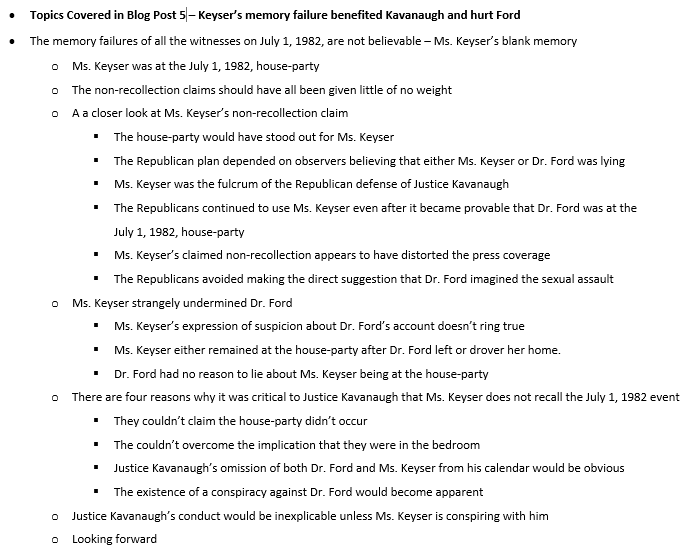
There are four reasons why it was critical to Justice Kavanaugh that Ms. Keyser does not recall the July 1, 1982 event

It is a virtual certainty that Ms. Keyser was there. And it seems implausible that she doesn’t recall the house-party. However, there are four reasons why it was critical to the defense of Justice Kavanaugh that Ms. Keyser did not acknowledge being at the July 1, 1982 house-party.

Remember, it wasn’t anticipated that there would be an objective source of proof that Dr. Ford attended the house-party. So think about the importance of Ms. Keyser’s memory failure in a context in which eyewitness testimony would have been the only way to confirm that Dr. Ford was at the July 1 house-party.

It is virtually certain that Ms. Keyser was at the house-party and likely that she remembers it, for the reasons explained above. The following are the motivations for her non-recollection claim, in my opinion – i.e., the problems that would have been caused for Justice Kavanaugh’s defense if Ms. Keyser had recalled being at the party.

They couldn’t have claimed the house-party didn’t occur

First, if Ms. Keyser had acknowledged she recalls the event, that would have proved that Dr. Ford was at the July 1, 1982 house-party. Such proof would have destroyed the Republican strategy of claiming the event at which Dr. Ford described being sexually assaulted didn’t occur and that she is delusional.

They couldn’t overcome the implication that Kavanaugh and Judge were in the bedroom with Ford

Second, once Dr. Ford was acknowledged to have attended the July 1, 1982 house-party, it would have then been impossible for Justice Kavanaugh to overcome the inference that Dr. Ford told the truth about having been in the bedroom with him and Mr. Judge. Ms. Keyser might also have confirmed that the three of them were on the second floor together.

Justice Kavanaugh and Mr. Judge couldn’t possibly have forgotten an interaction in the bedroom with Dr. Ford. So, they would have each made provably false statements to the Senate Judiciary Committee or the FBI about (i) the interaction in the bedroom with Dr. Ford, (ii) not recalling the July 1, 1982 house party, and (iii) not remembering that Dr. Ford was there.

That could have subjected Justice Kavanaugh to criminal prosecution and judicial sanction

This second point highlights how vulnerable Justice Kavanaugh would have been if any of the witnesses to the house-party had acknowledged remembering the event and testified that Dr. Ford was indeed present. That would have been catastrophic.

The question to think about is what could have given Justice Kavanaugh confidence that none of them would provide testimony that supported Dr. Ford’s version of events. Her testimony accurately reflected the details of the house-party. So, Justice Kavanaugh would have needed to have a very high level of certainty (that the others wouldn’t truthfully recount what occurred) to mitigate his exposure to criminal prosecution and judicial sanction if he proceeded with the confirmation process.

Kavanaugh’s omission of both Ford and Keyser from his calendar would have been an obvious admission of guilt

Third (and more devious), if Dr. Ford and Ms. Keyser were at the July 1 house-party, then Justice Kavanaugh consciously failed to reflect their presence at the house-party in his July 1, 1982 calendar entry. He vehemently testified about how carefully he maintained his calendar and how precise he was in reflecting who was present at the events recorded in his calendar.

So, the omission of both girls would have constituted a contemporaneous admission of guilt by Justice Kavanaugh in July of 1982. However, we know that Dr. Ford was at the house-party, and it is virtually certain that Ms. Keyser was also at the house-party. So, we don’t need her testimony to recognize that he made an admission of guilt in July 1982.

Justice Kavanaugh did omit both of them from his July 1, 1982 calendar entry, even though they were both there. That omission was a contemporaneous admission of his guilt of sexually assaulting Dr. Ford.

The existence of a conspiracy against Dr. Ford would have become apparent

Fourth, (and still more devious), if it were acknowledged that Dr. Ford and Ms. Keyser were at the house-party, the existence and potential scope of the conspiracy against Dr. Ford would have become visible. And the birth date of the conspiracy would have been established as in July 1982.

Justice Kavanaugh’s omission of the two girls from his calendar would have been at best useless, and at worst damning (as evidence of guilt) unless he had reason to know that none of the people at the house-party would confirm that Dr. Ford or Ms. Keyser was there. That realization is a mind-bender!

Justice Kavanaugh’s conduct would be inexplicable unless Ms. Keyser is conspiring with him

To be clear, the omission of Dr. Ford and Ms. Keyser would have been useless or damning, unless Justice Kavanaugh already knew in July 1982 that Ms. Keyser would not confirm that she and Dr. Ford were at the July 1 house-party. Without that assurance, there would have been no reason for him to have left Dr. Ford and Ms. Keyser out of his July 1, 1982 calendar entry, in my opinion.

Dr. Ford was provably at the July 1, 1982 house-party. So, we already knew of the existence of Justice Kavanaugh’s 1982 confession by the omission of Dr. Ford from his July 1 calendar entry. However, by taking account of Ms. Keyser’s presence at the house-party and omission from his calendar, the implications of his 1982 confession become even more significant.

The implications I draw include that the conspiracy to hide Dr. Ford’s presence at the July 1 event must have included Ms. Keyser from day one. Otherwise, nothing would have been accomplished by leaving her and Dr. Ford out of his calendar entry.

If Ms. Keyser is a co-conspirator, then she has been lying about not recalling the July 1, 1982 house-party. Also, that would evidence the existence of a conspiracy against Dr. Ford among a broader group, and possibly all, of the July 1, 1982 party attendees.

Looking forward

Blog #6 will examine the collective non-recollection claims of the seven boys who were present based on Justice Kavanaugh’s calendar entry. We will first look at the credibility of the non-recollection claims of the five male fact-witnesses. We will then look at the non-recollection claims of Justice Kavanaugh and Mr. Judge.
#5A Kavanaugh’s primary defense was both irrelevant & false

[wpseo_breadcrumb]

By George H Butcher III

Table of Contents for Blog Post #5A

Kavanaugh’s primary defense – the other witnesses’ claims that they don’t recall anything – were both irrelevant and mostly false

The supposedly blank memories of all the witnesses who were present on July 1, 1982, are not believable. They reflect the existence of a conspiracy led by Justice Kavanaugh, as explained herein. The purpose of the conspiracy is to obscure the fact that Dr. Ford attended the July 1, 1982 house-party, where she testified that Justice Kavanaugh sexually assaulted her.

The Kavanaugh defense theory was that if the event where Dr. Ford was sexually assaulted didn’t happen, then he didn’t sexually assault her. So, she just imagined being at the house-party she described, and she imagined being sexually assaulted. The essence of the Republicans’ defense of Justice Kavanaugh was – the victim is delusional.

Justice Kavanaugh’s involvement in that conspiracy is relevant both to the extent of his guilt of wrongdoing and to his suitability to be a federal judge at any level. His leadership of a multi-decade, multi-person conspiracy to subvert justice makes him singularly unsuitable to serve as a federal judge.

That conspiracy is one of several reasons Justice Kavanaugh has a strong case to make for the most unsuitable Supreme Court justice of all time – the GOAT (greatest of all time).

How did we get to this point?

This is Blog #5A in my series of blog posts. Blog #1 through Blog #4 explained the three independent proofs of Justice Kavanaugh’s guilt of sexually assaulting Dr. Ford.

So, it as a given that Justice Kavanaugh is guilty of the sexual assault. The assault occurred during a July 1, 1982 house-party at which either seven or eight people were present, in addition to Dr. Ford. See Blog #2.

Yet, the seven or eight other people who were present all claim to have no memories concerning the event. That even includes Dr. Ford’s two alleged assailants – Justice Kavanaugh and Mr. Judge.

Those other witnesses, seven boys and Ms. Keyser, each claim to remember nothing! They do not claim to have a memory of the event and to recall that Dr. Ford and Ms. Keyser were not present. They do not claim to remember that they did not attend the house-party. They claim to have no relevant memory one way or the other.

We will refer to the other witnesses claiming to have no relevant memory as a “non-recollection” claim.

Blog #5A topics

The critical issues related to the other witnesses’ non-recollection claims are so extensive that we will examine them in three parts – in Blog #5A, Blog #5B, and Blog #6. This Blog #5A examines the broader issues concerning the other witnesses’ non-recollection claims.

  • What was their political and media impact?
  • Did the collective non-recollection claims evidence a conspiracy?
  • What weight should have been given to non-recollection claims as evidence?
  • Was the weight they were given appropriate or excessive?

Blog #5B specifically looks at Ms. Keyser’s non-recollection claim. And Blog #6 looks explicitly at the non-recollection claims of the seven boys who were present on July 1, 1982.

The non-recollection claims of the others who were present have played a crucial role

The non-recollection claims of the other seven or eight other people who were present on July 1, 1982, have played a critically important role in two contexts.

As the centerpiece of Kavanaugh’s defense strategy

The other witnesses’ non-recollection claims were the centerpiece of the Republicans’ defense of Justice Kavanaugh. As described in Blog #3, Justice Kavanaugh dishonestly characterized the other witnesses’ non-recollection claims as refutations or Dr. Ford’s allegation. In her defense of Justice Kavanaugh, Senator Collins also dishonestly characterized P.J. Smyth’s non-recollection claim as a refutation of Dr. Ford’s allegation.

Senator Collins openly treated the irrelevant non-recollection claims, which were literally evidence of nothing, as if they were evidence that the event described by Dr. Ford didn’t occur. Senator Collins even extended the concept of giving importance to irrelevant evidence of nothing from the non-recollection claims to failures to take action by both known and unknown witnesses.

Senator Collins argued that the fact that the witnesses at the party hadn’t come forward with statements helpful to Dr. Ford was evidence the event she described did not happen. The senator specifically cited the fact that the unknown person who drove Dr. Ford home didn’t come forward as evidence that the event didn’t happen. The senator even irrationally cited the fact that the people who were at the party didn’t call Dr. Ford afterward to inquire how she was doing, as evidence that the house-party where she was sexually assaulted didn’t happen.

Pretending the event didn’t happen was crucial to the Republican defense strategy. It permitted Justice Kavanaugh to pretend that he doesn’t remember the event and to avoid answering questions about it.

In distorting the press coverage of Dr. Ford’s allegation against Justice Kavanaugh

A second context in which the other witnesses’ non-recollection claims played a critical role concerns the news media coverage of Dr. Ford’s allegation. The exaggerated importance attributed to the other witnesses’ non-recollection claims distorted the press coverage of her sexual-assault allegation.

That distortion had a significant impact. It is a reason why the dispositive evidence of Justice Kavanaugh’s guilt has been overlooked or ignored by observers in the media.

That reason is not a satisfactory explanation for the failure by the news media to cover the readily apparent evidence of Justice Kavanaugh’s guilt. But I’ve been unable to identify another reason for that news media failure, which makes any sense and which doesn’t involve malfeasance as well as a reporting failure.

A conspiracy exists to hide the fact that Dr. Ford was present at the July 1, 1982, house-party

At a minimum, there is a two-person conspiracy among Kavanaugh and Judge

Justice Kavanaugh and Mr. Judge were alone in the second-floor bedroom with Dr. Ford. That is a virtual certainty, as explained in Blog #2. So, they couldn’t reasonably have forgotten that encounter, even if there had been no sexual assault.

Further, Dr. Ford testified that Mr. Judge’s reaction indicated that he recalled the interaction in the bedroom when she encountered him later that summer. His discomfort during that encounter is confirmation that he hasn’t forgotten the house-party now, in my view.

Even if the only evidence of the event described by Dr. Ford had been her testimony, Justice Kavanaugh’s and Mr. Judge’s claims to have no memory of the event wouldn’t have been credible. Even then, their non-recollection claims could only have been true if Dr. Ford had fabricated or imagined the entire story.

The conspiracy is based on making false non-recollection claims.

After Dr. Ford testified, it should never have been viewed as a possibility by any senator or observer that her story was either a total fabrication or a delusion. Yet the entire Republican defense strategy for Justice Kavanaugh was based on using the other witnesses’ non-recollection claims to support the assertion that Dr. Ford is delusional.   

So, a conspiracy to hide the fact of Dr. Ford’s presence at the July 1, 1982 house-party does exist. The conspiracy includes Justice Kavanaugh and Mr. Judge for sure, in my view.

The conspiracy is reflected in their mutual non-recollection claims. They have each denied any memory of an event that they both must recall and which they know that the other recalls, in my opinion. They could only have lied about what they remember if they were sure that the other one would also lie.

My conclusion is that the conspiracy includes most or all of the witnesses

The critical questions about the conspiracy include the following. “How many witnesses are involved in the conspiracy?” “What have the conspirators’ activities been?”

My analysis indicates that the conspiracy must also include most or all of the group made up of the five male fact-witnesses and Ms. Keyser – the “uninvolved” witnesses. More specifically, it is evident that Justice Kavanaugh believed in both 1982 and 2018 that his co-conspirators included all of the uninvolved witnesses plus Mr. Judge.

The evidence of his belief is discussed throughout Blogs #5 and #6. Blog #5B contains my analysis concerning Ms. Keyser’s non-recollection claim. Blog#6 includes my analysis of the non-recollection claims of the male witnesses.

Justice Kavanaugh bet the ranch that his non-recollection conspiracy includes all of the other witnesses

Another way to address the issue is to ask, “Is there any reason not to accept Justice Kavanaugh’s apparent belief that all of the other witnesses are his co-conspirators?” He manifested that belief on two occasions, thirty-six years apart. My answer is, “No.”

We should trust his judgment on this. He had a lot riding on his belief being accurate when he continued with the confirmation process after Dr. Ford made her allegation and agreed to testify publicly.

Justice Kavanaugh gave pervasively false testimony that he knew could expose him to criminal prosecution if any of the others who were present on July 1, 1982, acknowledged recalling what we now know occurred. He claimed falsely and repeatedly that the event described by Dr. Ford never happened.

So, his belief in the number and commitment of his perceived co-conspirators was absolute. Justice Kavanaugh’s actions show he believed that all of the other witnesses were fully committed to the conspiracy.

There is an alternative perspective from which the non-recollection claims have been viewed that can make them seem material

How is it that other witnesses’ non-recollection claims could be treated as significant? Taken literally, the non-recollection claims are evidence of nothing.

Their claims are that they recall nothing. They have no memory of whether the event described by Dr. Ford occurred or not. They have no memory of whether the July 1, 1982 house-party happened or not. So, how could that have been viewed as evidence of anything?

What the alternative perspective is

The alternative perspective from which some observers have viewed the non-recollection claims ignores the literal meaning of the witnesses’ claims. It rejects the idea that all of the witnesses would not recall the event described by Dr. Ford if it had occurred. In particular, it rejects the idea that Ms. Keyser would not remember the house-party described by her friend Dr. Ford if it had happened.

Under that alternative perspective, either (1) Dr. Ford is lying or delusional, or (2) some or all of the other witnesses are lying about what they recall. Evidence that viewed literally would be immaterial (i.e., the non-recollection claims) is treated as being material evidence.

 In theory, the alternative perspective could be applied either against or in support of Dr. Ford’s allegation. But in practice, it was only used to undermine her sexual-assault accusation, even though that was the less logical outcome.  

There are two critical issues concerning the use of the other witnesses’ non-recollection claims as evidence

There are two significant concerns about the impacts of the failures to recall of the other witnesses. Those impacts affected both the political discussion in the Senate and the press coverage of Justice Kavanaugh’s confirmation proceedings. The two concerns are briefly described immediately below and are discussed after that.

The weight that should have been given to the non-recollection claims

What weight, if any, should have been given to the non-recollection claims of the other witnesses? As explained further below, the answer to that question changed as the facts changed.

There were three significant evolutions in the facts. The first was when Dr. Ford gave her credible testimony about the sexual assault. The second was when Justice Kavanaugh testified about his summer of 1982 calendars and his July 1, 1982 calendar entry. The third evolution should have occurred during and after the confirmation hearing as each political or media observer analyzed the implications of the evidence about the July 1 house-party.

Was the political and media impact of the non-recollection claims inappropriate

Was inappropriate weight given to the other witnesses’ non-recollection claims? The answer is, “Yes.”

Did Ms. Keyser’s non-recollection claim uniquely impact either the political discussion or the news media coverage of Dr. Ford’s sexual-assault allegation against Justice Kavanaugh? The answer is, “Yes.” Ms. Keyser’s non-recollection claim did uniquely impact the political discussion and news media coverage of Dr. Ford’s sexual-assault allegation.

The non-recollection claims, including Ms. Keyser’s, were used to question whether the event described by Dr. Ford – during which she was sexually assaulted – really occurred. But weight given to such claims should have changed as the facts evolved.

In the end, no weight should have been given to the non-recollection claims, as explained below. So, there was no justification for Ms. Keyser’s or the other non-recollection claims to have impacted either the political discussion or the news media coverage of Dr. Ford’s sexual-assault allegation.

What weight should have been given to the other witnesses’ non-recollection claims?

As noted above, the other witnesses’ non-recollection claims were the centerpiece of the Republicans’ defense of Justice Kavanaugh. Moreover, they impacted and distorted the news media coverage of Dr. Ford’s sexual-assault allegation.

There are three fact-scenarios to examine

We will consider what weight the non-recollection claims should have been given in three alternative fact-scenarios. The first fact-scenario is without any corroboration of Dr. Ford’s testimony beyond her prior consistent statements. The second is after the existence of Justice Kavanaugh’s July 1, 1982 calendar entry was revealed, but only considering its existence and not the implications thereof. The third fact-scenario also takes account of the common-sense and statistically-provable conclusion that Dr. Ford was at the July 1 house-party.

Looking at all three scenarios helps to answer the question asked above. “What weight should have been given to the other witnesses’ non-recollection claims?”

In two of the three fact-scenarios, no weight should have been given

My analysis of the fact-scenarios is detailed below in discussions of the individual scenarios. My summarized conclusions are as follows.

If the first fact-scenario reflected reality (i.e., no further corroboration), it might have been reasonable to treat the non-recollection claims of the other witnesses as having some evidentiary significance. It might have been reasonable, for example, to treat Ms. Keyser’s non-recollection claim as evidence that the event described by Dr. Ford did not occur.

However, under each of the other two fact-scenarios, the non-recollection claims of the other witnesses are immaterial as evidence against Dr. Ford. That applies both to Ms. Keyser and the male witnesses.

In the real world, every observer was operating under either fact-scenario 2 or fact-scenario 3. At a minimum, everyone had to be aware of the July 1, 1982 house-party.

So, no observer was justified in treating the non-recollection claims of the other witnesses as individually or collectively significant in undermining Dr. Ford’s allegation. That applies both to politicians, like Senator Collins, and the news media.

Scenario 1: The non-recollection claims viewed without further corroboration of Dr. Ford’s testimony

Someone must be lying

The non-recollection claims of the other witnesses would have had no evidentiary significance unless the alternative perspective referenced above were applied to conclude that someone must be lying. Under that perspective, the observer who uses it need only believe that some of the witnesses would recall the event if it occurred. It isn’t necessary to identify any specific witness who would remember the event.

Using the alternative perspective, an observer might decide that Dr. Ford is either lying or delusional about whether the event she described happened. To conclude that Dr. Ford is telling the truth would require accepting the inference that some or all the others are lying.

It might be difficult for the observer to imagine what the motivation might be for the uninvolved witnesses lie. They would have known that it would break the law to misrepresent what they recall. And if any such witness were to have lied, then any other witness could upset that plan by coming forward with the truth.  

But if they were all in it together, there should be no way for them to get caught. It would be her truthful testimony against their collective dishonest non-recollection claims. How could that possibly go wrong as long as they all stick to their position?

Either Dr. Ford or Ms. Keyser must be lying

The belief that Ms. Keyser would have recalled the event described by Dr. Ford if it occurred was encouraged by Justice Kavanaugh and the Senate Republicans. The alternative perspective, explicitly applied to Ms. Keyser, was the core element of their defense strategy.

If Ms. Keyser would have recalled the event if she was there, and if she is telling the truth about not remembering it, then it didn’t happen. That would mean Dr. Ford’s testimony that the event occurred and that she was sexually assaulted reflected either a lie or a delusion. On the other hand, if Dr. Ford is telling the truth, then Ms. Keyser is lying about not recalling the event.

That strategy of advancing the alternative perspective, based on Ms. Keyser’s non-recollection claim, was visible both in Justice Kavanaugh’s testimony and in Senator Collins’ speech explaining her vote in favor of confirmation.

It’s wold be hard enough for observers to confront the possibility that the five uninvolved boys might lie about such a serious matter. It would be even more difficult to accept the possibility that a female, and Dr. Ford’s friend, might be lying about what she recalls.

The liars would be truly despicable

If Ms. Keyser was lying, as I believe, then she was doing so for the purpose of making her former friend Dr. Ford out to be delusional – a nut job. The secondary objective of that lie would have been to help Justice Kavanaugh evade responsibility for the sexual assault, the conspiracy, and giving pervasively false testimony about Dr. Ford’s allegation. The primary objective would have been to help him get confirmed to the Supreme Court.

Ms. Keyser shouldn’t be held to a higher standard than Justice Kavanaugh or the male witnesses. Her conduct, in that case, would be truly despicable. But it would be less so than Justice Kavanaugh’s behavior and no more despicable than the actions of any of the male witnesses who were part of the conspiracy.

The Republicans’ use of the alternative perspective was despicable, even in fact-scenario 1

Senator Collins’ and the Republicans’ use of the non-recollection claims as evidence that the event didn’t happen would have been unenlightened, but not fully despicable, under two conditions. The first is if the only relevant evidence had been Dr. Ford’s testimony contrasted with the claims of all the other witnesses not to recall anything. The second is if they didn’t purposefully mischaracterize the other witnesses’ non-recollection claims as refutations of Dr. Ford’s allegation..

The second condition wasn’t satisfied. So, even under the scenario 1 facts (i.e., no further corroborating evidence), the Republicans’ conduct should be viewed as despicable.

But fact-scenario 1 is just a theoretical construct. No one in the real world was operating with this understanding of the facts.

Scenario 2: The non-recollection claims only considering that the July 1, 1982, house-party occurred

In this category, I mean to take account of the existence of the July 1, 1982 house-party, as shown by Justice Kavanaugh’s calendar entry. But I don’t mean to assume that any additional analysis is done. So, I’m not considering the common-sense observation that Dr. Ford was present at the July 1 event.

The mere existence of his calendar entry, without any further analysis, does not corroborate Dr. Ford’s recollection of the event where she was sexually assaulted. Nor does it confirm that Dr. Ford was present at the July 1, 1982 house-party and that the two events are the same.

But the event’s mere existence does create the possibility that the house-party Dr. Ford described might have been the July 1 event. That possibility couldn’t be dismissed since other witnesses all claim not to remember the event. That possibility represents evidence in support of Dr. Ford’s allegation, even without confirming that the two events are the same. 

The fact that Justice Kavanaugh’s calendar entry doesn’t include Dr. Ford is evidence that she wasn’t there. That inference was strengthened by Justice Kavanaugh’s strident testimony about how precise his calendars for the summer of 1982 were.

But there is no other event in his calendars which could be the event Dr. Ford described. So, her description of the event where she was assaulted is evidence that the event she described is the July 1 event. That is true without doing the additional analysis required to understand that it’s actually proof she was there.

The non-recollection claims should be given no weight against Dr. Ford in this scenario

Once Justice Kavanaugh’s calendar showed that an event occurred at which the seven listed boys were all present, their non-recollection claims should have been given zero weight. They claimed not to recall an event at which they were present.

Thus, their claims to have no memory of such an event were either unreliable indicators of what occurred or dishonest. So, their collective non-recollection claims could no longer be viewed as evidence that Dr. Ford might have been lying or delusional.

Ms. Keyser’s claimed non-recollection could also no longer be viewed as indicating that Dr. Ford is lying or delusional. If Ms. Keyser was at the July 1 house-party, she falls in the same category as the boys – having a memory that is unreliable or dishonest. If she wasn’t there, her non-recollection claim would be truthful but irrelevant.

There could be no justification in this fact-scenario for using the non-recollection claims of the other witnesses as evidence that the event described by Dr. Ford didn’t occur. Those claims are simply evidence of nothing, as they literally purport to be.

This scenario reflects reality for 100% of the political and media observers. They all knew about the July 1, 1982 house-party, even if they failed to apply their common sense to the known facts to understand that Dr. Ford was definitely at that event.

Scenario 3: The non-recollection claims taking account of the fact that Dr. Ford was at the July 1, 1982, house-party

From her own recollection, Dr. Ford knew seven distinct details that were aligned with the July 1 event in Justice Kavanaugh’s calendar. Three of those details were the names of people who were present, which would each have been exceptionally difficult to guess.

The common-sense conclusion that Dr. Ford was present on July 1, 1982 should have been apparent to observers

The common-sense conclusion that Dr. Ford was present on July 1, 1982, shouldn’t have taken long for any sophisticated observer to reach. Dr. Ford’s knowledge of those seven details couldn’t have been a coincidence. And there is no explanation of how she could have acquired her knowledge other by having been present.

She didn’t learn the details she knew from any of the others who attended the house-party. None of them recalled the event or telling her about it. And anyone who told her would have remembered telling her and would have recalled the event itself.

The non-recollection claims should have been given no weight against Dr. Ford in this scenario

In this scenario, the event described by Dr. Ford has provably occurred and is the July 1, 1982 house-party. So, the non-recollection claims of the other witnesses are of no conceivable relevance. Accordingly, they should have been given no weight as evidence against Dr. Ford.

This scenario should have reflected the reality for the senators and media observers. Less quantitative observers may not have realized that the probability that Dr. Ford was present is far beyond a reasonable or unreasonable doubt. But common sense alone, without the benefit of quantitative skills, would have been sufficient to conclude that it was far more likely than not that Dr. Ford was present at the July 1 house-party.

And quantitative resources are not that difficult to come by. Any interested party could have gotten quantitative assistance with a statistical analysis. In any event, the senators and any major media outlets and observers should have concluded that Dr. Ford was at the July 1 house-party, whether or not they went to the trouble of performing or obtaining a statistical analysis.

The other witnesses’ non-recollection claims should have been given no weight as evidence against Dr. Ford

The other witnesses’ non-recollection claims do not represent evidence that the event described by Dr.Ford didn’t occur. That conclusion applies regardless of whether an observer was operating under a scenario 2 or scenario 3 understanding of the facts.

The crucial evidence concerning the July 1, 1982 house-party was revealed during the September 27, 2018 hearing. Beyond that point, every observer was operating in either fact-scenario 2 or fact-scenario 3. So, there was no rationale for any observer to give any evidentiary weight to the non-recollection claims of the other seven or eight people who were present at the July 1 event.

The non-recollection claims inappropriately impacted both the political and news media discussions of Dr. Ford’s allegation

Senator Collins improperly applied the alternative perspective to the non-recollection claims of the other witnesses

Senator Collins expressly used the alternative perspective to treat the other witnesses’ non-recollection claims as evidence against Dr. Ford. The senator emphasized Ms. Keyser’s non-recollection claim, as if it had particular importance.

However, the senator had to be aware of Justice Kavanaugh’s July 1 calendar entry if she watched the hearing or read the hearing transcript. So she was operating in fact-scenario 2, at a minimum. Accordingly, there was no justification for Senator Collins to treat the witnesses’ non-recollection claims as evidence that the event described by Dr. Ford did not occur.

Senator Collins irrationally expanded the alternative perspective of non-recollection claims, including by double-counting

As mentioned above, the senator even expanded the concept of non-recollection claims. She drew adverse inferences against the victim because known and unknown witnesses didn’t take affirmative actions to corroborate her account.

It might be possible to assess whether a known witness would recall an event if it had occurred. But that isn’t possible with an unknown witness, who might not even be alive. So, Senator Collins drawing adverse inferences from the inaction of an unidentified witness – like the unknown person who drove Dr. Ford home – was nonsensical.

The senator drew those negative inferences from inaction, even though the witnesses may not have any memory of the relevant events. Indeed the known witness claimed not to have any relevant memory as to whether the event described by Dr. Ford or the July 1, 1982 house-party occurred or didn’t occur.

There was no basis for her to give any weight to the non-recollection claims. Yet Senator Collins counted the same irrelevant phenomenon twice – once as a non-recollection and again as a failure to take affirmative action to provide corroboration. 

I will describe other problems with Senator Collins’ justifications for ignoring Dr. Ford’s allegation in Blog #7.

The application of the alternative perspective by the news media was flawed, even only taking account of Dr. Ford’s testimony

There are significant problems with the way the news media has applied the alternative perspective in this instance. It hasn’t been used in a transparent manner that openly acknowledged the perspective’s use and which ensured that it would be thoughtfully applied.

The alternatives were either that Dr. Ford fabricated or imagined the event where she was sexually assaulted or that some or all of the other witnesses made false non-recollection claims. After Dr. Ford’s credible testimony, the more probable answer should have been that Dr. Ford was truthful and that some of the others were lying about what they remember.

Furthermore, the non-recollection claims of the other witnesses should have been viewed with suspicion. The idea that they had no idea whether or not they were present at the event described by Dr. Ford should have been viewed as dubious from the beginning.

The flawed application of the alternative perspective is reflected in the skewed outcome it produced. I see no evidence that any media observer applied the alternative perspective to conclude that the other witnesses were lying. It was only used to question or undermine Dr. Ford’s testimony, even though that was the less logical outcome.

That unbalanced or biased application of the alternative perspective is evident, even only taking account of Dr. Ford’s credible testimony.

The application of the alternative perspective was egregious, taking account of the calendar evidence

But the alternative perspective’s use against Dr. Ford reflects a significant media failure after the discussion of Justice Kavanaugh’s calendars occurred during the confirmation hearing. After that, no observer could have reasonably used that perspective to conclude that Dr. Ford might be lying or delusional.

First, after the existence of the July 1, 1982 calendar entry was known, the alternative perspective shouldn’t have been applied for the reasons discussed under fact-scenario 2 above. Moreover, the non-recollection claims of the seven male witnesses and Ms. Keyser should have been viewed with even more suspicion. The idea that they don’t know whether or not they were at the July 1 house-party is even more dubious.

Second, it only required common sense to discern that the July 1, 1982 house-party was the event described by Dr. Ford and that she was at the house-party. So, every observer who applied the alternative perspective should have concluded that her account is truthful, and some or all of the other witnesses’ claims that they don’t remember the house-party are dishonest.

Although the alternative perspective should have supported Dr. Ford, it was used against her

Accordingly, every observer who used it should have applied the alternative perspective in support of Dr. Ford’s allegation. However, observers could have decided that the alternative perspective should no longer be applied to avoid concluding that some or all of other witnesses were lying.

If they no longer applied the presumption, they would have no longer had to assume that either Dr. Ford or the other witnesses must be lying. It would have been a cop-out for observers to change the rules to avoid acknowledging that some or all of the the others were lying.

But what they actually did was much worse. The media observers who applied the alternative perspective continued to use it as a basis to question Dr. Ford’s truthfulness about whether the house-party she described occurred, even her honesty had been confirmed. Senator Collins and her Republican colleagues did likewise.

The observers who misapplied the alternative perspective missed the proof that Dr. Ford was at the house-party and the implications thereof.

Such media observers and the Republicans even ignored the definitive evidence that the house-party described by Dr. Ford occurred on July 1, 1982. Ignoring the proof she was there also obscured the implications of the fact that she was there.

One such implication is that the omission of Dr. Ford from the July 1 calendar entry was an admission of guilt. Another implication is that Dr. Ford was in the bedroom with Justice Kavanaugh and Mr. Judge and that her sexual-assault allegation is true.

Looking Forward

Blog #5B will examine Ms. Keyser’s non-recollection claim.  

#4 Kavanaugh omission of Ford shows consciousness of guilt

[wpseo_breadcrumb]

By George H Butcher III

Table of Contents for this Blog #4

Kavanaugh’s 1982 omission of Ford was a confession to sexually assaulting her and reflected the same strategy as his 2018 confession, 36 years later

I observed in Blog #1 of this series that Brett Kavanaugh’s omission of Christine Blasey Ford from his calendar entry for July 1, 1982, represented a contemporaneous July 1982 confession that he sexually assaulted her. This Blog #4 details the analysis which supports that conclusion.

How did we get to this point?

Blog #1 explained that three independent proofs of Justice Kavanaugh’s guilt flow from the certain fact that Dr. Ford attended the July 1, 1982 house-party at which Justice Kavanaugh and Mr. Judge were also present. Justice Kavanaugh repeatedly denied that she was there. Blog #2 describes the proof that she was there.

Two of those proofs of his guilt are confessions of his guilt through his actions. The first was his July 1982 confession referenced above.

His second confession occurred in September 2018, through his actions in giving false testimony about Dr. Ford’s allegation. Blog #3 described his 2018 confession.

Blog #4 topics

In addition to explaining Justice Kavanaugh’s 1982 confession, this Blog #4 describes the common strategy behind his 1982 and 2018 confessions. It also discusses the collective implications of Justice Kavanaugh’s two confessions and the third proof of his guilt.

There are clear implications for his suitability to be a federal judge. Justice Kavanaugh is a strong contender for the worst Supreme Court justice ever – the GOAT (greatest of all time). Equally or more important, there are implications regarding the culpability of the Republicans for confirming a manifestly unsuitable judge to the Supreme Court.

Kavanaugh’s calendars were both forward-looking and backward-looking

Justice Kavanaugh’s July 1, 1982 calendar entry says, “Go to Timmy’s for Skis w/ Judge, Tom, P.J., Bernie, Squi.” Many of Justice Kavanaugh’s calendar entries use the same “Go to” phrasing. That phrasing would typically be understood to be prospective or forward-looking.

But it appears that he used the same wording for both forward-looking and retrospective or backward-looking calendar entries. Many of his calendar entries have been corrected to reflect changes between what was planned and what occurred.

Two dates that are important for this discussion are July 1 and August 7. Justice Kavanaugh cited August 7, 1982 as comparable to July 1 regarding how he maintained his calendar.

Both his July 1 and August 7 entries include long lists of names to which no corrections were made. That seems to indicate they were likely backward-looking, i.e., made after the event occurred. Justice Kavanaugh testified that such lists of names generally reflect a backward-looking calendar entry.

Justice Kavanaugh’s careful process for maintaining his calendars

In his confirmation hearing testimony, Justice Kavanaugh explained the relevance of his summer of 1982 calendars. He referenced having submitted to the Senate Judiciary Committee “detailed calendars recording [his] activities in the summer of 1982.” He stated that his calendars operate as “both a calendar and a diary” and that his calendars “have the summer of 1982 documented pretty well.” He also testified that he had reviewed every entry in his calendars for May, June, July, and August of 1982.

Justice Kavanaugh stated that in documenting events in his calendars, he “was very precise about listing who was there; very precise.” He elaborated that his “calendars also were diaries of sorts, forward-look and backward-looking.” Justice Kavanaugh “crossed out missed workouts and the canceled doctor’s appointments.” Also, he “listed the precise people who had shown up for certain events.”

If an event like Dr. Ford described occurred, he would have put it in his calendar

Justice Kavanaugh testified that if a gathering like Dr. Ford described had occurred, he would have documented it. He explained that “I documented everything of those kinds of events, even small get-togethers.” He reinforced that he would have recorded such a gathering by referencing August 7, 1982. He characterized that date as “another good example where I documented a small get-together that summer.”

The July 1 calendar entry referred to a gathering of six people, excluding himself. The August 7 entry referred to a gathering of five people, excluding himself. Whether the August 7 calendar entry was initially prospective or retrospective, his testimony indicates that it “documented” what actually occurred at the gathering.

And it did not reflect any corrections after the fact. Likewise, there were no corrections in his July 1, 1982, calendar entry. Based on his testimony about his practices, the July 1 entry should reflect what actually occurred at the house-party.  

Justice Kavanaugh created a presumption that the July 1, 1982 calendar entry was backward-looking

Justice Kavanaugh also testified that when he listed “the specific people [he] was with, that is likely backward-looking.” That statement creates an implication that the July 1, 1982 calendar entry was made after-the-fact.

His statement strengthens the inference from his calendar that Dr. Ford wasn’t at the house-party since she wasn’t included in his presumptively backward-looking July 1 calendar entry. That inference was beneficial to Justice Kavanaugh when there was no corroboration that Dr. Ford attended the July 1 event.

However, his testimony created the presumption that his July 1 and August 7 calendar entries were both backward-looking. That presumption is consistent with a common-sense view of the facts, given the number of names. But that presumption is no longer beneficial to him given the proof that Dr. Ford was present on July 1, 1982.

Justice Kavanaugh’s calendar strategy in September 2018

In his testimony, Justice Kavanaugh attempted to create the impression that his summer of 1982 calendar entries were accurate. If his calendar were accurate, his July 1, 1982 calendar entry would prove Dr. Ford was not at the house-party at Timmy’s on that date. In multiple statements and responses, he testified that the July 1 house-party detailed in his calendar was not the event she described, at which she alleged he sexually assaulted her.

Kavanaugh and the Republicans adopted a reprehensible strategy – portraying Dr. Ford as delusional

His apparent objective was to create the impression that Dr. Ford imagined the house-party where she alleges that he sexually assaulted her. No other event in his calendar could have been the gathering that she described. So, if Dr. Ford didn’t attend the July 1, 1982 house-party, then she only imagined being sexually assaulted by Justice Kavanaugh and Mr. Judge.

It was reprehensible for Justice Kavanaugh to attempt to create the impression that Dr. Ford is delusional. He knew that she is wholly rational and that she was present at the July 1 house-party. Even if it were possible that he didn’t directly recall that fact, he knew she was there because of the number of details she knew about the July 1 house-party.

Justice Kavanaugh’s despicable treatment of Dr. Ford in September 2018 compounds what he initially did to her in July 1982. Moreover, he had the gall to act indignant about having been accused.

You can’t trust a witness not to remember an event they observed without a conspiracy

There is only one way to be sure that an eyewitness can be relied upon to say they don’t recall an event. That is, if they do remember it and have made a conscious decision to claim they have no recollection. Otherwise, their memory could return or could be refreshed. In that event, they should be expected to revise their testimony to reflect the new development.

There is only one way that Justice Kavanaugh could have been sure that the July 1, 1982, house-party attendees wouldn’t undermine his strategy of claiming the event described by Dr. Ford never happened. That is if he believes that they do remember the event, and have made conscious decisions to claim they don’t recall it.

The Republican Senators assisted in portraying Dr. Ford as delusional

The strategy to portray Dr. Ford as delusional could have worked without a hitch since all of the party attendees, except Dr. Ford, claim to have no recollection of the July 1, 1982 house-party. The Republican senators dutifully implied that she is delusional in justifying their votes to confirm Justice Kavanaugh as a Supreme Court justice.

Republican senators, like Senator Collins, even implausibly argued that Dr. Ford may have been sexually assaulted by a different person on a separate occasion and may have confused that person with Justice Kavanaugh. That argument was beyond implausible, given Dr. Ford’s credible and thoughtful testimony. I lack the vocabulary to characterize the argument and the senators who employed it adequately.

The detestable Republican strategy was a substantive failure but a pragmatic success

The outcome of the Republican strategy of portraying Dr. Ford as delusional can be viewed from two perspectives. First, it is a substantive failure because it is provable that Dr. Ford was present at the July 1, 1982 house-party. And virtually all of the details of her testimony have been corroborated.

Second, it has been a pragmatic success to date. The Republicans have suffered no penalty for using that baseless and despicable strategy. Moreover, Justice Kavanaugh sits on the Supreme Court.

Consider the systemic implications of the Republican senators’ willingness to employ that despicable and shameless strategy publicly. Those implications will be discussed in subsequent blog posts. The implications relate, first, to both the character and morality of those senators.  Second, they relate to their perspectives concerning what the public and the press will let them get away with.

Judge Kavanaugh’s 1982 confession and his calendar strategy in July 1982

Dr. Ford was provably at the July 1, 1982 house-party. So, Justice Kavanaugh should have reflected her presence in his July 1 calendar entry. His process for maintaining his calendar was both forward-looking and backward-looking, according to his testimony.

Justice Kavanaugh created a presumption that the July 1, 1982 calendar entry was made after-the-fact. If it was, then he intentionally omitted Dr. Ford from the attendee list after she attended the event and after the alleged sexual assault occurred.

Even if he initially made his calendar entry before the event and didn’t know at the time that Dr. Ford would attend, he should have edited his calendar after the house-party to reflect that she was at the event. He vehemently testified that he was very precise in reflecting the people who attended events in his calendar.

Justice Kavanaugh wouldn’t have deviated from his standard consistent practices in maintaining his calendar without some specific reason. Moreover, he testified that he didn’t deviate from his process and that his summer of 1982 calendars reflect what occurred.

But that claim is demonstrably untrue since Dr. Ford isn’t included in his July 1 calendar entry. So, the question is, “What motivated or explained his failure to reflect Dr. Ford’s presence at the house-party in his calendar?”

He didn’t just forget and he wasn’t incapacitated

He couldn’t have forgotten that Dr. Ford was there for two reasons. First, there were only eight or nine people at the party, and Dr. Ford was either the only girl or one of two girls. Second, it is virtually certain that Justice Kavanaugh and Mark Judge were in the second-floor bedroom with the 15-year-old Dr. Ford. There is no conceivable basis to believe she told the truth about being at the party but lied about being in the bedroom. Justice Kavanaugh couldn’t possibly have forgotten that they were in the bedroom.

The explanation for the deviation from his standard practice is not that he was incapacitated from consuming beer during the house-party. First, if he had been in such a condition, the others at the party would recall the event. Following the house-party, he would have learned of being in that condition from other attendees, which he also would remember.

Second, he and Mr. Judge were in a sufficiently coherent condition to walk down the stairs laughing after Dr. Ford escaped from the second-floor bedroom. So, they weren’t incapacitated. Third, Justice Kavanaugh testified that he was never in such an inebriated condition that he didn’t know what was happening.

Fourth, he can’t now plead that he was incapacitated and didn’t recall what had happened during the July 1 event. He would have to offer proof of that fact. Any such evidence would also show that he and others were lying when they claimed not to recall the house-party.

Justice Kavanaugh purposefully omitted Dr. Ford to hide the fact she attended the July 1, 1982, house-party

In summary, Justice Kavanaugh was aware of Dr. Ford’s presence during the July 1, 1982 house-party. He didn’t forget she was there when he completed or reviewed his calendar entry. Also, he wasn’t incapacitated from consuming alcohol during the house-party. So his failure to reflect Dr. Ford in his July 1 calendar entry manifested a conscious decision to deviate from his standard practice and omit her.

If he documented the July 1 house-party in his calendar after the fact, then he intentionally excluded Dr. Ford from the attendee list in his calendar entry. That is what presumptively occurred. If he initially documented the July 1 house-party before the event, he consciously failed to edit his calendar entry to reflect that Dr. Ford had attended the event.

Both Justice Kavanaugh’s description of his approach and the number of attendees indicate that the July 1, 1982 calendar entry was backward-looking. But the implications of the two alternatives are identical for Justice Kavanaugh’s guilt of sexually assaulting Dr. Ford. In either event, the omission of Dr. Ford was intentional and intended to hide the fact that she was present.

His omission of Dr. Ford from his calendar was a contemporaneous admission of guilt

Justice Kavanaugh heavily relied on the absence of Dr. Ford from his calendar entry to cast doubt on her allegation. That use of her omission reflects his apparent original motivation for omitting her. The motivation was to hide the fact that she was present at the July 1, 1982 house-party. If she wasn’t there, then he couldn’t have sexually assaulted her during the house-party.

Given the factual context, there is no other rational explanation for him to have intentionally omitted Dr. Ford from his calendar entry. There is only one reason Justice Kavanaugh would have needed to create the impression that Dr. Ford didn’t attend the house-party. The reason is that Justice Kavanaugh engaged in seriously inappropriate conduct with her in the second-floor bedroom of Timmy’s house.

His purposeful omission of Dr. Ford from his July 1, 1982 calendar entry reflected consciousness of guilt at that time. So, his omission of her from the list of attendees was a contemporaneous admission of guilt in July 1982. That admission corroborates Dr. Ford’s testimony that he sexually assaulted her.

His calendar strategies in both 1982 and 2018 evidence the existence of a conspiracy

Excluding Dr. Ford from his calendar entry for July 1, 1982, would have been useless unless the others who attended the house-party could be relied upon not to acknowledge that she did attend the house-party. Therefore, Justice Kavanaugh’s intentional omission of Dr. Ford creates an inference that he believed in July 1982 that he could rely on the others who attended the house-party not to confirm that Dr. Ford was there.

For the same reason, his use of that omission in his confirmation hearing testimony creates an inference that Justice Kavanaugh believed in September 2018 that he could rely on the others who attended the house-party not to acknowledge that Dr. Ford was there. By simply recalling that there was a girl or girls at the July 1 event, any one of the attendees could have destroyed the defensive value of his calendar and corroborated Dr. Ford’s memory.

That raises the following disquieting thought. There was a conspiracy against Dr. Ford that originated in July 1982 and has continued to the present. More specifically, Justice Kavanaugh believes there is such a conspiracy.

The conspiracy he believes exists necessarily includes most or all of the other party attendees. However difficult it may be to accept it, that thought makes it easier to rationalize the behavior of the group as a whole in 2018.

The existence of a conspiracy helps to explain the inexplicable

It makes it easier to understand why in 2018, all of the party attendees would claim not to recall an event that some of them must remember. Only one thing makes their 2018 behavior understandable from my perspective. The people who falsely claimed not to recall the event in 2018 had already committed to that course of action back in 1982.

It also explains how Judge Kavanaugh could rely on them not to change their minds and confirm Dr. Ford’s testimony about the house-party. He should have been concerned that several of them might have recalled the event after their memories had been refreshed by the information contained in his calendar. If they weren’t already complicit and acting out of self-preservation, they should have come forward and corroborated her account after their memories were refreshed.

They would have had to be heartless to hang Dr. Ford out to dry during the confirmation hearing when they knew she was telling the truth. It would also have been callous, relative to the country, for them to support Justice Kavanaugh’s confirmation through their false non-recollection claims. The simplest explanation is that they didn’t have the option to tell the truth.

The implications of Justice Kavanaugh’s 1982 and 2018 confessions

Justice Kavanaugh could not have forgotten intentionally omitting Dr. Ford from his July 1, 1982 calendar entry. He also couldn’t have forgotten the conduct which omitting her from his calendar was a confession of – i.e., the sexual assault.

His testimony about Dr. Ford’s allegation was pervasively false

So, he repeatedly gave knowingly false and purposefully deceitful testimony in his September 27, 2018 confirmation hearing. He also gave false testimony when the Senate Judiciary Committee staff interviewed him on September 17, 2018.

That false testimony included: when he denied Dr. Ford’s allegation that he sexually assaulted her; when he denied that she was present at the July 1, 1982 house-party that he attended; when he denied recalling the July 1 house-party; each time he denied ever having attended an event like the one Dr. Ford described; when he denied ever having pushed her into a bedroom; and when he claimed not to recall that he had met Dr. Ford. He may have also made similar false statements to the FBI.

In essence, all of the testimony that Justice Kavanaugh gave about Dr. Ford’s sexual-assault allegation was blatantly false!

The impacts of his two confessions are cumulative

Justice Kavanaugh’s confession by omission in July 1982 and his confession by giving false testimony in September 2018 don’t exist in isolation. They each independently corroborate Dr. Ford’s testimony that he and Mr. Judge sexually assaulted her.

Recall that his 2018 confession by giving false testimony is independent because it is based on statements that were visibly false in realtime. It doesn’t rely on or use any other proof of his guilt.

Either confession, together with Dr. Ford’s testimony, would be sufficient to support a jury verdict of “guilty” against Justice Kavanaugh in a criminal proceeding. However, his two confessions 36 years apart are additive and especially compelling evidence of his guilt.

The evidence of Justice Kavanaugh’s guilt is uniquely strong, but there was a Republican coverup

The Republican refrain during and since the Kavanaugh confirmation hearings has been that there is no corroboration for Dr. Ford’s allegation. That claim is as far from the truth as it is possible to get. Not only are there three independent proofs that Justice Kavanaugh is guilty, but one of them is even statistically quantifiable.

Justice Kavanaugh’s 2018 confession by giving false testimony about her presence on July 1, 1982 was obvious. Thus, the Republicans had to know that he is guilty. A credible allegation plus an admission of guilt should be enough evidence to sustain a conviction.

So, it is reasonable to infer that their leadership’s reason for constraining the FBI investigation was to prevent other evidence of his guilt – like his 1982 confession and the third proof of his guilt – from becoming public. Any competent investigation would have revealed all three proofs of his guilt.

In the Republican’s political calculation and moral calculation (if one exists), whether Justice Kavanaugh was guilty of sexual assault and of lying prodigiously under oath was apparently not a consideration. What it is that they do value will be a subject of a later blog post.

The strength of the evidence is comparable to a crime captured on multiple videos

Justice Kavanaugh’s calendar corroborates virtually all of Dr. Ford’s recollections. His two confessions decades apart leave no basis on which to challenge Dr. Ford’s testimony. They leave no basis on which to exculpate Justice Kavanaugh, based on either his testimony or the testimony of the other attendees of the July 1, 1982 house-party.

Moreover, there is also the third proof of guilt arising from the certainty that Dr. Ford was at the house-party. The statistical confidence level plus her testimony that she was there effectively make the probability that she was present at the event 100%.

There is no basis to believe that Dr. Ford would have told the truth about being at the house-party but then lied about the sexual assault. That probability should be assessed as nonexistent.

So, the probability that he is guilty, based solely on the third proof, should be assessed as certain. The only way to find similarly compelling evidence of guilt concerning a sexual assault, whether ancient or recent, would be if the crime were on video. Yet the Republicans chose to confirm Justice Kavanaugh to the Supreme Court on the theory that there is no supporting evidence.

Looking forward

My next blog will begin an examination of the significance of the collective blank memories of all of the witnesses who were present at the July 1, 1982 house-party. The initial focus will be on Ms. Keyser. Those collective memory failures provide an independent basis to believe that a conspiracy exists among most or all of the July 1, 1982, house-party attendees.

#3 Kavanaugh told provable lies re Ford’s assault allegation

[wpseo_breadcrumb]

By George H Butcher III

Table of Contents for this Blog Post #3

Kavanaugh’s false testimony about Ford’s allegation showed consciousness of guilt and was a confession of his guilt in September 2018

Brett Kavanaugh had Christine Blasey Ford’s written statement in advance, and she also testified first. So, he was aware during his testimony that Dr. Ford’s description of the event where she was sexually assaulted bore many similarities to the description in his calendar of a July 1, 1982 house-party. Not later than September 16, 2018, he had the same information based on details of her story that were public.

How did we get to this point?

This is Blog #3 in my series of blog posts about the Kavanaugh confirmation proceedings. Blog #1 explained that three independent proofs of Justice Kavanaugh’s guilt of sexually assaulting Dr. Ford follow from the fact that Dr. Ford attended the July 1, 1982 event. Justice Kavanaugh repeatedly denied that she was there.

Two of those proofs of his guilt are confessions of his guilt through his actions. The first such confession occurred in July 1982, contemporaneously with the sexual assault. His 1982 confession is described in Blog #4.

His second confession occurred in September 2018, through his actions if giving false testimony about Dr. Ford’s allegation. That confession is also the second proof of his guilt. His 2018 confession is explained in this blog post.

Kavanaugh knew the similarities between Dr. Ford’s memories and his description showed she was there

As discussed in Blog #2, there are seven respects in which his and her descriptions are aligned. In three of those respects, Justice Kavanaugh’s calendar provided additional information consistent with Dr. Ford’s memories:

  • She said the summer of 1982, and he identified the exact date – July 1, 1982.
  • She said a suburban house in Montgomery County, with a narrow stairway leading to the second floor, and he identified Timmy’s house, which is in Rockville, Montgomery County.
  • He identified Timmy, Tom, Bernie, and Squi as having been present, in addition to the three boys she named. She had said at least one unnamed boy attended the house-party, in addition to the three she identified by name.

None of those additional details provided a rationale for Justice Kavanaugh to claim the July 1, 1982 house-party was not the event described by Dr. Ford. The only material differences between his calendar entry and her description were Dr. Ford’s statements that she and Leland Keyser were at the house-party.

It might be conceivable, albeit highly unlikely, that Justice Kavanaugh had no direct recollection of Dr. Ford being at the July 1, 1982, house-party. But he had to know using common sense that she could not have known the seven details she recalled without having been present. Truthful testimony by Justice Kavanaugh would have reflected that conclusion.

Justice Kavanaugh had no rationale to conclude or assume D. Ford wasn’t there

Even if Justice Kavanaugh had suspended common sense, the possibility that Dr. Ford might have been present on July 1 was unavoidable. Importantly, there are two independent bases for Justice Kavanaugh to have realized that Dr. Ford attended the July 1, 1982 house party. The first is her knowledge of the same details that he described in his calendar, for which there is no explanation except that she was present. The second is her testimony that she attended the event she described. He was aware of both bases.

Her testimony that she was present at the event she described is independently corroborated by the otherwise inexplicable similarities between their descriptions. Justice Kavanaugh’s calendars show that only the July 1, 1982 house-party could have been the event she described. Since neither Justice Kavanaugh nor the other attendees admitted to recalling the house-party, he had no legitimate basis to either conclude or assume that Dr. Ford wasn’t there.

He told two categories of lies to obscure the evidence of his guilt

Two types of false or deceitful statements made by Justice Kavanaugh in his testimony are cataloged below. The first category is false or deceitful statements about the evidence – such as mischaracterizations of statements made by other witnesses. The second category is false or deceitful statements he made about whether the event described by Dr. Ford, at which she alleged he sexually assaulted her, ever occurred.

Let’s be clear. The second category is not about whether the assault took place, but about whether the event Dr. Ford described took place. By claiming the event she described didn’t even occur, Justice Kavanaugh was inherently claiming that she imagined the event and the sexual assault. So, he was claiming that Dr. Ford is delusional.

This analysis looks at the evidence concerning his truthfulness, without considering the proof of his guilt

The analysis in this blog post does not take account of or use Justice Kavanaugh’s 1982 confession by the omission of Dr. Ford from his calendar entry. Taking account of independent evidence that he sexually assaulted Dr. Ford would mean that 100% of his statements about her allegation were lies.

So, his 1982 confession isn’t used herein either to conclude that he must have recalled the July 1, 1982 house-party, or to conclude he is not credible and to disbelieve his claims on that basis. Those inferences will be reflected in a subsequent blog post.

The analysis in this blog post also doesn’t take account of the virtual certainty that Justice Kavanaugh and Mr. Judge were in the bedroom with Dr. Ford, and sexually assaulted her, as a basis for concluding that he gave knowingly false testimony. Once again, the implications of that evidence are that 100% of his testimony about her allegation was false. Those implications will also be reflected in a subsequent blog post.

Ignoring the evidence of his guilt is important in evaluating the actions of the Republicans and the press

You might ask, “Why is it worthwhile to examine his testimony without taking account of two independent bases for knowing that everything he said was a lie?” The importance of this examination of his testimony goes beyond the conclusion that Justice Kavanaugh’s lies were knowing, willful, and pervasive.

The greater import of this analysis concerns the two questions, what were the Republicans aware of and when did they know it. That crucial concern relates both to what they had to know about his guilt and what they had to know about his visibly false testimony.

The inquiry is specifically relevant concerning Senator Collins. She explicitly or implicitly made many of the same arguments that were advanced by Justice Kavanaugh. Whether those arguments were facially reasonable or visibly false is relevant to her culpability.

Those two questions also need to be asked concerning the news media. Does the reporting on the Kavanaugh proceedings in the mainstream media reflect what was evident from watching his testimony? The crucial concern again relates to what the press knew, both about his guilt and his visibly false testimony, and when they knew it. 

Many news commentators have observed that Justice Kavanaugh gave false testimony in multiple respects on September 27, 2018. Importantly, the false and deceitful testimony that we are reviewing related directly to Dr. Ford’s sexual-assault allegation.

Important context for analyzing Justice Kavanaugh’s testimony

In analyzing each statement below, important context is that Dr. Ford provably attended the July 1, 1982 house-party. Also, it is the event at which she alleges that Justice Kavanaugh sexually assaulted her. All of Dr. Ford’s recollections about the event details are corroborated by his calendar, except whether Ms. Keyser was present.

Additional context is that the memories of all the boys who were present at the July 1, 1982 event are provably unreliable or dishonest. They all claim to have no recollection of the July 1 house-party, which Justice Kavanaugh’s calendar shows they attended.

Justice Kavanaugh’s false and deceitful testimony about the evidence

In his confirmation hearing testimony, Justice Kavanaugh made the following false or deceitful statements about the evidence. The function of each statement was to create an inaccurate impression that there was evidence indicating Dr. Ford did not attend the July 1, 1982 house-party. But there was no such evidence.

He intended to undermine the credibility of Dr. Ford’s statement that she was at a summer of 1982 house-party with him and Mr. Judge, which he knew to be accurate. His goal was to mislead senators and the public about the credibility of her accusation that he sexually assaulted her.

Justice Kavanaugh repeatedly made similar statements of this type, making an analysis of them necessarily repetitive. But each one represents a separate potential crime by Justice Kavanaugh. So, it is crucial to analyze each of them to understand and catalog his misconduct. The underlined passages highlight false statements.

No one recalls the event, not even her longtime friend

  • “All four people allegedly at the event, including Dr. Ford’s longtime friend, Ms. Keyser, have said they recall no such event.” – Literally true, but irrelevant and purposefully deceptive.
    • Virtually all of Dr. Ford’s recollections are corroborated. She was provably present on July 1, 1982.
    • The recollections of Smyth, Judge, and Kavanaugh are provably unreliable or dishonest. So, their non-recollection claims are evidence of nothing.
    • Ms. Keyser’s non-recollection claim is also evidence of nothing. It was only potentially significant to the argument that the event Dr. Ford described never occurred. But the event provably occurred, and Dr. Ford was provably there. So, whether or not Ms. Keyser recalled or attended the July 1, 1982 house-party is immaterial, except as a distraction.

No corroboration and refuted by the witnesses she identified

  • “[As] we sit here today, some 36 years after the alleged event occurred when there is no corroboration and indeed it is refuted by the people allegedly there.” – Knowingly false and purposefully deceptive.
    • Virtually all of Dr. Ford’s recollections are corroborated. She was provably present on July 1, 1982.
    • None of the witnesses refuted that she was at the July 1, 1982 house-party.
    • The memories of the seven males who were at the house-party are unreliable or dishonest.
    • Whether Ms. Keyser recalled or attended the event is immaterial.
    • Mr. Judge only made a general denial without even admitting to recalling the July 1, 1982 house-party or the incident in the second-floor bedroom that Dr. Ford described. Also, he did not testify. So, he should be viewed as a co-defendant, whose denial is not additive to Justice Kavanaugh’s.  

Not only uncorroborated but refuted by her witnesses. Refuted

  • “Dr. Ford’s allegation is not merely uncorroborated, it is refuted by the very people she says were there, including by a long-time friend of hers. Refuted.” – Knowingly false and purposefully deceptive.
    • Virtually all of Dr. Ford’s recollections are corroborated. She was provably present on July 1, 1982.
    • None of the witnesses refuted that she was at the July 1, 1982 house-party.
    • The memories of the seven males who were at the house-party are unreliable or dishonest.
    • Whether Ms. Keyser recalled or attended the event is immaterial. She didn’t refute Dr. Ford’s recollection of the July 1, 1982 house-party. She claimed to have no memory.
    • Mr. Judge’s denial is not additive to Justice Kavanaugh’s.

If a mere allegation could destroy  a person’s life and career

  • “But if the mere allegation – the mere assertion of an allegation – a refuted allegation from 36 years ago is enough to destroy a person’s life and career, we will have abandoned the basic principles of fairness and due process that define our legal system and our country. – Knowingly false and purposefully deceptive.
    • There was evidence provided by Dr. Ford’s testimony that Justice Kavanaugh is guilty of sexual assault. That is not a mere allegation, and her testimony was credible, even viewed in isolation.
    • Virtually all of Dr. Ford’s recollections are corroborated. She was provably present on July 1, 1982.
    • None of the witnesses refuted that she was at the July 1, 1982 house-party.
    • The memories of the seven males who were at the house-party are unreliable or dishonest.
    • Whether Ms. Keyser recalled or attended the event is immaterial.
    • Mr. Judge’s denial is not additive to Justice Kavanaugh’s.

The location she identified can’t be right

  • “In her letter to Senator Feinstein, she said that there were four other people at the house, but none of those people, nor I, lived near Columbia Country Club.” – Purposefully deceptive
    • Justice Kavanaugh knew the event Dr. Ford described was the July 1, 1982 house-party. And he knew the party took place at Timmy’s house because that is stated in his July 1, 1982 calendar entry. That location is consistent with Dr. Ford’s description.

Justice Kavanaugh’s false and deceitful statements that there was no event like the one Dr. Ford described

In his confirmation hearing testimony, Justice Kavanaugh made the following knowingly false or purposefully deceitful statements. The theme of these statements concerns whether the house-party where Dr. Ford testified that he sexually assaulted her even occurred.

The defense theory is that if the event itself didn’t even happen, then Dr. Ford was not sexually assaulted by Justice Kavanaugh. So, she must have imagined the sexual assault or confused the perpetrator.

Justice Kavanaugh’s intention was to undermine the credibility of Dr. Ford’s statement that she was at a house party with him and Mr. Judge, which he knew to be accurate. His objective was to mislead senators and the public about the credibility of her accusation that he sexually assaulted her.

Justice Kavanaugh made six statements of this type. So, the discussion of them is a bit repetitive. But each one represents a separate potential crime by Justice Kavanaugh. So, it is essential to analyze each of them to understand and catalog his misconduct. The underlined passages highlight false statements.

I was not at the party she described

  • “I was not at the party described by Dr. Ford.” – Knowingly false and purposefully deceitful. He was at the July 1, 1982 house-party, which was the event described by Dr. Ford that she attended, and at which she was sexually assaulted.
    • The quoted testimony was in his opening statement and preceded any discussion of his July 1, 1982 calendar entry. So, it wasn’t apparent in real-time that his statement was blatantly false.
    • The relevant question, which he pretended to be addressing, was whether he was present at the event where Dr. Ford claimed that he assaulted her. That is the party she “described.” The answer is a definite, “Yes.” But he unequivocally testified, “No.” There was one and only one such house-party, and he was present.
    • He knew that his calendar was inaccurate since it did not reflect Dr. Ford’s provable presence on July 1, 1982. So, he couldn’t stand on the formality that Ms. Keyser wasn’t listed in his calendar entry to claim that he wasn’t at the event described by Dr. Ford.
    • Whether Ms. Keyser was there or not was immaterial to the point of the question that he pretended to be addressing. Regardless of whether Ms. Keyser was at the July 1 house-party, Dr. Ford, Mr. Judge, and Justice Kavanaugh were all present.

I never attended a gathering like that

  • “I never had any sexual or physical encounter of any kind with Dr. Ford. I never attended a gathering like the one Dr. Ford describes in her allegation.” – Knowingly false and purposefully misleading. He was at the July 1, 1982 event. That is the house-party Dr. Ford described at which she alleges that he sexually assaulted her.
    • The quoted testimony preceded any discussion of his July 1, 1982 calendar entry. So, it wasn’t apparent in real-time that his statement was blatantly false.
    • The statement is about the gathering itself. “Like” doesn’t mean precisely the same in every minute particular, but substantively the same as or similar to.
    • The relevant question was whether he was present at the gathering where Dr. Ford claimed that he sexually assaulted her. The answer is a definite “Yes.” The only relevant details are whether he, Mr. Judge, and Dr. Ford were present, which he knew to be true.

I don’t recall ever meeting her

  • “She and I did not travel in the same social circles. It is possible that we met at some point at some events, although I do not recall that. – Purposefully deceptive and virtually certain to be false.
    • The quoted testimony preceded any discussion of his July 1, 1982 calendar entry. So, it wasn’t apparent in real-time that his statement was blatantly false.
    • Even ignoring both his 1982 confession and the proof of his guilt based on Dr. Ford’s presence at the house-party, it is barely conceivable, and not at all credible, that he didn’t “recall” having met Dr. Ford at the July 1, 1982 house-party.
    • Dr. Ford was either the only girl or one of two girls at a party with seven older boys. In either case, is it not believable that he doesn’t recall the event based on the demographics of the attendees.
    • He also knew Dr. Ford had attended the July 1, 1982 house-party, based on the similarities between their descriptions. At a minimum (even ignoring the other evidence of his guilt), his answer that he didn’t “recall” having met her was purposefully deceptive since he knew he had met her at the July 1 event.

None of my gatherings included her people

  • “The calendars show a few weekday gatherings at friends’ houses after a workout or just to meet up and have some beers. But none of those gatherings included the group of people that Dr. Ford has identified. And as my calendars show, I was very precise about listing who was there; very precise… my calendars also were diaries of sorts, forward-looking and backward-looking… I listed the precise people who had shown up for certain events.” – Knowingly false and purposefully deceptive.
    • The quoted testimony preceded any discussion of his July 1, 1982 calendar entry. So, it wasn’t apparent in real-time that his statement was blatantly false.
    • His testimony was about who was at the gathering, not about his calendar entry. But he went to pains to suggest that his calendar entries that listed people who attended events were complete.
    • He knew that the July 1, 1982, gathering included everyone Dr. Ford described as having been present, with the possible exception of Ms. Keyser. But Ms. Keyser’s presence was immaterial. And he had no basis for assuming or concluding that Ms. Keyser wasn’t present.

Never at a gathering that fit her description

  • Justice Kavanaugh unequivocally responded “No” to the following question by Rachel Mitchell: “Dr. Ford described a small gathering of people at a suburban Maryland home in the summer of 1982. She said that Mark Judge, P.J. Smyth and Leland Ingham also were present, as well as an unknown male, and that the people were drinking to varying degrees. Were you ever at a gathering that fits that description?” – Knowingly false and purposefully deceptive. The July 1, 1982, the house-party fits Dr. Ford’s description.
    • This question preceded the discussion of the July 1, 1982 house-party. So, it wasn’t apparent in real-time that his statement was blatantly false.
    • The question was about the gathering described by Dr. Ford, not about his calendar.
    • Since Justice Kavanaugh, Mr. Judge, and Dr. Ford were present on July 1, 1982, the gathering fits her description of the event where she was sexually assaulted.
    • Whether Ms. Keyser was present or not is irrelevant, and he had no basis for concluding or assuming that she wasn’t there.

Nothing in my calendar that could even remotely fit what we’re talking about

  • Justice Kavanaugh also unequivocally responded “No” in the following exchange with Ms. Mitchell. “MITCHELL: Have you reviewed every entry that is in these calendars of May, June, July and August of 1982? KAVANAUGH: I have. MITCHELL: Is there anything that could even remotely fit what we’re talking about, in terms of Dr. Ford’s allegations? KAVANAUGH: No.” – Knowingly false.
    • This question and answer followed a discussion of his July 1 calendar entry. It was apparent from his testimony that the July 1 entry related to a summer of 1982 event at Timmy’s house, which was attended by Kavanaugh, Judge, Smyth, and additional boys, and that they were drinking beer.
    • So, it was evident that six details of his July 1 calendar entry aligned with Dr. Ford’s description, even without knowing that Timmy’s house was a two-story suburban house in Montgomery County, which Justice Kavanaugh knew.
    • Justice Kavanaugh was aware that his July 1 calendar entry aligned with seven of the nine details that Dr. Ford recalled. So, that entry more than remotely fit her description.
    • Justice Kavanaugh’s “No” answer would have been knowingly false, even if that were the extent of the relevance of his calendar entry to Dr. Ford’s allegations.
    • For Justice Kavanaugh to truthfully state that the July 1, 1982 house-party “could [not] even remotely fit” the event described by Dr. Ford, would have required that he be sure the two events were not substantially the same. That would have required that he be certain Dr. Ford did not attend the house-party.
    • He couldn’t have had such certainty she wasn’t there because he and the other witnesses all claimed to have no recollection of the house-party. Plus, she was provably present.
    • Even if Justice Kavanaugh could have been certain Ms. Keyser wasn’t at the event, that would not have been sufficient to justify his “No” answer, as long as it remained possible that Dr. Ford attended the July 1 house-party.
    • However, he couldn’t even have eliminated the possibility that Ms. Keyser was at the July 1 house-party.  Ms. Keyser’s non-recollection and the non-recollections of those listed in his calendar entry are easily outweighed by Dr. Ford’s affirmative testimony that Ms. Keyser was present.

Kavanaugh’s last answer above was so obviously false that it couldn’t have been missed without effort

After the last answer, every senator, Trump administration official, and news media analyst should have been aware that Justice Kavanaugh just told a blatant lie that should have been treated as an indication of guilt. And that’s before even taking account of the evidence that proves Dr. Ford was present at the July 1 house-party.

However, Justice Kavanaugh also knew that Dr. Ford was at the July 1, 1982 house-party despite not being listed in his calendar.  Either (i) he had a direct memory of the event or (ii) he recognized that she could only have known the specifics she described of the event by having been present or both.

Even stretching credulity, Justice Kavanaugh had to know that Dr. Ford was likely at the July 1, 1982 event, based solely on the similarities between their descriptions. And Dr. Ford also testified that she attended the event she described, at which she was sexually assaulted.

Justice Kavanaugh could only have answered “No” to Ms. Mitchell’s question if there were no possibility that Dr. Ford was at the July 1 house-party. So, his answer was a blatant lie.

Every senator, Trump administration official, and news media analyst should have recognized the blatant lie (since Dr. Ford was provably at the July 1 house-party, relying only on common sense). But it would still have been a lie if it were merely possible that Dr. Ford might have been present on July 1, 1982.

Justice Kavanaugh’s lies about Dr. Ford’s allegation are a 2018 confession of his guilt and are also independently disqualifying

Justice Kavanaugh’s lies about whether the event described by Dr. Ford occurred are central, rather than peripheral. Those falsehoods and deceptions in his testimony manifest consciousness of guilt and represent an admission of guilt on September 27, 2018.

The only reason for him to lie about Dr. Ford having attended the July 1, 1982 house-party is that he did sexually assault her. He remembers the July 1 event. So, if he had a different recollection from hers, he would have brought it forward.  

To reach those conclusions, I’m only considering his lies and deceptions that should have been readily apparent to observers in real-time, as described above. By real-time, I mean during his testimony but following the discussion about his calendar and his July 1, 1982 calendar entry.

Even from that narrow perspective, his lies were pervasive. However, when the other proofs of his guilt are also considered, it becomes apparent that his dishonesty is ubiquitous. Justice Kavanaugh may have been aiming for cleverly deceptive, but what he achieved was knowingly false and comprehensively deceitful.

Taking his provable guilt into account, all of his responses to questions about Dr. Ford’s allegation were knowingly false. His readily apparently lies should have been disqualifying for him to be confirmed. His lies that are now demonstrable should disqualify him from continuing to sit on the Supreme Court.

The media inexplicably failed to report on Justice Kavanaugh’s blatantly false testimony and its implications

The fact of and the significance of Justice Kavanaugh’s lies about the house-party should have been readily apparent to sophisticated observers. Even if that recognition were not immediate for a particular individual, it should have substantially preceded the confirmation vote on October 6, 2018.

There isn’t even an argument that Justice Kavanaugh’s last response listed above was not knowingly false. That Justice Kavanaugh gave knowingly false testimony to undermine Dr. Ford’s sexual-assault allegation isn’t a matter of opinion, that needs to be danced around. It is a fact that was easily discernible based on plainly visible direct and circumstantial evidence. His lie was recognizable in real-time in watching the confirmation hearing.

Justice Kavanaugh’s inarguable lies should have been reported as fact

Justice Kavanaugh’s lie, and its significance as an admission of his guilt, should have been reported on the front pages of newspapers across the country the next day, and again on subsequent days. But that did not happen. I will thoroughly discuss the implications of the inadequate press coverage of the Kavanaugh confirmation proceedings in blog post #12 of this series.

There was a significant amount of coverage, presented as commentary, about multiple respects in which Justice Kavanaugh appeared to have lied during his testimony about matters not directly related to Dr. Ford’s allegation. Examples are his statements about his drinking and his high-school yearbook.

But the lies cataloged herein relate directly to Dr. Ford’s sexual-assault allegation. Moreover, they include critical lies concerning her allegation that should be reported as fact, rather than as commentary or opinion.

Dr. Ford’s presence at the July 1, 1982 house-party should have been reported as fact

The evidence that Dr. Ford was present at the July 1, 1982 house-party is the equivalent of dispositive video evidence. Justice Kavanaugh was admittedly at the house-party but repeatedly denied under oath that she was there.

The inference should have been that he lied about Dr. Ford’s presence at the house-party because he is guilty of sexually assaulting her. But his false testimony about her allegation is disqualifying by itself, even without the inference that he’s guilty. The media reporting should have reflected both stories in that manner.

The House Judiciary Committee should investigate Justice Kavanaugh

Without exception, Justice Kavanaugh intended the statements detailed above to deceive senators and the public about the truthfulness of Dr. Ford’s sexual assault allegations. His mechanism for achieving that objective was to create sham disputes about an aspect of her testimony that he knew to be true.

In essence, Justice Kavanaugh treated Dr. Ford’s sexual-assault allegation like a joke, about which he could play the prankster. His pranks were to give intentionally false answers that he planned to argue, if needed, are technically correct in some irrelevant respect.

Justice Kavanaugh made a mockery of the confirmation process. And in doing so, he made a mockery of the role of a Supreme Court justice.

The evidence of Justice Kavanaugh’s guilt of the sexual assault and of giving false testimony is overwhelming

There are three independent proofs of his guilt that flow from the certainty that Dr. Ford was present on July 1, 1982. But even if it were not the case that Dr. Ford’s sexual-assault allegation is provably true, Justice Kavanaugh’s pervasive dishonesty in responding to her sexual-assault allegation should be disqualifying for him to sit on the Supreme Court.

It is not a mitigating circumstance that he had Senate Republicans, the President, the Vice-President, and other Trump administration officials as accomplices. However, Justice Kavanaugh could not rationally have engaged in such flagrantly corrupt conduct if he hadn’t known in advance that the Senate Republicans were his accomplices.  He must have known they would not make any effort to perform their responsibilities as senators honestly. And, Justice Kavanaugh is very rational.

At a minimum, Justice Kavanaugh should give public testimony before the House Judiciary Committee

At a minimum, Justice Kavanaugh should testify before the House Judiciary Committee about Dr. Ford’s allegations. He should give his testimony in a public setting that requires him to provide responsive, honest, and comprehensive answers to the questions cited above to which he repeatedly gave false and deceptive answers during his Senate Judiciary Committee testimony on September 27, 2018. That investigative process should occur without regard to whether there are sufficient votes in advance to impeach or to convict him.  

Looking forward

My next blog will examine Justice Kavanaugh’s 1982 confession by the omission of Dr. Ford from his July 1, 1982 calendar entry. I will also review the similar underlying strategies of the conduct that constitutes his 1982 confession and his 2018 confession by giving false testimony.

#2 Kavanaugh was at the party where Ford was assaulted

[wpseo_breadcrumb]

By George H Butcher III

Table of Contents for this Blog Post #2

Proof Christine Blasey Ford was at the July 1, 1982 house-party with Brett Kavanaugh and Mark Judge

The conclusion that Dr. Ford was present, together with Brett Kavanaugh and Mark Judge, is objectively provable! The proof does not rely on the credibility of Dr. Ford or of any other witness. The proof that she was there relies on the fact that 36 years after the event, Dr. Ford recalled many details of the house-party that she could only have known by having been present. She didn’t learn the details she knew from any of the others who were there, each of whom claims not to recall the event. So, the July 1, 1982 house-party is the event where she alleges that Justice Kavanaugh sexually assaulted her.

There is no credibility issue since Dr. Ford’s public statements on or before September 16, 2018, as confirmed in her testimony during Justice Kavanaugh’s September 27, 2018 confirmation hearing, prove that she knew the details from her own recollection. Her knowledge of the details from her memory proves that she was at the July 1, 1982 house-party, as explained below. The details Dr. Ford knew were made public before the existence of Justice Kavanaugh’s calendars was known.

How did we get to this point?

This is Blog #2 in my series of blog posts about the Kavanaugh confirmation proceedings. Blog #1 explained the significance of the fact that Dr. Ford attended the July 1, 1982 event. The proof that she was there is described in this blog post.

Three independent proofs of Justice Kavanaugh’s guilt of sexually assaulting Dr. Ford follow from that one critical fact. Two of those proofs are confessions by Justice Kavanaugh of his guilt through his actions.

The existence of those two confessions is only visible because of the certainty that Dr. Ford was at the July 1, 1982 house-party. So, those two proofs of his guilt result indirectly from the certainty that Dr. Ford was present on July 1. Those two proofs of Justice Kavanaugh’s guilt are described in Blogs #3 and #4.

This blog post explains the third proof of his guilt. That proof results directly from the fact that Dr. Ford was provably at the July 1, 1982 house-party.

It is far beyond a reasonable doubt that Dr. Ford attended the July 1, 1982 house-party – it’s a certainty

The following seven details of the house-party, which Dr. Ford knew from her recollection, are each confirmed by Justice Kavanaugh’s calendar entry for July 1, 1982. The meaning of the corresponding fractions is explained below.

  1. The general location: suburban two-story house in the Montgomery County, with a narrow stairway leading to the second floor – 1/2
  2. The general timing: summer of 1982 – 1/2
  3. Brett Kavanaugh was present – 1/10 
  4. Mark Judge was present – 1/10
  5. P.J. Smyth was present – 1/10
  6. At least one other male was present – 1/4
  7. The underage attendees were drinking beer – 1/2

Common sense is enough to recognize that Dr. Ford was present on July 1, 1982

The application of common sense by any sophisticated individual should be sufficient for him or her to realize that Dr. Ford was present on July 1, 1982. Otherwise, how could she have known so many confirmed details about the event? She recalled seven specific facts about the house-party. And there is no other entry on Justice Kavanaugh’s calendar that could be the event Dr. Ford described. Thus, the July 1, 1982 house-party is the event where Dr. Ford testified she was sexually assaulted.

So, Justice Kavanaugh and his Republican defenders should all be presumed to have known that Dr. Ford attended the July 1 event. Any claim that they didn’t understand should be viewed as a pretense and deception, especially since they used baseless or false arguments to counter the implication that she was there. Indeed, no competent observer could claim not to have had a strong suspicion that she was there.

Moreover, any observer or analyst, who claims that they didn’t understand, would have to acknowledge, in retrospect, that they should have realized, based on common sense, that Dr. Ford was present at the July 1, 1982 house-party. But, while there was a lot of excellent reporting about the Kavanaugh confirmation proceedings, the reporting of mainstream media analysts and outlets did not reflect this pivotal fact. An inquiry is warranted into whether that reporting blind spot is explainable. I will address that question below.

Statistical analysis proves she was there beyond any reasonable or unreasonable doubt

However, it isn’t necessary to rely only on a commonsense understanding. A statistical analysis supports the same conclusion – that Dr. Ford was present at the July 1, 1982 house-party. In that statistical analysis, we begin by asking the question, “What is the likelihood that Dr. Ford could have guessed the seven specific details that she knew about the July 1, 1982 house-party?” Recall that there is no similar event on his calendar that could be the event described by Dr. Ford.

The fractions listed next to the individual items above are generous estimates of the probabilities that Dr. Ford could have simply guessed those details. For example, the likelihood that she could have randomly guessed that any specifically named person was at the event is much lower than the listed probability of 1 out of 10.

Any such guess about who was there would involve three decisions: first, that an additional guest was present (1/2); second, the gender of that guest (1/2); and third, the person’s identity (1/30). The probability of guessing that a specifically named person was at the event (the product of the three fractions) would have been less than 1 out of 100.

That significant overstatement of the probability that she could have guessed what she knew by itself affects three of the seven details. Since most of the individual probability estimates overstate the likelihood that she could have guessed that item, taken together, they materially overestimate the probability that Dr. Ford could have guessed all the details she knew about the July 1, 1982 house-party.

The statistical probability she was not there is less that one-hundred-thousandth of one percent

Using the listed probability estimates, the calculated probability that Dr. Ford could have guessed all of those details is the product of the fractional estimates (0.00003125), which is less than one-hundredth of 1%. If we substitute the more realistic views of her ability to guess the specific identities of the party attendees (i.e., 1/100), the probability Dr. Ford could have guessed all of those details is less than one-hundred-thousandth of 1%.

Using either metric, it is far beyond a reasonable doubt that Dr. Ford knew the details which she reported because she was physically present on July 1, 1982. The legal “beyond-a-reasonable-doubt” standard would be met if there were only a 1% probability or less that she could have guessed the details she knew. Each of our calculated probabilities that Dr. Ford could have guessed the details she knew is a tiny fraction of 1%. So, she was definitively present at the July 1, 1982 house-party.

The statistical analysis, together with her testimony, make it certain that she was there!

The statistical assessments that show it is far beyond a reasonable doubt that Dr. Ford was at the July 1, 1982 house-party, don’t even take account of Dr. Ford’s testimony that she was present at the event she described. The statistical assessments rely solely on her knowledge of the house-party details confirmed by Justice Kavanaugh’s calendar. Taking account of both Dr. Ford’s testimony and the statistical analysis, we should view it as a certainty that Dr. Ford attended the July 1, 1982 house-party with Justice Kavanaugh and Mr. Judge.

Justice Kavanaugh’s calendar entry that references the July 1, 1982 house-party also provides new details that Dr. Ford didn’t recall. The party was at Timmy’s house in Montgomery County. The event occurred on July 1, 1982. There were seven boys at the house-party, including Timmy, Tom, Bernie, and Squi, in addition to the three boys who Dr. Ford recalled by name – Mr. Smyth, Mr. Judge, and Justice Kavanaugh.

The arguments used to question Dr. Ford’s recollection are all irrelevant – she was at the house-party

Statistical analysis permits us to identify arguments that are irrelevant

An important benefit of the statistical analysis is that it minimizes the ability of any party to create confusion or distractions using irrelevancies. Arguments or concerns that don’t affect the likelihood that the critical outcome occurred can be dismissed as irrelevant.

In this instance, the statistical proof that Dr. Ford was at the house-party is based on things that she remembers that are confirmed to be accurate by Justice Kavanaugh’s calendar. So, the other facts and circumstances that were raised in his defense cannot impact affect the statistical proof that she was there.

Two broad categories of irrelevant arguments are described in the following two sentences. Things that Dr. Ford doesn’t remember, about either the past or the present, have no impact on the statistical analysis. The fact that she may have used slightly different words to describe an event on different occasions does not affect the level of certainty that she was at the July 1, 1982 house-party.

The various items that Justice Kavanaugh, Senator Collins, and Ms. Mitchell used to create doubt about whether the event Dr. Ford described even occurred are addressed in the following several paragraphs. Note that increasing the number of irrelevancies or the categories of irrelevancies that are raised does not change the statistical outcome.

Not one of the arguments advanced to question Dr. Ford’s testimony is relevant

That Dr. Ford alternatively described the house where she was sexually assaulted as in Montgomery County, in the Bethesda area, and not far from her country club (each of which is accurate), doesn’t affect the level of certainty that she was at the July 1, 1982 house-party. The fact that Dr. Ford doesn’t recall how she got to the house-party, who invited her, or how she got home, has no effect on the level of certainty that she was at the July 1, 1982 house-party. That Dr. Ford used the phrase sexual assault in one case and physical abuse in another to describe her interaction with Justice Kavanaugh and Mr. Judge has no impact on the level of certainty that she was at the July 1, 1982 house-party.

The fact that she didn’t initially name Justice Kavanaugh to her confidants as her assailant has no impact on the level of certainty that she was at the July 1, 1982 house-party. That Dr. Ford testified Justice Kavanaugh and Mr. Judge were the two boys who assaulted her but her therapist’s notes refer to four boys having been involved has no impact on the level of certainty that Dr. Ford was at the July 1, 1982 house-party. That in describing the sexual assault to confidants, she didn’t initially specify that it occurred in the summer of 1982, has no impact on the level of certainty that she was at the July 1, 1982 house-party.

That others who Dr. Ford recalls being there, or who were there that she doesn’t remember, have no recollection of the event has no impact on the level of certainty that she was at the July 1, 1982 house-party. The fact that Dr. Ford didn’t recall other people who were at the house-party, like Squi whom she briefly dated, has no impact on the level of certainty that she was at the July 1, 1982 house-party. Whether or not Dr. Ford could hear the conversation of the seven boys who were downstairs as she escaped from the house, has no impact on the level of certainty that she was at the July 1, 1982 house-party.

Her capacity to remember details of recent events, has no impact on the level of certainty that she was at the July 1, 1982 house-party. Neither her attorneys nor congressional Democrats had any information which could impact the degree of certainty that she was at the July 1, 1982 house-party. Finally, how she has described the psychological impact on her of the sexual assault at different times, does not affect the level of certainty that she was at the July 1, 1982 house-party.

Both individually and collectively, the arguments raised in Justice Kavanaugh’s defense are irrelevant

In summary, the arguments described above that have been advanced by Justice Kavanaugh and his supporters to impugn Dr. Ford’s credibility are irrelevant. Dr. Ford was at the July 1, 1982 house-party. 

So, there should be no more discussion about whether the event at which Dr. Ford described being sexually assaulted ever occurred. It happened on July 1, 1982, and Justice Kavanaugh knew that when he testified on September 27, 2018.

The statistical analysis reinforces what an honest commonsense analysis would have been

Let’s look again from a common-sense perspective at the alignment between Dr. Ford’s recollections and Justice Kavanaugh’s July 1, 1982 calendar entry. The dishonest defense of Justice Kavanaugh by the Republicans was intended to prevent observers from exercising their common sense in evaluating the evidence.

Common sense alone was required to conclude that Dr. Ford was there

The statistical analysis proves that there is a snowball’s chance in hell that Dr. Ford was not at the July 1, 1982 house-party. And that’s before considering her testimony that she was at the event she described.

But we didn’t need the statistical analysis to tell us that the seven details Dr. Ford accurately described were only explainable if she was at the July 1 house-party. It is not rationally possible that her knowledge of all of those details thirty-six years later could have been a coincidence. And it didn’t come from any of the other attendees.

It should also have been clear, based on common sense, what was not relevant

Also, we shouldn’t have needed a statistical analysis to tell us what was not relevant. The common-sense conclusion that Dr. Ford was present relies solely on things that she provably knew. So, without any statistical analysis, it should have been clear that the questions raised to undermine her credibility were irrelevant.

What she demonstrably knew is the critical evidence. So, questions about her memory of other recent or historical facts could not have been relevant. Also, the recollections or non-recollections of other people could not have been relevant to what she provably knew.

Irrelevant means irrelevant

I will review that menu of dishonest tactics that the Republicans used to defend Justice Kavanaugh in my seventh, eighth, and ninth blogs in this series. One such tactic was to sneakily try to require evidence beyond-a-reasonable-doubt to vote against Justice Kavanaugh’s confirmation.

That evidence standard applies in criminal proceedings. It has no place in a judicial nomination proceeding. It allows criminal defendants to be acquitted based on much weaker arguments than should be required to justify confirming a federal judge.

But the arguments the Republicans used to undermine Dr. Ford’s testimony, that the event she described occurred, were truly irrelevant. The critical evidence was what she provably knew, which confirmed the event she described was the July 1, 1982 house-party.

The arguments used to challenge her credibility had zero relevance to that conclusion. So, they remained irrelevant regardless of what evidence standard might have been used, even beyond-a-reasonable-doubt.

This observation highlights the extent of the outrage the Republicans committed in confirming Justice Kavanaugh to the Supreme Court. There was visible definitive proof supporting Dr. Ford’s claim that she was together with Justice Kavanaugh and Mr. Judge on July 1, 1982. And the Republican efforts to defend Justice Kavanaugh against her charge were totally without merit.

The evidence must be given a fresh look considering the certainty she was there

The evidence against Justice Kavanaugh needs a fresh look

Analyses of Justice Kavanaugh’s testimony should start with the certainty that Dr. Ford was present on July 1, 1982. His recollections and non-recollections should be evaluated in light of that fact. On the other hand, virtually all of Dr. Ford’s testimony has been corroborated. Her credibility is established. The tiny portion of her recollections that remain uncorroborated is irrelevant to the truthfulness of her allegation.  

Analysis of the statements of the witnesses to the July 1, 1982 house-party should also start with the certainty that Dr. Ford was present. Those witnesses’ recollections and non-recollections should be evaluated in light of that demonstrable fact. The non-recollection claims of house-party attendees have no bearing on the credibility of either Dr. Ford’s corroborated testimony or her accusation. Those non-recollection claims should be scrutinized to determine if they are credible and to determine what the implications are if the non-recollection claims were dishonest.

The conduct of the Republicans needs a fresh look

There should also be a review of the Republicans’ conduct in continuing to support Justice Kavanaugh, not only after Dr. Ford made her allegation, but even after the September 27, 2018 confirmation hearing. The review should reflect that, after the hearing, Republican senators knew the July 1, 1982 house-party was the event at which Dr. Ford described being sexually assaulted by Justice Kavanaugh. They also knew that virtually all of her recollections about the event were corroborated.

Justice Kavanaugh and his Republican supporters elected to use a strategy of questioning whether the house-party at which Dr. Ford was sexually assaulted even happened. They chose that approach instead of conceding that the house-party took place and questioning her credibility about whether a sexual assault occurred.

That choice reflected an awareness that Justice Kavanagh’s position would become untenable if it had been acknowledged that he and Dr. Ford were together at the July 1 event. But instead of dealing honestly with the facts and finding another nominee, the Republicans perpetrated a massive fraud upon the American people.

His calendar and her memories resolve all but one unimportant detail about the house-party

Justice Kavanaugh’s July 1, 1982 calendar entry corroborates all of the details of Dr. Ford’s recollections about the party itself except two. First, his calendar entry doesn’t directly corroborate that Dr. Ford was present. But we don’t need his calendar to directly verify that fact since her recollections of details which are confirmed by his calendar entry prove she was there. The absence of Dr. Ford from his calendar entry is a respect in which Justice Kavanaugh’s calendar is provably inaccurate.

The second recollection of Dr. Ford that his July 1, 1982 calendar entry doesn’t corroborate is that her friend Ms. Keyser was present at the house-party. But since Justice Kavanaugh’s calendar entry is provably inaccurate concerning Dr. Ford’s presence, his failure to include Ms. Keyser in his calendar entry isn’t probative as to whether she was present. Whatever motivation or cause might have existed for his calendar’s inaccuracy about Dr. Ford’s presence could likewise have existed concerning Ms. Keyser’s presence.

The best evidence of whether Ms. Keyser was present is Dr. Ford’s provably reliable memory. The other witnesses’ memories are unreliable, or they have been dishonest about what they recall. In any event, since the only credible evidence is Dr. Ford’s testimony, it should be presumed that Ms. Keyser was at the July 1, 1982 house-party.

It is also possible that Justice Kavanaugh incorrectly listed a boy as being at the July 1 event who wasn’t there. I will address that possibility in a subsequent blog. But there is no apparent reason for Justice Kavanaugh to have listed a boy as having attended the house-party who was not there. That would have created a reason to question the accuracy of his calendars, which it was vital for him to portray as accurate.

Ms. Keyser’s irrelevant non-recollection distorted media coverage of the evidence of guilt

Leland Keyser’s claimed non-recollection of the July 1, 1982 house-party appears to have distorted the media coverage of Dr. Ford’s allegation. Ms. Keyser’s claimed non-recollection might be the explanation why many in the media suspended common sense and failed (1) to reach the obvious conclusion that Dr. Ford attended the July 1, 1982 house-party and (2) to report on the confirmation proceedings in a manner which reflects that understanding.

Given the readily apparent proof that Dr. Ford was at the July 1 house-party and that it is the event where she alleges she was assaulted, Ms. Keyser’s non-recollection of the event should have been viewed as irrelevant. But, in this case, the tail seems to have wagged the dog. Ms. Keyser’s non-recollection claim (which should have been viewed as a nullity, even if it were credible), has been used to justify what, in retrospect, was bad or credulous reporting.

Ms. Keyser’s dubious claim to having no memory of the event was used to ignore the critical and demonstrable fact that Dr. Ford was at the July 1, 1982 house-party. Moreover, the influence of her non-recollection claim seems to have affected the overall tenor of the reporting about both Dr. Ford and Justice Kavanaugh, whose blatantly false testimony about Dr. Ford’s allegation has effectively gone unreported.

The evidence Justice Kavanaugh and Mr. Judge were alone in the bedroom with Dr. Ford – the third proof of guilt

The proof that Dr. Ford was at the July 1, 1982 house-party has critical implications regarding another significant memory of hers. That memory is closely related to both the alleged sexual assault and the credibility of Justice Kavanaugh’s and Mr. Judge’s denials.

Dr. Ford testified that she was alone in the second-floor bedroom with Justice Kavanaugh and Mr. Judge. It is not a circumstance that she could have misremembered, and virtually all of her recollections about the July 1, 1982 house-party details have been corroborated.

It is not credible, in my view, that Justice Kavanaugh or Mr. Judge could have forgotten having been in the second-floor bedroom with Dr. Ford when they were 17, and she was 15. So, if they were in the bedroom with Dr. Ford, they couldn’t have forgotten that incident, and they couldn’t have forgotten being at the July 1, 1982 house-party.

It is effectively certain that Dr. Ford was in the bedroom with Justice Kavanaugh and Mr. Judge

So, let’s examine the possibility that Dr. Ford could have told the truth about having been at the house-party with Justice Kavanaugh and Mr. Judge, but falsely claimed that she was in the bedroom with them. That the three of them were in the second-floor bedroom is the only reason for any of the following:

  • Dr. Ford to have made her sexual assault allegation against Justice Kavanaugh and Mr. Judge.
  • Dr. Ford to have felt a responsibility to expose Justice Kavanaugh as unsuitable for the Supreme Court.
  • Her to have shared her story about the sexual assault with her husband.
  • Her to have shared the story of the sexual assault with her therapist.
  • Dr. Ford to have reached out to her legislators and to the media, in an attempt to prevent Judge Kavanaugh from being nominated to the Supreme Court, and
  • Dr. Ford to have gone through the trauma of testifying in Judge Kavanaugh’s confirmation hearing.

So, the possibility that Dr. Ford told the truth about being at the July 1, 1982 house-party but lied about having been in the second-floor bedroom with Justice Kavanaugh and Mr. Judge is effectively nonexistent. Since Dr. Ford was at the house-party, it is effectively certain that she was alone in the second-floor bedroom with Justice Kavanaugh and Mr. Judge, as she testified.

There is no chance that Dr. Ford told the truth about the house-party but lied about the sexual assault

For the same reasons which establish that they were in the bedroom, it is evident that Dr. Ford would not have lied about the sexual assault. The only conceivable reason for her to have taken all the actions she took over the years relating to Justice Kavanaugh is that he and Mr. Judge sexually assaulted her.

So, the possibility that Dr. Ford told the truth about being at the house-party (which she didn’t even recall the date or location of), but lied about having been sexually assaulted by Justice Kavanaugh is effectively nonexistent. That is the third independent proof of his guilt.

That inevitable implication is corroborated by the patently false claim of Justice Kavanaugh to have no memory of having ever met Dr. Ford. Note that this lie is distinct from his confession by repeatedly falsely testifying that the event described by Dr. Ford never even occurred.

Justice Kavanaugh’s testimony related to Dr. Ford’s allegation was pervasively false.

Since they were in the bedroom with Dr. Ford, neither Justice Kavanaugh nor Mr. Judge could have forgotten their interaction with her. They couldn’t have overlooked having been at the July 1, 1982 house-party or that Dr. Ford was there. Justice Kavanaugh couldn’t have forgotten having met Dr. Ford in July 1982. 

In giving testimony to the Senate Judiciary Committee staff on September 17, 2018, Justice Kavanaugh was asked a series of questions related to the bedroom. For example, he was asked whether he ever pushed Dr. Ford into a bedroom and whether he ever locked her in a bedroom. Justice Kavanaugh answered no to both questions.

It is possible that Mr. Judge pushed Dr. Ford into the bedroom and locked the door, even though Justice Kavanaugh took the lead in assaulting her. Even so, Justice Kavanaugh’s answers would have been false or purposefully deceptive, since they were working in concert.

The virtual certainty that the two boys were in the bedroom with Dr. Ford destroys any possible defense to Dr. Ford’s allegation. Moreover, it means that virtually every aspect of Justice Kavanaugh’s testimony about Dr. Ford’s allegation was knowingly false.

But, his testimony was observably blatantly false in real-time. That conclusion was evident without taking account of the virtual certainty that he and Mr. Judge were in the bedroom with her and that he sexually assaulted Dr. Ford, as she alleged.   

Looking forward

My next blog will examine Justice Kavanaugh’s numerous statements under oath that were knowingly false or purposefully intended to deceive the Senate and the public about the truthfulness of Dr. Ford’s testimony that he and she were both at a summer of 1982 house-party.  That examination will be done based only on what was apparent in real-time.

So, we won’t use the knowledge that he was in the bedroom with Dr. Ford, or its implications for his guilt, to infer that his testimony was false. Nor will that analysis use his 1982 admission of guilt to conclude that his statements were knowingly false.

That analysis will use the readily apparent conclusion that Dr. Ford was at the July 1, 1982 house-party. That was observable in real-time during the September 27, 2018 hearing, as a matter of common sense.

Kavanaugh is Guilty, and the Republicans are Complicit

[wpseo_breadcrumb]

By George H Butcher III

Table of Contents for this Blog Post #1

Proof Brett Kavanaugh sexually assaulted Christine Blasey Ford, and the Republicans covered it up

This discussion is the first of a twelve-part series of blogs. In my first several blogs, I will provide compelling objective evidence that in the summer of 1982, Brett Kavanaugh sexually assaulted Christine Blasey Ford during a suburban house party attended by several other teens. That is precisely what she testified at his confirmation hearing on September 27, 2018.

My assertion about compelling objective evidence may seem like an impossibility since Dr. Ford didn’t recall the date when or house where the sexual assault happened. Also, the witnesses that she testified were present all claim to have no memory of the event.

Yet compelling objective evidence of his guilt does exist, which corroborates Dr. Ford’s sexual-assault allegation beyond a reasonable doubt. Understanding the foundational fact described below is necessary for the evidence of Justice Kavanaugh’s guilt to become visible to you. Three independent proofs of his guilt flow from that one pivotal fact.

The foundational fact is that Dr. Ford was at a July 1, 1982 event with Justice Kavanaugh

Dr. Ford was provably present at a July 1, 1982 house-party, together with Justice Kavanaugh, Mark Judge, P.J. Smyth, and several other boys. The proof that Dr. Ford was at the house-party does not rely on the credibility of any witness testimony and is far beyond a reasonable doubt. Justice Kavanaugh admits that he, Mr. Judge, Mr. Smyth, and four other boys were at the July 1 event.

Justice Kavanaugh’s calendar contains a detailed description of the July 1, 1982 house-party. His calendar entry corroborates almost all of the details recalled by Dr. Ford about the event where she as assaulted. In total, it directly or indirectly confirms eight of the nine details that she remembered, including that she was present.

Only one detail that Dr. Ford recalled remains uncorroborated. But that detail is not material since Dr. Ford and her alleged assailants, Justice Kavanaugh and Mr. Judge, were all there. No evidence contradicts Dr. Ford’s one uncorroborated memory.

For the moment, take it on faith that she was at the July 1 event. In my second blog, I will describe the objective proof that Dr. Ford was present at the July 1, 1982 house-party. That proof is far beyond any reasonable doubt.  My second blog will be released imminently. So, there won’t be a long wait for that evidence.  

Importantly, the things that were used to undermine Dr. Ford’s credibility are all demonstrably irrelevant. The failed memories of other witnesses don’t impact the certainty of the proof that Dr. Ford attended the July 1 house-party. Also, the arguments used to question Dr. Ford’s ability to remember past and recent events don’t affect the certainty of that proof.

Three independent proofs of Justice Kavanaugh’s guilt of the sexual assault flow from the certainty that Dr. Ford was present on July 1, 1982. The first two proofs are described immediately below and are the subject of my third and fourth blogs. The third proof of his guilt is briefly referenced further below and is explained in my second blog.

Two proofs constituting confessions of guilt corroborate Dr. Ford’s sexual-assault allegation

The first two proofs of his guilt are confessions or admissions by Justice Kavanaugh, through his own actions. The first confession occurred in July 1982, contemporaneously with the sexual assault on Dr. Ford. The second confession occurred in September 2018, during his confirmation proceedings. Even viewed independently, each admission would corroborate Dr. Ford’s credible testimony that Justice Kavanaugh sexually assaulted her, beyond a reasonable doubt.

Justice Kavanaugh’s admission of guilt in July 1982

Justice Kavanaugh omitted Dr. Ford’s provable presence at the July 1, 1982 house-party from his calendar entry describing the event. He testified on September 27, 2018, about the process that he always used to maintain his calendars. He assured the Senate Judiciary Committee that if a house-party like the one described by Dr. Ford had occurred, it would have been noted in his calendar. He emphasized that his calendar entry for such an event would have accurately reflected the people who attended the house-party and how he was very precise in that regard.

Justice Kavanaugh also testified that his summer of 1982 calendars functioned as a diary and are both forward-looking and backward-looking. “Forward-looking” means that he put events on his calendar in advance that he expected to occur. “Backward-looking” could mean either of two things. Those calendar entries were either added after-the-fact or corrected afterward as needed to reflect what actually happened.  

I will prove in my next blog that Dr. Ford attended the July 1, 1982 house-party described in Justice Kavanaugh’s calendar. And he testified how precise he was in reflecting the people who attended such events in his calendar. So, Dr. Ford should have been included in his July 1 calendar entry.

Justice Kavanaugh did the list six boys who attended the house-party, in addition to himself. But his July 1, 1982 calendar entry did not show that Dr. Ford had also attended the house-party.  

In his testimony, Justice Kavanaugh repeatedly used the fact that Dr. Ford wasn’t in his calendar to claim that she wasn’t at the event. The intended implication from his claim that she did not attend the July 1 house-party was that she is delusional and imagined the alleged sexual assault by him and Mr. Judge.

Justice Kavanaugh stridently testified that Dr. Ford would have been listed in his calendar if she attended the July 1, 1982 house-party. So, his testimony proves that the omission of Dr. Ford from his calendar entry was not an oversight. Since Dr. Ford’s presence at the July 1 event is provable and since her omission from his calendar was not an oversight, Justice Kavanaugh’s omission of her name from the list of attendees was intentional.

Justice Kavanaugh’s purposeful omission of Dr. Ford from his calendar entry describing the July 1, 1982 house-party was in effect a contemporaneous admission of his guilt of sexually assaulting Dr. Ford. His intention in omitting her from his calendar in July 1982 was to use her absence to claim she wasn’t at the house-party. Even in 1982, he attempted to hide the fact that Dr. Ford attended the July 1, 1982 house-party. But there would have been no conceivable reason for him to do that if he had not sexually assaulted Dr. Ford.

Justice Kavanaugh’s admission of guilt in September 2018

Justice Kavanaugh repeatedly gave knowingly false or purposefully deceitful testimony about Dr. Ford’s allegation. His deceptive testimony was intended to mislead senators and the public about Dr. Ford’s credibility concerning statements he knew to be truthful. My third blog will describe his false or deceitful testimony.

The purpose of Justice Kavanaugh’s false statements in his September 2018 testimony was to create the appearance that Dr. Ford did not attend the July 1, 1982 house-party. That is the same as his objective for omitting Dr. Ford from his calendar in July 1982. His multiple false statements about Dr. Ford’s presence at the July 1 event were, in effect, an admission in September 2018 of his guilt of the July 1982 sexual assault.

Justice Kavanaugh’s plan in taking the actions that constitute his 1982 and 2018 confessions was the same:

  • First, to hide the fact that Dr. Ford was at the July 1, 1982 house-party;
  • Second, to undermine her credibility by claiming that the event at which she alleged he assaulted her never occurred; and
  • Third, to use the uncertainty he dishonestly created about whether the event even occurred to imply that she is delusional and imagined that he and Mr. Judge sexually assaulted her.

Importantly, his plan required Justice Kavanaugh to have multiple co-conspirators in both 2018 and 1982, who he could rely on not to testify truthfully about what they remember. 

Her accusation plus his confessions equals proof of guilt

As a general rule, a credible accusation plus a confession equals indisputable proof of guilt. In the instance, we have his pre-accusation 1982 confession, plus Dr. Ford’s credible accusation in her testimony, plus his post-accusation 2018 confession. The outcome is proof of Justice Kavanaugh’s guilt of sexually assaulting Dr. Ford, far beyond any reasonable doubt.

The evidence is compelling, even without the implications of guilt that arise from his two confessions

Dr. Ford’s testimony about the sexual assault by Justice Kavanaugh was compelling and credible, even standing alone before the existence of the other considerations described above became apparent. Those other considerations (excluding the effect of his two confessions) have the following impacts on the evidence; they:

  • Confirm Dr. Ford’s credibility, based on the accuracy and truthfulness of her testimony about the house-party.
  • Prove she was in the house with Justice Kavanaugh and Mr. Judge during the July 1, 1982 event (as explained in my second blog).
  • Destroy Justice Kavanaugh’s credibility concerning his denials and any exculpatory testimony that he has given or might offer in the future.
  • Prove that the memories of all of the other attendees at the July 1, 1982 house-party are either unreliable or dishonest.

In summary, even ignoring his 1982 and 2018 confessions, all of the credible evidence indicates that Justice Kavanaugh is guilty of the sexual assault of Dr. Ford. Since Dr. Ford is the only credible witness, Justice Kavanaugh cannot offer an effective defense.  And that’s before taking account of either of his two confessions or of the third proof of guilt referenced below.

As I previously noted, a third independent proof of Justice Kavanaugh’s guilt also flows from the certainty that Dr. Ford was at the July 1, 1982 house-party. That proof relies on the corroboration of Dr. Ford’s sexual-assault allegation, beyond a reasonable doubt, by direct and circumstantial evidence. That third proof of guilt will be covered in my second blog.

Justice Kavanaugh’s dishonesty and frivolousness about of a sexual assault allegation are each disqualifying

Even beyond the implications as to his guilt, Justice Kavanaugh’s blatant and rampant dishonesty in addressing Dr. Ford’s allegation manifests a frivolous attitude concerning complaints about sexual violence that should be disqualifying for any federal judge. He didn’t even handle her sexual-assault accusation seriously. He treated it like a game in which he could play tricks on the audience in responding to her allegation.

The sexual assault may have occurred many years ago. But Justice Kavanaugh’s false testimony and frivolous treatment of Dr. Ford’s allegation took place in 2018, during his confirmation hearing to be a Supreme Court justice. The evidence that he treated her allegation frivolously and with disdain is indisputable and public.

The frivolous treatment of Dr. Ford’s allegation went beyond Justice Kavanaugh. The same attitude is reflected in the actions of Senate Republicans, like Senator Collins, and in the work of Rachel Mitchell, the prosecutor hired by Senate Republicans to write a report about Dr. Ford’s allegation. Their conduct, which warrants that criticism, is a focus in my seventh and ninth blogs, respectively.

The Republican strategy for defending against Dr. Ford’s allegation was knowingly dishonest

They planned to claim the house-party never happened – she just imagined it and the sexual assault

The Senate Republican’s defense of Justice Kavanaugh against Dr. Ford’s sexual-assault allegation was based on the claim that there had never been an event like the one at which she described being sexually assaulted. Justice Kavanaugh’s defense of himself during his testimony was likewise based on the claim that he had never been at an event like the one described by Dr. Ford.

More specifically, both the Republican defense of Justice Kavanaugh and his defense of himself during his testimony were based on the pretense that Dr. Ford did not attend the July 1, 1982 house-party referenced in his calendar. That pretense had two components.

First, it ignored the evidence that Dr. Ford was at the house-party. The Senate Republicans and Justice Kavanaugh even attempted to obscure the existence of that evidence by claiming there was no corroboration of her account.

Second, their pretense relied on the nonsensical argument that the failed memories of other witnesses represented a refutation of Dr. Ford’s testimony that she was at the event where Justice Kavanaugh sexually assaulted her. His calendar proves that event she described was the July 1, 1982 house-party.

Their plan never made sense on the merits

You may be confused by the Republican argument that a non-recollection claim refutes a provable fact. That’s because it makes no sense. Indeed, a non-recollection wouldn’t even be a refutation of an unproven assertion. Moreover, the argument that the non-recollections of other people refuted Dr. Ford’s testimony was not just wrong. It was purposefully dishonest and part of a conscious deception by Justice Kavanaugh and his Republican supporters.

No witness affirmatively claimed that Dr. Ford was not at the house-party. Even without the proof that she was present, the non-recollection claims of those who were provably there (Justice Kavanaugh, Mr. Judge, Mr. Smyth, and the other four boys) would have no impact in refuting Dr. Ford’s testimony that she was there. Likewise, the non-recollection claim of Leland Keyser, who Dr. Ford testified was at the July 1 house-party, would have no impact in refuting Dr. Ford’s testimony that she was at the party herself.

Non-recollection claim means that they claim to know nothing

Let’s be clear what is meant by “non-recollection claim.” It doesn’t mean that they recalled the event but didn’t remember Dr. Ford being there. Nor does it mean that their memory is clear enough to say they were not at the house-party.,

Instead, it means that they claim to have no recollection at all of a July 1. 1982 house-party. So, they are unable even to express a view whether they attended the house-party or not.

The people who claimed to have no recollection include Justice Kavanaugh, Mr. Judge, and Mr. Smyth, the three people whose presence is confirmed by both Justice Kavanaugh’s calendar and Dr. Ford’s memory. It also includes Ms. Keyser, who Dr. Ford recalls being there.

Those who made non-recollection claims also presumptively includes the other four boys listed in the July 1, 1982 calendar entry, including the host of the house-party. If any of them had any memory, it would have come out during the confirmation proceedings.

I will discuss in my fifth and sixth blogs why the collective non-recollection claims of the witnesses are not credible. That point may seem obvious as to Justice Kavanaugh and Mr. Judge, who allegedly committed a sexual assault. But it is also true collectively of the group of five boys who are fact witnesses.

The plan only required that they discredit Dr. Ford

Before Dr. Ford and Justice Kavanaugh testified on September 27, 2018, the evidence against him consisted solely of her uncorroborated allegation. The Republicans necessarily created their plan, to deny the event described by Dr. Ford ever happened, in advance of the confirmation hearing. So it appeared that they only had to discredit her.

Their plan depended on there being no testimony or other evidence that corroborated the details of Dr. Ford’s recollection of the event. More specifically, the Republican plan was dependent on none of the three witnesses who Dr. Ford identified (Mr. Judge, Mr. Smyth, and Ms. Keyser) admitting to recalling the event or having their memories refreshed.

But Justice Kavanaugh’s calendar and Dr. Ford’s memories prove it did happen

The confirmation-hearing evidence concerning Justice Kavanaugh’s July 1, 1982 calendar entry included both the calendar itself and his related testimony. Given that evidence, witness testimony is no longer needed to corroborate Dr. Ford’s memories. It became objectively provable that Dr. Ford was present on July 1, 1982, together with her alleged assailants – Justice Kavanaugh and Mr. Judge.

Importantly, only common sense is required to conclude that she was present on July 1. So, Justice Kavanaugh was aware that Dr. Ford was at the July 1 house-party, even if he had no independent recollection. Likewise, the Republicans who defended Justice Kavanaugh, like Senator Collins and Senator Graham, were aware that Dr. Ford was present on July 1, 1982. However, they each continued to engage in the pretense that the event she described never occurred.

There was a conspiracy to obstruct the investigation, led by Justice Kavanaugh

Justice Kavanaugh knew the event described by Dr. Ford occurred on July 1, 1982. His calendar entry showed that he, Mr. Judge, and Mr. Smyth were all present at the July 1 house-party, as she described. It also listed four other boys as having been present, consistent with her description that at least one additional boy was there. Since he claimed to have no recollection of the house-party, Justice Kavanaugh couldn’t have eliminated the possibility that Dr. Ford and Ms. Keyser were present as well.

In truth, he had to know that Dr. Ford was at the house-party, either based on his recollection of the house-party or based on the many details she knew about the event. Moreover, Dr. Ford testified that Ms. Keyser was also there, and no other witness admitted to having any memory of the house-party. Thus, he had no basis for claiming that Ms. Keyser wasn’t at the July 1 house-party.

A conspiracy existed in September 2018

So, how could Justice Kavanaugh have been confident that one or more of the six or seven other witnesses would not undermine his knowingly bogus defense – that the event described by Dr. Ford never happened. Any of the six other boys or Ms. Keyser could have blown up his defense. The question is rhetorical.

He would have had to be extremely confident that no one would remember the house-party to have proceeded with the confirmation process. But Justice Kavanaugh knew that the house-party described by Dr. Ford occurred on July 1, 1982, and that anyone who was present could have remembered it.

Given that knowledge, it would not have been rational for him to move forward with the confirmation process unless he were sure the other six or seven house-party attendees would not “remember” it. And Justice Kavanaugh is indisputably rational.

So, it isn’t credible that he would have proceeded without believing he had assurances that none of the other witnesses would corroborate Dr. Ford’s testimony. However, he could not have received such assurances unless a conspiracy existed among the house-party attendees in September 2018.

A conspiracy already existed in July 1982

There is another persuasive reason to conclude that a conspiracy exists. Justice Kavanaugh’s omission of Dr. Ford from his July 1, 1982 calendar entry would have been at best useless, and at worst damning, unless he had assurances that none of the other party attendees would admit that Dr. Ford was at the July 1 house-party. Without such guarantees, it would have made no sense for him to omit Dr. Ford from his July 1, 1982 calendar entry. However, he could not have received such assurances unless a conspiracy existed among the house-party attendees in July 1982.

In a later blog, I will discuss an additional reason to believe that a conspiracy led by Justice Kavanaugh has existed among many or all of the partygoers, other than Dr. Ford, since July 1, 1982. That means there are three separate bases for concluding that a conspiracy exists, each of which is compelling on its own.

The September 27, 2018 hearing reduced the Republican defense of Justice Kavanaugh to a farce

The Republican plan viewed before the confirmation hearing

Even without taking account of Justice Kavanaugh’s confession by omitting Dr. Ford from his July 1, 1982 calendar entry, the defense by the Senate Republicans and Justice Kavanaugh against Dr. Ford’s sexual-assault allegation was ludicrous and knowingly dishonest. Initially, they had what appeared to be a bold and workable plan – deny the event ever occurred – albeit one that involved not taking a credible sexual assault allegation against a Supreme Court nominee seriously.

To be clear, their plan to claim Dr. Ford is delusional was always despicable. Moreover, I can’t believe this approach could have ever been accepted as a viable defense by the public and the press in this era of the #metoo movement, even if it hadn’t been blatantly false. Bizarrely, the news media has taken their despicable approach seriously even after it was unmasked as nonsense.

They were “only” facing a he-said, she-said sexual assault allegation

Let’s concede that until Dr. Ford gave her testimony and Judge Kavanaugh testified about his calendar, the strength of the case against Justice Kavanaugh rested solely on her testimony. Given the non-recollection claims of the other witnesses that Dr. Ford identified, there was no corroborating witness to support any portion of her story. So, without the similarities between her detailed recollections of the event where she was assaulted and his detailed calendar entry describing the July 1, 1982 house-party, the evidence would have resulted in a purely “he-said, she-said” fact pattern.

Given Dr. Ford’s credible testimony, that posture of the matter should have been sufficient to defeat Justice Kavanaugh’s nomination to a lifetime position on the Supreme Court, in my view. But clearly, Senate Republicans don’t agree that protecting the public interests, women’s rights, and victims’ rights should be a priority if the nominee is a Republican.

But the Republicans could have served the public interest by finding a better nominee

Before the September 27, 2018 hearing, the strong Republican support for Justice Kavanaugh, despite Dr. Ford’s allegations, could have been viewed as reflecting an objectionable balancing of interests. The Republicans give more weight to having another reliable vote for their views on the Supreme Court than to the interests of the public.

The interests of the public broadly and of women, in particular, are in not having an unsuitable nominee like Justice Kavanaugh confirmed to the Supreme Court. The Republicans could easily have found a more suitable nominee who shares their judicial philosophy.

The Republican plan viewed after the confirmation hearing

The Republican plan – to claim the event described by Dr. Ford never happened – came apart during the September 27, 2018 confirmation hearing because of the similarities between her description and his calendar entry. But when their plan was reduced to a farce, pretending something didn’t happen that obviously did occur, the Senate Republicans proceeded with Justice Kavanaugh’s confirmation undeterred.

As executed, the Republicans’ plan to confirm Justice Kavanaugh to the Supreme Court involved consciously relying on a false argument to undermine Dr. Ford’s sexual-assault allegation. That approach reflects two highly problematic attitudes.

First, it reflects a willingness to disregard the public interests, women’s rights, and victims’ rights, despite the #metoo movement. Second, it manifests a lack of respect for the public and contempt for the press. Both the disrespect and contempt are evidenced by the Republicans’ belief that they could get away with their despicable conduct, unscathed.

However, after the September 27, 2018 confirmation hearing, there is a definitive basis for concluding that the Republicans knowingly confirmed to the Supreme Court a grossly unsuitable nominee. A nominee they knew was likely guilty of a violent sexual assault and was definitively guilty of repeatedly lying under oath in defending against the allegation.

Even after their plan fell apart, the Republicans still implied that Dr. Ford is delusional, and they confirmed Justice Kavanaugh based on that theory

After Dr. Ford’s recollections and Justice Kavanaugh’s calendars were in evidence, there was no longer a purely he-said, she-said fact pattern. It became objectively provable that Dr. Ford was present at the house-party described in his July 1, 1982 calendar entry and that virtually all of the details of her recollection of the event are accurate.

So, Justice Kavanaugh’s and the Republicans’ claims that the event she described never happened became provably false, without the need for testimony from any corroborating witness. Still, they went ahead with their plan to portray Dr. Ford as delusional. Yet, the Republicans have not experienced any adverse consequences of their plan falling apart or of their despicable conduct in confirming Justice Kavanaugh.

Beyond the absence of negative consequences, the Republican plan has succeeded for more than 1.66 years, even though it fell apart in substance. They still got away with publicly claiming that Dr. Ford just imagined attending the event where she alleged Justice Kavanaugh sexually assaulted her. So, she obviously imagined the sexual assault as well.

How could this possibly have happened?

It seems unfathomable that this outcome could be possible in the era of the #metoo movement. The following discussion provides some insight into how it happened, from the Republican perspective. However, it doesn’t explain the more important phenomenon – why the news media has done absolutely nothing to ensure there are negative consequences for both Justice Kavanaugh and his Republican supporters.

That would have required nothing more than for the press to do its job. I will explain in my twelfth blog my critique of the coverage by the mainstream media of the Kavanaugh confirmation proceedings. In particular, I will detail what the fact-based coverage should have been and how Justice Kavanaugh could not have been confirmed if the coverage had been appropriate.  

The Republicans have developed a systematic approach for rejecting sexual assault allegations

The Republicans have developed a systematic approach for responding to sexual assault allegations. They used that approach to confirm a nominee who is provably guilty of sexual assault and who gave blatantly false testimony in responding to the sexual assault allegation. So, from their perspective, the application of their systematic approach to Dr. Ford’s sexual-assault allegation is an unqualified success.

Three pillars of the Republicans’ systematic approach for rejecting sexual assault allegations are: distort the facts to undermine the victim’s credibility; hide and refuse to acknowledge evidence of the nominee’s guilt; and require an inappropriate level of certainty of the nominee’s guilt. A fourth pillar is the use of a proxy/expert to reinforce and support their own dishonest efforts. It is also no accident that the Republicans used women to be the public face of their despicable conduct in rejecting Dr. Ford’s sexual-assault allegation. That reflects a fifth pillar of their approach.

The existence or use of the Republicans’ systematic approach for rejecting sexual-assault allegations is newsworthy!

The Republicans’ adoption of their systematic approach for rejecting sexual assault allegations, which they successfully tested in the Kavanaugh confirmation proceedings, should be viewed as just as newsworthy as the fact that they confirmed Justice Kavanaugh as a Supreme Court justice. But it isn’t only the existence of their systematic approach for rejecting sexual-assault allegations that is newsworthy.

Each use of any of the pillars of their system should be independently newsworthy. The individual Republican senators who employ any of them to justify ignoring a sexual-assault allegation should be scrutinized and required to justify their conduct, which they cannot do. It should not have been possible for Senator Collins to employ three of those pillars in her speech in support of Justice Kavanaugh’s confirmation without being scrutinized, challenged, and shamed.

The Democrats’ prior reasons for not launching an investigation of Justice Kavanaugh do not apply

In September 2019, many prominent Democrats advocated that the House Judiciary Committee launch an impeachment investigation of Justice Kavanaugh. That effort occurred after a new witness emerged regarding alleged sexual misconduct inconsistent with his confirmation hearing testimony.

But Democratic leaders dismissed the idea of holding impeachment proceedings for what they deemed to be both pragmatic and political reasons. I assume that decision was well-considered. However, both the practical and political considerations support taking immediate action concerning Justice Kavanaugh’s now-provable guilt of sexually assaulting Dr. Ford and of giving false testimony in his confirmation hearing about her sexual assault allegation.

I will detail in my eleventh blog in this series, the pragmatic, political, and institutional considerations which support commencing an impeachment investigation of Justice Kavanaugh. However, moving forward with an investigation also has the virtue of being the right thing to do. It would be malpractice from a governance perspective, to leave Justice Kavanaugh on the Supreme Court.

The damage done by Justice Kavanaugh and the Senate Republicans is extensive

There may be an inclination to proverbially sweep the damage done by Justice Kavanaugh and the Republicans who confirmed him, under the rug. The Republicans, the judiciary, and elements within the media may all be incentivized not to be transparent. They may prefer to hide or minimize the damage to and flaws in their institutions that are exposed by the Kavanaugh episode.

But the cost of this episode is incalculable and should be highlighted rather than hidden. The Republicans perverted the Senate confirmation process to put the most corrupt justice ever onto the Supreme Court.

Justice Kavanaugh is the GOAT

Do you really want to argue whether he deserves the crown? Justice Kavanaugh would be a leading contender for most corrupt Supreme Court justice ever, i.e., the GOAT (greatest of all time), even if he were only guilty of sexually assaulting Dr. Ford and pervasively lying about everything related to her allegation.

He didn’t just lie profusely. He was indignant and blamed everyone else for his predicament. He questioned both Dr. Ford’s motivations and her sanity. And all the while, he knew that he was as guilty as sin. The level of gall that took is unfathomable!

But, he also led a three-decade-long conspiracy in which he induced multiple other witnesses to make false statements to the Senate Judiciary Committee and the FBI about her allegation. And his false testimony about Dr. Ford’s allegation and other corrupt related actions were during his confirmation proceedings, not in some antecedent context. Furthermore, he lied in many other respects during both his recent confirmation proceedings and prior confirmation proceedings.

All of Justice Kavanaugh’s judicial actions should be viewed as tainted

Given Justice Kavanaugh’s ubiquitous dishonesty, nothing that he has said should be viewed as credible. First, nothing he said about his judicial philosophy, to garner the votes needed for confirmation, should be viewed as having been honest. Nor should his claimed legal philosophy be considered to reflect an actual philosophy, as opposed to outcome-oriented rationalizations.

His dishonesty also impacts everything that he has said about his reasoning in any judicial action while serving on either the Supreme Court or the Court of Appeals. So, no decision in which he has cast a meaningful vote should be viewed as untainted.

Those are the cost to the legitimacy of the judicial system of putting a pervasively dishonest person into a position as a senior federal judge. The paramount requirement for any jurist should be honesty in the performance of his or her official duties.

The Republicans approach to confirming judges is also tainted

By being complicit in the confirmation of Justice Kavanaugh, the Republicans have validated concerns that already existed. Those concerns relate to the legitimacy of the process by which they have approved their judicial nominees.

That is also the cost of putting a demonstrably corrupt individual into a position as a federal judge. Moreover, their decision to confirm Justice Kavanaugh wasn’t an accident. It reflected a conscious determination to ignore the consequences of a visibly poor decision.

Those costs to the legitimacy of our institutions should be motivations to ensure that the highest standards are maintained for judicial appointees in the future. However, there will be no motivation to do better if the costs to their legitimacy are not imposed on the judiciary and the Republicans. Things will just continue as before.

The judiciary failed to act to address a plainly visible threat to its integrity

The judiciary had an opportunity to take action concerning Justice Kavanaugh, and irresponsibly failed to do so. That failure to act reflected a conscious decision not to protect the interests of the public. Even worse, the appellate panel, which made that decision, pretended that they had no choice when that wasn’t true. Their dishonesty reflected an awareness that their decision was unjust.

A big part of the cost in both cases – for the Republicans and the judiciary – must be well-deserved public shaming. Both stories warrant the highest possible level of transparency and the most significant possible level of reporting intensity.

Looking forward

My next blog will look at the cornerstone of the proof of Justice Kavanaugh’s guilt of sexually assaulting Dr. Ford – the conclusive evidence that Christine Blasey Ford was at the July 1, 1982 house-party attended by Brett Kavanaugh and Mark Judge. Once that cornerstone is laid, it will become clear that Justice Kavanaugh made numerous statements that were knowingly false or purposefully intended to deceive the Senate and the public about the truthfulness of Dr. Ford’s allegation that he sexually assaulted her. His pervasively false testimony is the topic of my third blog.