 by
by [wpseo_breadcrumb]
By George H Butcher III
Table of Contents for this Blog #4
Kavanaugh’s 1982 omission of Ford was a confession to sexually assaulting her and reflected the same strategy as his 2018 confession, 36 years later
I observed in Blog #1 of this series that Brett Kavanaugh’s omission of Christine Blasey Ford from his calendar entry for July 1, 1982, represented a contemporaneous July 1982 confession that he sexually assaulted her. This Blog #4 details the analysis which supports that conclusion.
How did we get to this point?
Blog #1 explained that three independent proofs of Justice Kavanaugh’s guilt flow from the certain fact that Dr. Ford attended the July 1, 1982 house-party at which Justice Kavanaugh and Mr. Judge were also present. Justice Kavanaugh repeatedly denied that she was there. Blog #2 describes the proof that she was there.
Two of those proofs of his guilt are confessions of his guilt through his actions. The first was his July 1982 confession referenced above.
His second confession occurred in September 2018, through his actions in giving false testimony about Dr. Ford’s allegation. Blog #3 described his 2018 confession.
Blog #4 topics
In addition to explaining Justice Kavanaugh’s 1982 confession, this Blog #4 describes the common strategy behind his 1982 and 2018 confessions. It also discusses the collective implications of Justice Kavanaugh’s two confessions and the third proof of his guilt.
There are clear implications for his suitability to be a federal judge. Justice Kavanaugh is a strong contender for the worst Supreme Court justice ever – the GOAT (greatest of all time). Equally or more important, there are implications regarding the culpability of the Republicans for confirming a manifestly unsuitable judge to the Supreme Court.
Kavanaugh’s calendars were both forward-looking and backward-looking
Justice Kavanaugh’s July 1, 1982 calendar entry says, “Go to Timmy’s for Skis w/ Judge, Tom, P.J., Bernie, Squi.” Many of Justice Kavanaugh’s calendar entries use the same “Go to” phrasing. That phrasing would typically be understood to be prospective or forward-looking.
But it appears that he used the same wording for both forward-looking and retrospective or backward-looking calendar entries. Many of his calendar entries have been corrected to reflect changes between what was planned and what occurred.
Two dates that are important for this discussion are July 1 and August 7. Justice Kavanaugh cited August 7, 1982 as comparable to July 1 regarding how he maintained his calendar.
Both his July 1 and August 7 entries include long lists of names to which no corrections were made. That seems to indicate they were likely backward-looking, i.e., made after the event occurred. Justice Kavanaugh testified that such lists of names generally reflect a backward-looking calendar entry.
Justice Kavanaugh’s careful process for maintaining his calendars
In his confirmation hearing testimony, Justice Kavanaugh explained the relevance of his summer of 1982 calendars. He referenced having submitted to the Senate Judiciary Committee “detailed calendars recording [his] activities in the summer of 1982.” He stated that his calendars operate as “both a calendar and a diary” and that his calendars “have the summer of 1982 documented pretty well.” He also testified that he had reviewed every entry in his calendars for May, June, July, and August of 1982.
Justice Kavanaugh stated that in documenting events in his calendars, he “was very precise about listing who was there; very precise.” He elaborated that his “calendars also were diaries of sorts, forward-look and backward-looking.” Justice Kavanaugh “crossed out missed workouts and the canceled doctor’s appointments.” Also, he “listed the precise people who had shown up for certain events.”
If an event like Dr. Ford described occurred, he would have put it in his calendar
Justice Kavanaugh testified that if a gathering like Dr. Ford described had occurred, he would have documented it. He explained that “I documented everything of those kinds of events, even small get-togethers.” He reinforced that he would have recorded such a gathering by referencing August 7, 1982. He characterized that date as “another good example where I documented a small get-together that summer.”
The July 1 calendar entry referred to a gathering of six people, excluding himself. The August 7 entry referred to a gathering of five people, excluding himself. Whether the August 7 calendar entry was initially prospective or retrospective, his testimony indicates that it “documented” what actually occurred at the gathering.
And it did not reflect any corrections after the fact. Likewise, there were no corrections in his July 1, 1982, calendar entry. Based on his testimony about his practices, the July 1 entry should reflect what actually occurred at the house-party.
Justice Kavanaugh created a presumption that the July 1, 1982 calendar entry was backward-looking
Justice Kavanaugh also testified that when he listed “the specific people [he] was with, that is likely backward-looking.” That statement creates an implication that the July 1, 1982 calendar entry was made after-the-fact.
His statement strengthens the inference from his calendar that Dr. Ford wasn’t at the house-party since she wasn’t included in his presumptively backward-looking July 1 calendar entry. That inference was beneficial to Justice Kavanaugh when there was no corroboration that Dr. Ford attended the July 1 event.
However, his testimony created the presumption that his July 1 and August 7 calendar entries were both backward-looking. That presumption is consistent with a common-sense view of the facts, given the number of names. But that presumption is no longer beneficial to him given the proof that Dr. Ford was present on July 1, 1982.
Justice Kavanaugh’s calendar strategy in September 2018
In his testimony, Justice Kavanaugh attempted to create the impression that his summer of 1982 calendar entries were accurate. If his calendar were accurate, his July 1, 1982 calendar entry would prove Dr. Ford was not at the house-party at Timmy’s on that date. In multiple statements and responses, he testified that the July 1 house-party detailed in his calendar was not the event she described, at which she alleged he sexually assaulted her.
Kavanaugh and the Republicans adopted a reprehensible strategy – portraying Dr. Ford as delusional
His apparent objective was to create the impression that Dr. Ford imagined the house-party where she alleges that he sexually assaulted her. No other event in his calendar could have been the gathering that she described. So, if Dr. Ford didn’t attend the July 1, 1982 house-party, then she only imagined being sexually assaulted by Justice Kavanaugh and Mr. Judge.
It was reprehensible for Justice Kavanaugh to attempt to create the impression that Dr. Ford is delusional. He knew that she is wholly rational and that she was present at the July 1 house-party. Even if it were possible that he didn’t directly recall that fact, he knew she was there because of the number of details she knew about the July 1 house-party.
Justice Kavanaugh’s despicable treatment of Dr. Ford in September 2018 compounds what he initially did to her in July 1982. Moreover, he had the gall to act indignant about having been accused.
You can’t trust a witness not to remember an event they observed without a conspiracy
There is only one way to be sure that an eyewitness can be relied upon to say they don’t recall an event. That is, if they do remember it and have made a conscious decision to claim they have no recollection. Otherwise, their memory could return or could be refreshed. In that event, they should be expected to revise their testimony to reflect the new development.
There is only one way that Justice Kavanaugh could have been sure that the July 1, 1982, house-party attendees wouldn’t undermine his strategy of claiming the event described by Dr. Ford never happened. That is if he believes that they do remember the event, and have made conscious decisions to claim they don’t recall it.
The Republican Senators assisted in portraying Dr. Ford as delusional
The strategy to portray Dr. Ford as delusional could have worked without a hitch since all of the party attendees, except Dr. Ford, claim to have no recollection of the July 1, 1982 house-party. The Republican senators dutifully implied that she is delusional in justifying their votes to confirm Justice Kavanaugh as a Supreme Court justice.
Republican senators, like Senator Collins, even implausibly argued that Dr. Ford may have been sexually assaulted by a different person on a separate occasion and may have confused that person with Justice Kavanaugh. That argument was beyond implausible, given Dr. Ford’s credible and thoughtful testimony. I lack the vocabulary to characterize the argument and the senators who employed it adequately.
The detestable Republican strategy was a substantive failure but a pragmatic success
The outcome of the Republican strategy of portraying Dr. Ford as delusional can be viewed from two perspectives. First, it is a substantive failure because it is provable that Dr. Ford was present at the July 1, 1982 house-party. And virtually all of the details of her testimony have been corroborated.
Second, it has been a pragmatic success to date. The Republicans have suffered no penalty for using that baseless and despicable strategy. Moreover, Justice Kavanaugh sits on the Supreme Court.
Consider the systemic implications of the Republican senators’ willingness to employ that despicable and shameless strategy publicly. Those implications will be discussed in subsequent blog posts. The implications relate, first, to both the character and morality of those senators. Second, they relate to their perspectives concerning what the public and the press will let them get away with.
Judge Kavanaugh’s 1982 confession and his calendar strategy in July 1982
Dr. Ford was provably at the July 1, 1982 house-party. So, Justice Kavanaugh should have reflected her presence in his July 1 calendar entry. His process for maintaining his calendar was both forward-looking and backward-looking, according to his testimony.
Justice Kavanaugh created a presumption that the July 1, 1982 calendar entry was made after-the-fact. If it was, then he intentionally omitted Dr. Ford from the attendee list after she attended the event and after the alleged sexual assault occurred.
Even if he initially made his calendar entry before the event and didn’t know at the time that Dr. Ford would attend, he should have edited his calendar after the house-party to reflect that she was at the event. He vehemently testified that he was very precise in reflecting the people who attended events in his calendar.
Justice Kavanaugh wouldn’t have deviated from his standard consistent practices in maintaining his calendar without some specific reason. Moreover, he testified that he didn’t deviate from his process and that his summer of 1982 calendars reflect what occurred.
But that claim is demonstrably untrue since Dr. Ford isn’t included in his July 1 calendar entry. So, the question is, “What motivated or explained his failure to reflect Dr. Ford’s presence at the house-party in his calendar?”
He didn’t just forget and he wasn’t incapacitated
He couldn’t have forgotten that Dr. Ford was there for two reasons. First, there were only eight or nine people at the party, and Dr. Ford was either the only girl or one of two girls. Second, it is virtually certain that Justice Kavanaugh and Mark Judge were in the second-floor bedroom with the 15-year-old Dr. Ford. There is no conceivable basis to believe she told the truth about being at the party but lied about being in the bedroom. Justice Kavanaugh couldn’t possibly have forgotten that they were in the bedroom.
The explanation for the deviation from his standard practice is not that he was incapacitated from consuming beer during the house-party. First, if he had been in such a condition, the others at the party would recall the event. Following the house-party, he would have learned of being in that condition from other attendees, which he also would remember.
Second, he and Mr. Judge were in a sufficiently coherent condition to walk down the stairs laughing after Dr. Ford escaped from the second-floor bedroom. So, they weren’t incapacitated. Third, Justice Kavanaugh testified that he was never in such an inebriated condition that he didn’t know what was happening.
Fourth, he can’t now plead that he was incapacitated and didn’t recall what had happened during the July 1 event. He would have to offer proof of that fact. Any such evidence would also show that he and others were lying when they claimed not to recall the house-party.
Justice Kavanaugh purposefully omitted Dr. Ford to hide the fact she attended the July 1, 1982, house-party
In summary, Justice Kavanaugh was aware of Dr. Ford’s presence during the July 1, 1982 house-party. He didn’t forget she was there when he completed or reviewed his calendar entry. Also, he wasn’t incapacitated from consuming alcohol during the house-party. So his failure to reflect Dr. Ford in his July 1 calendar entry manifested a conscious decision to deviate from his standard practice and omit her.
If he documented the July 1 house-party in his calendar after the fact, then he intentionally excluded Dr. Ford from the attendee list in his calendar entry. That is what presumptively occurred. If he initially documented the July 1 house-party before the event, he consciously failed to edit his calendar entry to reflect that Dr. Ford had attended the event.
Both Justice Kavanaugh’s description of his approach and the number of attendees indicate that the July 1, 1982 calendar entry was backward-looking. But the implications of the two alternatives are identical for Justice Kavanaugh’s guilt of sexually assaulting Dr. Ford. In either event, the omission of Dr. Ford was intentional and intended to hide the fact that she was present.
His omission of Dr. Ford from his calendar was a contemporaneous admission of guilt
Justice Kavanaugh heavily relied on the absence of Dr. Ford from his calendar entry to cast doubt on her allegation. That use of her omission reflects his apparent original motivation for omitting her. The motivation was to hide the fact that she was present at the July 1, 1982 house-party. If she wasn’t there, then he couldn’t have sexually assaulted her during the house-party.
Given the factual context, there is no other rational explanation for him to have intentionally omitted Dr. Ford from his calendar entry. There is only one reason Justice Kavanaugh would have needed to create the impression that Dr. Ford didn’t attend the house-party. The reason is that Justice Kavanaugh engaged in seriously inappropriate conduct with her in the second-floor bedroom of Timmy’s house.
His purposeful omission of Dr. Ford from his July 1, 1982 calendar entry reflected consciousness of guilt at that time. So, his omission of her from the list of attendees was a contemporaneous admission of guilt in July 1982. That admission corroborates Dr. Ford’s testimony that he sexually assaulted her.
His calendar strategies in both 1982 and 2018 evidence the existence of a conspiracy
Excluding Dr. Ford from his calendar entry for July 1, 1982, would have been useless unless the others who attended the house-party could be relied upon not to acknowledge that she did attend the house-party. Therefore, Justice Kavanaugh’s intentional omission of Dr. Ford creates an inference that he believed in July 1982 that he could rely on the others who attended the house-party not to confirm that Dr. Ford was there.
For the same reason, his use of that omission in his confirmation hearing testimony creates an inference that Justice Kavanaugh believed in September 2018 that he could rely on the others who attended the house-party not to acknowledge that Dr. Ford was there. By simply recalling that there was a girl or girls at the July 1 event, any one of the attendees could have destroyed the defensive value of his calendar and corroborated Dr. Ford’s memory.
That raises the following disquieting thought. There was a conspiracy against Dr. Ford that originated in July 1982 and has continued to the present. More specifically, Justice Kavanaugh believes there is such a conspiracy.
The conspiracy he believes exists necessarily includes most or all of the other party attendees. However difficult it may be to accept it, that thought makes it easier to rationalize the behavior of the group as a whole in 2018.
The existence of a conspiracy helps to explain the inexplicable
It makes it easier to understand why in 2018, all of the party attendees would claim not to recall an event that some of them must remember. Only one thing makes their 2018 behavior understandable from my perspective. The people who falsely claimed not to recall the event in 2018 had already committed to that course of action back in 1982.
It also explains how Judge Kavanaugh could rely on them not to change their minds and confirm Dr. Ford’s testimony about the house-party. He should have been concerned that several of them might have recalled the event after their memories had been refreshed by the information contained in his calendar. If they weren’t already complicit and acting out of self-preservation, they should have come forward and corroborated her account after their memories were refreshed.
They would have had to be heartless to hang Dr. Ford out to dry during the confirmation hearing when they knew she was telling the truth. It would also have been callous, relative to the country, for them to support Justice Kavanaugh’s confirmation through their false non-recollection claims. The simplest explanation is that they didn’t have the option to tell the truth.
The implications of Justice Kavanaugh’s 1982 and 2018 confessions
Justice Kavanaugh could not have forgotten intentionally omitting Dr. Ford from his July 1, 1982 calendar entry. He also couldn’t have forgotten the conduct which omitting her from his calendar was a confession of – i.e., the sexual assault.
His testimony about Dr. Ford’s allegation was pervasively false
So, he repeatedly gave knowingly false and purposefully deceitful testimony in his September 27, 2018 confirmation hearing. He also gave false testimony when the Senate Judiciary Committee staff interviewed him on September 17, 2018.
That false testimony included: when he denied Dr. Ford’s allegation that he sexually assaulted her; when he denied that she was present at the July 1, 1982 house-party that he attended; when he denied recalling the July 1 house-party; each time he denied ever having attended an event like the one Dr. Ford described; when he denied ever having pushed her into a bedroom; and when he claimed not to recall that he had met Dr. Ford. He may have also made similar false statements to the FBI.
In essence, all of the testimony that Justice Kavanaugh gave about Dr. Ford’s sexual-assault allegation was blatantly false!
The impacts of his two confessions are cumulative
Justice Kavanaugh’s confession by omission in July 1982 and his confession by giving false testimony in September 2018 don’t exist in isolation. They each independently corroborate Dr. Ford’s testimony that he and Mr. Judge sexually assaulted her.
Recall that his 2018 confession by giving false testimony is independent because it is based on statements that were visibly false in realtime. It doesn’t rely on or use any other proof of his guilt.
Either confession, together with Dr. Ford’s testimony, would be sufficient to support a jury verdict of “guilty” against Justice Kavanaugh in a criminal proceeding. However, his two confessions 36 years apart are additive and especially compelling evidence of his guilt.
The evidence of Justice Kavanaugh’s guilt is uniquely strong, but there was a Republican coverup
The Republican refrain during and since the Kavanaugh confirmation hearings has been that there is no corroboration for Dr. Ford’s allegation. That claim is as far from the truth as it is possible to get. Not only are there three independent proofs that Justice Kavanaugh is guilty, but one of them is even statistically quantifiable.
Justice Kavanaugh’s 2018 confession by giving false testimony about her presence on July 1, 1982 was obvious. Thus, the Republicans had to know that he is guilty. A credible allegation plus an admission of guilt should be enough evidence to sustain a conviction.
So, it is reasonable to infer that their leadership’s reason for constraining the FBI investigation was to prevent other evidence of his guilt – like his 1982 confession and the third proof of his guilt – from becoming public. Any competent investigation would have revealed all three proofs of his guilt.
In the Republican’s political calculation and moral calculation (if one exists), whether Justice Kavanaugh was guilty of sexual assault and of lying prodigiously under oath was apparently not a consideration. What it is that they do value will be a subject of a later blog post.
The strength of the evidence is comparable to a crime captured on multiple videos
Justice Kavanaugh’s calendar corroborates virtually all of Dr. Ford’s recollections. His two confessions decades apart leave no basis on which to challenge Dr. Ford’s testimony. They leave no basis on which to exculpate Justice Kavanaugh, based on either his testimony or the testimony of the other attendees of the July 1, 1982 house-party.
Moreover, there is also the third proof of guilt arising from the certainty that Dr. Ford was at the house-party. The statistical confidence level plus her testimony that she was there effectively make the probability that she was present at the event 100%.
There is no basis to believe that Dr. Ford would have told the truth about being at the house-party but then lied about the sexual assault. That probability should be assessed as nonexistent.
So, the probability that he is guilty, based solely on the third proof, should be assessed as certain. The only way to find similarly compelling evidence of guilt concerning a sexual assault, whether ancient or recent, would be if the crime were on video. Yet the Republicans chose to confirm Justice Kavanaugh to the Supreme Court on the theory that there is no supporting evidence.
Looking forward
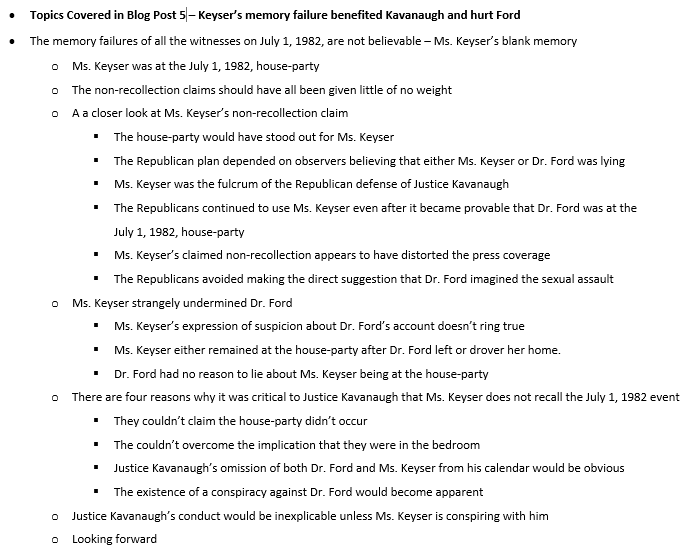
My next blog will begin an examination of the significance of the collective blank memories of all of the witnesses who were present at the July 1, 1982 house-party. The initial focus will be on Ms. Keyser. Those collective memory failures provide an independent basis to believe that a conspiracy exists among most or all of the July 1, 1982, house-party attendees.
 OPIFACTION
Leave a comment