 by
by [wpseo_breadcrumb]
By George H Butcher III
Table of Contents for this Blog Post #2
Proof Christine Blasey Ford was at the July 1, 1982 house-party with Brett Kavanaugh and Mark Judge
The conclusion that Dr. Ford was present, together with Brett Kavanaugh and Mark Judge, is objectively provable! The proof does not rely on the credibility of Dr. Ford or of any other witness. The proof that she was there relies on the fact that 36 years after the event, Dr. Ford recalled many details of the house-party that she could only have known by having been present. She didn’t learn the details she knew from any of the others who were there, each of whom claims not to recall the event. So, the July 1, 1982 house-party is the event where she alleges that Justice Kavanaugh sexually assaulted her.
There is no credibility issue since Dr. Ford’s public statements on or before September 16, 2018, as confirmed in her testimony during Justice Kavanaugh’s September 27, 2018 confirmation hearing, prove that she knew the details from her own recollection. Her knowledge of the details from her memory proves that she was at the July 1, 1982 house-party, as explained below. The details Dr. Ford knew were made public before the existence of Justice Kavanaugh’s calendars was known.
How did we get to this point?
This is Blog #2 in my series of blog posts about the Kavanaugh confirmation proceedings. Blog #1 explained the significance of the fact that Dr. Ford attended the July 1, 1982 event. The proof that she was there is described in this blog post.
Three independent proofs of Justice Kavanaugh’s guilt of sexually assaulting Dr. Ford follow from that one critical fact. Two of those proofs are confessions by Justice Kavanaugh of his guilt through his actions.
The existence of those two confessions is only visible because of the certainty that Dr. Ford was at the July 1, 1982 house-party. So, those two proofs of his guilt result indirectly from the certainty that Dr. Ford was present on July 1. Those two proofs of Justice Kavanaugh’s guilt are described in Blogs #3 and #4.
This blog post explains the third proof of his guilt. That proof results directly from the fact that Dr. Ford was provably at the July 1, 1982 house-party.
It is far beyond a reasonable doubt that Dr. Ford attended the July 1, 1982 house-party – it’s a certainty
The following seven details of the house-party, which Dr. Ford knew from her recollection, are each confirmed by Justice Kavanaugh’s calendar entry for July 1, 1982. The meaning of the corresponding fractions is explained below.
- The general location: suburban two-story house in the Montgomery County, with a narrow stairway leading to the second floor – 1/2
- The general timing: summer of 1982 – 1/2
- Brett Kavanaugh was present – 1/10
- Mark Judge was present – 1/10
- P.J. Smyth was present – 1/10
- At least one other male was present – 1/4
- The underage attendees were drinking beer – 1/2
Common sense is enough to recognize that Dr. Ford was present on July 1, 1982
The application of common sense by any sophisticated individual should be sufficient for him or her to realize that Dr. Ford was present on July 1, 1982. Otherwise, how could she have known so many confirmed details about the event? She recalled seven specific facts about the house-party. And there is no other entry on Justice Kavanaugh’s calendar that could be the event Dr. Ford described. Thus, the July 1, 1982 house-party is the event where Dr. Ford testified she was sexually assaulted.
So, Justice Kavanaugh and his Republican defenders should all be presumed to have known that Dr. Ford attended the July 1 event. Any claim that they didn’t understand should be viewed as a pretense and deception, especially since they used baseless or false arguments to counter the implication that she was there. Indeed, no competent observer could claim not to have had a strong suspicion that she was there.
Moreover, any observer or analyst, who claims that they didn’t understand, would have to acknowledge, in retrospect, that they should have realized, based on common sense, that Dr. Ford was present at the July 1, 1982 house-party. But, while there was a lot of excellent reporting about the Kavanaugh confirmation proceedings, the reporting of mainstream media analysts and outlets did not reflect this pivotal fact. An inquiry is warranted into whether that reporting blind spot is explainable. I will address that question below.
Statistical analysis proves she was there beyond any reasonable or unreasonable doubt
However, it isn’t necessary to rely only on a commonsense understanding. A statistical analysis supports the same conclusion – that Dr. Ford was present at the July 1, 1982 house-party. In that statistical analysis, we begin by asking the question, “What is the likelihood that Dr. Ford could have guessed the seven specific details that she knew about the July 1, 1982 house-party?” Recall that there is no similar event on his calendar that could be the event described by Dr. Ford.
The fractions listed next to the individual items above are generous estimates of the probabilities that Dr. Ford could have simply guessed those details. For example, the likelihood that she could have randomly guessed that any specifically named person was at the event is much lower than the listed probability of 1 out of 10.
Any such guess about who was there would involve three decisions: first, that an additional guest was present (1/2); second, the gender of that guest (1/2); and third, the person’s identity (1/30). The probability of guessing that a specifically named person was at the event (the product of the three fractions) would have been less than 1 out of 100.
That significant overstatement of the probability that she could have guessed what she knew by itself affects three of the seven details. Since most of the individual probability estimates overstate the likelihood that she could have guessed that item, taken together, they materially overestimate the probability that Dr. Ford could have guessed all the details she knew about the July 1, 1982 house-party.
The statistical probability she was not there is less that one-hundred-thousandth of one percent
Using the listed probability estimates, the calculated probability that Dr. Ford could have guessed all of those details is the product of the fractional estimates (0.00003125), which is less than one-hundredth of 1%. If we substitute the more realistic views of her ability to guess the specific identities of the party attendees (i.e., 1/100), the probability Dr. Ford could have guessed all of those details is less than one-hundred-thousandth of 1%.
Using either metric, it is far beyond a reasonable doubt that Dr. Ford knew the details which she reported because she was physically present on July 1, 1982. The legal “beyond-a-reasonable-doubt” standard would be met if there were only a 1% probability or less that she could have guessed the details she knew. Each of our calculated probabilities that Dr. Ford could have guessed the details she knew is a tiny fraction of 1%. So, she was definitively present at the July 1, 1982 house-party.
The statistical analysis, together with her testimony, make it certain that she was there!
The statistical assessments that show it is far beyond a reasonable doubt that Dr. Ford was at the July 1, 1982 house-party, don’t even take account of Dr. Ford’s testimony that she was present at the event she described. The statistical assessments rely solely on her knowledge of the house-party details confirmed by Justice Kavanaugh’s calendar. Taking account of both Dr. Ford’s testimony and the statistical analysis, we should view it as a certainty that Dr. Ford attended the July 1, 1982 house-party with Justice Kavanaugh and Mr. Judge.
Justice Kavanaugh’s calendar entry that references the July 1, 1982 house-party also provides new details that Dr. Ford didn’t recall. The party was at Timmy’s house in Montgomery County. The event occurred on July 1, 1982. There were seven boys at the house-party, including Timmy, Tom, Bernie, and Squi, in addition to the three boys who Dr. Ford recalled by name – Mr. Smyth, Mr. Judge, and Justice Kavanaugh.
The arguments used to question Dr. Ford’s recollection are all irrelevant – she was at the house-party
Statistical analysis permits us to identify arguments that are irrelevant
An important benefit of the statistical analysis is that it minimizes the ability of any party to create confusion or distractions using irrelevancies. Arguments or concerns that don’t affect the likelihood that the critical outcome occurred can be dismissed as irrelevant.
In this instance, the statistical proof that Dr. Ford was at the house-party is based on things that she remembers that are confirmed to be accurate by Justice Kavanaugh’s calendar. So, the other facts and circumstances that were raised in his defense cannot impact affect the statistical proof that she was there.
Two broad categories of irrelevant arguments are described in the following two sentences. Things that Dr. Ford doesn’t remember, about either the past or the present, have no impact on the statistical analysis. The fact that she may have used slightly different words to describe an event on different occasions does not affect the level of certainty that she was at the July 1, 1982 house-party.
The various items that Justice Kavanaugh, Senator Collins, and Ms. Mitchell used to create doubt about whether the event Dr. Ford described even occurred are addressed in the following several paragraphs. Note that increasing the number of irrelevancies or the categories of irrelevancies that are raised does not change the statistical outcome.
Not one of the arguments advanced to question Dr. Ford’s testimony is relevant
That Dr. Ford alternatively described the house where she was sexually assaulted as in Montgomery County, in the Bethesda area, and not far from her country club (each of which is accurate), doesn’t affect the level of certainty that she was at the July 1, 1982 house-party. The fact that Dr. Ford doesn’t recall how she got to the house-party, who invited her, or how she got home, has no effect on the level of certainty that she was at the July 1, 1982 house-party. That Dr. Ford used the phrase sexual assault in one case and physical abuse in another to describe her interaction with Justice Kavanaugh and Mr. Judge has no impact on the level of certainty that she was at the July 1, 1982 house-party.
The fact that she didn’t initially name Justice Kavanaugh to her confidants as her assailant has no impact on the level of certainty that she was at the July 1, 1982 house-party. That Dr. Ford testified Justice Kavanaugh and Mr. Judge were the two boys who assaulted her but her therapist’s notes refer to four boys having been involved has no impact on the level of certainty that Dr. Ford was at the July 1, 1982 house-party. That in describing the sexual assault to confidants, she didn’t initially specify that it occurred in the summer of 1982, has no impact on the level of certainty that she was at the July 1, 1982 house-party.
That others who Dr. Ford recalls being there, or who were there that she doesn’t remember, have no recollection of the event has no impact on the level of certainty that she was at the July 1, 1982 house-party. The fact that Dr. Ford didn’t recall other people who were at the house-party, like Squi whom she briefly dated, has no impact on the level of certainty that she was at the July 1, 1982 house-party. Whether or not Dr. Ford could hear the conversation of the seven boys who were downstairs as she escaped from the house, has no impact on the level of certainty that she was at the July 1, 1982 house-party.
Her capacity to remember details of recent events, has no impact on the level of certainty that she was at the July 1, 1982 house-party. Neither her attorneys nor congressional Democrats had any information which could impact the degree of certainty that she was at the July 1, 1982 house-party. Finally, how she has described the psychological impact on her of the sexual assault at different times, does not affect the level of certainty that she was at the July 1, 1982 house-party.
Both individually and collectively, the arguments raised in Justice Kavanaugh’s defense are irrelevant
In summary, the arguments described above that have been advanced by Justice Kavanaugh and his supporters to impugn Dr. Ford’s credibility are irrelevant. Dr. Ford was at the July 1, 1982 house-party.
So, there should be no more discussion about whether the event at which Dr. Ford described being sexually assaulted ever occurred. It happened on July 1, 1982, and Justice Kavanaugh knew that when he testified on September 27, 2018.
The statistical analysis reinforces what an honest commonsense analysis would have been
Let’s look again from a common-sense perspective at the alignment between Dr. Ford’s recollections and Justice Kavanaugh’s July 1, 1982 calendar entry. The dishonest defense of Justice Kavanaugh by the Republicans was intended to prevent observers from exercising their common sense in evaluating the evidence.
Common sense alone was required to conclude that Dr. Ford was there
The statistical analysis proves that there is a snowball’s chance in hell that Dr. Ford was not at the July 1, 1982 house-party. And that’s before considering her testimony that she was at the event she described.
But we didn’t need the statistical analysis to tell us that the seven details Dr. Ford accurately described were only explainable if she was at the July 1 house-party. It is not rationally possible that her knowledge of all of those details thirty-six years later could have been a coincidence. And it didn’t come from any of the other attendees.
It should also have been clear, based on common sense, what was not relevant
Also, we shouldn’t have needed a statistical analysis to tell us what was not relevant. The common-sense conclusion that Dr. Ford was present relies solely on things that she provably knew. So, without any statistical analysis, it should have been clear that the questions raised to undermine her credibility were irrelevant.
What she demonstrably knew is the critical evidence. So, questions about her memory of other recent or historical facts could not have been relevant. Also, the recollections or non-recollections of other people could not have been relevant to what she provably knew.
Irrelevant means irrelevant
I will review that menu of dishonest tactics that the Republicans used to defend Justice Kavanaugh in my seventh, eighth, and ninth blogs in this series. One such tactic was to sneakily try to require evidence beyond-a-reasonable-doubt to vote against Justice Kavanaugh’s confirmation.
That evidence standard applies in criminal proceedings. It has no place in a judicial nomination proceeding. It allows criminal defendants to be acquitted based on much weaker arguments than should be required to justify confirming a federal judge.
But the arguments the Republicans used to undermine Dr. Ford’s testimony, that the event she described occurred, were truly irrelevant. The critical evidence was what she provably knew, which confirmed the event she described was the July 1, 1982 house-party.
The arguments used to challenge her credibility had zero relevance to that conclusion. So, they remained irrelevant regardless of what evidence standard might have been used, even beyond-a-reasonable-doubt.
This observation highlights the extent of the outrage the Republicans committed in confirming Justice Kavanaugh to the Supreme Court. There was visible definitive proof supporting Dr. Ford’s claim that she was together with Justice Kavanaugh and Mr. Judge on July 1, 1982. And the Republican efforts to defend Justice Kavanaugh against her charge were totally without merit.
The evidence must be given a fresh look considering the certainty she was there
The evidence against Justice Kavanaugh needs a fresh look
Analyses of Justice Kavanaugh’s testimony should start with the certainty that Dr. Ford was present on July 1, 1982. His recollections and non-recollections should be evaluated in light of that fact. On the other hand, virtually all of Dr. Ford’s testimony has been corroborated. Her credibility is established. The tiny portion of her recollections that remain uncorroborated is irrelevant to the truthfulness of her allegation.
Analysis of the statements of the witnesses to the July 1, 1982 house-party should also start with the certainty that Dr. Ford was present. Those witnesses’ recollections and non-recollections should be evaluated in light of that demonstrable fact. The non-recollection claims of house-party attendees have no bearing on the credibility of either Dr. Ford’s corroborated testimony or her accusation. Those non-recollection claims should be scrutinized to determine if they are credible and to determine what the implications are if the non-recollection claims were dishonest.
The conduct of the Republicans needs a fresh look
There should also be a review of the Republicans’ conduct in continuing to support Justice Kavanaugh, not only after Dr. Ford made her allegation, but even after the September 27, 2018 confirmation hearing. The review should reflect that, after the hearing, Republican senators knew the July 1, 1982 house-party was the event at which Dr. Ford described being sexually assaulted by Justice Kavanaugh. They also knew that virtually all of her recollections about the event were corroborated.
Justice Kavanaugh and his Republican supporters elected to use a strategy of questioning whether the house-party at which Dr. Ford was sexually assaulted even happened. They chose that approach instead of conceding that the house-party took place and questioning her credibility about whether a sexual assault occurred.
That choice reflected an awareness that Justice Kavanagh’s position would become untenable if it had been acknowledged that he and Dr. Ford were together at the July 1 event. But instead of dealing honestly with the facts and finding another nominee, the Republicans perpetrated a massive fraud upon the American people.
His calendar and her memories resolve all but one unimportant detail about the house-party
Justice Kavanaugh’s July 1, 1982 calendar entry corroborates all of the details of Dr. Ford’s recollections about the party itself except two. First, his calendar entry doesn’t directly corroborate that Dr. Ford was present. But we don’t need his calendar to directly verify that fact since her recollections of details which are confirmed by his calendar entry prove she was there. The absence of Dr. Ford from his calendar entry is a respect in which Justice Kavanaugh’s calendar is provably inaccurate.
The second recollection of Dr. Ford that his July 1, 1982 calendar entry doesn’t corroborate is that her friend Ms. Keyser was present at the house-party. But since Justice Kavanaugh’s calendar entry is provably inaccurate concerning Dr. Ford’s presence, his failure to include Ms. Keyser in his calendar entry isn’t probative as to whether she was present. Whatever motivation or cause might have existed for his calendar’s inaccuracy about Dr. Ford’s presence could likewise have existed concerning Ms. Keyser’s presence.
The best evidence of whether Ms. Keyser was present is Dr. Ford’s provably reliable memory. The other witnesses’ memories are unreliable, or they have been dishonest about what they recall. In any event, since the only credible evidence is Dr. Ford’s testimony, it should be presumed that Ms. Keyser was at the July 1, 1982 house-party.
It is also possible that Justice Kavanaugh incorrectly listed a boy as being at the July 1 event who wasn’t there. I will address that possibility in a subsequent blog. But there is no apparent reason for Justice Kavanaugh to have listed a boy as having attended the house-party who was not there. That would have created a reason to question the accuracy of his calendars, which it was vital for him to portray as accurate.
Ms. Keyser’s irrelevant non-recollection distorted media coverage of the evidence of guilt
Leland Keyser’s claimed non-recollection of the July 1, 1982 house-party appears to have distorted the media coverage of Dr. Ford’s allegation. Ms. Keyser’s claimed non-recollection might be the explanation why many in the media suspended common sense and failed (1) to reach the obvious conclusion that Dr. Ford attended the July 1, 1982 house-party and (2) to report on the confirmation proceedings in a manner which reflects that understanding.
Given the readily apparent proof that Dr. Ford was at the July 1 house-party and that it is the event where she alleges she was assaulted, Ms. Keyser’s non-recollection of the event should have been viewed as irrelevant. But, in this case, the tail seems to have wagged the dog. Ms. Keyser’s non-recollection claim (which should have been viewed as a nullity, even if it were credible), has been used to justify what, in retrospect, was bad or credulous reporting.
Ms. Keyser’s dubious claim to having no memory of the event was used to ignore the critical and demonstrable fact that Dr. Ford was at the July 1, 1982 house-party. Moreover, the influence of her non-recollection claim seems to have affected the overall tenor of the reporting about both Dr. Ford and Justice Kavanaugh, whose blatantly false testimony about Dr. Ford’s allegation has effectively gone unreported.
The evidence Justice Kavanaugh and Mr. Judge were alone in the bedroom with Dr. Ford – the third proof of guilt
The proof that Dr. Ford was at the July 1, 1982 house-party has critical implications regarding another significant memory of hers. That memory is closely related to both the alleged sexual assault and the credibility of Justice Kavanaugh’s and Mr. Judge’s denials.
Dr. Ford testified that she was alone in the second-floor bedroom with Justice Kavanaugh and Mr. Judge. It is not a circumstance that she could have misremembered, and virtually all of her recollections about the July 1, 1982 house-party details have been corroborated.
It is not credible, in my view, that Justice Kavanaugh or Mr. Judge could have forgotten having been in the second-floor bedroom with Dr. Ford when they were 17, and she was 15. So, if they were in the bedroom with Dr. Ford, they couldn’t have forgotten that incident, and they couldn’t have forgotten being at the July 1, 1982 house-party.
It is effectively certain that Dr. Ford was in the bedroom with Justice Kavanaugh and Mr. Judge
So, let’s examine the possibility that Dr. Ford could have told the truth about having been at the house-party with Justice Kavanaugh and Mr. Judge, but falsely claimed that she was in the bedroom with them. That the three of them were in the second-floor bedroom is the only reason for any of the following:
- Dr. Ford to have made her sexual assault allegation against Justice Kavanaugh and Mr. Judge.
- Dr. Ford to have felt a responsibility to expose Justice Kavanaugh as unsuitable for the Supreme Court.
- Her to have shared her story about the sexual assault with her husband.
- Her to have shared the story of the sexual assault with her therapist.
- Dr. Ford to have reached out to her legislators and to the media, in an attempt to prevent Judge Kavanaugh from being nominated to the Supreme Court, and
- Dr. Ford to have gone through the trauma of testifying in Judge Kavanaugh’s confirmation hearing.
So, the possibility that Dr. Ford told the truth about being at the July 1, 1982 house-party but lied about having been in the second-floor bedroom with Justice Kavanaugh and Mr. Judge is effectively nonexistent. Since Dr. Ford was at the house-party, it is effectively certain that she was alone in the second-floor bedroom with Justice Kavanaugh and Mr. Judge, as she testified.
There is no chance that Dr. Ford told the truth about the house-party but lied about the sexual assault
For the same reasons which establish that they were in the bedroom, it is evident that Dr. Ford would not have lied about the sexual assault. The only conceivable reason for her to have taken all the actions she took over the years relating to Justice Kavanaugh is that he and Mr. Judge sexually assaulted her.
So, the possibility that Dr. Ford told the truth about being at the house-party (which she didn’t even recall the date or location of), but lied about having been sexually assaulted by Justice Kavanaugh is effectively nonexistent. That is the third independent proof of his guilt.
That inevitable implication is corroborated by the patently false claim of Justice Kavanaugh to have no memory of having ever met Dr. Ford. Note that this lie is distinct from his confession by repeatedly falsely testifying that the event described by Dr. Ford never even occurred.
Justice Kavanaugh’s testimony related to Dr. Ford’s allegation was pervasively false.
Since they were in the bedroom with Dr. Ford, neither Justice Kavanaugh nor Mr. Judge could have forgotten their interaction with her. They couldn’t have overlooked having been at the July 1, 1982 house-party or that Dr. Ford was there. Justice Kavanaugh couldn’t have forgotten having met Dr. Ford in July 1982.
In giving testimony to the Senate Judiciary Committee staff on September 17, 2018, Justice Kavanaugh was asked a series of questions related to the bedroom. For example, he was asked whether he ever pushed Dr. Ford into a bedroom and whether he ever locked her in a bedroom. Justice Kavanaugh answered no to both questions.
It is possible that Mr. Judge pushed Dr. Ford into the bedroom and locked the door, even though Justice Kavanaugh took the lead in assaulting her. Even so, Justice Kavanaugh’s answers would have been false or purposefully deceptive, since they were working in concert.
The virtual certainty that the two boys were in the bedroom with Dr. Ford destroys any possible defense to Dr. Ford’s allegation. Moreover, it means that virtually every aspect of Justice Kavanaugh’s testimony about Dr. Ford’s allegation was knowingly false.
But, his testimony was observably blatantly false in real-time. That conclusion was evident without taking account of the virtual certainty that he and Mr. Judge were in the bedroom with her and that he sexually assaulted Dr. Ford, as she alleged.
Looking forward
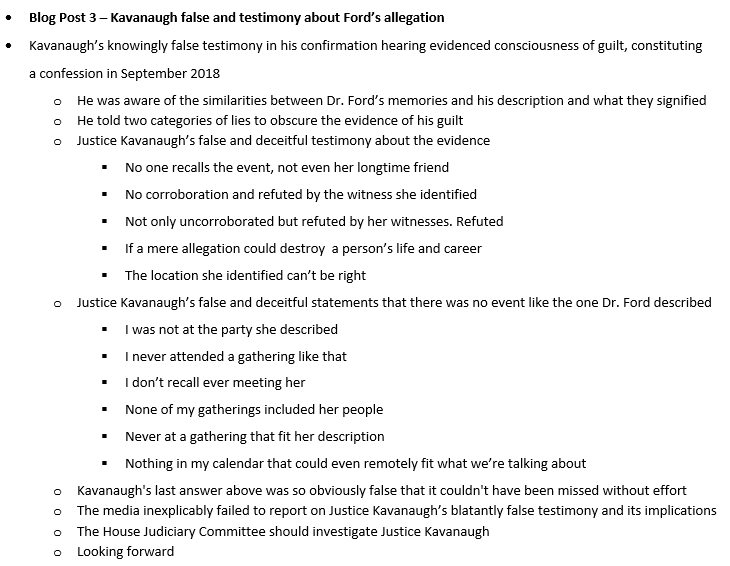
My next blog will examine Justice Kavanaugh’s numerous statements under oath that were knowingly false or purposefully intended to deceive the Senate and the public about the truthfulness of Dr. Ford’s testimony that he and she were both at a summer of 1982 house-party. That examination will be done based only on what was apparent in real-time.
So, we won’t use the knowledge that he was in the bedroom with Dr. Ford, or its implications for his guilt, to infer that his testimony was false. Nor will that analysis use his 1982 admission of guilt to conclude that his statements were knowingly false.
That analysis will use the readily apparent conclusion that Dr. Ford was at the July 1, 1982 house-party. That was observable in real-time during the September 27, 2018 hearing, as a matter of common sense.
 OPIFACTION
Leave a comment